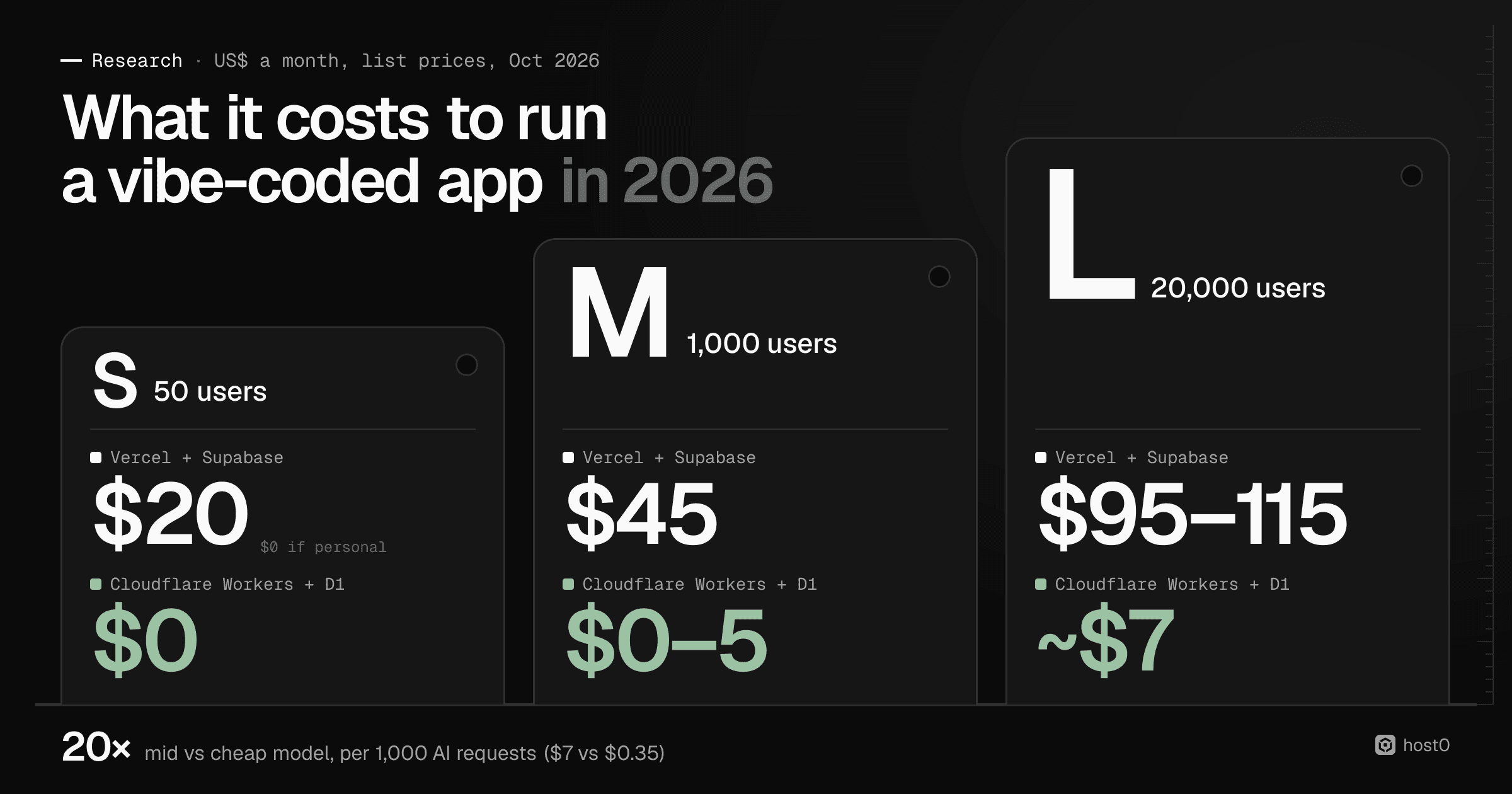
An agent can build you an app in an afternoon. Then it has to live somewhere, and the bill starts. The entry paid plans of the big app builders cost $20 to $30 a month, and Supabase said in June 2026 that more than 60% of its new databases are launched by an AI tool. But a price page is not a bill. What you pay depends on how many people use the app, how much data it moves, whether it calls a model, and what happens on each platform when you go over a limit.
So we modelled one. We took the published prices of Lovable, Bolt, Replit, v0, Vercel, Supabase, Netlify and Cloudflare as of mid-October 2026 and priced the same app at three sizes: a 50-person team tool, a 1,000-user app and a 20,000-user app. Then we added the two token bills that come with an AI-built app: the coding agent that keeps changing it, and any AI feature inside it. The model is ours and every assumption is listed in the methodology. Vendor numbers are the vendor's own claims, and list prices aren't bills.
Key findings
- 1A small app costs $0 to $50 a month, and the plan is the whole bill. Usage is pennies. What sets the price is a rule: Vercel's free Hobby plan is for non-commercial use only, and a free Replit app "will automatically go down after 30 days", so a work app on either starts at $20.
- 2At 1,000 users the database is the first real line. Supabase's free plan stops at a 500 MB database, so a 1 GB app moves to Pro at $25. Most stacks land between $25 and $75 a month in our model; Cloudflare stays near $0.
- 3At 20,000 users the spread is about 20×. About $7 a month on Cloudflare Workers and D1, $95–115 on Vercel and Supabase, and $138–175 on Netlify or Replit. Lovable and Bolt don't publish the usage rates that decide this bill, so we can only say "from $25".
- 4Bandwidth is priced from $0 to $0.15 a GB. Cloudflare charges nothing for egress; Vercel's usage rate is $0.15 per GB past 1 TB. In September 2026 Vercel's Flat Rate CDN stopped billing traffic spikes for new Pro teams.
- 5Hitting a limit means different things on each platform. A free Bolt site goes offline until the next billing cycle; Supabase Pro blocks the overage by default instead of billing it; Vercel's default $200 setting for new Pro teams is an alert, not a stop.
- 6With a cheap model, the coding agent is the bigger token bill until the app gets big. About $20 a month is the floor for keeping an app changing. An AI feature on a cheap model costs $0.35 per 1,000 requests by our arithmetic, 20× less than a mid-tier model at $7.
- 7The bills that make the news come from traffic and stolen keys, not plans. A free Netlify site was billed $104,500 after a DDoS; a stolen Gemini key ran up $82,314.44 in 48 hours for a startup whose usual bill was about $180.
$45
A month for a 1,000-user app on Vercel Pro and Supabase Pro (our model)
Source: host0 cost model
~$7
The same app at 20,000 users on Cloudflare Workers and D1, vs $95–115 on Vercel and Supabase (our model)
Source: host0 cost model
20×
Mid vs cheap model for the same AI feature: $7 vs $0.35 per 1,000 requests
Source: Anthropic, OpenAI prices
$82,314
Billed in 48 hours on a stolen Gemini API key; the startup's usual month was ~$180
Feb 2026
Source: The Register
Three app sizes#
Most vibe-coded apps are single-page apps: a bundle of HTML, JavaScript and CSS that the browser caches after the first visit, plus calls to a database API. We priced one such app at three sizes. The traffic per page view is our assumption; the hosting researchers' estimate of 1.5 MB per view is the sensitivity case further down.
The three apps we priced
Monthly usage per app size, our assumptions
- Small, a team tool. About 50 people, 1,000 page views, 0.5 GB of traffic, 5,000 requests, a 100 MB database, 10 production deploys, 1,000 AI requests.
- Medium, a real product. About 1,000 monthly active users, 50,000 page views, 25 GB, 250,000 requests, a 1 GB database, 20 deploys, 30,000 AI requests.
- Large, a hit. About 20,000 monthly active users, 1 million page views, 500 GB, 5 million requests, an 8 GB database, 30 deploys, 600,000 AI requests.
Source: host0 cost model
For each stack we priced the cheapest plan that keeps the app online all month for a team using it at work: commercial use allowed, no automatic shutdown. The app builders' plans also cover editing the app, so those bars include it. The stacks you put together yourself (Vercel and Supabase, Netlify, Cloudflare) don't include the coding agent; that's in the token sections below. Where a free and a paid plan both work, the bar shows the range and sits at its midpoint.
A small app: the plan is the bill#
At 1,000 page views a month, usage rounds to zero everywhere. On Replit, our usage estimate for a small app is about $6 a month, well inside the $20 of credits that come with its $20 Core plan. On Bolt, 0.5 GB is a twentieth of the free plan's 10 GB. So the price is set by the rules of each free plan, not by the meter.
Monthly cost, small app
A team tool for ~50 people, 1,000 page views a month, US dollars, as of mid-October 2026
| Label | Value |
|---|---|
| Lovable | $0–25 (Free hosts it) |
| Bolt | $0–25 (Free is public) |
| Replit | $20 (Core plan) |
| v0 + Vercel + Supabase | $20–50 |
| Vercel + Supabase | $20 ($0 if personal) |
| Netlify + Supabase | $0–9 |
| Cloudflare Workers + D1 | $0 |
Each free plan carries a catch. Supabase's free projects are paused after a week of inactivity, which a team tool used every week never hits but a monthly report might. Bolt's free plan publishes every site publicly and carries a "Made in Bolt" badge. Lovable's free plan hosts the app with 20 Cloud credits a month for the backend, while a custom domain needs Pro at $25 and a private app needs Business at $50. Netlify's free plan has a hard limit of 300 credits, and each production deploy costs 15: an agent that redeploys 20 times a month uses the whole allowance with no visitors at all.
The v0 stack costs the most here, because it's two subscriptions. The app runs on Vercel, which needs Pro for work use, and keeping it changing in v0 is $30 a month for Plus.
A medium app: the database is the first real line#
At 1,000 users and a 1 GB database, the free database tiers run out. Supabase's free plan allows 500 MB per project, so the app moves to Pro: $25 a month with 8 GB of disk, 250 GB of egress, 100,000 monthly active users and a $10 compute credit that covers the smallest instance. At this size nothing else on Supabase's bill moves.
Monthly cost, medium app
~1,000 monthly active users, 50,000 page views, 25 GB, a 1 GB database, US dollars, as of mid-October 2026
| Label | Value |
|---|---|
| Lovable | from $25 (rate unpublished) |
| Bolt | $25 |
| Replit | ~$40 (rate unverified) |
| v0 + Vercel + Supabase | $75 |
| Vercel + Supabase | $45 |
| Netlify + Supabase | $34 |
| Cloudflare Workers + D1 | $0–5 |
Sources: Supabase; Lovable; Replit; Netlify; host0 cost model
The builders diverge on how they bill the backend. Bolt's Pro plan includes 30 GB of bandwidth and 1 million requests, and our 25 GB fits, just: at 0.6 MB a page view instead of 0.5 it would hit the cap. Lovable's docs say the backend runs on a database instance whose larger sizes cost more credits per hour, and the product shows an estimated monthly cost, but there is no public rate to model. Replit bills its database by compute hours and storage; at our guess of 240 active hours a month, that's most of a roughly $40 bill.
On Netlify, 25 GB at 20 credits a GB plus 250,000 requests and 20 deploys comes to about 850 credits, inside the $9 Personal plan's 1,000. Add Supabase Pro and the stack is $34. Cloudflare's free plan still covers it: 250,000 requests a month is about 8,000 a day against a limit of 100,000 a day, and static files are free and unlimited.
Spend data is thin. Brex found that 9.6% of companies whose first app-builder purchase was in 2025–26 added a paid database within 90 days, and that the median wait for a first Supabase or Neon charge was 106 days. Sacra estimates a paying Supabase customer spends about $700 a year, roughly $58 a month, about what Pro plus a little usage would cost.
A large app: bandwidth and backend decide it#
At 20,000 users, 500 GB of traffic and an 8 GB database, the stacks spread out by about 20×.
Monthly cost, large app
~20,000 monthly active users, 1M page views, 500 GB, an 8 GB database, US dollars, as of mid-October 2026
| Label | Value |
|---|---|
| Lovable | from $25 (usage unpriced) |
| Bolt | from $25 (overage unpriced) |
| Replit | ~$155–175 (rate unverified) |
| v0 + Vercel + Supabase | $125–145 |
| Vercel + Supabase | $95–115 |
| Netlify + Supabase | $138–170 |
| Cloudflare Workers + D1 | ~$7 |
Sources: Vercel; Supabase; Netlify; Cloudflare; host0 cost model
On Vercel and Supabase, the bill is $95–115. Supabase is $75 of it: Pro at $25 plus a step up to a Medium compute instance ($60, minus the $10 credit), our assumption for 20,000 users; disk, egress and users all stay inside Pro's quotas. Vercel is $20 to $40. Under its usage pricing, 500 GB is inside Pro's 1 TB and the functions fit in the $20 credit. Under Flat Rate CDN, which Vercel made generally available for Pro teams in September 2026 and switches on for new teams, Pro includes 1 TB but only 1 million requests, and paid tiers start at $20 a month, so our 5 million requests take Vercel to $40.
Netlify and Supabase land at $138–170. Traffic, requests and deploys come to about 11,450 Netlify credits: Pro's 15,000-credit tier at $95 a month, or the 10,000-credit tier at $63 plus a $10 top-up. At the 10 credits a GB Netlify charged when its credit plans launched, the $63 tier covers it. Add Supabase's $75. Replit's bill, about $155–175, is mostly an always-on database: 730 hours at $0.16 an hour, a rate from a third-party guide that we couldn't confirm on Replit's site. Replit's August 2026 price cut took 81% off Autoscale compute, but the docs we found don't say it touched database compute.
Cloudflare is the outlier, at about $7: the $5 Workers Paid plan, plus $2.25 for 3 GB of D1 storage over the included 5 GB. Static files and egress are free, and our 3 million API requests fit in the 10 million included. The catch is work, not money: the app has to run on Workers with a SQLite database rather than Postgres, and auth isn't included.
The bandwidth rate is what spreads the stacks apart.
What one more GB of traffic costs
List price per GB past each plan's allowance, US dollars, as of mid-October 2026
| Label | Value |
|---|---|
| Vercel, usage pricing | $0.15 (past 1 TB) |
| Netlify | ~$0.13 (20 credits) |
| Supabase egress | $0.09 (uncached) |
| Replit | $0.05–0.10 |
| Cloudflare | $0 |
Sources: Vercel; Netlify; Supabase; Replit; Cloudflare
Our 0.5 MB per page view is kind to everyone. At 1.5 MB, an image-heavy app, the large app moves 1.5 TB: Vercel's usage pricing adds $75, Netlify needs about 30,000 credits, more than its top 20,000-credit tier, and Cloudflare's bill doesn't change. The medium app would also pass Bolt Pro's 30 GB.
What happens when you hit a limit#
The price of going over a limit is only half the question. The other half is whether the app stays up.
When you go over the limit
What each platform says happens at the edge of a plan, as of mid-October 2026
- Bolt. On Free, past 10 GB or 333,333 requests, the site goes offline until the billing cycle resets. On Pro, overage is billed up to a spending cap you set, then the site pauses. The limits are shared by every site on the account.
- Supabase. Pro's spend cap is on by default: over-quota disk, egress and users are blocked, not billed. Compute isn't covered. Free projects pause after a week of inactivity.
- Vercel. Hobby can't buy more: a feature stops until its 30-day window resets. On Pro, new teams get a $200 spend notification; deployments keep running unless you set a hard limit.
- Netlify. The free 300 credits are a hard limit. Forum reports say published sites stay up but production deploys pause.
- Replit. The free app goes down after 30 days. Paid plans bill usage past the included credits.
- Lovable. At zero credits you can't build, but the published site stays live; backend and AI features can pause.
Neither default is safe for everyone. A stop protects your card and takes your app down; a bill keeps it up and is how a free static site ended up owing $104,500. Pick the behaviour on purpose.
Prices keep moving#
Most of the platforms in this post changed their pricing in the last 14 months. Lovable's head of growth said at Stripe Sessions that it adjusted its pricing ten times in one year.
Hosting and backend price changes
Selected changes for vibe-coded apps, Aug 2025 to Oct 2026
14 Aug 2025
22 Aug 2025
4 Sep 2025
9 Sep 2025
29 Sep 2025
29 Sep 2025
A built-in backend, with $25 of free Cloud usage a month until the end of March 2026.24 Feb 2026
18 Jun 2026
1 Aug 2026
1 Aug 2026
Compute $3.20 to $0.60 per million units; requests $1.20 to $0.40 per million.Sep 2026
7 Oct 2026
Source: Vendor changelogs, blogs and docs
Most of the moves went in the buyer's favour: cheaper egress, cheaper compute, no billing for spikes. The ones that didn't were quieter: Lovable's free Cloud allowance ended, and Netlify now charges 20 credits a GB for bandwidth, against 10 when the credit plans launched.
Tokens: the agent that keeps building it#
An app that people use gets change requests, and every change is a prompt. On the builders, the plan includes credits for that: Lovable's own examples put a small tweak at 0.5 credits and a landing page at 1.7, about $0.13 and $0.43 at Pro's $0.25 a credit. Bolt's docs warn that "the larger the project, the more tokens used per message", so the same edit costs more as the app grows.
If you build with a coding agent instead, a $17–20 plan is the floor and the API is the ceiling. Anthropic says Claude Code costs about $13 per developer per active day on average at API prices, or $150–250 per developer a month. We compared the two in Claude Code and Codex: subscription or API?.
What it costs to keep changing the app
Monthly cost of the agent or builder plan, US dollars, as of mid-October 2026
| Label | Value |
|---|---|
| Claude Pro, billed annually | $17 |
| Claude Pro, ChatGPT Plus or Cursor Pro | $20 |
| Lovable Pro or Bolt Pro | $25 (includes hosting) |
| v0 Plus | $30 |
| API, four active days | $52 |
| API, eight active days | $104 |
| Claude Max or ChatGPT Pro | $100–200 |
| API, heavy use | $600 (~20 days) |
Sources: Claude Code costs; Claude pricing; Lovable; v0; host0 arithmetic
The heavy end is real. Jason Lemkin found $607.70 in charges over his $25 Replit plan three and a half days into a project in July 2025, and a Replit user told The Register in September 2025 that editing existing apps cost most: "I spent $1k this week alone", against "$180-200 a month" before.
Tokens: the AI feature inside the app#
Many vibe-coded apps call a model at runtime: a chat box, a summary, a classifier. We priced one request at 1,500 input tokens and 400 output, about a short answer with a system prompt, with no caching and no batch discount.
Monthly cost of an AI feature
1,500 input + 400 output tokens per request, list prices, US dollars, as of mid-October 2026
| Label | Value |
|---|---|
| Small app, cheap model | $0.35 (1,000 requests) |
| Small app, mid model | $7 |
| Medium app, cheap model | $10.50 (30,000 requests) |
| Medium app, mid model | $210 |
| Large app, cheap model | $210 (600,000 requests) |
| Large app, mid model | $4,200 |
On a cheap model, a small team app's AI feature costs 35 cents a month. On a mid-tier model it's $7, and at 20,000 users $4,200: more than every hosting bill in this post put together. Output is the expensive half: at a 5:1 output-to-input price ratio, 400 output tokens are 57% of the mid-model cost. Reasoning makes it worse, because thinking tokens are billed as output; by our arithmetic, 1,000 hidden reasoning tokens per request make the same feature 2.4× dearer. The levers go the other way: caching a 1,000-token system prompt cuts the bill by about a quarter, and the batch API halves it for anything nobody is waiting for. The full price history is in The price of AI tokens, 2020–2026.
What dominates the bill#
Put the three bills together for one stack and the answer changes with size. Here it's Vercel and Supabase, a $20 agent plan for the small and medium apps and a $100 plan for the large one, and an AI feature on a cheap model.
Where the money goes
Vercel + Supabase, coding agent and a cheap-model AI feature, US dollars a month and share of the total
| Label | Value |
|---|---|
| Small: hosting and database | $20 · 50% |
| Small: coding agent | $20 · 50% |
| Small: AI feature | $0.35 · 1% |
| Medium: hosting and database | $45 · 60% |
| Medium: coding agent | $20 · 26% |
| Medium: AI feature | $10.50 · 14% |
| Large: hosting and database | $105 · 25% |
| Large: coding agent | $100 · 24% |
| Large: AI feature | $210 · 51% |
Source: host0 cost model
For a small app, hosting and the coding agent split the bill. At 1,000 users, hosting and the database lead. At 20,000 users with AI in the app, the model is half the bill on a cheap model and 95% of it on a mid one. Hosting and the database are the biggest line only at the medium size.
The bills that make the news#
None of those are the bills people write about. Those come from traffic nobody planned for and keys somebody stole.
Surprise bills
Reported cases, Feb 2024 to Jun 2026
Feb 2024
Feb 2024
$104,500 on a free Netlify site
A DDoS pulled ~190 TB in four days at $55 per 100 GB. Support offered to cut it to 5%; Netlify's CEO waived it after Hacker News.Jun 2024
Jun 2024
$98,280 in Vercel Functions for Cara
The art app grew from 40,000 to 650,000 users in a week; 56M function calls on 3 June.Jul 2025
Sep 2025
Feb 2026
Feb 2026
$82,314.44 on a stolen Gemini key
48 hours of mostly Gemini 3 Pro image and text calls for a three-person startup that usually spent ~$180 a month.Jun 2026
Jun 2026
$11,089.77 after an account hijack
Gemini image generation on a compromised service-account key; Google declined to forgive it.
Sources: The Register; InfoQ; Netlify forum; SaaStr
The key cases are the ones to fear. A key in a front-end bundle is public. Truffle Security found 2,863 live Google API keys on public websites that had silently gained access to Gemini, and Reeve's scan of 30,998 vibe-coded apps found 52 shipping a key that "can spend money or read the whole database". By our arithmetic, the stolen-key bill was 457 times the startup's normal month. More in Vibe-coded app security in 2026.
What this means if you build with AI#
- Price your app at the size you expect, not the size it is. Below 1,000 users almost every stack costs a plan fee. The differences show up at 20,000, and moving an app later costs more than choosing well now.
- Read the free plan's rules, not its numbers. Non-commercial terms, 30-day expiry, inactivity pauses and public-only publishing decide more than the quotas do.
- Set a cap, and know what it does. Turn on Supabase's spend cap, set a hard limit on Vercel rather than relying on the $200 alert, set Bolt's spending cap, and add a project spend cap to any AI API key.
- Use a cheap model by default. It's 20× cheaper per request than a mid-tier one. Move a feature up only when the cheap model fails at it, and turn reasoning effort down for simple tasks.
- Keep keys server-side. Never ship a model or database key in the front end. A stolen key can cost more in two days than the large app in this post spends on hosting in years.
- Watch bandwidth. It's the hosting line that grows with your users, and its price ranges from $0 to $0.15 a GB. Compress images and let the browser cache your bundle.
- Pick hosting before you need it. If the builder doesn't publish the rate that decides your large-app bill, ask before you have the users.
host0 hosts what your agent made: static apps, sites and PDFs, with a shared records database, private by default and free to start. It takes the deploy from any agent, so you can keep the builder you like and still know where the app lives.
Methodology#
Prices were gathered on 18 October 2026 from vendor pricing pages, docs and changelogs, and from our earlier research packs. Most vendor pages couldn't be opened directly from our research environment, so the figures come from search-engine extracts of the named pages, and we spot-checked the ones this post leans on with independent searches. Builder plan prices come from pages read live on 8 October 2026 for our AI app builders post.
The cost model is ours. The three app sizes, 0.5 MB and 5 requests per page view, 0.1 MB of database traffic per view, deploy counts, 0.2 seconds of instance time per server request on Replit, and one function call per page with 50 ms of CPU on Vercel are assumptions. So are the Supabase Medium compute instance for the large app and Replit's database running 30, 240 and 730 hours a month. Replit's database compute rate of $0.16 an hour comes from a third-party guide; Replit's own page didn't load. Vercel is modelled two ways because new Pro teams are on Flat Rate CDN and older teams may be on usage pricing. Where a free and a paid plan both fit, bars show the range at its midpoint; where a vendor doesn't publish a usage rate (Lovable Cloud, Bolt's overage), the bar is the plan price and says "from". Token costs assume 1,500 input and 400 output tokens per request at list prices, with no caching, batch or reasoning tokens unless stated.
List prices aren't bills. Discounts, annual plans, free credits, region and how an app is built all move the real number, and this model doesn't include domains, email, monitoring or your own time.
Open questions#
- What Lovable Cloud costs per hour and per GB. Lovable shows an estimate inside the product but publishes no rate.
- Bolt's pay-as-you-go price above Pro's 30 GB and 1 million requests, and what its database costs.
- Replit's production database rate after its August 2026 changes, and whether Core still includes 100 GB of egress.
- How Vercel treats sustained traffic above a Flat Rate CDN tier. Spikes aren't billed; a permanent step up appears to mean a higher tier.
- What vibe coders actually pay. We found no credible survey of monthly hosting and backend spend; Sacra's ~$58 a month per paying Supabase customer is the nearest figure.
- How many tokens a real in-app AI feature uses per request. Our 1,500 and 400 are an assumption, not a measurement.