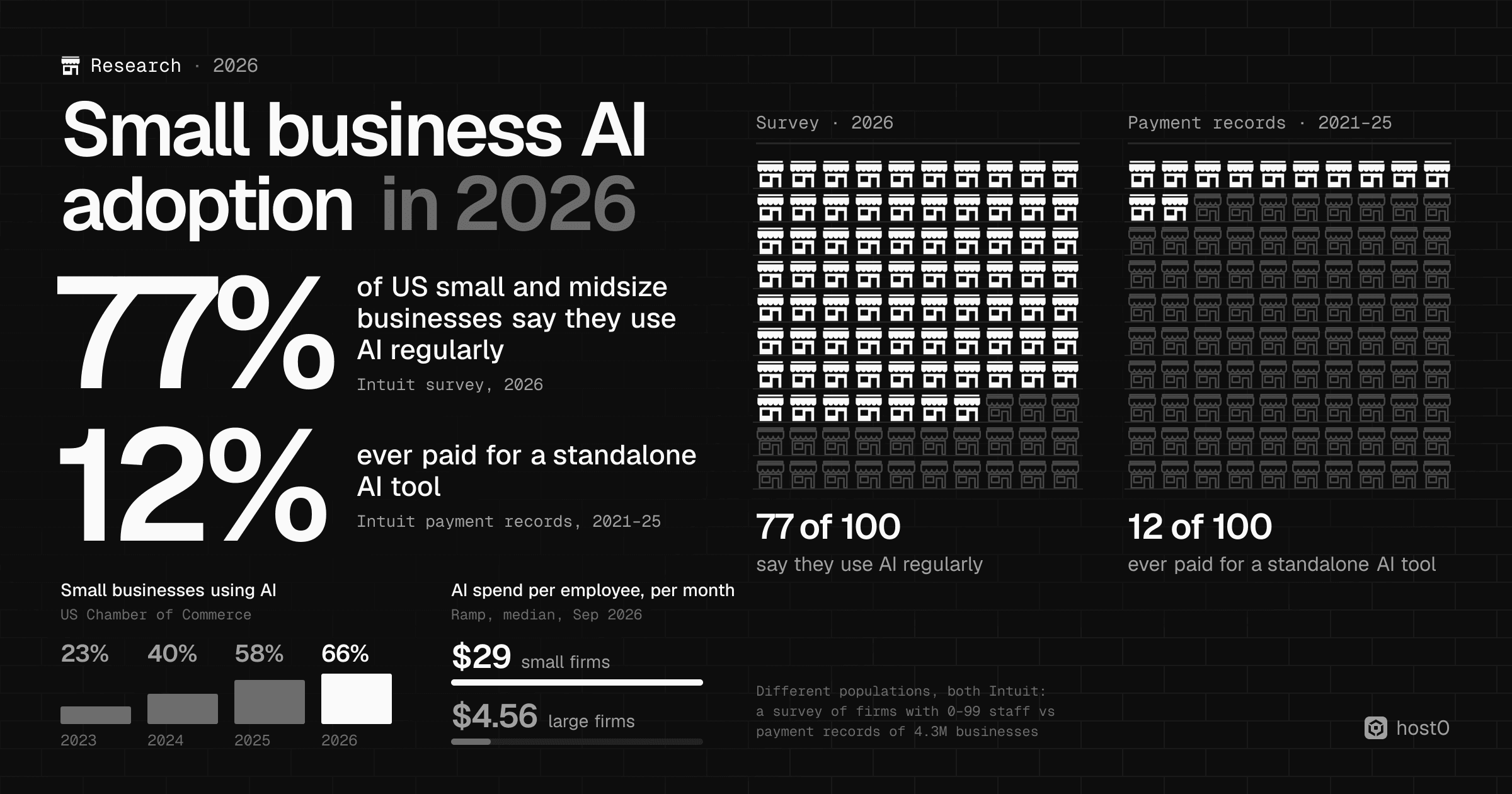
Ask how many small businesses use AI and the answer runs from about one in four to three in four, depending on who asks. NFIB, which surveys its own members, found 24% of small employers using AI tools in 2025. The Census Bureau's survey puts the smallest US firms at about 24% this autumn. The US Chamber of Commerce says 66%, and U.S. Bank says 75% of owners use generative AI in their business. One report looks at both what owners say and what businesses pay, and shows the gap: in Intuit's 2026 AI Impact Report, 77% of the US small and midsize businesses it surveyed say they use AI regularly, while in a separate, much larger sample of payment records only 12% of US businesses ever paid for a standalone AI tool.
We collected the small-business numbers published up to 16 October 2026: government statistics read from the agencies' own download files (US Census, Eurostat, the UK's ONS, Statistics Canada), the Federal Reserve's small-business survey, private surveys (Chamber, Intuit, Goldman Sachs, Thryv, Verizon), spend data (Ramp, Intuit, Capital on Tap), vendor price lists and the few causal studies there are. For large companies, see our sibling posts Enterprise AI adoption in 2026 and AI readiness in 2026. Vendor and lobby-group numbers are their own claims, and every number links to its source. The methodology says how we checked them.
Key findings
- 1The smallest US firms use AI more than firms with 5–19 employees. 23.8% of firms with 1–4 employees used AI in a business function over the Census survey's latest three cycles (our average), against 21.2% of firms with 5–9 and 39.6% of firms with 250 or more.
- 2Micro firms took off over the summer. The Census Bureau said in May that use among firms under 20 employees hadn't changed significantly. Since then firms with 1–4 employees went from 19.1% to 23.8% in our analysis of its data, as fast in points as the largest firms.
- 3
- 4Small firms that pay spend the most per head. On Ramp's cards, the median small firm (1–24 employees) spent $29.00 per employee per month on AI in September 2026, against $4.56 at firms with 100 or more. But only 50.0% of small firms pay at all, against 65.7% of large ones, and that gap has widened.
- 5They use it to write. 83% of small employer firms using AI use it for writing or marketing, and 19% for coding, per the Fed's Small Business Credit Survey. Just 7% have it fully integrated.
- 6"Not applicable" is losing ground to "don't know how". Among US firms with no plans to use AI, "not applicable" fell from 80.9% to 61.6% between Census supplements, while "lack of knowledge" went from 7.3% to 22.0% and privacy concerns from 6.6% to 20.7%. Cost stayed under 7%.
- 7Productivity yes, jobs barely. In the Fed's survey, 71% of small-firm AI users report higher productivity and 31% higher sales. In Census data, 95.7% of AI-using firms with 1–4 employees saw no change in headcount from AI.
- 8A quarter use AI coding tools. The Chamber says 26% of small businesses use AI coding tools such as Cursor, Replit or GitHub Copilot, up 6 points in a year. Nobody measures how many build their own apps.
23.8%
US firms with 1–4 employees using AI in a business function, our average of Aug–Oct 2026 cycles (39.6% at 250+)
Source: Census BTOS
66%
US small businesses using AI, 2026 (23% in 2023, 40% in 2024, 58% in 2025)
Source: US Chamber / Teneo
12%
US businesses in Intuit's payment data that ever paid for a standalone AI subscription, 2021–25
Source: Intuit QuickBooks
$29
Median AI spend per employee per month at small firms (1–24 staff), Sep 2026 ($4.56 at 100+)
Source: Ramp AI Index
How many small businesses use AI#
Three things move the number: who is in the sample, what counts as AI, and whether the business has to have chosen it. The Census Bureau's Business Trends and Outlook Survey (BTOS) is a representative survey that gets answers from about 24,000 US employer firms every two weeks; it asks whether the business used AI "in any of its business functions" in the past two weeks. The Fed's Small Business Credit Survey asks whether the business "or any of its employees" uses AI for work, and its definition includes "features of software you already use". Private surveys use online panels, their own customers or program alumni.
The Census series is the one to anchor on, because it's representative and broken down by size. We downloaded its size-class file and averaged the latest three two-week cycles (collected 24 August to 4 October 2026), since single readings for large firms swing by several points. Use rises with size above 20 employees, as everywhere. Below that it doesn't: firms with 1–4 employees (23.8%) are ahead of firms with 5–9 (21.2%) and 10–19 (22.1%). On the survey's older question, the Census Bureau's own researchers documented the same bump and suggested small firms "may benefit disproportionately because of a need for multitasking by a small number of employees".
US firms using AI, by number of employees
Percent of US employer firms using AI in a business function in the past two weeks, average of three cycles, Aug 24 – Oct 4, 2026
| Label | Value |
|---|---|
| 1–4 | 23.8% |
| 5–9 | 21.2% |
| 10–19 | 22.1% |
| 20–49 | 24.2% |
| 50–99 | 28.1% |
| 100–249 | 35.0% |
| 250+ | 39.6% |
Other countries' statistics offices see the same order of magnitude for their smallest firms, and a wider gap to the largest. The UK's ONS counts 28.7% of businesses with fewer than 10 employees using at least one AI technology in September 2026, against 50.9% at 250 or more. Statistics Canada found 19.9% of firms with 1–4 employees using AI in the year to spring 2026, ahead of firms with 5–19 (14.9%), the same U-shape as the US. Eurostat doesn't cover firms under 10 employees; among small EU firms (10–49) it counted 17.0% in 2025, against 55.0% of large ones.
Smallest vs largest firms using AI, by country
Percent of businesses using AI, latest official reading
| Label | Value |
|---|---|
| US, 1–4 employees | 23.8% (Aug–Oct 2026) |
| US, 250+ employees | 39.6% (Aug–Oct 2026) |
| UK, 0–9 employees | 28.7% (Sep 2026) |
| UK, 250+ employees | 50.9% (Sep 2026) |
| Canada, 1–4 employees | 19.9% (Q2 2026) |
| Canada, 100+ employees | 27.8% (Q2 2026) |
| EU, 10–49 employees | 17.0% (2025) |
| EU, 250+ employees | 55.0% (2025) |
Sources: Census BTOS; ONS BICS; Statistics Canada; Eurostat
The trend#
The US government series has a break that matters for small firms. Until October 2025 the BTOS asked about AI "in producing goods or services", and on that question the smallest firms crept from 4.3% in autumn 2023 to 10.6% in autumn 2025. In December 2024 the Census Bureau projected that, at that pace, firms with 1–4 employees would take "about 15 years" to reach 25%. From November 2025 the question asks about AI "in any of its business functions", and every size class jumped at once. The two lines can't be joined, so we chart them separately.
US firms using AI, old question
Percent using AI in producing goods or services, three-cycle rolling average, Oct 2023 – Oct 2025
| Series | x | y |
|---|---|---|
| 1–4 staff | 22 Oct 2023 | 4.3% |
| 1–4 staff | 25 Feb 2024 | 5.6% |
| 1–4 staff | 30 Jun 2024 | 5.3% |
| 1–4 staff | 20 Oct 2024 | 6.6% |
| 1–4 staff | 23 Feb 2025 | 7.5% |
| 1–4 staff | 29 Jun 2025 | 9.8% |
| 1–4 staff | 5 Oct 2025 | 10.6% |
| 20–49 staff | 22 Oct 2023 | 2.6% |
| 20–49 staff | 25 Feb 2024 | 3.9% |
| 20–49 staff | 30 Jun 2024 | 3.7% |
| 20–49 staff | 20 Oct 2024 | 4.5% |
| 20–49 staff | 23 Feb 2025 | 5.5% |
| 20–49 staff | 29 Jun 2025 | 7.8% |
| 20–49 staff | 5 Oct 2025 | 7.3% |
| 250+ staff | 22 Oct 2023 | 4.3% |
| 250+ staff | 25 Feb 2024 | 7.5% |
| 250+ staff | 30 Jun 2024 | 6.7% |
| 250+ staff | 20 Oct 2024 | 10% |
| 250+ staff | 23 Feb 2025 | 11.5% |
| 250+ staff | 29 Jun 2025 | 13.9% |
| 250+ staff | 5 Oct 2025 | 12.8% |
On the broad question, use among the smallest firms barely moved for its first six months. The Census Bureau's May 2026 story said use "hovered between 17% and 20%" and "didn't change significantly among firms with fewer than 20 employees". The summer changed that. Comparing three-cycle averages from April–May with August–October, firms with 1–4 employees rose 4.7 points, from 19.1% to 23.8%, the same gain as firms with 250 or more (34.9% to 39.6%) and more than firms with 5–49 employees (2.4 to 3.1 points). That's our analysis of the published estimates; the Census Bureau hasn't written about it yet.
US firms using AI, current question
Percent using AI in any business function, three-cycle rolling average, Dec 2025 – Oct 2026
| Series | x | y |
|---|---|---|
| 1–4 staff | 28 Dec 2025 | 17.2% |
| 1–4 staff | 22 Feb 2026 | 18.1% |
| 1–4 staff | 19 Apr 2026 | 18.9% |
| 1–4 staff | 17 May 2026 | 19.1% |
| 1–4 staff | 28 Jun 2026 | 20% |
| 1–4 staff | 9 Aug 2026 | 21.2% |
| 1–4 staff | 4 Oct 2026 | 23.8% |
| 20–49 staff | 28 Dec 2025 | 18.4% |
| 20–49 staff | 22 Feb 2026 | 18.4% |
| 20–49 staff | 19 Apr 2026 | 21.1% |
| 20–49 staff | 17 May 2026 | 21.1% |
| 20–49 staff | 28 Jun 2026 | 22.3% |
| 20–49 staff | 9 Aug 2026 | 23.4% |
| 20–49 staff | 4 Oct 2026 | 24.2% |
| 250+ staff | 28 Dec 2025 | 29.6% |
| 250+ staff | 22 Feb 2026 | 31.3% |
| 250+ staff | 19 Apr 2026 | 34.5% |
| 250+ staff | 17 May 2026 | 34.9% |
| 250+ staff | 28 Jun 2026 | 39.3% |
| 250+ staff | 9 Aug 2026 | 39% |
| 250+ staff | 4 Oct 2026 | 39.6% |
The private trend lines rise faster, from higher levels. The US Chamber of Commerce and Teneo have run the same online survey of small businesses (fewer than 250 employees) each summer since 2023: 23% used AI in 2023, 40% in 2024, 58% in 2025 and 66% in 2026. The wording drifted: the 2025 release and the 2024 figure were about generative AI, while the 2026 report says "use AI" in its headline and "generative AI" elsewhere. Thryv's vendor survey also lands on 66% for 2026, up from 55% in 2025 and 39% in 2024, and Goldman Sachs found 76% of the growth-minded owners in its 10,000 Small Businesses program using AI, but only 14% with it embedded across core operations. One series went flat: Verizon measured 14% in 2023, 39% in 2024 and 38% in March 2025.
US small businesses using AI, Chamber survey
Percent of US small businesses (fewer than 250 employees), each summer, 2023–2026
| Label | Value |
|---|---|
| 2023 | 23% |
| 2024 | 40% |
| 2025 | 58% |
| 2026 | 66% |
Outside the US the official lines climb steadily. In the UK, businesses with fewer than 10 employees went from 9.1% in September 2023 to 28.7% in September 2026, per the ONS's quarterly survey. Canada's smallest firms went from 5.9% in 2024 to 12.8% in 2025 and 19.9% in 2026. Small EU firms went from 6.1% in 2021 and 6.4% in 2023 to 11.2% in 2024 and 17.0% in 2025: they nearly tripled in two years, but the gap to large firms widened from 24 points to 38.
UK businesses using AI, smallest and largest
Percent using at least one AI technology, by employees, Sep 2023 – Sep 2026
| Series | x | y |
|---|---|---|
| 0–9 staff | 24 Sep 2023 | 9.1% |
| 0–9 staff | 24 Mar 2024 | 13.9% |
| 0–9 staff | 22 Sep 2024 | 14.4% |
| 0–9 staff | 23 Mar 2025 | 17.6% |
| 0–9 staff | 21 Sep 2025 | 23.1% |
| 0–9 staff | 22 Mar 2026 | 25.1% |
| 0–9 staff | 27 Sep 2026 | 28.7% |
| 250+ staff | 24 Sep 2023 | 18.7% |
| 250+ staff | 24 Mar 2024 | 23.8% |
| 250+ staff | 22 Sep 2024 | 30.4% |
| 250+ staff | 23 Mar 2025 | 31.2% |
| 250+ staff | 21 Sep 2025 | 39.4% |
| 250+ staff | 22 Mar 2026 | 44.6% |
| 250+ staff | 27 Sep 2026 | 50.9% |
What they use it for#
Small businesses mostly use AI to write. Among small employer firms using AI, 83% use it for writing or marketing and 61% for their own productivity, against 29% for customer service and 19% for coding, per the Fed's Small Business Credit Survey, fielded in autumn 2025. The survey is a convenience sample that the Fed weights to Census data on firm size, age, industry and location. Use is shallow: 49% of users are experimenting, 44% have AI partially integrated and 7% fully. Among firms with no employees, 40% use AI and 10% of those users have it fully integrated.
What small businesses use AI for
Percent of US small employer firms using AI, by task, Sep–Nov 2025
| Label | Value |
|---|---|
| Writing or marketing | 83% |
| Individual productivity | 61% |
| Planning or analysis | 51% |
| Administrative functions | 38% |
| Customer service | 29% |
| Process automation | 21% |
| Coding or coding assistance | 19% |
Source: Federal Reserve Banks, SBCS 2026 Report on Employer Firms
The Census Bureau's 2026 AI supplement, asked of its whole 1.2-million-firm sample, gives the same picture by size. Among firms whose staff use generative AI, 83.6% of those with 1–4 employees use it for writing and editing. 14.1% use it for coding, more than any size class from 5 to 99 employees (9.9% to 12.5%). Other surveys agree that customers come first: the Chamber finds marketing and promotions the top use (41% of users), Intuit has marketing (45%), customer service (37%) and bookkeeping (35%), and the ONS finds UK firms under 10 employees more likely than large ones to use AI to develop a new product (24.4% against 13.7%).
The tools are the general-purpose chatbots. A TechNet / Morning Consult poll of 1,008 small online sellers, sponsored by a tech trade group, found ChatGPT used by 67%, Google Gemini by 62% and Microsoft Copilot by 44%. In the Chamber's survey, generative-AI chatbots are the third most-used technology among small businesses (41%), after search engines and social media.
AI tools used by small online sellers
Percent of US small e-commerce businesses using each tool, Feb–Mar 2026
| Label | Value |
|---|---|
| ChatGPT | 67% |
| Google Gemini | 62% |
| Microsoft Copilot | 44% |
| Canva AI | 28% |
| Salesforce Einstein | 15% |
| Anthropic Claude | 11% |
| Amazon Seller Assistant | 10% |
| Grammarly IQ | 9% |
| Shopify Magic | 8% |
Source: TechNet / Morning Consult
What they spend#
Most small-business AI is free or bundled. In the Chamber's survey, 41% use free AI tools, and the median monthly spend among small businesses that pay for AI is $250. Intuit's report puts the gap in two numbers: 77% of US small and midsize firms in its January 2026 survey say they use AI at least monthly, counting free tools and built-in features, while in its payment records from 4,313,000 US businesses on QuickBooks only 12% paid for a standalone, third-party AI subscription at least once between 2021 and 2025. The two come from different samples, and the 12% leaves out AI bundled into other software. Those who pay tend to keep paying: 86% of US firms that paid in 2024 still paid in 2025.
Card data shows paid adoption rising, and the gap by size widening. Ramp, whose AI Index draws on the corporate-card and bill-pay spend of more than 85,000 US businesses, publishes the share paying any AI vendor by size through FRED. In September 2026, 50.0% of its small customers (1–24 employees) paid for AI, 62.5% of medium ones (25–99) and 65.7% of large ones. In July 2023 the three were within 3.2 points of each other; now small and large are 15.7 points apart. Ramp's customers chose a modern spend platform and likely lean tech-forward, so these levels are probably high for small businesses in general, though Ramp notes that free tools and personal accounts don't show up in its data.
Businesses paying for AI on Ramp, by size
Percent of Ramp business customers with AI spend in the month, Jul 2023 – Sep 2026
| Series | x | y |
|---|---|---|
| Small, 1–24 | Jul 2023 | 23.7% |
| Small, 1–24 | Jan 2024 | 29.1% |
| Small, 1–24 | Jul 2024 | 30.8% |
| Small, 1–24 | Jan 2025 | 32.9% |
| Small, 1–24 | Jul 2025 | 38.1% |
| Small, 1–24 | Jan 2026 | 40.1% |
| Small, 1–24 | Jul 2026 | 49% |
| Small, 1–24 | Sep 2026 | 50% |
| Large, 100+ | Jul 2023 | 26.9% |
| Large, 100+ | Jan 2024 | 34.1% |
| Large, 100+ | Jul 2024 | 35.9% |
| Large, 100+ | Jan 2025 | 41.7% |
| Large, 100+ | Jul 2025 | 49.7% |
| Large, 100+ | Jan 2026 | 54.5% |
| Large, 100+ | Jul 2026 | 64.9% |
| Large, 100+ | Sep 2026 | 65.7% |
Source: Ramp AI Index via FRED
Small firms that do pay spend far more per employee. Ramp's AI Index puts the median AI spend per employee per month at $29.00 for small firms in September 2026, $11.91 for medium firms and $4.56 for large ones. A seat costs about the same whatever the company size, so at a firm of five it's a large share of the budget per head. The small-firm median has risen almost sixfold since October 2023, most of it in the past year. The live index runs higher than Ramp's summer report, which put small firms at $22.79, and Ramp says its estimates are subject to change, so use the live index.
Median AI spend per employee on Ramp
US$ per employee per month, median among Ramp businesses with AI spend, Oct 2023 – Sep 2026
| Series | x | y |
|---|---|---|
| Small, 1–24 | Oct 2023 | $5 |
| Small, 1–24 | Jul 2024 | $6.13 |
| Small, 1–24 | Jan 2025 | $7.82 |
| Small, 1–24 | Jul 2025 | $10 |
| Small, 1–24 | Jan 2026 | $13.33 |
| Small, 1–24 | Jul 2026 | $26.33 |
| Small, 1–24 | Sep 2026 | $29 |
| Medium, 25–99 | Oct 2023 | $1.7 |
| Medium, 25–99 | Jul 2024 | $2.31 |
| Medium, 25–99 | Jan 2025 | $2.57 |
| Medium, 25–99 | Jul 2025 | $3.85 |
| Medium, 25–99 | Jan 2026 | $5.17 |
| Medium, 25–99 | Jul 2026 | $10.77 |
| Medium, 25–99 | Sep 2026 | $11.91 |
| Large, 100+ | Oct 2023 | $0.55 |
| Large, 100+ | Jul 2024 | $0.76 |
| Large, 100+ | Jan 2025 | $0.82 |
| Large, 100+ | Jul 2025 | $1.19 |
| Large, 100+ | Jan 2026 | $1.59 |
| Large, 100+ | Jul 2026 | $3.88 |
| Large, 100+ | Sep 2026 | $4.56 |
Source: Ramp AI Index
UK card data tells a similar story. Capital on Tap, which issues business credit cards, says 12.8% of its UK small-business cardholders bought from an AI company in the second quarter of 2026, up from 1.1% at the start of 2023. Anthropic took 54.1% of that spend and OpenAI 27.3%, but OpenAI reached more buyers (65.2% against 48.9%). The firm itself warns that it isn't a measure of total UK small-business adoption.
Vendors cut their small-business prices. Microsoft launched a cheaper Copilot for firms with up to 300 users, Google folded Gemini into Workspace for $2 more per user, and OpenAI and Anthropic now sell team plans from two seats.
AI seat prices for small teams
US$ per user per month, list prices as of October 2026
- Microsoft 365 Copilot Business: $21. From 1 December 2025, for organizations with 300 or fewer users on a Microsoft 365 Business plan; Microsoft 365 Copilot had been $30.
- Google Workspace Business Standard with Gemini: $14. Gemini became part of the plan in January 2025; the plan was $12 without it, and customers on the Gemini add-on had paid $32.
- ChatGPT Business: $20. $25 billed monthly, two-seat minimum; cut by $5 on 2 April 2026.
- Claude Team: $20. $25 billed monthly, for teams of 2 to 150; premium seats with more usage are $100.
Sources: Computerworld; Google Workspace; OpenAI Help Center; Claude pricing
Why they don't#
The most common reason small firms give for not using AI is that it doesn't apply to them. In the Fed's survey, 56% of employer firms with no plans to use AI say so, about 18% of all small employers by our arithmetic. Only 13% of them cite cost. In Canada, 41.4% of firms with 1–4 employees say AI is not relevant, against 21.3% at 100 or more. In the UK's DSIT survey, 71% of businesses (5 or more staff) cite not having identified a use as a barrier.
That answer is shrinking. The Census Bureau asked firms with no plans to use AI why, once in winter 2023–24 and again in winter 2025–26. "Not applicable" fell from 80.9% to 61.6%, while lack of knowledge of AI's capabilities tripled and privacy and security concerns did too. The question's wording changed with the main survey's, so read the direction rather than the exact size.
Why US firms don't plan to use AI
Percent of US firms not planning to use AI, by reason, 2023–24 vs 2025–26 Census supplements
| Label | Value |
|---|---|
| Not applicable, 2023–24 | 80.9% |
| Not applicable, 2025–26 | 61.6% |
| Lack of knowledge, 2023–24 | 7.3% |
| Lack of knowledge, 2025–26 | 22.0% |
| Privacy or security, 2023–24 | 6.6% |
| Privacy or security, 2025–26 | 20.7% |
| Too expensive, 2023–24 | 4.1% |
| Too expensive, 2025–26 | 6.9% |
Sources: Census BTOS AI supplement 2023–24; Census BTOS AI supplement 2026
Private surveys put trust first. In Intuit's survey, privacy and security is the top barrier in every country (36% in the US), and cost ranks only fourth. Goldman Sachs's program alumni cite data privacy (50%), lack of expertise (49%) and choosing the right tool (48%). Among firms that already use AI, the Fed finds accuracy (46%) and adapting tools to the business (43%) the biggest problems.
In the EU the legal worries are growing. Eurostat asks firms that considered AI but don't use it what stopped them. Among small firms (10–49) in 2025, lack of expertise led at 70.9%, unclear legal consequences rose from 47.4% in 2023 to 54.8%, and data-protection concerns from 43.9% to 52.5%. Only about one small EU firm in ten ever considered AI, so these are shares of a small group: lack of expertise is a stated barrier for 7.2% of all small firms.
What stops small EU firms that considered AI
Percent of EU enterprises with 10–49 employees that considered AI but don't use it, 2025
| Label | Value |
|---|---|
| Lack of relevant expertise | 70.9% |
| Unclear legal consequences | 54.8% (47.4% in 2023) |
| Data protection or privacy | 52.5% (43.9% in 2023) |
| Data availability or quality | 43.7% |
| Incompatible with existing systems | 41.7% |
| Costs seem too high | 38.8% (48.2% in 2023) |
| Ethical considerations | 25.3% |
| AI not useful | 19.2% |
Source: Eurostat, isoc_eb_ai
What happens when they do#
Owners who use AI mostly report doing the same work faster. In the Fed's survey, 71% of small-firm AI users say it raised productivity and 39% the quality of their goods or services, but only 31% say it raised sales, and 77% saw no change in labor costs. The UK's DSIT survey is more sober: 77% of adopters saw no change in revenue and 12% an increase. Intuit's vendor survey is the most positive, with 78% of US users reporting higher productivity and 43% higher revenue.
What small-firm AI users report
Percent of US small employer firms using AI that report each effect, Sep–Nov 2025
| Label | Value |
|---|---|
| Productivity increased | 71% |
| Quality improved | 39% |
| Sales increased | 31% |
| Labor costs decreased | 16% |
| Labor costs increased | 7% |
Source: Federal Reserve Banks, SBCS 2026
Jobs have barely moved. In the Census supplement, 95.7% of AI-using firms with 1–4 employees saw no change in employment from AI and 2.0% a decrease. NFIB found 98% of small employers saying AI hadn't affected their headcount. In the New York Fed's regional surveys, the share of AI-using service firms that laid off workers because of AI went from 10% in 2024 to 1% in 2025 and 4% in 2026, while just over a third retrained staff. In a survey of CFOs, smaller companies (under 500 employees) anticipate modest AI-driven employment growth in 2026 and large ones expect to cut a little.
AI users that cut staff because of AI
Percent of AI-using businesses reporting an AI-driven headcount decrease, latest reading
| Label | Value |
|---|---|
| US Census, 1–4 employees | 2.0% (2025–26) |
| US Fed SBCS, employer firms | ~2% (our estimate) |
| NY Fed region, service firms | 4% (Aug 2026) |
| Intuit, US firms | 4% (vendor) |
| UK ONS, 0–9 employees | 4.5% (Jun 2026) |
| Statistics Canada, all firms | 6.3% (Q2 2025) |
Sources: Census BTOS AI supplement; Fed SBCS; NY Fed; Intuit; ONS; Statistics Canada
The few causal studies say the gains are uneven. In a randomized trial with 640 Kenyan entrepreneurs, a GPT-4 business mentor on WhatsApp had no detectable effect on average: owners who were already doing well gained about 15% and those below the median did about 8–10% worse, per Harvard Business School. The authors trace the gap to which advice owners chose to act on, not to the advice itself. Field experiments on a large cross-border retail platform found generative AI in seven workflows raised sales by between nothing and 16.3%, depending on how much it added to what the platform already did. And for the smallest businesses of all, freelancers, AI is also competition: after ChatGPT's release, writing freelancers on Upwork saw monthly jobs fall 2% and earnings 5.2%, per Hui, Reshef and Zhou. The OECD warns that much of the productivity premium measured for AI users is selection: firms that were already digital adopt first.
Building their own tools#
Small businesses are starting to write software with AI. The Chamber says 26% of small businesses use AI coding tools such as Cursor, Replit or GitHub Copilot, up 6 points from 2025, and calls it "one in four small businesses are now writing their own code using AI". The Fed finds 19% of small-firm AI users using it for coding, and the Census finds 14.1% of the smallest firms whose staff use generative AI doing so. Building AI in-house is rarer: 8% of small businesses in the Chamber survey take "a home-grown approach", and 64% rely mostly or entirely on outside tools.
In the EU, 19.1% of small firms using AI in 2024 said their own employees had developed it, and more had adapted open-source or commercial software, per Eurostat. Eurostat didn't ask again in 2025. What nobody measures is the thing the vibe-coding wave suggests: how many small businesses build their own apps, dashboards and internal tools with app builders or coding agents, where they host them and who can open them. Vendors report what share of their own users aren't developers, but there is no representative survey of small businesses on it.
How small EU firms got their AI
Percent of EU enterprises with 10–49 employees using AI, by source (more than one possible), 2024
| Label | Value |
|---|---|
| Ready-to-use commercial software | 56.3% |
| Open source, modified by own staff | 26.3% |
| Built by an external provider | 25.8% |
| Commercial, modified by own staff | 22.7% |
| Developed by own employees | 19.1% |
Source: Eurostat, isoc_eb_ai
Sectors and countries#
Knowledge work leads, and trades are catching up from a low base. Across EU firms with 10 or more employees, Eurostat counts AI use in construction going from 3.2% in 2023 to 10.8% in 2025, accommodation and food from 3.8% to 12.0%, and retail from 6.1% to 15.5%, against 40.4% in professional, scientific and technical services and 62.5% in ICT. In the US, the Census survey shows construction firms going from 7.4% to 17.2% between November 2025 and early October 2026 (single two-week readings). Intuit's payment data has 32% of US information-sector businesses paying for AI since 2021, against 7% in construction and 4% in agriculture.
Country differences are bigger than size differences. Among small EU firms, AI use in 2025 ranged from 37.5% in Denmark to 4.1% in Romania, more than a ninefold spread.
Small EU firms using AI, by country
Percent of enterprises with 10–49 employees using at least one AI technology, 2025, top and bottom six
| Label | Value |
|---|---|
| Denmark | 37.5% |
| Finland | 33.5% |
| Sweden | 30.7% |
| Luxembourg | 30.5% |
| Belgium | 28.8% |
| Netherlands | 28.8% |
| EU average | 17.0% |
| Hungary | 8.7% |
| Cyprus | 7.7% |
| Greece | 7.3% |
| Bulgaria | 7.2% |
| Poland | 5.8% |
| Romania | 4.1% |
Source: Eurostat, isoc_eb_ai
Elsewhere, the OECD found generative AI in use at 31% of small and medium-sized firms across seven countries at the end of 2024, and Australia's National AI Centre tracker puts its SMEs at 43% for December 2025 to February 2026, on a broad "some level of adoption" definition from a survey of about 400 firms a month.
What this means if you run a small business#
- You're not behind if you're using a chatbot to write. That's what most small firms do with AI. The firms reporting real gains use it on a specific job that recurs (quotes, follow-ups, bookkeeping), not "AI" in general.
- Know what you already pay for. Microsoft 365, Google Workspace and many other tools now include AI, and the free chatbots are capable. Before buying a standalone seat, check what's in the plans you have; the Chamber's median payer spends $250 a month.
- Decide what goes into it. Privacy is now a top reason firms hold back. Write down, even in one paragraph, what staff may paste into which tool, and where it matters use a business plan whose terms keep your data out of model training.
- Check the output. Accuracy is the first problem small-firm users report. In the Kenya trial, what separated winners from losers was which of the chatbot's suggestions owners chose to act on.
- Measure one thing. Most users say they're more productive; few see more sales. Pick a number before you start (hours on invoicing, response time) and look again in a month.
- Try building the small tool you've always wanted. A quarter of small businesses now use AI coding tools. A booking sheet, a stock tracker or a quote calculator is a small job for a coding agent, as long as you know where it will live and who can open it.
When a small team's agent builds that tool, it still needs somewhere to run. host0 hosts whatever your agent creates at a private link you share with colleagues by email, with a shared database the app can use, so a small team can ship an internal tool without an IT department.
Methodology#
We gathered these numbers on 16 October 2026 in three parallel research passes: official statistics by firm size; private surveys, tools and spend; and barriers, outcomes and jobs. Unlike our earlier posts, the network we researched from could reach census.gov, Eurostat, the ONS and Statistics Canada, so the official numbers are read from the agencies' download files rather than from press coverage.
- Census BTOS is a representative biweekly survey of US employer firms (about 24,000 responses per cycle). We read the size-class and national files and averaged three consecutive cycles ourselves (every BTOS three-cycle average in this post is our computation, not a Census estimate), because single readings for firms with 250+ employees (about 450 responses, standard error about 2 points) swing by several points. The question changed in November 2025 from AI "in producing goods or services" to AI "in any of its business functions"; we never compute growth across that break. The post-May comparisons are our analysis, not a Census publication. The AI supplements were asked of the whole 1.2-million-firm sample.
- Eurostat covers enterprises with 10+ employees; micro firms aren't in the EU aggregate. ONS BICS covers UK businesses including those with fewer than 10 employees. Statistics Canada asks about AI use in the past 12 months.
- The Fed's Small Business Credit Survey is a convenience sample of firms with fewer than 500 employees (and a separate one of firms with none), weighted to Census data. Its AI question includes AI features in software firms already use.
- Private surveys (Chamber/Teneo, Intuit, Thryv, Goldman Sachs, U.S. Bank, Verizon, TechNet, NFIB) use online panels, customers, members or program alumni. Thryv and Intuit sell to small businesses; the Chamber and NFIB are business lobbies and TechNet is a tech trade group. Their numbers are their claims.
- Spend data (Ramp, Intuit, Capital on Tap) reflects each company's own customers. Ramp's likely skew tech-forward and its index is revised; we used the live values as of 16 October.
- Tiers: in the data pack every number is marked as computed from an agency file, spot-checked against the primary document or a second outlet, or single-source. We re-checked every headline number that rested on one source.
The full data pack, with tiers, quotes, resolved conflicts and a do-not-cite list, is in our repository at docs/research/2026-10-16-small-business-ai-adoption.md.
Open questions#
- Who builds what. No representative survey asks small businesses whether they build their own apps with AI coding tools or app builders, where those apps are hosted, or who can open them.
- Paid, bundled or free. No statistics office asks whether a firm's AI is a paid subscription, bundled into other software or free. Intuit's and Ramp's payment data are the only lenses, and both see only their own customers.
- Did the summer jump last? The rise among the smallest US firms from May to October 2026 comes from our reading of the biweekly files. The next cycles, from 22 October, will say whether it holds.
- All US businesses, not just employers. The Census survey covers firms with employees. Firms with none outnumber them several times over, and only the Fed's convenience sample (40%) speaks for them.
- Real effects at small firms. Apart from the Kenya trial, a retail platform's experiments and the freelancer studies, there's no causal evidence on what AI does to small employers' sales, costs or jobs.