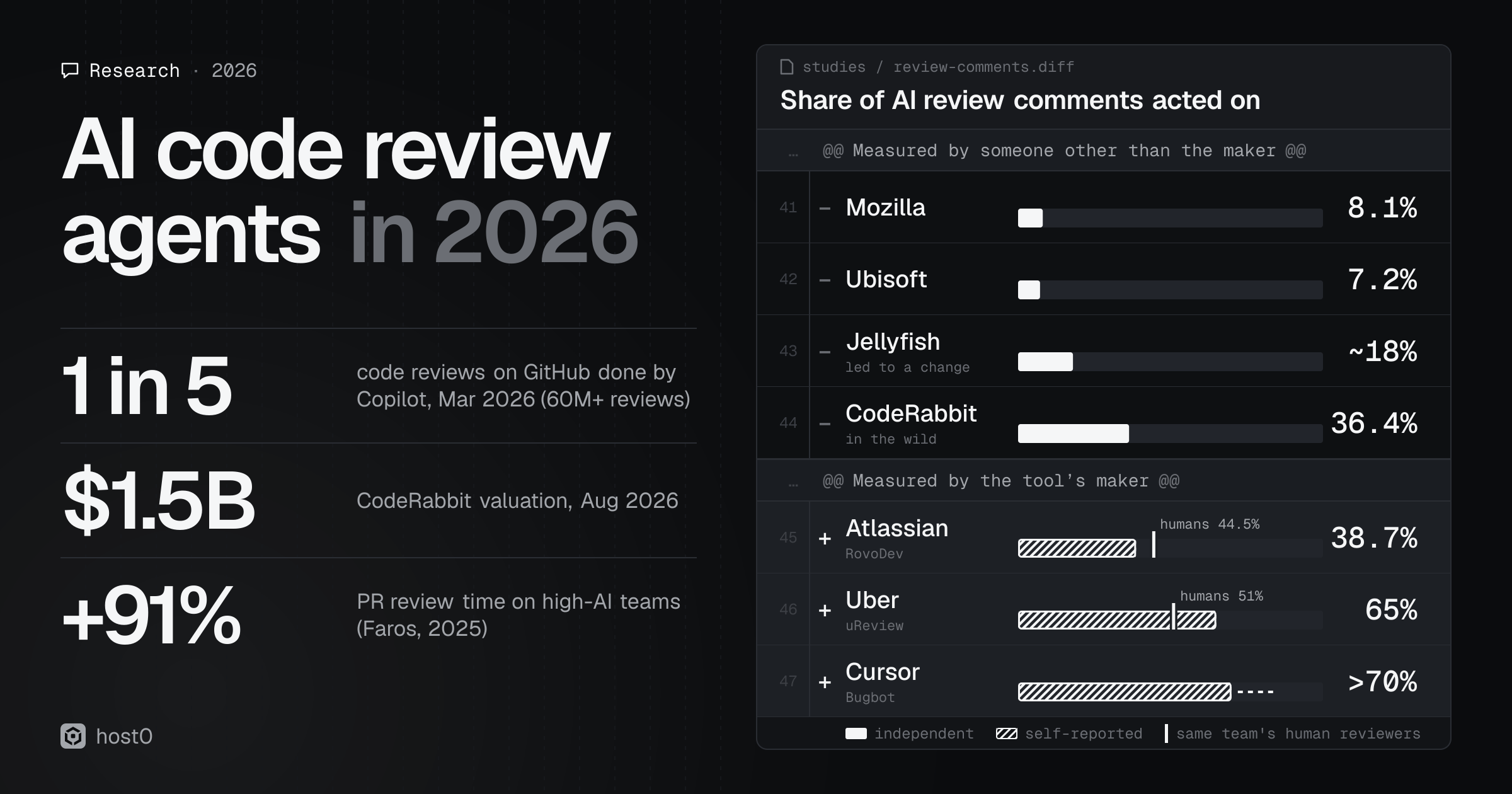
Coding agents made writing a pull request cheap. Reading one didn't get any cheaper. Teams that adopted AI merge far more pull requests than they used to, and the time those pull requests wait for review has gone up with them. So the industry did the obvious thing: it pointed AI at the review too. In eighteen months, AI code review went from a preview feature to something that runs on most pull requests at Microsoft and Uber, on one in five reviews on GitHub, and inside a $1.5B startup.
We collected the adoption, money, accuracy and security numbers published up to 16 October 2026: vendor disclosures (GitHub, Anthropic, Cursor, CodeRabbit, OpenAI), company engineering blogs (Microsoft, Uber, Atlassian), peer-reviewed and preprint studies, benchmarks, and engineering-analytics data (Faros AI, Jellyfish, LinearB). Vendor numbers are their own claims, and every number links to its source. Most of these sites were blocked from the sandbox we researched in, so each headline number was checked against at least two independent reports; the methodology has the details.
Key findings
- 1AI review went mainstream in a year and a half. Copilot code review reached general availability in April 2025. By March 2026 it had run 60 million reviews and accounted for more than one in five code reviews on GitHub, GitHub says. In Jellyfish's customer data, adoption of code-review agents went from 14.8% to 51.4% between January and October 2025.
- 2Big engineering orgs run it on almost every change. Microsoft's internal reviewer covers more than 90% of pull requests, over 600,000 a month. Uber's covers more than 90% of about 65,000 weekly diffs.
- 3The demand comes from a review bottleneck. High-AI teams merged 98% more pull requests while review time rose 91%, per Faros AI. A Harvard study of 718 firms found agents added code but not finished work, with review the constraint.
- 4Money followed. CodeRabbit raised $143M at a $1.5B valuation in August 2026, up from $550M eleven months earlier. Cursor bought Graphite, and Anthropic, OpenAI, GitHub and Google all ship a reviewer of their own.
- 5Most AI review comments are not acted on. Studies run by someone other than the tool's maker find developers act on 7–36% of AI comments: 8.1% at Mozilla, 36.4% for CodeRabbit across 239 open-source repos. Makers' own numbers run from 39% to over 70%.
- 6Human comments aren't acted on much more. At Atlassian, 44.5% of human comments led to a code change, against 38.7% for its AI reviewer, which still cut median pull-request cycle time by 30.8%.
- 7Every vendor wins its own benchmark. Greptile's puts Greptile first, GitHub's puts Copilot first, and the independent Martian leaderboard put Cubic first on 6 October. On an academic benchmark, frontier models found 15–31% of the issues humans flagged.
- 8The reviewer is an attack surface. A malicious pull request gave researchers code execution on CodeRabbit's servers and a key with write access to up to a million repositories. Pull-request text has since been used to prompt-inject Copilot, Claude and Gemini review agents.
+91%
PR review time on high-AI-adoption teams, while merged PRs rose 98%
Source: Faros AI via Unblocked
Why review became the bottleneck#
The supply of pull requests jumped. GitHub users merged 43.2 million pull requests a month on average in the year to August 2025, up 23%. By September 2026, our own count found that 25.8% of new public pull requests on GitHub carried a coding agent's signature, up from 6.9% a year earlier. Anthropic says code output per engineer at the company grew 200% in a year, and puts it plainly: "Code review has become a bottleneck, and we hear the same from customers every week."
Telemetry from engineering-analytics companies shows where the extra output goes. Faros AI compared teams with high and low AI adoption across more than 10,000 developers: the high-AI teams completed 21% more tasks and merged 98% more pull requests, but their pull requests were 154% larger and took 91% longer to review. A Harvard job-market paper by Fiona Chen and James Stratton, using Jellyfish data on 725,938 workers at 718 firms, found that after teams adopted coding agents, they wrote about 30% more code and opened 23% more pull requests, review-related time rose 49%, and finished work didn't rise significantly, according to coverage of the paper.
More code, slower review
Change for teams using AI heavily, percent
| Label | Value |
|---|---|
| PR size (Faros) | +154% |
| PRs merged (Faros) | +98% |
| PR review time (Faros) | +91% |
| Review-related time (Chen & Stratton) | +49% |
| Code written (Chen & Stratton) | +30% |
| PRs opened (Chen & Stratton) | +23% |
| Tasks completed (Faros) | +21% |
Sources: Faros AI via Unblocked; Chen & Stratton via FourWeekMBA
Agent-written pull requests also wait longer. LinearB's 2026 benchmarks, drawn from 8.1 million pull requests, say AI pull requests wait 4.6 times longer before review but are reviewed twice as fast once someone picks them up, and 32.7% are accepted against 84.4% of unassisted ones. Reviewers have reasons to slow down. CodeRabbit's own analysis of 470 open-source pull requests found about 1.7 times as many issues in AI-co-authored ones (10.83 per PR against 6.45). In Stack Overflow's 2025 survey, 46% of developers said they distrust the accuracy of AI output, against 33% who trust it, and in Sonar's January 2026 survey 96% said they don't fully trust AI code to be functionally correct, while only 48% always check it before committing.
How fast AI review spread#
GitHub's reviewer is the default for most teams because it's already in the product they use. GitHub says more than a million developers tried Copilot code review in the month-long preview before general availability in April 2025. By March 2026 it had done 60 million reviews, usage had grown tenfold, and 12,000 organizations ran it automatically on every pull request. Among Jellyfish customers using review agents in 2025, 67% used Copilot and 12% CodeRabbit, and the biggest jump in adoption came the month Copilot's reviewer became generally available.
How much of the work an AI reviewer sees
Percent, latest self-reported figure from each organization
| Label | Value |
|---|---|
| Microsoft, PRs covered | >90% (Jul 2025) |
| Uber, diffs covered | >90% (Aug 2025) |
| Anthropic, PRs with substantive comments | 54% (Mar 2026; 16% before) |
| Jellyfish customers using review agents | 51.4% (Oct 2025; 14.8% in Jan) |
| Code reviews on GitHub done by Copilot | >20% (Mar 2026) |
The independents grew too. CodeRabbit says it runs more than two million reviews a week for over 17,000 customers. Its free reviews on public repositories passed a million in a month for the first time in September 2026, the company says, across more than 300,000 installed public repos. Cursor says Bugbot reviews more than two million pull requests a month. OpenAI says Codex reviews almost every pull request opened inside OpenAI.
CodeRabbit reviews on open-source repositories
Completed reviews per month, 2026
| x | y |
|---|---|
| Apr 2026 | 421.3K |
| Jul 2026 | 800K (>800K) |
| Aug 2026 | 917.4K |
| Sep 2026 | 1M |
Source: CodeRabbit
Who sells it#
There are three kinds of seller. Platforms bundle a reviewer with what you already pay for: GitHub with Copilot, Cursor with Bugbot, OpenAI with Codex, Anthropic with Claude Code, Google with Gemini Code Assist. Independents (CodeRabbit, Greptile, Qodo, Macroscope, Baz, Cubic) sell review as the product and work across all of them. And companies with enough engineers build their own: Microsoft, Uber, Atlassian, Google, Meta.
AI code review, 2024 to 2026
Aug 2024
18 Mar 2025
18 Mar 2025
Graphite raises $52M
Series B led by Accel, with Anthropic, alongside its Diamond reviewer.Source: TechCrunch
4 Apr 2025
Jun 2025
Jun 2025
Cursor ships Bugbot
In Cursor 1.0, as a beta.14 Jul 2025
16 Sep 2025
16 Sep 2025
CodeRabbit Series B at $550M
$60M; more than $15M in annual recurring revenue.Source: TechCrunch
6 Oct 2025
6 Oct 2025
Codex generally available
OpenAI says Codex reviews almost every internal PR.Source: OpenAI
19 Dec 2025
9 Mar 2026
9 Mar 2026
Anthropic launches Code Review for Claude Code
Several agents per pull request, about 20 minutes each, Team and Enterprise plans.Source: Anthropic
30 Mar 2026
12 Aug 2026
12 Aug 2026
CodeRabbit Series C at $1.5B
$143M, co-led by Atomico and Smash Capital.Source: CodeRabbit
6 Oct 2026
6 Oct 2026
GitHub publishes ReviewBench
An open benchmark for AI code review, with Copilot on top.Source: The New Stack
The independents raised most of the venture money. CodeRabbit alone has raised $219M across three rounds, and its valuation went up 2.7 times in eleven months. Graphite raised $52M at a $290M valuation in March 2025, and Axios reported that Cursor paid "way over" that nine months later.
Latest rounds for AI code review startups
Amount raised in the most recent priced round, US dollars
| Label | Value |
|---|---|
| CodeRabbit | $143M (Series C, Aug 2026) |
| Qodo | $70M (Series B, Mar 2026) |
| Graphite | $52M (Series B, Mar 2025) |
| Macroscope | $30M (Series A, Sep 2025) |
| Greptile | $25M (Series A, Sep 2025) |
| Baz | $17M (Seed, Jun 2026) |
Sources: CodeRabbit; Globes; TechCrunch; Lightspeed; Pulse 2.0; SiliconANGLE
What it costs#
Pricing is moving from seats to runs, because an agent can open more pull requests than a person. Cursor moved Bugbot from $40 per user a month to usage-based billing in May 2026, about $1.50 per run on average. GitHub started charging Actions minutes for Copilot reviews on private repositories on 1 June 2026. Anthropic's Code Review is billed by tokens and generally averages $15–25 per review, because it runs several agents for about 20 minutes per pull request.
How AI reviewers are priced
As of October 2026
- CodeRabbit Pro: $24 per developer a month billed yearly, $30 monthly; free on public repos.
- GitHub Copilot code review: included in paid Copilot plans; on private repos it also uses Actions minutes.
- Cursor Bugbot: per run, about $1.50 on average.
- Claude Code Review: per token, typically $15–25 a review.
- OpenAI Codex review: included in ChatGPT plan usage.
- Gemini Code Assist on GitHub: a free consumer version, 33 PRs a day.
The difference adds up. For a ten-person team opening 400 pull requests a month, reviewed once each, our arithmetic puts the bill at a few hundred dollars for a per-seat or per-run reviewer and several thousand for the deepest per-token one.
Monthly cost of 400 reviews
Ten developers, one review per pull request, US dollars a month
| Label | Value |
|---|---|
| CodeRabbit Pro, ten seats billed yearly | $240 |
| Cursor Bugbot at ~$1.50 a run | $600 |
| Claude Code Review at $15–25 a review | $6,000–10,000 |
Sources: CodeRabbit docs; Cursor; Anthropic
Does anyone act on the comments#
The most useful measure of a reviewer is whether its comments lead to a change in the code. Every study measures it a little differently ("accepted", "resolved", "addressed in the same changeset"), so the numbers below aren't a ranking. They do split cleanly by who did the measuring.
The largest independent study looked at 31,073 CodeRabbit comments in 10,191 pull requests across 239 GitHub repositories. Developers accepted 36.4%, discussed 7.3% and rejected 56.3%, mostly because the suggestion was a false positive, redundant or out of scope. At Mozilla and Ubisoft, reviewers accepted 8.1% and 7.2% of a research tool's generated comments; refactoring suggestions did far better (about 18%) than comments about functionality (about 5%).
The makers' numbers are higher, and they also show what the right baseline is. Human review comments aren't acted on every time either. Atlassian's peer-reviewed study of its RovoDev reviewer, across 54,000 comments in 1,900 repositories, found 38.7% of AI comments led to a code change against 44.5% of human ones, and median pull-request cycle time fell 30.8%, from 20.7 to 14.4 hours. Uber says 65% of uReview's comments are addressed in the same change, against 51% of human-written comments, though the two were measured differently. Anthropic says its engineers mark fewer than 1% of findings incorrect, and that the share of its pull requests getting substantive review comments went from 16% to 54%.
Faster isn't guaranteed. At the appliance maker Beko, an AI reviewer's comments were labelled resolved 73.8% of the time, but pull requests took longer to close. In a controlled experiment with 29 professional developers, 89% of the issues an LLM flagged ended up in the humans' reviews, attention clustered on the lines the model pointed at, and the humans found no more high-severity issues and saved no time.
Benchmarks: every vendor wins its own#
Greptile's benchmark seeds 50 real bugs from five open-source repositories and asks which reviewers catch them. Greptile catches the most. False positives don't count against a tool, so a noisy reviewer can score well.
Greptile's benchmark: real bugs caught
Share of 50 known bugs flagged, July 2025, run by Greptile
| Label | Value |
|---|---|
| Greptile | 82% |
| Cursor Bugbot | 58% |
| GitHub Copilot | 54% |
| CodeRabbit | 44% |
| Graphite | 6% |
Source: Greptile
GitHub's ReviewBench, built with Microsoft and published in October 2026, puts Copilot first at 40.1% grounded F1 on 219 pull requests. GitHub ran its competitors' public versions itself, and they didn't verify their entries. Martian's independent leaderboard, which counts a comment as correct when the developer then changed the code, had Cubic first at 64.9% F1 on 6 October and Copilot fourth. At least five vendors have announced they were first on Martian's board, on different dates and metrics.
Who ran the benchmark, who won
- Greptile benchmark, run by Greptile: Greptile first.
- ReviewBench, run by GitHub and Microsoft: Copilot first.
- Macroscope's internal benchmark, run by Macroscope: Macroscope first.
- Martian online leaderboard (independent), 6 October 2026: Cubic first.
- SWE-PRBench, run by academics: no model above 31%.
Sources: Greptile; The New Stack; arXiv 2603.26130
Academic benchmarks score the models rather than the products, and they're humbling. On SWE-PRBench, eight frontier models found only 15–31% of the issues human reviewers had flagged in 350 pull requests when given just the diff.
The reviewer is an attack surface#
A review bot reads untrusted input (anyone's pull request) and usually holds write access to the repository. That combination has already been exploited. In January 2025, researchers at Kudelski Security opened a pull request with a configuration file that made CodeRabbit load their code, got remote code execution on its production servers, and read its GitHub App private key, which could act on any repository where the app was installed. CodeRabbit fixed it within hours and says no customer data was accessed.
Review bots under attack
Jan 2025
Jan 2025
CodeRabbit remote code execution
A malicious PR's linter config ran code on CodeRabbit's servers and exposed its GitHub App key: write access to up to ~1M repositories. Fixed the same month, published in August 2025.Source: Kudelski Security
8 Oct 2025
8 Oct 2025
CamoLeak
Hidden text in a PR description made Copilot Chat leak private code through GitHub's image proxy. CVSS 9.6, fixed in August 2025.Source: Legit Security
15 Apr 2026
15 Apr 2026
Comment and Control
PR titles, issue bodies and comments hijacked Claude Code Security Review, Gemini CLI Action and Copilot's agent into leaking secrets.Source: Cloud Security Alliance
Jul 2026
Jul 2026
Ghostcommit
Instructions hidden in an image that the AI reviewer never opens, for the next coding agent to follow.Source: BleepingComputer
Prompt injection is the newer problem. Any GitHub user who can open a pull request or an issue controls text the review agent reads. Researchers have used that text to make review agents leak secrets, and in Ghostcommit they hid instructions where the reviewer doesn't look, so it approved what a later agent would act on.
What this means if you ship with AI#
- Turn it on, then measure what gets acted on. Comment counts flatter every tool. Track the share of AI comments that lead to a code change, and compare it with your human reviewers' rate; at Atlassian and Uber the two were close.
- Tune for precision. Most rejected comments are false positives, duplicates or out of scope. Limit the bot to bugs and security, turn style comments off, and run it when a pull request is ready rather than on every push.
- Keep a human approval. AI review is a first pass, not a sign-off. Anthropic's reviewer doesn't approve pull requests, and in the one controlled experiment humans followed the model's attention rather than adding to it.
- Make pull requests smaller. Anthropic's reviewer found issues in 84% of pull requests over 1,000 lines and 31% of those under 50. Agent-written pull requests are getting bigger; split them before anyone reviews them.
- Treat the reviewer as privileged code. Give the app the narrowest repository permissions, never run repository-supplied config outside a sandbox, and assume pull-request text is hostile.
- Price per review, not per seat. When agents open the pull requests, seats stop being the right unit. A deep per-token reviewer on every push can cost more than the developer seats it serves.
Not everything an agent builds needs a pull request. For the small tools, reports and pages people make for their own team, we built host0: a private link only invited colleagues can open, with one-click restore when a new version is wrong.
Methodology#
We gathered these numbers on 16 October 2026 with three parallel research passes: products and money, effectiveness and failure modes, and adoption and the review bottleneck. The network we researched from blocked most primary sites (github.blog, coderabbit.ai, cursor.com, uber.com, arxiv.org, faros.ai, linearb.io, jellyfish.co), so for each headline number we required the primary page's own text in search results plus an independent report, or two independent reports that agree. Anthropic's post was read directly. Eighteen headline numbers were re-checked with fresh searches before writing.
- Vendor numbers (reviews run, customers, resolution rates, benchmark wins) are the companies' own claims. Cursor's resolution rate is judged by an LLM.
- Field studies measure different things: accepted by the reviewer (Mozilla, Ubisoft, CodeRabbit study), led to a code change (Atlassian, Jellyfish), addressed in the same change (Uber), resolved by merge (Cursor). Uber's AI and human rates were measured by different methods.
- Faros AI and Chen & Stratton are correlational or quasi-experimental studies of analytics data; we read them through published coverage. Write-ups differ on whether Chen and Stratton's 49% is review time or time to merge.
- Costs are our arithmetic on list prices for one illustrative team.
- The agent-signature share of GitHub pull requests is our own count from the State of AI coding agents 2026 post.
The full data pack, with tiers, the spot-check log and a do-not-cite list, is in our repository at docs/research/2026-10-16-ai-code-review-agents.md.
Open questions#
- Bugs that reach production. No public study compares production defects with and without AI review. Every metric here is a proxy: a comment acted on, a pull request merged, a cycle time.
- A fair leaderboard. No independent benchmark scores Copilot, CodeRabbit, Bugbot, Claude Code Review and Codex on the same pull requests on the same day.
- Review depth over time. Only one small experiment asks whether people review less carefully once a bot reviews first.
- AI reviewing AI. A growing share of pull requests is written by one agent and reviewed by another. Nobody has published how often both miss the same bug.