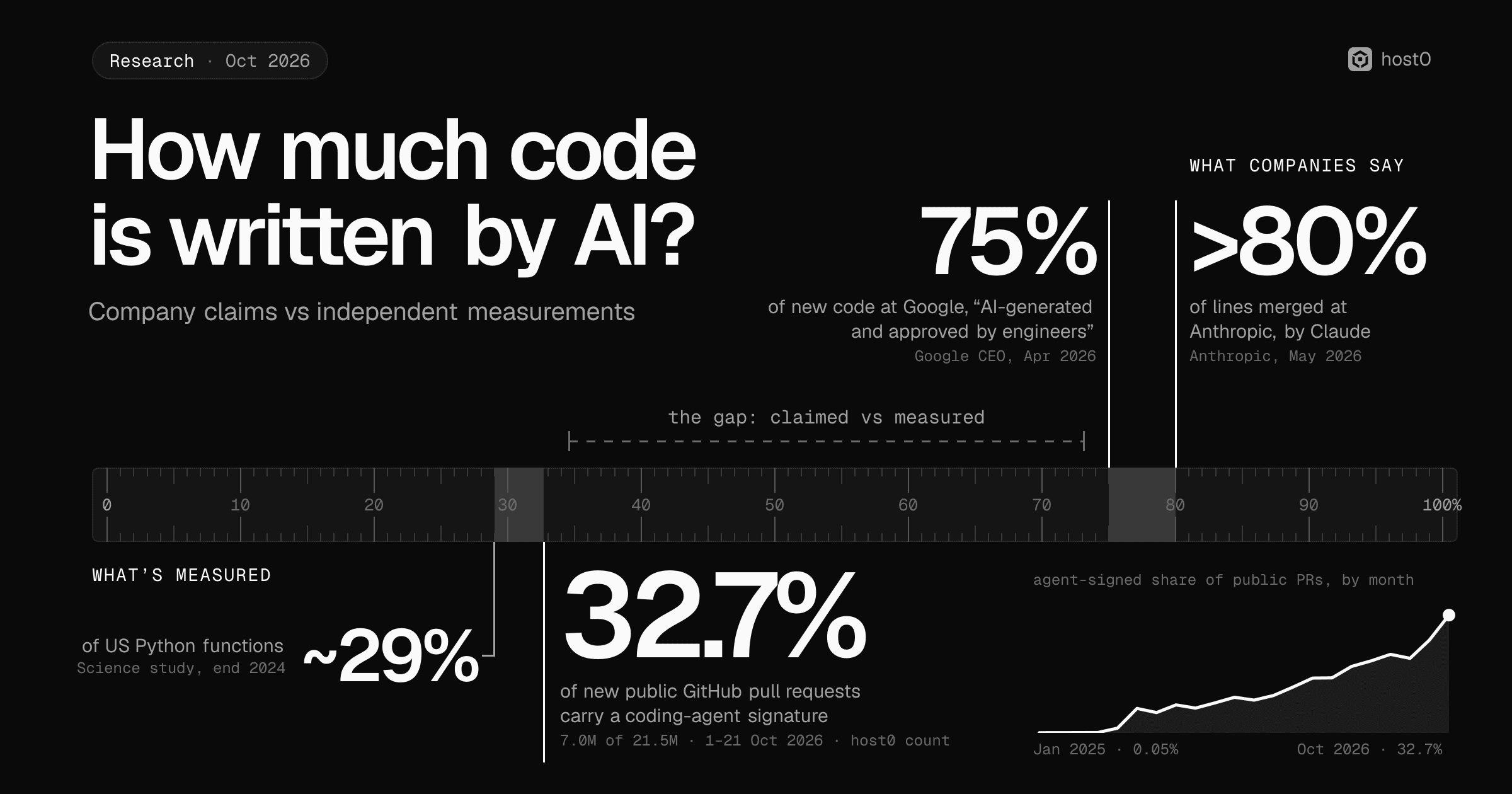
Ask a company how much of its code AI writes and you'll get a number anywhere from 10% to 100%. Google's CEO said "more than a quarter" in October 2024 and 75% eighteen months later. Coinbase says roughly all of it. Uber said about 10% in May and more than 70% in August. These numbers don't necessarily contradict each other. They count different things: characters typed by autocomplete, "new code", lines merged, pull requests, or anything an AI tool touched.
We collected about 45 public claims from companies and executives between 2022 and September 2026 and noted what each one is a share of. Then we put them next to the independent measurements (peer-reviewed papers, censuses of public repositories, developer surveys) and ran our own count of every public pull request on GitHub that carries a coding agent's signature, up to 21 October 2026. Before using that count we stress-tested it: we sampled the pull requests it matches to see how many really came from an agent, and how many come from a few accounts opening thousands of them. Company numbers are their own claims, and every number links to its source. The methodology has the details.
Key findings
- 1Google's claim tripled in 18 months. It went from "more than a quarter" of new code in October 2024 to "75% of all new code" in April 2026. Coinbase says AI-generated code went from 5.7% of everything merged in early 2025 to "roughly 100%" by July 2026.
- 2The claims don't share a definition. Google's famous 2024 "50%" was characters accepted from autocomplete. On 2025–26 earnings calls, companies that said "written by AI" or "AI-generated" gave a median of 50%. Companies that said "AI-assisted" gave a median of 82%.
- 3Anthropic's is the most carefully defined number. It says more than 80% of the lines merged into its codebase were authored by Claude as of May 2026, and notes that its leadership's public "90% or more" includes scripts and experimental code. Dario Amodei had predicted 90% within three to six months in March 2025.
- 4The same company can give two very different numbers. Shopify's president said AI writes "well over 50%" of its code; three weeks later Shopify Engineering said its agent coauthors one in eight merged pull requests. Uber's CEO put code committed by autonomous agents at "about 10%" in May; in August Uber said agents are credited with more than 70% of pull requests.
- 5Independent measurements are lower. A classifier study published in Science found AI wrote about 29% of Python functions by US developers on GitHub at the end of 2024. Developers surveyed by DX, an engineering-analytics vendor, put AI's share of their merged code at 22% for July to mid-October 2025 and "nearly 30%" for October 2025 to January 2026. In Sonar's survey, developers say 42% of the code they commit.
- 6A third of new public pull requests on GitHub now carry an agent's signature. In 1–21 October 2026, 7.0 million of the 21.5 million pull requests opened in public repositories (32.7%) had a coding agent's footer, branch name or bot author, by our count. A year earlier it was 8.3%. Claude Code's footer alone was on 24.2%.
- 7Our count holds up under a stress test. We opened 100 randomly sampled matches: 98 showed the agent's mark (the footer or a co-author line, the agent's bot account, or the agent's GitHub app as opener), and the other two were Codex branches with no second trace. Leaving out accounts that opened 200 or more pull requests in three weeks gives 30.9%; leaving out those with 1,000 or more gives 34.6%. Codex is the weak spot: only 20 of 50 Codex-branch pull requests carried a second marker.
- 8Big projects are far lower. In September 2026, 23.9% of merged pull requests in Next.js carried an agent signature, 2.8% in VS Code, 1.9% in Kubernetes and 0.1% in Rust. A low share means unsigned, not unused: the repository of OpenAI's own Codex agent showed two signed pull requests out of 1,609.
75%
New code at Google that's AI-generated and approved by engineers, April 2026 (claim)
Source: Google
~30%
Merged code that's AI-generated, as developers at 400+ companies report it, Oct 2025–Jan 2026
Source: DX
32.7%
New public GitHub pull requests with a coding-agent signature, 1–21 Oct 2026
Our count; PRs, not lines
Source: GitHub search API
How fast the claims rose#
Google's is the longest series from one speaker. In October 2024 Sundar Pichai said "more than a quarter of all new code at Google is generated by AI, then reviewed and accepted by engineers". Six months later, on the first-quarter 2025 call, it was "well over 30%" of code checked in. In October 2025 it was "nearly half", and at Cloud Next in April 2026 Pichai said "75% of all new code at Google is now AI-generated and approved by engineers, up from 50% last fall". Google has never said what the unit is (lines, changes or characters), or whether generated files and migrations count.
Coinbase gives the clearest company series: one stated definition, three points. It's the share of "everything merged into our codebase" that AI generated. In a July 2026 post it says that share was 5.7% in the first quarter of 2025, crossed 50% in the fourth quarter, and has now "reached roughly 100%", while "humans still review all of our code". Its own February 2026 engineering post said something that sounds smaller: "AI assists with roughly 40% of the code written at Coinbase." Different words, different count.
The most quoted prediction came first. On 10 March 2025, Dario Amodei told the Council on Foreign Relations: "I think we'll be there in three to six months—where AI is writing 90 percent of the code." Here is how that played out at his own company.
Anthropic's 90%: the prediction and the measurement
10 Mar 2025
10 Mar 2025
Amodei predicts 90% in three to six months
“And then in twelve months, we may be in a world where AI is writing essentially all of the code.”Source: CFR
7 May 2025
7 May 2025
Claude Code team: “maybe like 80, 90%”
An estimate for the Claude Code product's own code.Source: Latent Space
22 Oct 2025
22 Oct 2025
An outside estimate: “more like 50%”
Ryan Greenblatt of Redwood Research, on lines of merged code across all of Anthropic.Source: LessWrong
13 Feb 2026
May 2026
May 2026
Anthropic measures more than 80%
Share of lines merged to production attributed to Claude. Engineers merge 8× as much code per day as in 2024.Source: Anthropic
23 Sep 2026
Anthropic's own page is unusually careful about it. It says its ">80% figure measures the share of lines merged to production that can be attributed to Claude", and notes that leadership's public "90% or more" includes "scripts and experimental code". It also says engineers merged 8 times as much code per day in mid-2026 as in 2024. A share can rise because the AI writes more, not only because people write less.
What the numbers actually count#
Read any "X% of our code" with one question: X% of what? Here is every unit we found behind the published claims, and what pushes each one up or down.
A decoder for “X% of code is written by AI”
The units behind published claims, 2022 to 2026
- Characters from autocomplete. Accepted AI characters divided by typed plus accepted characters, pasted code left out. Google Research's 3% in 2022 and 50% in 2024. One accepted Tab of boilerplate counts like a line of hand-designed logic.
- Code in files where the tool was on. GitHub's 46% for Copilot in 2023. Only files where Copilot was enabled count.
- "AI-assisted" or "developed with AI". Any AI touch counts. HubSpot 97%, Chime 84%, Instacart over 80%, DocuSign about 75%.
- "New code", unit unstated. Google's CEO series, Snap, Pinterest. "New" leaves the existing codebase out.
- Committed or merged lines. Closest to authorship: Anthropic, Coinbase, Workday. Attribution depends on tooling, and verbose AI output inflates line counts.
- Pull requests attributed to an agent. Uber over 70%, Spotify 73%, Cursor 35%, Shopify one in eight. A pull request isn't a line, and "attributed" can mean an agent touched it.
- Committed by an autonomous agent. The strictest: Uber about 10% (May 2026), Block 15% (April 2026), Cognition 89% (by its own agent, Devin).
- One person, one project, one product. Boris Cherny's 30 days at 100%, OpenAI's Sora for Android at about 85%, an internal OpenAI product with "0 lines of manually-written code". Showcases, not company-wide shares.
- Not code at all. OpenAI's 99.8% is output tokens; Anthropic's 59% is the share of staff's work that uses Claude.
Source: Company statements and research blogs, linked in each item
The word a company picks comes with a very different number. We took the 13 point values we found in earnings calls from 2025 and 2026 and split them by wording. The nine that said "written by AI" or "AI-generated" have a median of 50%. The four that said "AI-assisted", "with AI assist" or "developed with AI" have a median of 82%.
Earnings-call claims, by the words used
Share of code each company said AI wrote or assisted, percent, 2025–26
| Label | Value |
|---|---|
| HubSpot | 97% (assisted) |
| Chime | 84% (with AI) |
| Instacart | >80% (assisted) |
| DocuSign | ~75% (assisted) |
| DoorDash | 50–67% (written) |
| Airbnb | ~60% (written) |
| Workday | >50% (generated) |
| Shopify | >50% (written) |
| ~50% (generated) | |
| Google (CFO) | ~50% (written) |
| MercadoLibre | majority (by AI) |
| Snap | ~40% (generated) |
| Uber | ~10% (agents) |
Sources: HubSpot; Chime; Instacart; DocuSign; DoorDash; Airbnb; Workday; Shopify; Pinterest; Alphabet (MarketBeat); MercadoLibre; Snap; Uber; Snap 8-K
The clearest examples of the problem come from inside one company. On 5 May 2026, Shopify's president Harley Finkelstein said "AI right now writes well over 50% of our code today". On 28 May, Shopify Engineering wrote that its Slack agent River "coauthored" one in eight merged pull requests. On Uber's May call, Dara Khosrowshahi said "About 10% of our code now is committed. That committed is built by agents, autonomous agents". In August, Uber Engineering wrote that "more than 70% of pull requests are attributed to local or cloud agents". A month later Dropbox's CTO benchmarked his company's "around 70% AI-generated code" against "a number around 70%" from Uber: a share of code compared with a share of pull requests.
Same company, two numbers
Percent, as stated by each company in 2026
| Label | Value |
|---|---|
| Shopify: code AI writes | >50% (5 May) |
| Shopify: merged PRs coauthored by River | 1 in 8 (28 May) |
| Uber: PRs attributed to agents | >70% (27 Aug) |
| Uber: code committed by autonomous agents | ~10% (6 May) |
Sources: Shopify Q1 2026 call; Shopify Engineering; Uber Q1 2026 call; Uber Engineering
Pull requests are becoming the unit companies report. They're easier to attribute than lines, since an agent often opens the pull request itself. But the definitions still differ: "created by agents operating autonomously" at Cursor, "attributed to local or cloud agents" at Uber, "involves an agent" for Satya Nadella's figure for all of GitHub.
Some of the biggest names haven't published a recent company-wide share at all. The last Microsoft-internal figure we found is from April 2025, when Nadella said "maybe 20%, 30% of the code that is inside of our repos today" was "written by software", with some projects probably written entirely that way. OpenAI has given showcase projects and token shares but no company-wide share of code. Amazon has given saved developer-years and a six-engineer team story. Meta has given forecasts and a 30% rise in output per engineer since the start of 2025.
What independent measurement finds#
People outside the companies measure this four ways, and each has its own denominator.
A classifier on the code itself. Simone Daniotti, Johannes Wachs and colleagues trained a model to recognize AI-written Python functions and ran it over 31 million GitHub commits by about 170,000 developers. In the version published in Science in 2026, they estimate that AI wrote about 29% of Python functions by US developers by the end of 2024, followed by Germany and France at 23–24% and India at 20%. Newcomers to GitHub used it more than veterans: 37% of their code against 27% for the most experienced. Going from no AI to 29% was associated with 3.6% more commits.
Signatures in public repositories. A census of more than 180 million repositories found that looking only at bot accounts, the method most adoption studies use, finds 3.3% of the Claude Code commits that a multi-signal method detects (28,154 of 850,157), so single-signal counts are "biased low by at least this factor". Among projects created after August 2025 with at least 100 commits, 41.2% are "pervasive" adopters, with more than 20% of commits AI-assisted, against 21.1% of older projects.
Surveys inside companies. DX, which sells engineering analytics, asks developers at its customers each quarter how much of their merged code AI wrote, counting code "merged without major human rewrites or modifications". In its first report, covering July to mid-October 2025, the answer was 22% across 266 companies, "far below vendor marketing claims". The next one, covering October 2025 to January 2026 and more than 400 companies, found "nearly 30% of all merged code". These are developers' own estimates; DX says it will compare them with telemetry from version control.
Asking developers. In Sonar's survey of more than 1,100 professional developers, published in January 2026, respondents said 42% of the code they commit is AI-generated or assisted, and expected 65% by 2027. 96% said they don't fully trust that AI code is functionally correct. Stack Overflow's surveys ask whether developers use AI, not how much of their code it writes.
The independent numbers land lower and later than the claims. While Google's CEO was saying "nearly half" (October 2025), developers at DX's customers put AI's share of their merged code at nearly 30% (October 2025 to January 2026). Six months later Google said 75%. That's not proof the claims are inflated: Google and Anthropic build the tools and adopt them first, and DX averages over hundreds of ordinary companies. It does mean no single figure describes "the industry".
A third of public pull requests#
Agents leave fingerprints on the pull requests they open. Claude Code adds a "🤖 Generated with Claude Code" footer unless you turn it off, and its web sessions push branches named claude/…. Codex's cloud tasks push codex/… branches, Cursor's cloud agents push cursor/…, and GitHub's Copilot coding agent, Devin, Jules and the Claude and Cursor GitHub apps open pull requests under their own bot accounts. We counted these in early October for the state of AI coding agents. For this post we re-ran the count on 23 October with three more signatures, every month from January 2024, the first three weeks of October 2026 and merged pull requests.
In 1–21 October 2026, 7,016,906 of the 21,457,204 pull requests opened in public repositories carried at least one signature: 32.7%. In September it was 25.8%, in October 2025 8.3%, and in every month of 2024 it was 0.04% or less.
Everything on public GitHub grew, not only agent work. Public pull requests went from 4.6 million a month on average in 2024 to 22.8 million in September 2026, and to 1.02 million a day in the first three weeks of October. Signed agent pull requests went from about 22,000 a day in October 2025 to 334,000 a day in October 2026, 15 times as many. Unsigned pull requests grew 2.4 times between September 2025 and September 2026. Some of that is surely agent work with the signature off; we can't tell how much. Dependency bots (Dependabot and Renovate) opened 12.4% of public pull requests in October; leave them out of the denominator and the agent share is 37.3%.
Agent pull requests are merged more often than the average one: 91% of those opened in September and October had been merged by 23 October, against 79–80% of all pull requests. So they are a bigger share of what lands, 29.4% of merged public pull requests opened in September and 37.6% of those opened in 1–21 October. In a one-person repository, "merged" mostly means the author kept it, so this isn't a quality signal.
Claude Code's footer is most of it. It was on 5,190,802 public pull requests in 1–21 October, 24.2% of all of them, up from 0.7% a year earlier. Codex's branches were on 922,103 and Cursor's on 298,167. GitHub's own Copilot coding agent peaked at 317,623 pull requests in March 2026 and opened 44,207 in the first three weeks of October.
Which signatures the pull requests carry
Public pull requests opened 1–21 Oct 2026, by signature
| Label | Value |
|---|---|
| Claude Code footer | 5.2M |
| claude/ branch | 1.8M |
| Codex: codex/ branch | 922.1K |
| Cursor: cursor/ branch | 298.2K |
| Co-Authored-By: Claude | 54.7K |
| Copilot coding agent | 44.2K |
| Devin | 39.1K |
| Cursor app | 17.4K |
| Claude app | 7.7K |
| Jules | 7.3K |
Source: host0 count, GitHub search API
Most of the most recent jump is Claude Code's. Its footer sat at about 11% of public pull requests every week in August 2026, rose to 15–17% over the next three weeks, 21.4% in the week of 21 September and 24–26% from the week of 28 September. Over the same weeks total public pull requests rose from 4.1 million to 7.5 million a week. We don't know what caused the step.
Stress-testing our own number#
A count like this can be inflated in two ways: the queries can catch pull requests no agent wrote, or a few automated accounts can open so many that they swamp everyone else. We checked both on 23 October. We drew random moments in 1–21 October and took the first matching pull request after each one: 100 from the combined query, 50 for each big signature, and 150 from all public pull requests for comparison. For each, we read the title, description, branch, author, the first commit messages and which GitHub app (if any) opened it, and we counted how many public pull requests its author and its repository opened in the same three weeks.
False positives are rare, except for Codex. All 50 sampled footer matches carried the footer in the description (one only after 13,000 characters of text). All 50 claude/ branches named Claude in the description or commits, or were opened by Claude's GitHub app, and all 50 Copilot pull requests came from the Copilot agent's own account. 47 of 50 cursor/ branches had Cursor's agent marker or were opened by Cursor's app. Codex is different: only 20 of 50 codex/ branches carried a second marker (13 were opened by the Codex connector app). The other 30 were opened from the developer's own account with no mention of Codex. Many read like agent-written descriptions, but we can't prove it from the pull request.
How many sampled matches show the agent's mark
Sampled public pull requests, 1–21 Oct 2026, with a second, explicit agent marker, percent
| Label | Value |
|---|---|
| Claude Code footer | 100% (50 of 50) |
| claude/ branch | 100% (50 of 50) |
| Copilot coding agent | 100% (50 of 50) |
| Cursor: cursor/ branch | 94% (47 of 50) |
| Codex: codex/ branch | 40% (20 of 50) |
| Any signature (combined) | 98% (98 of 100) |
Source: host0 sample, GitHub API
If every unmarked Codex branch were human-written, the October share would fall from 32.7% to about 30.1%. Two other possible leaks are negligible: footer matches found only in a pull request's comments, not its text, are 0.3% of footer matches, and copilot/ branches not opened by the Copilot agent add 2,624 pull requests.
Heavy accounts don't inflate it. Public GitHub is busy: the median account behind a random public pull request opened about 80 of them in those three weeks, and the median account behind an agent-signed one opened 94. Three in ten agent-signed pull requests came from accounts that opened 200 or more (about ten a day), but so did a quarter of all public pull requests, and 17 of the 39 busy accounts in that random sample were themselves mostly agent-signed. The busiest agent account we found opened 3,515 pull requests, 3,365 of them signed, which is 0.05% of the October total. Removing busy accounts from both sides moves the share by two points either way.
The undercount is real. 6 of the 150 random public pull requests (4%) had an AI co-author line, mostly Claude's, in a commit message but no signature on the pull request itself, so they aren't in our count. Signed agent pull requests sit mostly in small, personal projects: 68% of the sampled ones were in repositories with no stars. But so were 63% of all public pull requests. Public GitHub is mostly small projects.
Big projects are far lower#
The 32.7% is an average over millions of pull requests, most of them in small repositories. Big, review-heavy open-source projects look very different. We counted merged pull requests opened in September 2026 in a dozen well-known repositories.
What this means if you build with AI#
- Ask "X% of what?" before you repeat a number. Characters, new code, merged lines, pull requests and "assisted" can differ by 40 points or more at the same company. If a claim doesn't say, treat it as the loosest unit.
- Measure your own team with one fixed definition. Merged lines attributed to an agent, or pull requests opened by one, measured the same way every quarter, beats any industry benchmark. Coinbase and Anthropic are the only companies we found that publish anything like that.
- Leave the attribution on. The footer, the branch prefix and the co-author line are how your team, your reviewers and anyone counting can tell what an agent wrote. Turning them off doesn't make the code less AI-written; it makes it harder to review.
- Budget for review, not for typing. When most new pull requests come from agents, the constraint is reading them. We covered what AI code review does and doesn't catch.
- Don't read a high share as a quality bar. Agent pull requests merge more often than average on public GitHub, but two-thirds of the ones we sampled were in repositories with no stars, where "merged" mostly means the author kept it. In busy, review-heavy projects the signed share is a fraction of the public average.
A lot of that agent-written code ends up as small tools and pages someone wants to share. host0 puts whatever your agent made at a private link you can share with your team, with a shared database if it needs one.
Methodology#
Company claims. We collected 45 statements from 2022 to September 2026: earnings-call transcripts (Motley Fool and MarketBeat, Alphabet's own transcript for Q1 2025), SEC filings, company and engineering blogs, and podcast transcripts. Leads from aggregator sites were used only after we re-read the primary. For each claim we recorded the exact wording, the date and what it is a share of. Video-only claims we didn't re-watch, internal targets reported second-hand and forecasts are left out of the charts. The earnings-call medians use stated point values, with floors taken at the floor.
Independent measurement. We read the papers (arXiv HTML), the DX, Sonar and GitHub Octoverse pages and the Stack Overflow survey results directly. DX's and Sonar's numbers are vendor research, and both are surveys: DX asks developers at its customers what share of their merged code AI wrote (its first report's PDF gives the definition, the 266-company sample and the July to mid-October 2025 period), and Sonar asks developers about the code they commit. We left out a detector study whose model reports 19–30% AI-written files in 2022, before ChatGPT existed.
Our GitHub count. On 23 October 2026 we queried GitHub's search API (search/issues, authenticated, advanced_search=true, reading total_count) for every month from January 2024 to 21 October 2026, restricted to pull requests created that month. The signatures were: "Generated with Claude Code", "Co-Authored-By: Claude", branches starting claude/, codex/, cursor/ and copilot/, and the bot authors app/copilot-swe-agent, app/devin-ai-integration, app/google-labs-jules, app/cursor and app/claude, joined with OR in one query so each pull request is counted once. Every call returned complete results. Merged shares add is:merged. Our per-agent totals agree within 3% with the open PRarena tracker for the agents it follows.
Stress test. On 23 October we drew uniformly random moments in 1–21 October and, through GitHub's GraphQL search, took the first pull request created at or after each moment that matched a query: 100 for the combined signature query, 50 each for the Claude footer, claude/, codex/, cursor/ and the Copilot agent, and 150 from all public pull requests. We read each one's text, branch, author, first five commit messages and the GitHub app that opened it (REST performed_via_github_app), and counted the public pull requests its author and repository opened in the window. The scripts and the classified samples are in the data folder below.
The count is a floor for signed agent pull requests and not a share of code. It covers public repositories only, pull requests not lines, and only pull requests that still existed on 23 October (the same September query returned 1.1% fewer pull requests than on 8 October as repositories are deleted or made private). Signatures can be turned off, and agents that leave none (Claude Code with attribution off, Cursor's local agent, Aider, OpenCode, Gemini CLI, code pasted from a chat) aren't counted. The data pack, with every claim, its unit and tier, and a do-not-cite list, is in our repository at docs/research/2026-10-23-ai-code-share.md; the monthly counts, samples and the scripts that compute every number in this post are in docs/research/2026-10-23-ai-code-share-data/.
Open questions#
- Private code. GitHub says 81.5% of contributions happen in private repositories, and our count sees none of them.
- Unsigned work. 14.4 million public pull requests in 1–21 October carried no signature. A classifier pass over 2026 diffs, like Daniotti's over 2024 commits, would say how many were written by AI.
- Lines, not pull requests. No independent study measures AI-written lines across public GitHub for 2026.
- Fixed definitions. No company we found publishes a time series with a stated, unchanged definition except Coinbase. None reports how much AI-written code survives 30 or 90 days, or how often it's reverted.
- The September step. What pushed Claude Code's footer from 11% to about 25% of public pull requests in two months, and public pull requests per day up a third in October.