"AI is taking the junior developer jobs" is one of the most repeated claims in tech. Some of it is backed by data. Postings for software developers on Indeed fell almost three-quarters between 2022 and 2025. Payroll data shows developers aged 22 to 25 losing ground while their older colleagues gain it. Computer science graduates now have one of the highest unemployment rates of any major. CEOs have said AI would do the work of mid-level engineers, and that half of entry-level white-collar jobs could go.
But timing matters, and the timing doesn't fit one simple story. Most of the postings collapse happened before ChatGPT launched, while interest rates rose and big tech undid two years of overhiring. The same crash happened in the UK, Germany and France, which had the same AI tools and different economies. Since mid-2025, US postings have been recovering, mostly at the senior end. We put the public data side by side: Indeed's postings tracker, BLS employment, the New York Fed's graduate data, Stanford's payroll research, SEC headcount filings and what executives actually said, labelled as predictions or as reports of what they did. The methodology has the details.
Key findings
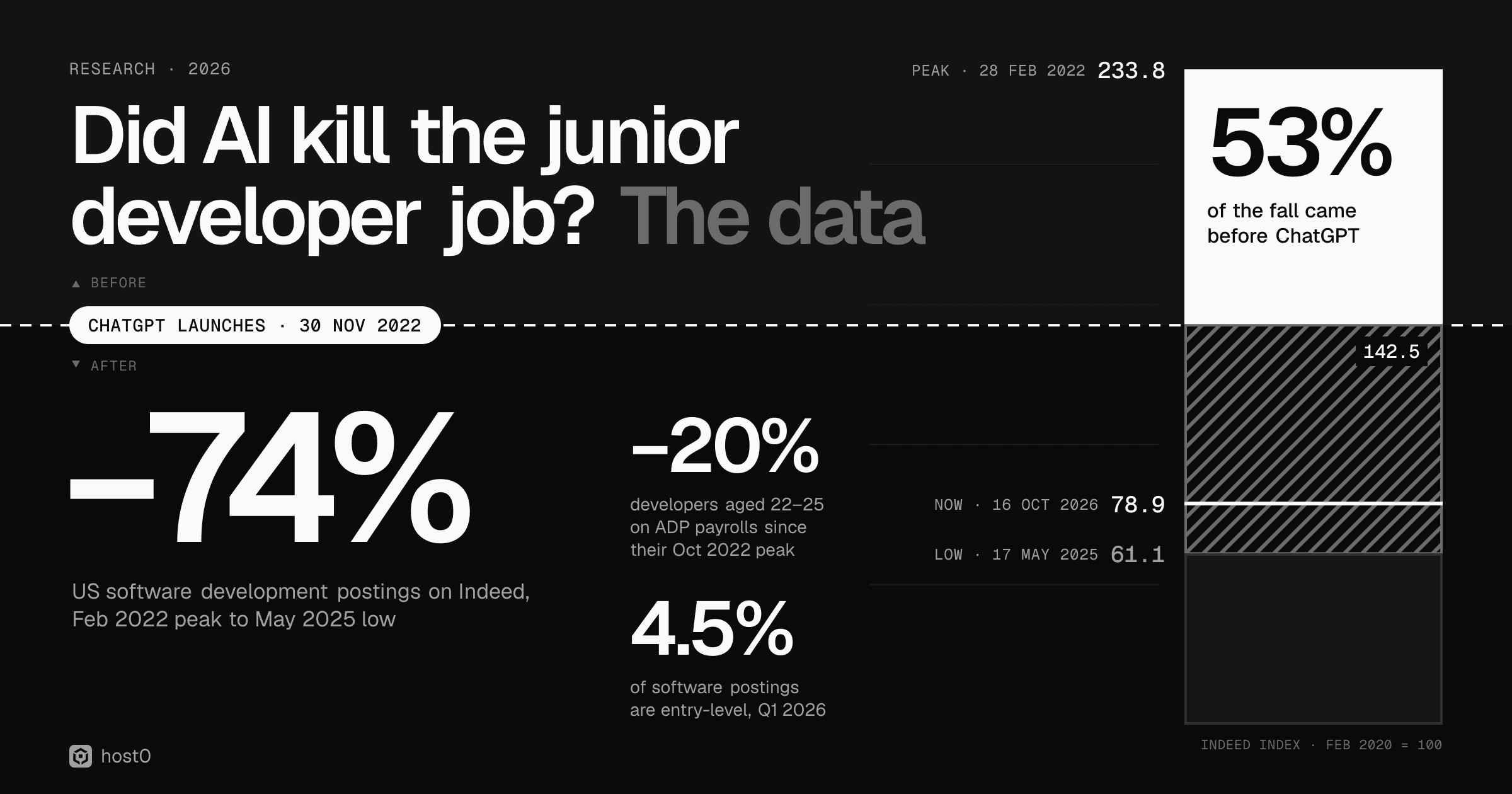
- 1The crash started before ChatGPT. Indeed's US software development postings index peaked at 233.8 on 28 February 2022 (February 2020 = 100) and bottomed at 61.1 on 17 May 2025, a 74% fall. By ChatGPT's launch on 30 November 2022 it was already 39% below the peak: 53% of the whole fall had already happened.
- 2The same boom and bust hit Europe, and only the US is recovering. In the UK, Germany and France, software postings rose and fell on the same 2022 timeline. On 16 October 2026 the US index was 78.9, up 21% on a year earlier. Germany's was 47.7, close to a new low.
- 3Young developers really are losing ground. On ADP payrolls, employment of software developers aged 22–25 stood at 81.4 in September 2026 (November 2022 = 100), 20% below its October 2022 peak. For developers aged 41–49 it was 120.2.
- 4What's being posted is senior. In early 2026, only 4.5% of US software development postings on Indeed were entry-level and 69.3% were senior, the most senior mix of any sector. 71% of the rise in software postings between May 2025 and May 2026 was senior roles.
- 5Computer science went from a safe major to one of the hardest starts. Recent computer science graduates had 7.0% unemployment in the New York Fed's latest data (2024), 4th highest of 74 majors; computer engineering was 2nd at 7.8%. In the 2021 data, computer science ranked 40th.
- 6The overall number of developers didn't collapse. The BLS counted 1,687,890 software developers in May 2025, up 2.0% on a year earlier. Employment in computer systems design is about 5% below its 2023 peak. The squeeze is on who gets hired, not on who keeps their job.
- 7The research disagrees on the cause. Stanford finds 22–25-year-olds in the most AI-exposed jobs 19% behind their less-exposed peers, and calls it "descriptive patterns, not causal estimates". A Harvard paper finds junior employment at firms that adopted generative AI about 9% lower. The New York Fed estimates remote work can explain 64% of the rise in young graduates' unemployment.
- 8The loudest executive claims were predictions. When Amazon cut 14,000 corporate jobs, its CEO said on the earnings call that the cuts were "not even really AI-driven – not right now, at least". Meta's headcount rose 94% to its 2022 peak and fell 24% within a year, before any AI coding agent shipped.
−74%
US software development postings on Indeed, Feb 2022 peak to May 2025 low
Source: Indeed via FRED
53%
Share of that fall already done when ChatGPT launched, 30 Nov 2022
Our calculation
Source: Indeed via FRED
−20%
Software developers aged 22–25 on ADP payrolls, Oct 2022 peak to Sep 2026
Source: Stanford Digital Economy Lab
The postings crash came before ChatGPT#
The best long series on software hiring is Indeed's postings index, published daily on FRED. It tracks the number of software development job postings on Indeed in the US, seasonally adjusted, as an index with 1 February 2020 = 100. It measures postings, not filled jobs. In the pandemic it more than doubled. It peaked at 233.8 on 28 February 2022, about two weeks before the Federal Reserve's first rate rise. On 30 November 2022, the day ChatGPT launched, it was already down to 142.5. It kept falling to 61.1 on 17 May 2025, and has risen since, to 78.9 on 16 October 2026.
Of the 172.7 points the index lost between the peak and the low, 91.3 were gone by ChatGPT's launch: 53%. Indeed's own economists made the same point about all tech postings in July 2025: "nearly half of the net decline" happened before ChatGPT, and "there isn't a smoking gun linking the plunge to the rise of AI". They added that AI could be one reason postings hadn't rebounded.
US software development job postings vs all postings
Indeed postings index, 1 Feb 2020 = 100, seasonally adjusted, Feb 2020 to 16 Oct 2026
| Series | x | y |
|---|---|---|
| Software development | 1 Feb 2020 | 100 |
| Software development | 1 Jul 2020 | 65.4 |
| Software development | 1 Jan 2021 | 91.3 |
| Software development | 1 Jul 2021 | 141.2 |
| Software development | 1 Jan 2022 | 213 |
| Software development | 28 Feb 2022 | 233.8 (peak) |
| Software development | 1 Jul 2022 | 211.3 |
| Software development | 30 Nov 2022 | 142.5 (ChatGPT) |
| Software development | 1 Apr 2023 | 99.5 |
| Software development | 1 Oct 2023 | 75.1 |
| Software development | 1 Apr 2024 | 70.7 |
| Software development | 1 Oct 2024 | 69.2 |
| Software development | 17 May 2025 | 61.1 (low) |
| Software development | 1 Oct 2025 | 64.3 |
| Software development | 1 Apr 2026 | 72.8 |
| Software development | 16 Oct 2026 | 78.9 |
| All postings | 1 Feb 2020 | 100 |
| All postings | 1 Jul 2020 | 74.4 |
| All postings | 1 Jan 2021 | 95.3 |
| All postings | 1 Jul 2021 | 136.6 |
| All postings | 1 Jan 2022 | 157.3 |
| All postings | 28 Feb 2022 | 160.4 |
| All postings | 1 Jul 2022 | 157.3 |
| All postings | 30 Nov 2022 | 146.7 |
| All postings | 1 Apr 2023 | 135.5 |
| All postings | 1 Oct 2023 | 125.6 |
| All postings | 1 Apr 2024 | 119 |
| All postings | 1 Oct 2024 | 112.3 |
| All postings | 17 May 2025 | 105.8 |
| All postings | 1 Oct 2025 | 101.3 |
| All postings | 1 Apr 2026 | 102.2 |
| All postings | 16 Oct 2026 | 103.8 |
Sources: Indeed Hiring Lab via FRED (software); Indeed Hiring Lab via FRED (all)
Three things that have nothing to do with AI happened in that window. Interest rates went from near zero to over 5%: the effective federal funds rate was 0.08% in February 2022, 3.78% in November 2022 and 5.33% from August 2023 to August 2024. Big tech companies that had hired as if the pandemic boom would last started cutting. And a US tax change took effect: from 2022, Section 174 made companies spread the cost of software developers' salaries over five years (15 for work done abroad), instead of deducting it in the year they paid it. Nobody has measured how much the tax change cut hiring. Congress reversed it for US-based work in July 2025.
What happened when
Rates, tax, layoffs and AI tools, 2022 to 2026
Jan 2022
Jan 2022
Section 174 amortization starts
Software development costs must be spread over 5 years (15 abroad) for tax years from 2022.Source: IRS
28 Feb 2022
Mar 2022
Mar 2022
The Fed starts raising rates
Fed funds 0.20% in March 2022, 5.33% by August 2023.Source: FRED
30 Sep 2022
30 Nov 2022
30 Nov 2022
ChatGPT launches
Software postings are at 142.5, already 39% below the peak.24 Feb 2025
24 Feb 2025
Claude Code launches
Agentic coding tools spread through 2025.17 May 2025
4 Jul 2025
4 Jul 2025
Section 174 reversed for US work
Domestic R&D, software included, is deductible again from 2025. Work abroad stays at 15 years.Source: IRS
16 Oct 2026
16 Oct 2026
Software postings at 78.9
Up 21% on a year earlier, still 21% below February 2020.
Meta's headcount is the clearest public record of the overhiring. It went from 44,942 at the end of 2019 to 87,314 in September 2022, then fell to 66,185 a year later. Alphabet grew 60% over the same three years, from 118,899 to 190,234. Meta grew again to 78,865 by the end of 2025, then cut 8,000 jobs in 2026, framed around AI (more on that below). On 30 September 2026 it had 66,775 people, 15% fewer than a year earlier.
Meta's headcount: the boom, the correction, the AI-era cut
Employees at the end of each period, from Meta's quarterly results
| Label | Value |
|---|---|
| Dec 2019 | 44,942 |
| Dec 2021 | 71,970 |
| Sep 2022 | 87,314 (peak) |
| Sep 2023 | 66,185 |
| Dec 2025 | 78,865 |
| Sep 2026 | 66,775 |
Sources: Meta 8-K filings; Meta Q3 2026 results
Same AI tools, different countries#
If AI coding tools were the main cause, countries with the same tools should look alike. They don't. Indeed publishes the same index for other countries. The UK, Germany and France all had the 2022 boom and bust. But since mid-2025 the US is the only one with a real rebound. On 16 October 2026, US software postings were 21% below February 2020; the UK's were 40% below, France's 49% and Germany's 52%, close to a new low.
Software development postings in the US, UK and Germany
Indeed postings index, 1 Feb 2020 = 100, monthly average, Feb 2020 to Oct 2026
| Series | x | y |
|---|---|---|
| US | Feb 2020 | 99.7 |
| US | Jul 2020 | 67.3 |
| US | Jan 2021 | 93.4 |
| US | Jul 2021 | 145.7 |
| US | Jan 2022 | 216.1 |
| US | Jul 2022 | 202.1 |
| US | Jan 2023 | 126.3 |
| US | Jul 2023 | 83.5 |
| US | Jan 2024 | 71.8 |
| US | Jul 2024 | 70.1 |
| US | Jan 2025 | 67.5 |
| US | Jul 2025 | 65.4 |
| US | Jan 2026 | 68.1 |
| US | Jul 2026 | 75 |
| US | Oct 2026 | 78.3 |
| UK | Feb 2020 | 100.8 |
| UK | Jul 2020 | 51.4 |
| UK | Jan 2021 | 81.9 |
| UK | Jul 2021 | 129.5 |
| UK | Jan 2022 | 164.1 |
| UK | Jul 2022 | 166.4 |
| UK | Jan 2023 | 121.9 |
| UK | Jul 2023 | 82.3 |
| UK | Jan 2024 | 71 |
| UK | Jul 2024 | 60 |
| UK | Jan 2025 | 57.8 |
| UK | Jul 2025 | 59.8 |
| UK | Jan 2026 | 63.8 |
| UK | Jul 2026 | 60.2 |
| UK | Oct 2026 | 60.1 |
| Germany | Feb 2020 | 100.1 |
| Germany | Jul 2020 | 83.9 |
| Germany | Jan 2021 | 95.8 |
| Germany | Jul 2021 | 125.8 |
| Germany | Jan 2022 | 149.1 |
| Germany | Jul 2022 | 163.6 |
| Germany | Jan 2023 | 138.8 |
| Germany | Jul 2023 | 122.1 |
| Germany | Jan 2024 | 101.7 |
| Germany | Jul 2024 | 81.2 |
| Germany | Jan 2025 | 70.1 |
| Germany | Jul 2025 | 60 |
| Germany | Jan 2026 | 58.2 |
| Germany | Jul 2026 | 51.1 |
| Germany | Oct 2026 | 47.7 |
Indeed's economists read the US rebound as partly an AI effect in the other direction. In July 2026 they noted that the occupations most exposed to AI fell most between May 2022 and May 2026 but rebounded most in the last of those years, and that 37% of the rise in software postings was jobs with AI in the title. That rebound hasn't reached juniors, as the next sections show.
Fewer new developers, not fewer developers#
Postings measure hiring. Employment measures how many people have the job, and it barely moved. The BLS occupation survey counted 1,687,890 software developers in May 2025, up 2.0% on a year earlier and 10% above 2022. BLS industry data shows the same: employment in computer systems design was 2,355,400 in September 2026, 5.2% below its March 2023 peak and still 5.4% above February 2020.
The occupation that really shrank is "computer programmer", and it has been shrinking for 25 years. The BLS counted 530,730 programmers in 2000 and 92,230 in 2025, an 83% fall that started long before AI, as the work moved into "developer" job titles and offshore.
Computer programmers vs software developers in the US
Employment, BLS Occupational Employment and Wage Statistics, May of each year, 2000 to 2025
| Series | x | y |
|---|---|---|
| Software developers | May 2000 | 639.3K |
| Software developers | May 2005 | 776.7K |
| Software developers | May 2010 | 878.2K |
| Software developers | May 2015 | 1.1M |
| Software developers | May 2018 | 1.3M |
| Software developers | May 2019 | 1.4M |
| Software developers | May 2020 | 1.5M |
| Software developers | May 2021 | 1.4M |
| Software developers | May 2022 | 1.5M |
| Software developers | May 2023 | 1.7M |
| Software developers | May 2024 | 1.7M |
| Software developers | May 2025 | 1.7M |
| Computer programmers | May 2000 | 530.7K |
| Computer programmers | May 2005 | 389.1K |
| Computer programmers | May 2010 | 333.6K |
| Computer programmers | May 2015 | 289.4K |
| Computer programmers | May 2018 | 230.5K |
| Computer programmers | May 2019 | 199.5K |
| Computer programmers | May 2020 | 178.1K |
| Computer programmers | May 2021 | 152.6K |
| Computer programmers | May 2022 | 132.7K |
| Computer programmers | May 2023 | 120.4K |
| Computer programmers | May 2024 | 109.9K |
| Computer programmers | May 2025 | 92.2K |
Source: BLS OEWS national estimates
So the question isn't whether developers are being replaced en masse. They aren't, so far. It's whether the people who would have been hired as developers in 2023–26 got in. That is where the data turns.
The junior squeeze is real#
The sharpest evidence comes from payroll records. Stanford's Digital Economy Lab works with ADP, the payroll processor, and publishes employment by age for software developers on its Canaries dashboard. Indexed to November 2022, developers aged 22–25 were at 81.4 in September 2026. Their peak was 101.6 in October 2022, so they're 20% below it. Developers aged 41–49 were at 120.2. The lab presents these as descriptive patterns, not as proof of what caused the split.
Software developers on ADP payrolls, by age
Employment index, Nov 2022 = 100, Oct 2021 to Sep 2026
| Series | x | y |
|---|---|---|
| Aged 41–49 | Oct 2021 | 92 |
| Aged 41–49 | Apr 2022 | 96 |
| Aged 41–49 | Nov 2022 | 100 |
| Aged 41–49 | Jul 2023 | 104 |
| Aged 41–49 | Jan 2024 | 105.7 |
| Aged 41–49 | Jul 2024 | 108.2 |
| Aged 41–49 | Jan 2025 | 111.4 |
| Aged 41–49 | Jul 2025 | 115.7 |
| Aged 41–49 | Jan 2026 | 118.5 |
| Aged 41–49 | Sep 2026 | 120.2 |
| Aged 26–30 | Oct 2021 | 90.1 |
| Aged 26–30 | Apr 2022 | 95.5 |
| Aged 26–30 | Nov 2022 | 100 |
| Aged 26–30 | Jul 2023 | 99 |
| Aged 26–30 | Jan 2024 | 96.6 |
| Aged 26–30 | Jul 2024 | 96.1 |
| Aged 26–30 | Jan 2025 | 94.7 |
| Aged 26–30 | Jul 2025 | 98.1 |
| Aged 26–30 | Jan 2026 | 96.9 |
| Aged 26–30 | Sep 2026 | 95.8 |
| Aged 22–25 | Oct 2021 | 90.2 |
| Aged 22–25 | Apr 2022 | 92.1 |
| Aged 22–25 | Oct 2022 | 101.6 (peak) |
| Aged 22–25 | Jul 2023 | 92.8 |
| Aged 22–25 | Jan 2024 | 88.2 |
| Aged 22–25 | Jul 2024 | 86.5 |
| Aged 22–25 | Jan 2025 | 82.7 |
| Aged 22–25 | Jul 2025 | 84.9 |
| Aged 22–25 | Jan 2026 | 80.9 |
| Aged 22–25 | Sep 2026 | 81.4 |
Source: Stanford Digital Economy Lab, Canaries dashboard (ADP data)
Postings tell the same story from the other side. Indeed now classifies postings by seniority from the job description, not the title. In the first quarter of 2026, 4.5% of US software development postings were entry-level and 69.3% senior. Across all US postings it's 46% entry-level and about 14% senior. Software is the most senior-skewed sector Indeed tracks. Experience requirements were already tightening in 2025: the share of tech postings asking for at least five years went from 37% to 42% between mid-2022 and mid-2025.
Who software employers are looking for
Share of US job postings on Indeed by seniority, Q1 2026, percent
| Label | Value |
|---|---|
| Software development: senior | 69.3% |
| All postings: senior | ~14% |
| Software development: entry-level | 4.5% |
| All postings: entry-level | 46% |
Source: Indeed Hiring Lab, Jul 2026
The recovery since 2025 is mostly senior too. Indeed says 71% of the increase in software postings between May 2025 and May 2026 came from senior roles. At the biggest employers it looks starker. SignalFire, a venture firm, says from its own data on professional profiles that new-grad and entry-level hiring is down roughly 65% at twelve large tech companies compared with 2019, and about 76% at early-stage startups. That's a vendor estimate, but it points the same way. LinkedIn's own economists are more cautious: they found entry-level software hiring "broadly kept pace" with software hiring overall over the decade, and that its failure to rebound at the end of 2025 "is not enough to conclude that AI is the cause".
New graduates#
The New York Fed tracks unemployment for recent college graduates (aged 22–27). For most of its history they were less likely to be unemployed than the average worker. That flipped in 2019, three years before ChatGPT, and the gap has widened since. In June 2026, recent graduates' unemployment was 5.7% against 4.1% for all workers. The record gap, 1.78 points, was in April 2025.
Unemployment: recent college graduates vs all workers
Percent, annual average, US, 2000 to 2026 (2026 = Jan–Jun). Recent graduates are aged 22–27, all workers 16–65
| Series | x | y |
|---|---|---|
| Recent graduates | 2000 | 2.8% |
| Recent graduates | 2002 | 4.6% |
| Recent graduates | 2004 | 4.3% |
| Recent graduates | 2006 | 3.6% |
| Recent graduates | 2008 | 4.1% |
| Recent graduates | 2010 | 7% |
| Recent graduates | 2012 | 5.5% |
| Recent graduates | 2014 | 5.3% |
| Recent graduates | 2016 | 3.9% |
| Recent graduates | 2018 | 3.7% |
| Recent graduates | 2019 | 3.9% |
| Recent graduates | 2020 | 8% |
| Recent graduates | 2021 | 5.8% |
| Recent graduates | 2022 | 4.1% |
| Recent graduates | 2023 | 4.4% |
| Recent graduates | 2024 | 4.8% |
| Recent graduates | 2025 | 5.4% |
| Recent graduates | 2026 | 5.6% |
| All workers | 2000 | 3.8% |
| All workers | 2002 | 5.6% |
| All workers | 2004 | 5.3% |
| All workers | 2006 | 4.5% |
| All workers | 2008 | 5.4% |
| All workers | 2010 | 9.5% |
| All workers | 2012 | 7.9% |
| All workers | 2014 | 6.1% |
| All workers | 2016 | 4.8% |
| All workers | 2018 | 3.8% |
| All workers | 2019 | 3.6% |
| All workers | 2020 | 7.7% |
| All workers | 2021 | 5.5% |
| All workers | 2022 | 3.6% |
| All workers | 2023 | 3.6% |
| All workers | 2024 | 3.9% |
| All workers | 2025 | 4.1% |
| All workers | 2026 | 4.2% |
Source: Federal Reserve Bank of New York
By major, computer science and computer engineering went from comfortable to near the top of the table. In the New York Fed's February 2026 release, which uses 2024 data, computer engineering had the 2nd highest unemployment of 74 majors (7.8%) and computer science the 4th (7.0%). Nursing was 2.1%. The same two majors still had the highest starting pay of any major: $90,000 a year for computer engineering and $87,000 for computer science. It's hard to get in, and it pays well once you do.
Unemployment of recent graduates by major
Percent, ages 22–27, 2024 data, selected majors of 74
| Label | Value |
|---|---|
| Anthropology | 7.9% |
| Computer engineering | 7.8% |
| Fine arts | 7.7% |
| Computer science | 7.0% |
| Physics | 6.6% |
| Mathematics | 5.8% |
| Mechanical engineering | 4.4% |
| Economics | 3.5% |
| Electrical engineering | 3.2% |
| Nursing | 2.1% |
The rise is recent. We compared the New York Fed's last four releases, using archived copies of its data file. Computer science unemployment went from 4.8% in the 2021 data, 40th of 74 majors, to 7.0% and 4th in the 2024 data. Meanwhile more people are graduating with the degree: PhD-granting departments in the US and Canada awarded a record 32,266 computer science bachelor's degrees in 2025, 48.5% more than five years earlier.
Computer science graduates' unemployment, release by release
Percent, ages 22–27, by data year, with rank among 74 majors (1 = highest unemployment)
| Label | Value |
|---|---|
| 2021 | 4.8% (rank 40) |
| 2022 | 4.3% (rank 23) |
| 2023 | 6.1% (rank 8) |
| 2024 | 7.0% (rank 4) |
Sources: Federal Reserve Bank of New York; Earlier releases via the Wayback Machine
What the studies say about the cause#
Everyone agrees that young workers in software are doing worse. The disagreement is over why. The studies don't measure the same thing, so it helps to read them side by side.
What each study measured, and what it found
Research on AI and early-career employment, Aug 2025 to Aug 2026
- Stanford (Brynjolfsson, Chandar, Chen), ADP payrolls. 22–25-year-olds in the most AI-exposed occupations are 19% below where they'd be had they kept pace with less-exposed peers, as of June 2026. The gap comes from less hiring, not more firing, and widened "well after interest rates peaked". The authors call it descriptive, not causal.
- Hosseini and Lichtinger (Harvard), résumés of 65 million workers. At firms that adopted generative AI, junior employment fell about 9% relative to non-adopters six quarters after early 2023. Senior employment trends were largely unchanged. The fall came mainly through slower hiring.
- Anthropic, an AI vendor, Current Population Survey. No systematic increase in unemployment for highly exposed workers, but 22–25-year-olds' job-finding into exposed jobs fell 14%, "just barely statistically significant".
- St. Louis Fed. Occupations more exposed to AI saw bigger rises in unemployment between 2022 and 2025 (correlation 0.47 to 0.57). "Correlation, not causation."
- New York Fed (Emanuel, Harrington, Pallais). Remote work can explain 64% of the rise in young graduates' unemployment between 2017–19 and 2022–24, by a back-of-the-envelope estimate: it makes training new people harder, so firms hire fewer of them.
- Yale Budget Lab. The broader labor market hasn't seen a "discernible disruption" in the 33 months since ChatGPT, judged mainly by how fast the occupational mix changed; the shifts were "well on their way during 2021".
- Economic Innovation Group. From 2022 to early 2025, unemployment rose 0.30 points for the most AI-exposed fifth of workers and 0.94 points for the least exposed.
- Dallas Fed. Even if every lost job among young, highly exposed workers became unemployment, it would add only 0.1 point to the national rate since November 2022.
Source: Each study, linked in its item
These findings fit together better than the headlines suggest. The whole-economy studies say AI hasn't moved total unemployment. The age-specific studies say something is happening at the entry point of exposed jobs: fewer young people get hired, while the people already in those jobs keep them. The Stanford paper takes on the rates objection directly. The relative position of young workers in exposed jobs had already returned to its pre-pandemic level by November 2022. It then fell well below that baseline, rather than just giving back the boom. The authors read that as pointing at something more than the end of cheap money. Remote work and a growing supply of graduates are also candidates, and none of these studies rules them all out.
What executives said, and what they did#
Executive statements get quoted as if they were data. Most of the strongest ones were predictions. When companies actually cut engineering jobs, they mostly gave other reasons.
Executive statements on AI and engineering jobs, by kind
Predictions, plans and reports of what a company actually did, 2025 to 2026
Jan 2025
Jan 2025
Prediction · Mark Zuckerberg, Meta
“Probably in 2025” Meta would have an AI that can “effectively be a sort of midlevel engineer”, on the Joe Rogan podcast.Source: Business Insider via TheCable
26 Feb 2025
26 Feb 2025
Plan · Marc Benioff, Salesforce
“We're not going to hire any new engineers this year”, citing a 30% productivity increase in engineering, on Salesforce's earnings call.Source: The Register
7 Apr 2025
7 Apr 2025
Policy · Tobi Lütke, Shopify
In a memo to staff, which he posted publicly: teams must show why AI can't do the work before asking for more headcount.Source: TechCrunch
28 May 2025
28 May 2025
Prediction · Dario Amodei, Anthropic
Told Axios AI could displace half of all entry-level white-collar jobs in the next one to five years. In January 2026 he wrote that he agrees AI is likely not displacing jobs right now.Source: Amodei essay
17 Jun 2025
17 Jun 2025
Prediction · Andy Jassy, Amazon
In a memo to staff: “We expect that this will reduce our total corporate workforce” as Amazon uses AI more widely.Source: Fortune
Aug 2025
Aug 2025
Opinion · Matt Garman, AWS
In an interview with AI investor Matthew Berman: replacing juniors with AI is “the dumbest thing I've ever heard”; they're “probably the least expensive employees you have”.Source: The Register
Sep 2025
Sep 2025
Report · Salesforce
Support headcount cut from about 9,000 to about 5,000 as its AI agents handle conversations. Support, not engineering.Source: TechRepublic
30 Oct 2025
30 Oct 2025
Report · Andy Jassy, Amazon
On the Q3 earnings call: the 14,000 corporate cuts were about culture and layers, “not even really AI-driven – not right now, at least”.Source: TechRadar
Feb 2026
Feb 2026
Plan · IBM
IBM's HR chief told Bloomberg it will triple US entry-level hiring in 2026 and has rewritten junior developer roles toward customer work. No numbers given.Source: PYMNTS (Bloomberg)
20 May 2026
20 May 2026
Report · Mark Zuckerberg, Meta
In a memo to staff: 8,000 layoffs, about 10% of staff, framed around the AI race: “success isn't a given”.Source: CNBC
One quote often pinned on GitHub's then-CEO Thomas Dohmke, "either you have to embrace the AI, or you get out of your career", isn't his. In the August 2025 post he wrote with Eirini Kalliamvakou, it's what "one developer said", one of 22 heavy AI users interviewed for the post. The expectation that AI will write 90% of code within two to five years is theirs too, not a GitHub forecast. We looked at how much code AI actually writes, and why company claims run far ahead of measurements, in How much code is written by AI?
What this means if you build with AI#
For people starting out:
- Expect to compete on evidence of experience. Only 4.5% of software postings are entry-level, and asks for five or more years of experience grew from 37% to 42% of tech postings. A degree alone reads as "no experience". Software you built that other people actually use is the nearest thing to experience you can show before your first job.
- Look beyond big tech and beyond the "software engineer" title. The largest firms cut new-grad hiring the most, by SignalFire's count. LinkedIn found that 55% of computer science graduates in 2023–24 started in roles other than software engineering, up from 49% in 2016. Jobs with AI in the title made up 37% of the rise in software postings over the year to May 2026, and IBM says its junior developer roles now involve more work with customers. Both are part of the same market.
- AI fluency is the baseline, not the edge. In Stack Overflow's 2025 survey, early-career developers (1–5 years) used AI tools daily more often than experienced ones: 55.5%, against 47.3% for developers with ten or more years. Employers can assume you use these tools. What stands out is judgement about when their output is wrong.
- Where you look matters. US software postings rose 21% in a year; Germany's fell 17%. The same skills meet very different markets.
For people who hire:
- Mind the pipeline. On ADP payrolls, developers aged 22–25 are 20% below their 2022 peak while those aged 41–49 are up 20% since November 2022. Both big studies find the gap comes from hiring fewer young people, not from letting them go. That makes it a choice companies are making, and the senior engineers of the 2030s have to come from somewhere.
- Redesign the junior role instead of deleting it. IBM's answer was to triple entry-level hiring and rewrite junior developer jobs around more work with customers and less routine coding. If AI takes the routine tickets, decide what a junior learns from instead.
- Plan headcount on what's measured, not on forecasts. The "AI will be a mid-level engineer in 2025" prediction didn't turn into a measured drop in total developer employment. And the US tax code changed in July 2025: salaries for software work done in the US can be deducted in the year they're paid again, while work abroad is still spread over 15 years.
For more on the tools themselves, see the state of AI coding agents in 2026.
Plenty of what new developers build now starts as a weekend project made with an agent. host0 puts whatever your agent made at a link you can share, private until you open it, with a shared database if it needs one.
Methodology#
Postings. Indeed's software development and all-postings indexes come from FRED (series IHLIDXUSTPSOFTDEVE and IHLIDXUS, daily, seasonally adjusted, 7-day trailing average, 1 February 2020 = 100), downloaded on 24 October 2026 with data to 16 October. The country comparison uses Indeed's open tracker (CC BY 4.0), averaged by month. Indeed revised its methodology in November 2024, so figures it published earlier can differ slightly from today's file; where we quote Indeed's own numbers we use the wording and date of its post. The "53%" is our calculation: (233.8 − 142.5) / (233.8 − 61.1). Seniority shares are from Indeed Hiring Lab's posts.
Employment. Occupation counts are BLS Occupational Employment and Wage Statistics national files for May of each year; codes changed in 2010 and 2018, and 2019–20 combine software developers with QA testers. Industry employment is BLS Current Employment Statistics. Payroll employment by age is the Stanford Digital Economy Lab's Canaries dashboard (ADP data), read from the dashboard's chart data. ADP covers firms using its payroll, a balanced panel that over-represents professional services, information and finance, and the authors note their estimates are larger in ADP than in national surveys. The household survey (CPS) shows no fall in the under-25 share of software developers, but it has only a few dozen young developers in its sample each month, too few to confirm or rule out the payroll decline.
Graduates. New York Fed recent-graduate data: the monthly unemployment file (3-month moving average, through June 2026) and the by-major file from the February 2026 release (2024 American Community Survey data). Earlier by-major releases come from Wayback Machine copies of the same file; release dates are from the archived page metadata. Ranks are among the 74 majors the New York Fed reports, 1 = highest unemployment.
Headcount and statements. Meta and Alphabet headcounts are from their quarterly 8-K exhibits on SEC EDGAR. Executive statements were read in the original or, for podcasts and calls, in at least two outlets; each is labelled as a prediction, plan or policy, opinion, or a report of something the company did. We left out résumé-site polls and surveys whose primary report we couldn't read.
Tiers. The data pack marks each number as computed by us from raw data, spot-checked against the primary source, or single-sourced. The pack, with conflicts between sources and how we resolved them and a do-not-cite list, is in our repository at docs/research/2026-10-24-junior-developer-jobs.md; the CSVs, raw files and the script that prints every charted value are in docs/research/2026-10-24-junior-developer-jobs-data/.
Open questions#
- A clean age-by-occupation count. There is no official US series of software developers by age with a large enough sample after 2024.
- The tax change. Nobody has measured how much Section 174 cut software hiring in 2022–24, or whether its July 2025 reversal helped the US rebound. The timing fits; the evidence isn't there.
- Offshoring. There's no reliable count of junior software roles moved abroad.
- Whether the rebound reaches juniors. 71% of the US postings recovery is senior, and ADP's 22–25 line was flat to down through September 2026.
- Europe. Indeed shows postings by country, but there's no UK or EU employment data by age and occupation to compare with ADP.
- The invisible graduates. Surveys record unemployed people by their last job, so a computer science graduate who never got a first developer job doesn't count as an unemployed developer. How many are there?