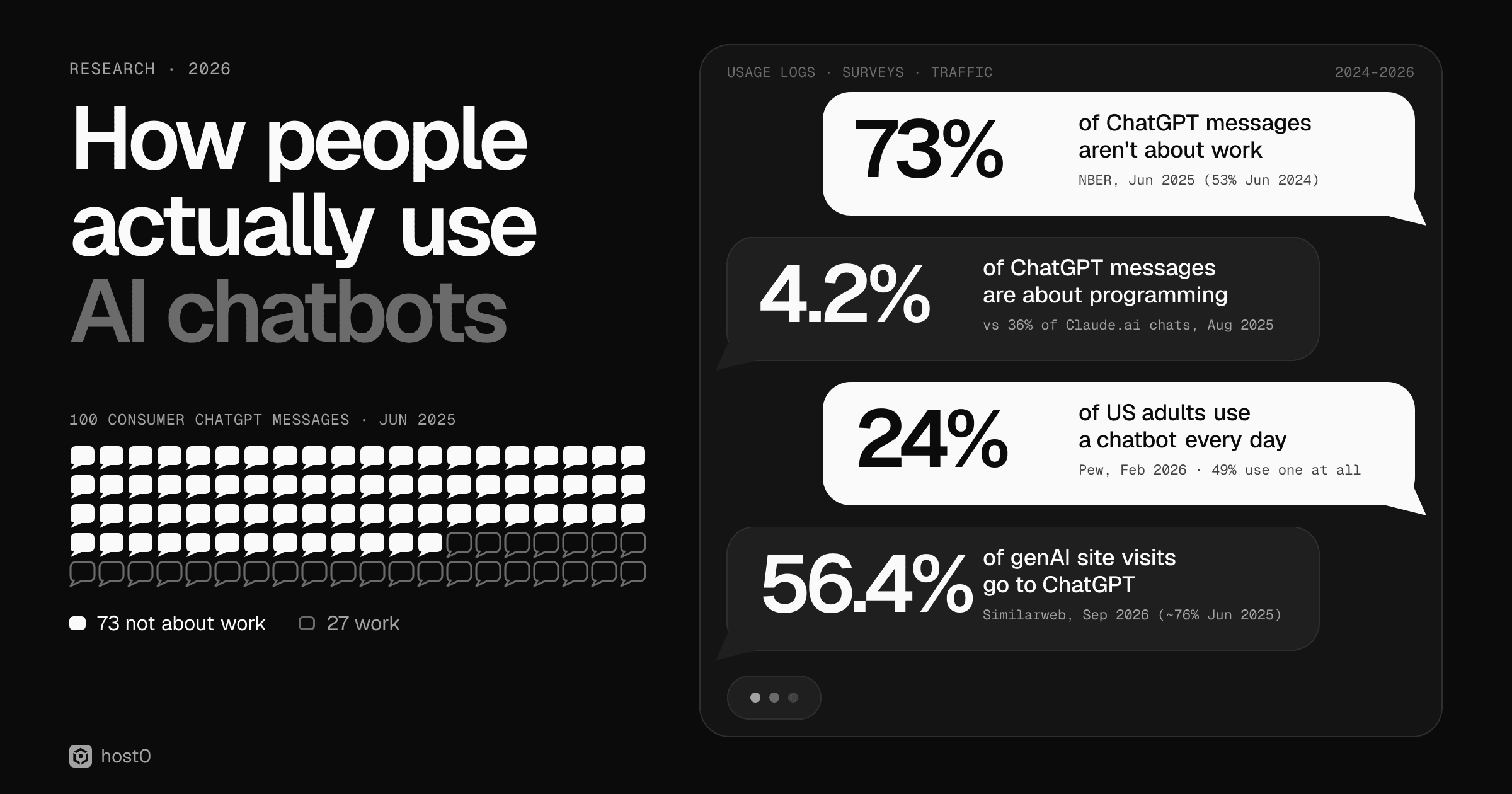
The picture most people have of AI chatbots comes from work: drafting emails, writing code, summarizing meetings. The usage data says something else. When OpenAI's economists classified a sample of about 1.1 million ChatGPT conversations, most messages had nothing to do with a job, and the share kept growing. People ask chatbots what to do, how something works, what a word means and whether a rash is serious. Coding, the use that dominates the conversation about AI, is a small slice of ChatGPT and a large slice of Claude.
We put the vendors' own usage studies (OpenAI, Anthropic, Microsoft, Perplexity) next to independent surveys (Pew, the Real-Time Population Survey, Gallup, the Reuters Institute, Menlo Ventures) and traffic data from Similarweb. Each vendor describes only its own users and sorts them with its own classifier, and each survey asks a slightly different question, so every figure says whose numbers it shows and what it counts. The methodology has the details.
Key findings
- 1Most ChatGPT use isn't work. 53% of consumer ChatGPT messages were not work-related in June 2024 and 73% in June 2025, according to OpenAI's NBER paper. Daily messages grew from 451 million to 2.6 billion over the same year.
- 2Advice, information and writing are about 77% of ChatGPT conversations. Writing fell from 36% to 24% of usage in a year and seeking information rose from 14% to 24%. Two-thirds of writing requests ask ChatGPT to change text the user supplied.
- 3Coding concentrates on Claude. Computer programming is 4.2% of ChatGPT messages. Coding is 36% of Claude.ai conversations, Anthropic reported for August 2025. The two companies count different units (messages and conversations), but a gap this wide is hard to explain by units alone.
- 4Claude is getting more personal too. Personal use rose from 35% to 42% of Claude.ai conversations between November 2025 and February 2026, while coursework fell from 19% to 12%, in Anthropic's March 2026 report.
- 5Emotional use is small in the logs. Relationships and personal reflection are 1.9% of ChatGPT messages; 2.9% of Claude.ai conversations are "affective". In surveys, 10% of US adults say they use chatbots for emotional support.
- 6Half of US adults use a chatbot, a quarter daily. Pew found 49% ever use one and 24% use one daily (February 2026). Among US adults aged 18 to 64, genAI use rose from 44.6% to 60.8% in two years, and use outside work rose in every wave of the Real-Time Population Survey.
- 7ChatGPT keeps growing while its share shrinks. OpenAI said on 31 August 2026 that ChatGPT has more than 1 billion weekly users. Its share of visits to generative AI websites fell from about 76% in June 2025 to about 53% in May 2026, Similarweb says, with Gemini at about 27% and Claude near 9%.
- 8People use several assistants. The average US AI user now uses 3.0 general assistants, up from 2.2, in Menlo Ventures' survey, and Gemini (58% of AI users) nearly matches ChatGPT (60%).
73%
Consumer ChatGPT messages not related to work, Jun 2025 (53% in Jun 2024)
Source: OpenAI / NBER w34255
4.2%
ChatGPT messages about computer programming; coding is 36% of Claude.ai conversations
different units
Source: NBER; Anthropic
56.4%
ChatGPT's share of generative AI website visits, Sep 2026 (about 76% in Jun 2025)
web visits only
Source: Similarweb via OfficeChai
Mostly not work#
The largest study of chatbot use is OpenAI's own. In "How People Use ChatGPT", a September 2025 NBER working paper, OpenAI's economic research team and Harvard's David Deming classified one message from each of about 1.1 million sampled conversations sent between May 2024 and June 2025. No human read the messages. The sample covers the consumer Free, Plus and Pro plans only: Business, Enterprise and Edu accounts, users who opted out of training, users under 18 and logged-out users aren't in it.
Over that year, messages that weren't about work grew much faster than messages that were. In June 2024 ChatGPT received about 451 million messages a day, 53% of them non-work. A year later it received 2.6 billion, and 73% were non-work. The authors write that the shift happened mostly within cohorts of users, not through an influx of new ones: people who already used ChatGPT brought more of the rest of their lives to it.
ChatGPT daily messages, work and non-work
Consumer plans, daily messages (7-day averages ending 26 June), millions
| Label | Value |
|---|---|
| Non-work, Jun 2024 | 238M (53%) |
| Work, Jun 2024 | 213M (47%) |
| Non-work, Jun 2025 | 1,911M (73%) |
| Work, Jun 2025 | 716M (27%) |
Source: Chatterji et al., How People Use ChatGPT, NBER w34255, Table 1
The work share still varies a lot by who's typing. Among users who shared employment data, 57% of messages from people in computer-related jobs were work-related, against 40% for people in non-professional jobs. Users with a graduate degree sent 48% work messages, users without a bachelor's 37%. And the sample is young: about 46% of messages from users who report an age come from 18 to 25-year-olds.
What people ask for#
OpenAI groups conversations into seven topics. Three of them, practical guidance, seeking information and writing, account for about 77% of conversations. Practical guidance (tutoring, how-to advice and the like) held at about 29% of usage between July 2024 and July 2025. Writing fell from 36% to 24%, while seeking information, which looks most like web search, rose from 14% to 24%.
What ChatGPT is used for
Share of consumer ChatGPT messages by topic, July 2025
| Label | Value |
|---|---|
| Practical guidance | ~29% (flat) |
| Seeking information | 24% (from 14%) |
| Writing | 24% (from 36%) |
| Multimedia | >7% (from 2%) |
| Technical help | ~5% (from 12%) |
Source: NBER w34255, Figure 7
Writing is about 40% of work-related messages, and most writing is editing: about two-thirds of all writing messages ask ChatGPT to change text the user provided (editing, critiquing, translating, summarizing) rather than produce something new. Tutoring and teaching are 10.2% of all messages. The paper also sorts messages by intent: by late June 2025, 51.6% were "asking" (looking for information or advice), 34.6% "doing" (producing an output) and 13.8% "expressing". In July 2024 asking and doing had been roughly even.
Surveys of the public find the same order. In Pew's February 2026 survey of 5,119 US adults, searching for information was the most common use of chatbots, ahead of work tasks.
What Americans use AI chatbots for
Share of US adults who say they ever use AI chatbots for each, February 2026
| Label | Value |
|---|---|
| Search for information | 42% |
| Tasks at work | 38% (of employed) |
| Fun or entertainment | 25% |
| Create or edit images or video | 24% |
| Medical advice | 20% |
| Diet and fitness information | 20% |
| Get news | 13% |
| Emotional support or advice | 10% |
| Companionship | 4% |
The Reuters Institute's six-country survey (Argentina, Denmark, France, Japan, the UK and the US) reached the same conclusion for mid-2025: weekly use of generative AI to get information rose from 11% to 24% of people in a year, and "information-seeking is now the lead use-case across countries", ahead of creating media.
Health is the clearest example of everyday advice. OpenAI said in January 2026 that health is a little over 5% of ChatGPT messages and that more than 40 million people a day ask it health questions, as reported by Axios. Microsoft's analysis of 37.5 million consumer Copilot conversations, "It's About Time", found that on phones "health is the dominant topic", in every hour of the day and every month it observed, while on desktop "Work and Career" overtook "Technology" as the top topic during business hours. In a follow-up on health conversations, Microsoft found one in seven questions about symptoms and conditions were asked on behalf of someone else.
Coding concentrates on Claude#
On ChatGPT, computer programming is 4.2% of messages. The paper's broader "technical help" topic, which also covers math and data analysis, fell from 12% of usage in July 2024 to about 5% a year later. The authors suggest one reason: programming with language models has grown fast elsewhere, through the API, code editors and agents such as Codex.
Anthropic's numbers show where some of it went. In its Economic Index, which classifies a sample of Claude conversations each release, coding was 36% of Claude.ai conversations in August 2025, and computer and mathematical tasks were 44% of the traffic from businesses using Anthropic's API.
How much of each chatbot's use is code
Coding share of use, as each vendor measures it
| Label | Value |
|---|---|
| ChatGPT, programming | 4.2% (messages) |
| ChatGPT, technical help | ~5% (messages) |
| Claude.ai | 36% (conversations) |
| Claude API | 44% (API traffic) |
Claude.ai's users skew toward developers, so this says as much about who uses Claude as about what chatbots are for. Even so, Anthropic's coding share has stayed high: computer and mathematical tasks peaked at 40% of Claude.ai conversations in March 2025 and were 34% in November 2025. Since then Anthropic says coding has been moving from Claude.ai to the API and Claude Code, and its June 2026 report moved to a new pipeline that reports chat and Cowork together and Claude Code separately, so its later numbers aren't comparable. For what coding agents do once they leave the chat window, see the state of AI coding agents.
Claude is getting more personal too#
Anthropic sorts Claude.ai conversations into work, coursework and personal use. Between November 2025 and February 2026, the personal share rose from 35% to 42% and coursework fell from 19% to 12%, while work stayed at about 45%. Anthropic also found that people who signed up a year earlier devote 38% of their conversations to personal use, against 44% for the newest users, so new users arrive with more personal questions.
Work, coursework and personal use on Claude.ai
Share of sampled Claude.ai conversations, 5–12 February 2026
| Label | Value |
|---|---|
| Work | 45.2% (from 46%) |
| Personal | 42.3% (from 35%) |
| Coursework | 12.4% (from 19%) |
Sources: Anthropic Economic Index, Mar 2026; dataset (computed)
The Economic Index also tracks how people work with Claude. "Automation" means the user hands over a task (directive or feedback-loop conversations); "augmentation" means the user works through it with Claude (iterating, learning, validating). Augmentation led from the first report. In August 2025, automation passed it for the first time, but Anthropic notes that part of that jump came from switching classifier models: re-run with the older one, automation was 45%, not 49%. By November it had fallen back.
Handing tasks over or working them through
Automation and augmentation, share of sampled Claude.ai conversations
| Series | x | y |
|---|---|---|
| Augmentation | Jan 2025 | 55.5% |
| Augmentation | Mar 2025 | 55.1% |
| Augmentation | Aug 2025 | 47% |
| Augmentation | Nov 2025 | 51.7% |
| Augmentation | Feb 2026 | 52.8% |
| Automation | Jan 2025 | 41.1% |
| Automation | Mar 2025 | 41.7% |
| Automation | Aug 2025 | 49.1% |
| Automation | Nov 2025 | 45.4% |
| Automation | Feb 2026 | 44.2% |
Source: Anthropic Economic Index releases (computed by host0)
Perplexity's study of its Comet browser agent points the same way from a different product: 55% of agent queries between July and October 2025 were personal, 30% professional and 16% educational.
Feelings are a small share of the logs#
A popular claim is that therapy and companionship are now the main use of chatbots. The logs don't show it. On ChatGPT, relationships and personal reflection are 1.9% of messages and games and role play 0.4%. On Claude.ai, Anthropic's study of support and companionship found 2.9% of conversations were "affective" and companionship and roleplay together under 0.5%.
Emotional and companion use, as the vendors measure it
Share of sampled messages (ChatGPT) or conversations (Claude.ai)
| Label | Value |
|---|---|
| Claude.ai, affective | 2.9% |
| ChatGPT, relationships | 1.9% (and reflection) |
| Claude.ai, companionship | <0.5% (with roleplay) |
| ChatGPT, games and role play | 0.4% |
Sources: NBER w34255; Anthropic, June 2025
Surveys measure something else: whether a person has ever done it, not what share of their chats it is. By that measure it's common. Pew found 10% of US adults use chatbots for emotional support or advice, and 20% of adults under 30. An Elon University survey run by YouGov in May 2026 found 27% of US adults who use the internet have significant emotional or social interactions with chatbots. Both can be true: many people have the occasional personal conversation, and it's a small fraction of the total.
Half of Americans, a quarter daily#
Pew has asked Americans about ChatGPT since 2023. The share who say they use it rose from 18% in 2023 to 34% in 2025. In 2026 the question also asked about other chatbots, and 44% said they use ChatGPT; the earlier waves were asked only of people who had heard of ChatGPT, so the last step isn't a like-for-like comparison. Among adults 65 and older the share nearly doubled in the last wave, though the new wording affects that step too.
Americans who say they use ChatGPT
Share of US adults who have ever used ChatGPT, by age
| Series | x | y |
|---|---|---|
| Ages 18–29 | Jul 2023 | 33% |
| Ages 18–29 | Feb 2024 | 43% |
| Ages 18–29 | Mar 2025 | 58% |
| Ages 18–29 | Feb 2026 | 61% |
| All adults | Jul 2023 | 18% |
| All adults | Feb 2024 | 23% |
| All adults | Mar 2025 | 34% |
| All adults | Feb 2026 | 44% |
| Ages 65+ | Jul 2023 | 4% |
| Ages 65+ | Feb 2024 | 6% |
| Ages 65+ | Mar 2025 | 10% |
| Ages 65+ | Feb 2026 | 19% |
Sources: Pew Research Center; Pew appendix, Jun 2026
Counting any chatbot, 49% of US adults use one, up from 33% in 2024, and the gap between men and women has closed (50% and 47%). The Real-Time Population Survey by Alexander Bick, Adam Blandin and David Deming, which asks US adults aged 18 to 64 about any generative AI every three months, shows the same rise and where it comes from. Use for any purpose went from 44.6% in August 2024 to 60.8% in August 2026. Use outside work rose in every one of the nine waves, from 36.0% to 55.1%.
Generative AI use in the US, at work and outside it
Share of US adults aged 18–64 who use generative AI (work: share of employed adults)
| Series | x | y |
|---|---|---|
| Any use | Aug 2024 | 44.6% |
| Any use | Nov 2024 | 46.3% |
| Any use | Feb 2025 | 48% |
| Any use | May 2025 | 51.9% |
| Any use | Aug 2025 | 54.5% |
| Any use | Nov 2025 | 56% |
| Any use | Feb 2026 | 57.6% |
| Any use | May 2026 | 61.8% |
| Any use | Aug 2026 | 60.8% |
| Outside work | Aug 2024 | 36% |
| Outside work | Nov 2024 | 39.3% |
| Outside work | Feb 2025 | 41.9% |
| Outside work | May 2025 | 45.9% |
| Outside work | Aug 2025 | 48.6% |
| Outside work | Nov 2025 | 49.8% |
| Outside work | Feb 2026 | 51% |
| Outside work | May 2026 | 54.8% |
| Outside work | Aug 2026 | 55.1% |
| For work | Aug 2024 | 33.3% |
| For work | Nov 2024 | 31% |
| For work | Feb 2025 | 32.7% |
| For work | May 2025 | 35.1% |
| For work | Aug 2025 | 37.4% |
| For work | Nov 2025 | 40.6% |
| For work | Feb 2026 | 42.8% |
| For work | May 2026 | 45.2% |
| For work | Aug 2026 | 40.5% |
Daily use is where the numbers stay small. Every source we have puts daily users at a quarter of its population or fewer, except teenagers.
Daily users are a minority
Share who use AI daily, by survey (each counts a different population)
| Label | Value |
|---|---|
| Pew, teens 13–17 | ~30% (chatbots) |
| Menlo, US adults | 25% (any AI) |
| Pew, US adults | 24% (chatbots) |
| Gallup, US employees | 15% (at work) |
| RPS, US ages 18–64 | 14.4% (every day) |
Sources: Pew teens; Menlo Ventures; Pew; Gallup; RPS
Reach is growing more slowly than intensity. In Menlo Ventures' surveys with Morning Consult, the share of US adults who used AI in the past six months rose only from 61% to 64% between April 2025 and July 2026, while daily use rose from 19% to 25%. Among non-users, Pew found 83% say they aren't interested, 79% cite privacy and 76% don't trust the accuracy; 67% say they're not likely to start in the next year. If privacy is the worry, what ChatGPT does with your data is the place to start.
At work, rising but unevenly#
Use at work is growing too. Gallup's quarterly panel of US employees found 52% use AI in their role at least a few times a year in May 2026, up from 21% in 2023, and 15% use it daily, up from 4%.
US employees who use AI at work
Share of US employees, by how often they use AI in their role
| Series | x | y |
|---|---|---|
| Any use | May 2023 | 21% |
| Any use | May 2024 | 27% |
| Any use | May 2025 | 40% |
| Any use | Aug 2025 | 45% |
| Any use | Nov 2025 | 46% |
| Any use | Feb 2026 | 50% |
| Any use | May 2026 | 52% |
| Weekly or more | May 2023 | 11% |
| Weekly or more | May 2024 | 12% |
| Weekly or more | May 2025 | 19% |
| Weekly or more | Aug 2025 | 23% |
| Weekly or more | Nov 2025 | 26% |
| Weekly or more | Feb 2026 | 28% |
| Weekly or more | May 2026 | 30% |
| Daily | May 2023 | 4% |
| Daily | May 2024 | 4% |
| Daily | May 2025 | 8% |
| Daily | Aug 2025 | 10% |
| Daily | Nov 2025 | 12% |
| Daily | Feb 2026 | 13% |
| Daily | May 2026 | 15% |
The RPS puts work use at 40.5% of employed adults in August 2026, ranging from 68.8% in computer and math jobs to 13.5% in building and grounds work, and estimates that 5.3% of all work hours were spent using generative AI. The two surveys disagree on the latest direction: Gallup kept rising through May 2026, and the RPS dropped in August. Gallup's next wave hadn't been published when we wrote this.
ChatGPT is bigger, its share is smaller#
OpenAI's user counts have kept climbing. ChatGPT had 100 million weekly users when Sam Altman announced it in November 2023, 800 million in October 2025 and, OpenAI said in its 31 August 2026 post on ads, more than 1 billion.
ChatGPT weekly active users
As announced by OpenAI
| x | y |
|---|---|
| 6 Nov 2023 | 100M |
| 29 Aug 2024 | 200M |
| 4 Dec 2024 | 300M |
| 20 Feb 2025 | 400M |
| 31 Mar 2025 | 500M |
| 31 Jul 2025 | 700M |
| 6 Oct 2025 | 800M |
| 27 Feb 2026 | 900M |
| 31 Aug 2026 | 1B (>1B) |
Sources: OpenAI; NBER w34255; TechCrunch
Everyone else grew faster on the web. Using the monthly visits Similarweb published for 2025, we computed each site's share of the combined visits to seven chatbot domains. Between January and December, ChatGPT's visits rose 43%, Gemini's 548% and Claude's 125%. DeepSeek's spike in February 2025 faded within months.
Visits to seven chatbot websites, 2025
Share of combined monthly visits to chatgpt.com, gemini.google.com, deepseek.com, grok.com, perplexity.ai, claude.ai and meta.ai
| Series | x | y |
|---|---|---|
| ChatGPT | Jan 2025 | 84% |
| ChatGPT | Feb 2025 | 77.4% |
| ChatGPT | Mar 2025 | 77.9% |
| ChatGPT | Apr 2025 | 79.8% |
| ChatGPT | May 2025 | 79.9% |
| ChatGPT | Jun 2025 | 78.8% |
| ChatGPT | Jul 2025 | 78.9% |
| ChatGPT | Aug 2025 | 79.1% |
| ChatGPT | Sep 2025 | 75.6% |
| ChatGPT | Oct 2025 | 73.9% |
| ChatGPT | Nov 2025 | 71.6% |
| ChatGPT | Dec 2025 | 67.1% |
| Gemini | Jan 2025 | 5.8% |
| Gemini | Feb 2025 | 5.6% |
| Gemini | Mar 2025 | 5.9% |
| Gemini | Apr 2025 | 6.4% |
| Gemini | May 2025 | 7.7% |
| Gemini | Jun 2025 | 9.5% |
| Gemini | Jul 2025 | 9.7% |
| Gemini | Aug 2025 | 9.8% |
| Gemini | Sep 2025 | 13.5% |
| Gemini | Oct 2025 | 14.2% |
| Gemini | Nov 2025 | 16.6% |
| Gemini | Dec 2025 | 21.1% |
| DeepSeek | Jan 2025 | 6.1% |
| DeepSeek | Feb 2025 | 12.2% |
| DeepSeek | Mar 2025 | 8.7% |
| DeepSeek | Apr 2025 | 7.4% |
| DeepSeek | May 2025 | 6.3% |
| DeepSeek | Jun 2025 | 5.6% |
| DeepSeek | Jul 2025 | 4.8% |
| DeepSeek | Aug 2025 | 4.3% |
| DeepSeek | Sep 2025 | 4.3% |
| DeepSeek | Oct 2025 | 4.3% |
| DeepSeek | Nov 2025 | 4.2% |
| DeepSeek | Dec 2025 | 4% |
The shift continued into 2026. Similarweb wrote in July 2026 that ChatGPT's share of generative AI website visits fell from about 76% in June 2025 to roughly 53% by May 2026, while Gemini rose from under 9% to around 27–28% and Claude "moved from barely 2% to close to 9%". Since then ChatGPT has recovered a little. Similarweb's September 2026 numbers, reported by OfficeChai, show ChatGPT at 56.4% and Gemini at 25.0%, Gemini's fourth monthly decline in a row.
Who gets the chatbot web traffic
Share of worldwide generative AI website visits, September 2026
| Label | Value |
|---|---|
| ChatGPT | 56.4% |
| Gemini | 25.0% |
| Claude | 9.6% |
| DeepSeek | 3.4% |
| Grok | 2.3% |
| Copilot | 1.5% |
| Perplexity | 0.9% |
Sources: Similarweb data reported by OfficeChai; Similarweb, Jul 2026
Surveys show the same fragmentation from the user's side. In Pew's February 2026 survey, 44% of US adults had used ChatGPT, 24% Gemini, 17% Copilot, 14% Meta AI, 8% Grok and 6% Claude. People who use AI tend to use several: in Menlo's July 2026 survey, AI users used 3.0 general assistants on average, up from 2.2.
Most AI users have more than one assistant
Share of US AI users who use each assistant, July 2026
| Label | Value |
|---|---|
| ChatGPT | 60% (from 45%) |
| Gemini | 58% (from 36%) |
| Claude | 20% (from 7%) |
What this means if you build with AI#
- Design for advice and information, not only for tasks. Practical guidance and information-seeking are over half of ChatGPT use, and "asking" outgrew "doing". If your product sits inside or beside a chatbot, the common request is "help me decide" or "explain this", so make answers easy to check and to act on.
- Expect people to bring their own text. Two-thirds of writing requests modify text the user supplied. Features that take a pasted draft, a file or a link and keep the person's voice match how people already write with chatbots.
- Build for weekly users, not daily ones. At most a quarter of adults use a chatbot daily. Most of your users will come back after days away, so make the first answer good without setup and keep context they'd otherwise have to repeat.
- Go where your users' kind of work happens. Developers are concentrated on Claude, the API and coding agents; mass-market questions go to ChatGPT and, increasingly, Gemini. A developer tool belongs in Claude Code, Cursor and MCP directories; a consumer tool needs to work where most of the 1 billion weekly users are.
- Don't bet on one assistant. People use three on average and the web share moves by tens of points in a year. Build on open interfaces (MCP, skills, plain links and files) so the same tool works in ChatGPT, Claude and Gemini.
- Treat health, money and feelings as core use, with care. Health is the top Copilot topic on phones and 20% of US adults have asked a chatbot for medical advice. Say what your product can't do, point to a person when it matters, and expect questions asked on someone else's behalf.
- Answer the privacy question up front. Privacy (79%) and accuracy (76%) are among the top reasons non-users give in Pew's survey. Say what you store, for how long, and whether it trains a model.
- Measure your own users. Every vendor number here describes that vendor's users through its own classifier. Your mix of work and personal use, and your share of coding, will differ; log categories (privately) before you plan around anyone else's.
When a chat produces something worth keeping, such as a page, a deck or a small app, host0 hosts it at a link that stays private until you share it.
Methodology#
Sources. Vendor usage studies: OpenAI and Harvard's NBER working paper w34255 (about 1.1 million sampled consumer conversations, May 2024 to June 2025, classified by a model, no human reading); Anthropic's Economic Index (six releases from February 2025 to June 2026) and its June 2025 study of support and companionship; Microsoft AI's Copilot usage report (37.5 million consumer conversations, January to September 2025) and its health report; Perplexity and Harvard's study of the Comet agent. Surveys: Pew Research Center (American Trends Panel, February 2026, n = 5,119; teens, Ipsos KnowledgePanel, September–October 2025, n = 1,458); the Real-Time Population Survey (US adults 18–64, nine waves, August 2024 to August 2026); Gallup's panel of US employees; the Reuters Institute's six-country survey (YouGov, June–July 2025); Menlo Ventures with Morning Consult (July 2026, n = 5,067); Elon University with YouGov (May 2026). Traffic: Similarweb's published visit estimates and share snapshots.
What we computed. The Claude.ai collaboration and use-case shares come from the global rows of each Economic Index release on Hugging Face: automation is directive plus feedback-loop conversations, augmentation is task iteration, learning and validation. The first release didn't sum to 100%, so we normalized it. The RPS series come from the authors' workbook rather than FRED, because FRED's "adoption rate outside of work" series matches the workbook's at-home use by people without a college degree, not overall non-work use. The 2025 web shares are each domain's share of Similarweb's monthly visits to seven chatbot domains.
Limits. Vendor studies describe their own users only: ChatGPT's paper covers consumer plans, not Business or Enterprise, and Claude.ai's users skew toward developers. OpenAI counts messages and Anthropic conversations, and each uses its own taxonomy, so cross-vendor comparisons show the size of a gap, not an exact difference. Survey questions differ (ever used, used in the past six months, used last week), as do populations (all adults, ages 18–64, employees, teens). Similarweb measures website visits, not users, and leaves out apps and API traffic; its monthly shares after June 2025 come from its posts on social media as reported by OfficeChai, FourWeekMBA and others, and outlets differ by a point or two for the same month. We re-read the quoted lines in the primary documents on 24 October 2026. The data pack, with every row, its source and tier, the scripts and the conflicts we resolved, is in our research notes for this post.
Open questions#
- What do people ask Gemini? Google publishes user counts for the Gemini app but no breakdown of topics or work and personal use.
- Has ChatGPT kept moving away from work? OpenAI's public work and topic series ends in mid-2025; its January 2026 health figures are the only newer topic share.
- Is work use falling? The RPS dropped from 45.2% to 40.5% in one wave while Gallup still rose. The next waves will show whether it was noise.
- How much happens in apps? Every public share series measures website visits. No independent source publishes app usage shares across chatbots.
- What's the work share across all plans? ChatGPT's paper excludes Business and Enterprise accounts, so the overall split of work and personal use on ChatGPT is unknown.