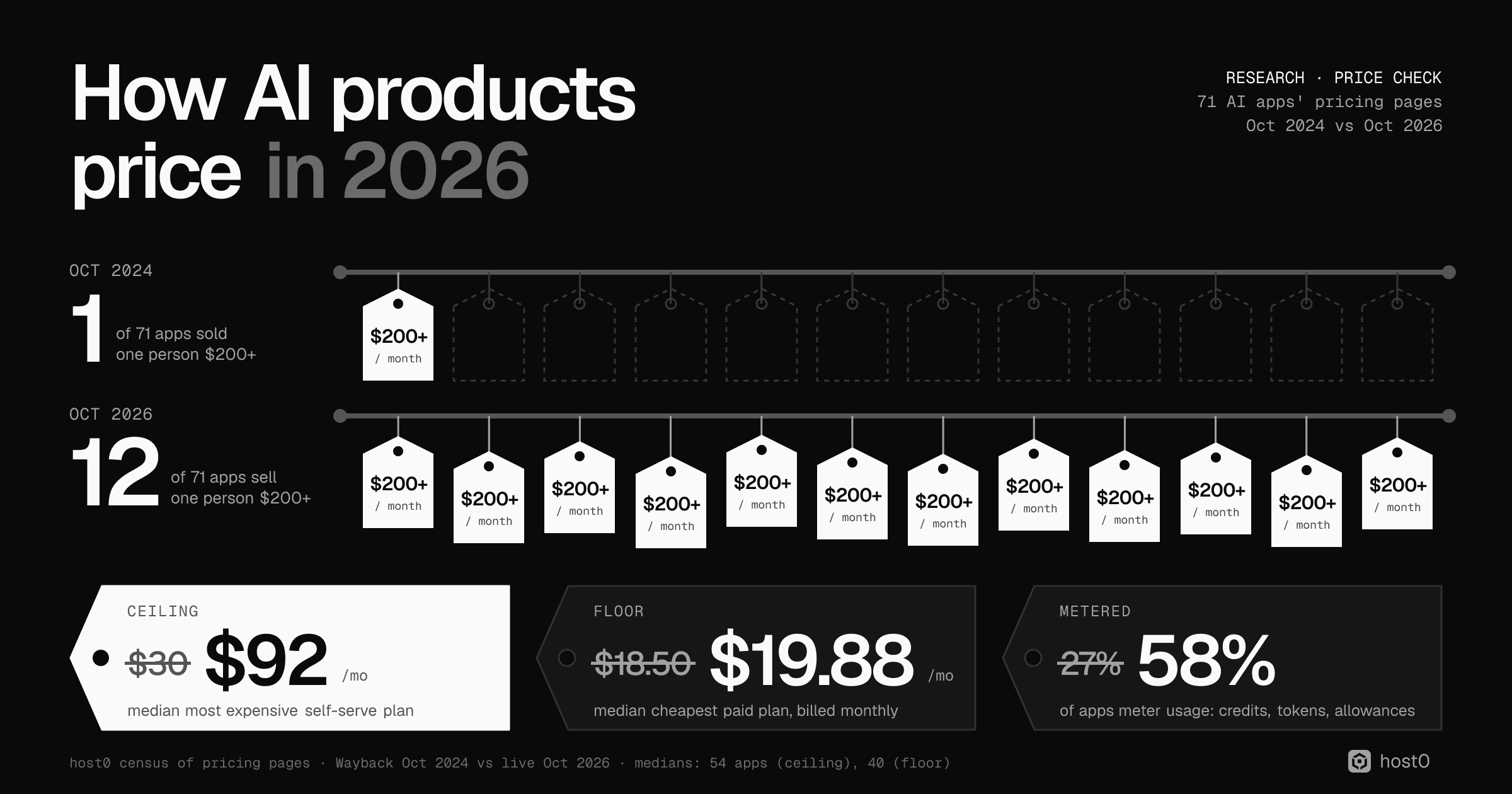
Two years ago, hardly any well-known AI app sold one person a plan above $100 a month: of the 71 we tracked, two did. ChatGPT Pro at $200 was still two months away. Today ChatGPT, Claude, Gemini, Grok, Cursor, Devin, Warp and a handful of video and research tools all sell a single person a plan at $200 or more, and ChatGPT's top plan costs $500. The cheapest paid plan, meanwhile, has barely moved: it was about $20 then and it's about $20 now. What changed in between is what the money buys. "Unlimited" turned into credits, and a $20 plan increasingly means $20 of usage at API prices.
To measure it, we read the pricing pages of 96 AI apps twice: the copy in the Wayback Machine closest to 15 October 2024, and the live page on 23 October 2026. 71 of them had a readable pricing model both times, and that panel is the denominator below unless we say otherwise. We coded each page's pricing model, its cheapest and most expensive self-serve plan, and whether it meters usage. Then we put the result next to surveys of the companies building AI products, the biggest pricing changes of the last two years and what those companies say about their margins. The methodology lists every product, including the 25 we couldn't read.
Key findings
- 1Plans at $200 or more for one person went from 1 to 12 of the 71 apps, and plans at $100 or more from 2 to 16. In October 2024 the only $200 plan in the panel was GPT Engineer's (now Lovable).
- 2The ceiling tripled, the floor held. The median most expensive self-serve plan rose from $30 to $92 a month (54 apps readable both times). The median cheapest paid plan, billed monthly, went from $18.50 to $19.88 (40 apps), and 18 of the 40 didn't change it at all.
- 3Usage became the unit. 27% of the apps metered their plans in credits, tokens, requests or a usage allowance in 2024; 58% do now. The word "credit" appears on 63% of the pages, up from 39%.
- 4Coding tools changed most. None of 15 coding tools had a hybrid plan (a subscription with metered usage on top) as its main model in 2024; 9 do now. GitHub Copilot prices every plan in AI credits worth $0.01 each, and Warp's $20 plan is "$20 of agent usage included each month at API rates".
- 5Outcome pricing is growing, mostly in customer service. Intercom charges $0.99 per outcome, and HubSpot moved its support agent from $1.00 per conversation to $0.50 per resolved conversation. In ICONIQ's survey of companies building AI products, 23% use outcome-based pricing, up from 18% six months earlier.
- 6Seats aren't going away. In the same survey, seat-based pricing rose from 23% to 28% in six months, and Salesforce now sells its agents on a flat, seat-based licence next to per-action credits.
- 7Margins help explain the shift. ICONIQ's respondents report an average 45% gross margin on AI products in 2025 and project 53% for 2026, against the 70–80% software companies are used to. In Growth Unhinged's survey the median target is about 50%.
- 8A few heavy users carry consumer AI. In Menlo Ventures' survey, the 14% of US AI payers who spend $100 or more a month account for 60% of consumer AI spending.
12
Of 71 AI apps, those with a $200+ plan for one person, Oct 2026 (1 in Oct 2024)
Source: host0 census of pricing pages
$92
Median most expensive self-serve plan per month, Oct 2026 ($30 in Oct 2024)
54 apps readable both times
Source: host0 census
58%
Share of the 71 apps that meter plans in credits, tokens or a usage allowance (27% in 2024)
Source: host0 census
$19.88
Median cheapest paid plan billed monthly, Oct 2026 ($18.50 in Oct 2024)
40 matched apps
Source: host0 census
The ceiling: $200 plans for one person#
In October 2024 the panel had two plans for one person at $100 or more: GPT Engineer's $200 "Scale" plan and Midjourney's $120 Mega plan, which costs the same today. By October 2026 there were 16 at $100 or more and 12 at $200 or more. Four apps top out between $100 and $199: two coding tools, GitHub Copilot Max and Replit Pro at $100 each, plus Midjourney and Perplexity Max. ChatGPT, Claude and Google also sell a premium plan at about $100, below their $200 ones.
The $200 plans are of two kinds. The chat labs and the coding tools sell a multiple of their $20 plan: Claude Max is "5x or 20x more usage than Pro", Google's top AI Ultra plan has "20x higher usage limits vs. AI Pro", and Warp's Max plan is "$200 of agent usage included each month (10× Build)". The video tools sell a bigger credit balance on a slider: Synthesia's Pro plan goes up to 48,000 credits for $676 a month, and HeyGen's page lists a 20,000-credit tier at $900.
The most expensive plan for one person, October 2026
Highest monthly price of an individual plan on each app's pricing page, US dollars
| Label | Value |
|---|---|
| HeyGen | $900 (credit tier) |
| Synthesia | $676 (credit tier) |
| ChatGPT | $500 |
| Pika | from $440 |
| Grok | $300 (inferred) |
| Claude | $200 |
| Cursor | $200 |
| Devin and Windsurf | $200 (one page) |
| Warp | $200 |
| SciSpace | $200 |
| Google Gemini | $199.99 |
Sources: learn.chatgpt.com; claude.com; cursor.com; devin.ai; warp.dev; synthesia.io; heygen.com; pika.art; host0 census, 23 Oct 2026
Most of these plans arrived in a 21-month run that started with ChatGPT Pro. The top of the consumer market went from $200 to $500, and Google first priced above $200 and then came back down to $199.99.
How the top consumer plans arrived
5 Dec 2024
9 Apr 2025
20 May 2025
16 Jun 2025
2 Jul 2025
9 Jul 2025
18 Mar 2026
19 May 2026
29 Sep 2026
The shift shows across the whole panel, not just the headline plans. Two years ago 40 of the 62 apps with a readable top price topped out under $50 a month. Now 24 of 59 do, and 19 have a self-serve plan at $200 or more, counting team plans this time. We wrote up what the $200 coding plans buy in API terms separately.
Most expensive self-serve plan on the pricing page, October 2026
Number of apps by monthly price band, any plan bought without talking to sales
| Label | Value |
|---|---|
| Under $50 | 24 (was 40) |
| $50–99 | 7 (was 10) |
| $100–199 | 9 (was 3) |
| $200–499 | 10 (was 5) |
| $500+ | 9 (was 4) |
Source: host0 census of pricing pages
The floor: still about $20#
The entry price is a different story. Across the 40 apps whose cheapest monthly-billed plan we could read both times, the median went from $18.50 to $19.88. Billed annually it went from $12 to $15 (29 apps). Claude Pro is $20, as it was in 2024, and Google AI Pro is still $19.99. GitHub Copilot Pro is still $10, Midjourney still starts at $10, and Kagi still sells $5, $10 and $25 plans.
Median prices, same apps in both years
US dollars per month, October 2024 vs October 2026
| Label | Value |
|---|---|
| Cheapest plan, 2024 | $18.50 |
| Cheapest plan, 2026 | $19.88 |
| Cheapest, annual billing, 2024 | $12 |
| Cheapest, annual billing, 2026 | $15 |
| Most expensive plan, 2024 | $30 |
| Most expensive plan, 2026 | $92 |
Source: host0 census of pricing pages
Nine apps lowered their cheapest plan. The biggest labs did it by adding a cheaper, limited tier under the $20 one rather than cutting the $20 plan: ChatGPT Go is $8, Google AI Plus $4.99. Thirteen raised theirs, five of them coding tools (v0, Qodo, CodeRabbit, Windsurf and Warp) whose cheapest plan now costs $20 or $30. Jasper dropped its $49 Creator plan, and Grok moved from X Premium to its own $30 plan.
Who moved the cheapest paid plan
Cheapest paid plan billed monthly, October 2024 → October 2026
Cut it
- Augment: $60 per developer → $20 flat
- Copy.ai: $49 → $29
- Gemini: $19.99 → $4.99 (Google AI Plus)
- ChatGPT: $20 → $8 (Go)
- Cursor: $20 → $8 (Plus)
- Microsoft Copilot: $20 Copilot Pro → $9.99 Microsoft 365 Personal
- Superhuman: $30 → $15
Raised it
- Jasper: $49 → $69
- CodeRabbit: $15 → $30
- Qodo: $19 → $30
- v0: $20 → $30
- Windsurf: $10 → $20 (now sold on Devin's page)
- Grok: $8 through X Premium → $30 for SuperGrok
Source: host0 census of pricing pages; PricingSaaS for the Cursor change date
Cursor's ladder is the newest. Between PricingSaaS's captures of 12 and 19 October 2026, Cursor replaced its $20 Pro plan with five plans that bundle Grok and X features, and its pricing page now says "Every tier includes a pool of AI usage shared across Cursor and Grok."
Credits replaced unlimited#
The biggest change is in what a plan is denominated in. In 2024, 39% of the panel sold a flat subscription as their main model: a price per account, not an allotment of credits or a usage allowance with a published rate beyond it. That share is now 23%. Hybrid pricing, a subscription that includes a usage allowance and bills beyond it at a published rate, went from one app to 14.
Main pricing model of the same 71 AI apps, October 2026
Share of apps, with the October 2024 share for comparison
| Label | Value |
|---|---|
| Credits or units | 27% (was 24%) |
| Flat subscription | 23% (was 39%) |
| Hybrid (subscription + usage) | 20% (was 1%) |
| Per seat | 17% (was 24%) |
| Contact sales only | 8% (was 7%) |
| Per outcome | 4% (was 3%) |
| Usage only | 1% (was 1%) |
Source: host0 census of pricing pages
Counting the mechanics rather than the main model shows the same thing. 58% of the apps now meter their plans in some unit: credits, tokens, requests, minutes or dollars of usage. That share overlaps the models above: it takes in 13 of the 14 hybrid apps and 18 of the 19 credit plans, plus five flat subscriptions, such as Claude and Gemini, whose plans come with credits. A third publish a rate for usage beyond the plan. More pages also push buyers to sales, and slightly fewer offer a free tier.
What the pricing pages show
Share of the same 71 AI apps, October 2026, with October 2024 for comparison
| Label | Value |
|---|---|
| Contact sales or demo | 85% (was 72%) |
| Free tier | 66% (was 70%) |
| Says “credit” | 63% (was 39%) |
| Metered in units | 58% (was 27%) |
| Published overage rate | 34% (was 18%) |
Source: host0 census of pricing pages
This isn't only AI-native apps. PricingSaaS, which tracks 500 software companies, counted 79 offering a credit model at the end of 2025, up from 35 a year earlier, Figma, HubSpot and Salesforce among them. In Growth Unhinged's 2026 survey, 29% of software companies use AI credits and another 33% plan to add them within a year.
In coding, $20 now means $20 of usage#
Coding tools moved fastest. Their users run agents that can burn tokens for hours. Of the 15 coding tools in the panel, six charged per seat and six a flat price in 2024. Now nine are hybrid: a plan that includes a dollar amount or a quota of model usage, and bills extra usage at or near the model makers' API prices.
Pricing model of 15 AI coding tools, October 2026
Number of tools, with October 2024 for comparison
| Label | Value |
|---|---|
| Hybrid (subscription + usage) | 9 (was 0) |
| Credits | 3 (was 2) |
| Contact sales only | 2 (was 1) |
| Per seat | 1 (was 6) |
| Flat subscription | 0 (was 6) |
Source: host0 census of pricing pages
The pattern is the same everywhere: the price of the plan becomes a prepaid balance at API rates. Cursor moved its Pro plan off 500 requests a month in June 2025; after users got surprise bills, which it refunded, it restated the plan in July as "$20 of frontier model usage per month at API pricing". GitHub said in April 2026 that its premium request model was "no longer sustainable" and moved every Copilot plan to AI credits priced at "the published API rates for each model" from 1 June. Anthropic's enterprise seat is now "Seat price + usage at API rates": $20 per seat a month plus usage, and its Max plans include $100 or $200 a month of API credits.
From requests to dollars: how coding plans changed
16 Jun 2025
16 Jun 2025
Cursor drops its 500-request Pro plan
Pro moves to usage; a $200 Ultra plan launches.Source: Cursor
18 Jun 2025
18 Jun 2025
GitHub enforces premium request allowances
Requests beyond the allowance cost extra once users raise a spending limit that defaults to $0.Source: GitHub changelog
4 Jul 2025
4 Jul 2025
Cursor apologises and refunds three weeks of charges
Pro is restated as $20 of frontier model usage at API pricing.Source: Cursor
18 Mar 2026
18 Mar 2026
Windsurf swaps credits for quotas
Pro $20, a new $200 Max plan, extra usage at API pricing.Source: Windsurf
27 Apr 2026
27 Apr 2026
GitHub moves Copilot to usage-based billing
From 1 June, every plan is an allowance of AI credits worth $0.01 each.Source: GitHub
12–19 Oct 2026
12–19 Oct 2026
Cursor bundles Grok and X
Plans from $8 to $200 share one usage pool across Cursor and Grok.Source: PricingSaaS
Hybrid plans have also spread past coding: ChatGPT now offers "ChatGPT credits" to extend a plan, Notion meters its AI in credits, and Salesforce sells Agentforce in Flex Credits.
Outcome pricing, starting with support#
Paying for results rather than usage has taken hold where the result is easy to count: a customer's question resolved without a human. Zendesk announced it in August 2024, saying customers "will only incur costs for issues that are resolved autonomously by AI", and Sierra followed in December. Intercom's page says Fin costs "$0.99 per outcome", with a minimum monthly commitment (its example is 50 outcomes) and "No seat costs". All three outcome-priced apps in our panel are support tools: Intercom, Zendesk and Gorgias.
Outcome prices have been falling. Salesforce launched Agentforce at "$2 per conversation" and in May 2025 added Flex Credits at "$0.10 per action", so a 20-action conversation still costs $2. HubSpot halved its support agent's price in April 2026 and only charges for resolved conversations. At the 65% resolution rate HubSpot claims, that's about $0.33 per conversation, down from $1.00.
What an AI support agent costs per unit
List price in US dollars per conversation, outcome or action
| Label | Value |
|---|---|
| Agentforce, per conversation | $2.00 (Sep 2024) |
| HubSpot, per conversation | $1.00 (until Apr 2026) |
| Intercom Fin, per outcome | $0.99 |
| HubSpot, per resolved conversation | $0.50 (Apr 2026) |
| Agentforce, per action | $0.10 (May 2025) |
Sources: Salesforce, 2024; Salesforce, 2025; Intercom; HubSpot
Surveys of the companies building AI products show the same direction. ICONIQ, a growth investor, asks AI builders which pricing models they use. In its December 2025 and May 2026 surveys, consumption-based pricing went from 35% to 42% and outcome-based from 18% to 23%. Its January report also prints mid-2025 results of 19% and 2%. Companies use more than one model at once, 1.7 on average, and seat-based pricing grew too.
Pricing models used by companies building AI products
Share of respondents, select all that apply, ICONIQ surveys from mid-2025 to May 2026
| Series | x | y |
|---|---|---|
| Consumption-based | Apr 2025 | 19% |
| Consumption-based | Dec 2025 | 35% |
| Consumption-based | May 2026 | 42% |
| Seat-based | Dec 2025 | 23% |
| Seat-based | May 2026 | 28% |
| Outcome-based | Apr 2025 | 2% |
| Outcome-based | Dec 2025 | 18% |
| Outcome-based | May 2026 | 23% |
Seats are bending, not breaking#
The obituaries for per-seat pricing are early. In our panel the share of per-seat apps fell from 24% to 17%, and in coding it nearly disappeared. But the seat stays as the base of most team plans, with usage added on top: Claude's enterprise plan is a $20 seat plus usage, and Devin's team plan is $80 a month plus $40 per developer seat. In ICONIQ's surveys seat-based pricing rose from 23% to 28%. Salesforce, after per-conversation pricing and per-action credits, introduced an Agentic Enterprise License Agreement that The Register describes as "a flat, seat-based arrangement", and its chief revenue officer said he was relaxed about losing money on those licences, because Salesforce would have many more years to "monetize" the customers.
Buyers explain why. In a16z's 2025 survey of 100 CIOs, the most popular choice for buying an AI app was usage-based pricing, at 39%, according to figures reproduced by L.E.K., and a16z wrote that buyers "don't want to be left holding the bag". In ICONIQ's January report, 40% of the companies changing their AI pricing ranked customer demand for more predictable pricing among their top three reasons, close behind the 46% who ranked demand for consumption- or outcome-based pricing.
Why: AI margins are lower than software margins#
Margins are a big part of why. Software companies are used to gross margins of 70–80% or more, because one more user costs almost nothing. An AI product pays for every model call. The companies in ICONIQ's 2026 survey report an average gross margin of 45% on their AI products in 2025 and expect 53% in 2026 and 59% in 2027. In Growth Unhinged's survey "the median target AI margin is about 50%", and only 12% aim for software-like margins of 80% or more.
Gross margin on AI products vs software
Average or median gross margin, per cent
| Label | Value |
|---|---|
| AI, 2025 | 45% (actual) |
| AI, 2026 (projected) | 53% |
| AI, 2027 (projected) | 59% |
| Median AI target | ~50% |
| Software (SaaS) | 70–80%+ |
A flat plan only works if the heaviest users don't cost more than they pay. Agents strain that assumption, and the cost increasingly goes to the customer. ICONIQ asked the companies that use consumption pricing who pays for inference: 58% pass part of it on to customers and 26% all of it. Only 15% absorb it.
Who pays for inference in usage-priced AI products
Companies building AI products that use consumption-based pricing, share of respondents, May 2026
| Label | Value |
|---|---|
| Passed on in part | 58% |
| Passed on in full | 26% |
| Absorbed by the vendor | 15% |
Source: ICONIQ State of AI 2026
Model prices at the top haven't collapsed either. Anthropic's most expensive model costs $10 per million input tokens and $50 per million output tokens, against $15 and $75 for Claude 3 Opus in 2024, while OpenAI's flagship went from $2.50 and $10 for GPT-4o to $10 and $50. Google's flagship is on an introductory price that its pricing page says doubles on 1 December 2026. The longer history is in the price of AI tokens, and where the spending goes is in AI token spending in 2026.
What consumers pay#
Most consumers who pay still pay about $20. In Menlo Ventures' July 2026 survey of 5,067 US adults, 55% of AI users pay for at least one AI product, and "the typical payer spends $20 to $49 a month". The money comes from a minority: "The 14% who spend $100 or more a month account for 60% of consumer AI spending." That's the business case for the $200 plan. A small group of people who use AI all day pay ten times the entry price, and the $20 tier, or an $8 one with limits or ads, brings everyone else in.
What this means if you build with AI#
- Anchor the entry plan near $20. That's where ChatGPT Plus, Claude Pro and Google AI Pro sit, and where the median app in our panel has stayed for two years. A cheaper tier works if it's clearly limited, like ChatGPT Go at $8 or Google AI Plus at $4.99.
- Add a ceiling for the heaviest users. If a few customers use ten times the median, sell them a $100 or $200 plan with a stated multiple of the base plan ("5x", "20x"). Menlo's 14% / 60% split says that's where much of the revenue is.
- Denominate usage in dollars if you can. "$20 of usage at API rates" (Warp, Cursor, GitHub's $0.01 credits) can be checked against the API price list; a balance of proprietary credits can't, and customers notice when a credit buys less after a model change.
- Publish the overage rate and default to a spend cap. A third of the apps in our panel publish what usage beyond the plan costs. When GitHub started billing extra premium requests, the default spend limit was $0; Cursor refunded three weeks of charges after users were surprised. Weekly allowances, like Cursor's, stop one heavy day from using up a month.
- Charge per outcome only for an outcome both sides can count. A resolved support ticket works because both sides can count it. Set a minimum monthly commitment, as Intercom does, and write down what counts before the first invoice.
- Keep a seat for teams. Buyers want predictable bills, and seat-based pricing grew in ICONIQ's surveys. A seat plus pooled usage, like Claude's enterprise plan or Devin's team plan, gives finance a base number and gives you a way to bill heavy use.
- Price from your margin. If inference is half your cost, a flat unlimited plan loses money on your best users. Work out what a heavy user costs at API prices before setting the top plan, and expect to change it: 37% of the companies in ICONIQ's December 2025 survey planned to change their AI pricing model within a year.
- If you're buying, read the unit. Check what one credit buys and whether it's priced at the vendor's API rates, whether the usage pool is shared with other products (Cursor's is shared with Grok), what counts as an outcome, and whether there's a spend cap. With the median annual discount at 20%, commit to a year only when your usage is steady. We compared subscriptions with API pricing for coding agents.
Once the agent has built the thing, host0 hosts it, from a static page to a team app with a shared database, at a link that's private until you share it.
Methodology#
The panel rule. Before fetching anything we fixed a list of 100 products in 10 groups: chat assistants (11), coding (16), writing and marketing (11), image (11), video (11), audio (6), meetings and productivity (12), customer service and agents (10), search and research (8), and four API platforms (OpenAI, Anthropic, Google, Mistral) read for list prices only. Each group is its category's leaders plus their best-known peers, with a16z's top 100 generative AI consumer apps and the Menlo and Ramp business spending lists as the reference for "well known". It's a curated list, not a random sample, and no product was swapped out afterwards. The 71-app panel is every app whose pricing model we could read at both dates.
The 25 apps we couldn't read. Bolt (2024 page), Canva (served an "unsupported client" page), Character.AI and Poe (behind logins), Consensus, Ideogram, Krea, InVideo, Recraft, Photoroom, VEED, Freepik, Luma, Leonardo, Adobe Firefly, Suno, Udio, Murf, Monica and tl;dv (rendered in the browser or no usable 2024 capture), Elicit, Captions and Genspark (no 2024 capture), and Tome and Phind, whose pricing pages returned 404 on 23 October 2026. They're all in the data with the reason.
Fetching. The 2026 snapshot is the live page fetched on 23 October 2026. Our server is in the UK, so where a page showed pounds or only rendered in a browser we used headless Chrome or the latest Wayback Machine capture from 2 to 23 October 2026, which shows US prices. ChatGPT's row comes from OpenAI's own pricing documentation, because chatgpt.com blocks automated requests. The 2024 snapshot is the Wayback capture nearest 15 October 2024 between July 2024 and January 2025 (median capture date 9 October 2024).
Coding. Each app gets one main model per snapshot, read from its self-serve plans, in this order: per outcome, usage only, hybrid (a subscription with a usage allowance and a published rate beyond it), credits (tiers sold as an allotment of credits, tokens, minutes or messages), per seat, flat, contact sales only. A plan "for one person" excludes team, business and per-seat plans. Judgement calls are written into the data: Cursor's 2024 plan of 500 fast requests is coded flat; Perplexity Max counts at the $167 a month its page shows by default; Grok's $30 and $300 come from subscription IDs in the page code; Google's 2024 $19.99 is its announced price, because the archived page loaded it in the browser. Prices shown only in pounds or euros (Lovable, Photoroom, remove.bg, Freepik, VEED, tl;dv) were left blank, not converted, so Lovable's 2024 $200 plan has no 2026 counterpart in the count.
Robustness. Eleven apps changed what they sell between the snapshots (You.com, Writesonic, Resemble AI, Hedra, Relevance AI, Sourcegraph, Tabnine, Surfer, Windsurf, Superhuman and Microsoft's Copilot Pro). Dropping them and the Windsurf/Devin duplicate leaves 60 apps and the same picture: $200+ plans 1 → 11, metered plans 28% → 57%, the median top price $30 → $79 and the median cheapest plan $18.50 → $19.38.
Context. Survey numbers are from ICONIQ, Growth Unhinged, a16z, Menlo Ventures and PricingSaaS. Several are investors or sell billing software, and their panels aren't random samples of software companies. Vendor numbers, such as HubSpot's resolution rate and the margin projections, are the vendors' own claims. We re-read the quoted lines on the primary pages on 23 October 2026. The data pack, with every row, its source, the scripts and the conflicts we resolved, is in our research notes for this post.
Open questions#
- How many people buy the $200 plans? No vendor publishes it. Menlo's 14% of payers spending $100 or more is the closest number.
- Will outcome pricing move beyond support? All three outcome-priced apps in our panel are support tools, where a resolution is easy to count.
- Do credits survive model changes? When a new model costs more per token, a fixed credit buys less. We don't yet know whether customers accept that or vendors absorb it.
- Are AI margins really rising? ICONIQ's 53% for 2026 and 59% for 2027 are projections, and no AI app has reported an actual figure in a filing that we could find.
- What does a pricing page leave out? We read list prices for one self-serve US buyer. Discounts, enterprise contracts and regional prices aren't in the data.