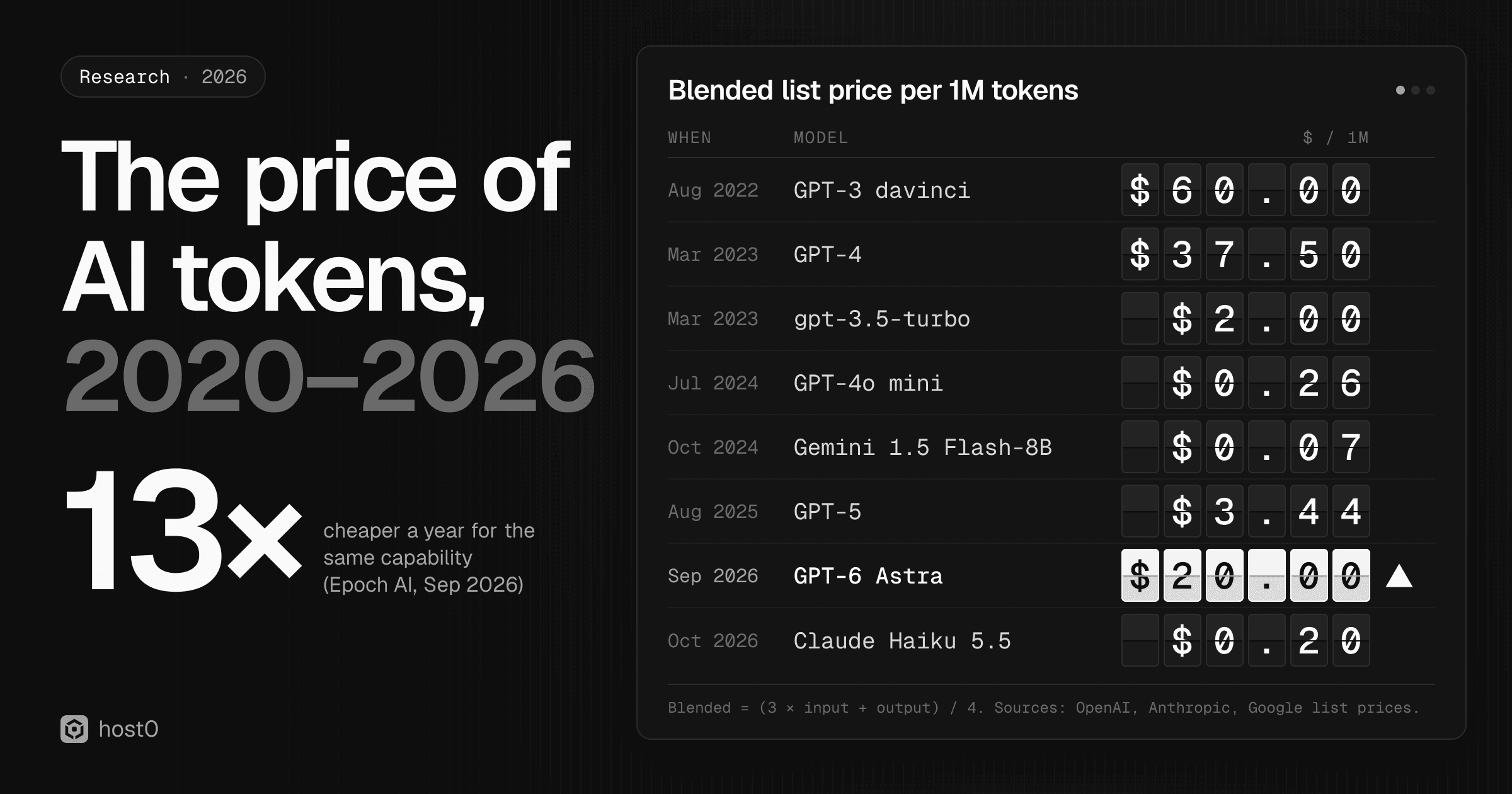
In 2020, OpenAI's GPT-3 API cost $40 to $80 per million tokens, depending on the plan, and you paid the same for the words you sent as for the words you got back. In October 2026, Claude Haiku 5.5 lists at $0.10 per million input tokens, and OpenAI's GPT-6 Luna at the same. Read that way, the story is simple: AI got hundreds of times cheaper.
It isn't that simple. The price of a fixed level of capability has collapsed, by about 13× a year on Epoch AI's latest estimate. But the list price of each lab's best model fell for two years and then climbed back, the cheapest models stopped getting cheaper in 2025, output tokens got dearer relative to input, and the cost of a whole task went up as models started to think before they answer. We pulled every public price change we could find from OpenAI, Anthropic, Google and DeepSeek, plus the studies that track price per capability, GPU rental rates, what businesses actually pay, and consumer plans, as of 14 October 2026. Vendor figures are the vendor's own claims. Every number links to its source.
Key findings
- 1The same capability got hundreds of times cheaper. GPT-3.5-level performance cost $20 per million tokens in November 2022 and $0.07 in October 2024, a drop of more than 280×. Epoch AI puts the average decline at about 47% a quarter, or 13× a year, fastest right after a capability first appears.
- 2The frontier price made a U-turn. OpenAI's flagship fell from $37.50 per million tokens (GPT-4, March 2023) to $3.44 (GPT-5, August 2025), 11× cheaper. Then each release cost more, up to GPT-6 Astra at $10 input and $50 output, $20 blended, in September 2026.
- 3Small models got more expensive. Google's newest small model went from $0.066 (Gemini 1.5 Flash-8B, 2024) to $0.85 (3.5 Flash-Lite, 2026), about 13× more. Every Claude Haiku after March 2024 cost more than Haiku 3 until Haiku 5.5 arrived on 7 October 2026 at $0.10 and $0.50. We counted about 20 list-price increases since November 2024.
- 4Output tokens got relatively dearer. GPT-3 charged the same for input and output. The ratio reached 8:1 with GPT-5 and Gemini 2.5 in 2025, and every lab's newest models now sit at 5:1. That matters because reasoning tokens are billed as output, even when you never see them.
- 5Hardware and software both cut the cost. H100 rental fell from about $8 an hour to under $2 between 2023 and late 2024, and Google says it cut Gemini serving unit costs by 78% in 2025. In 2026 GPU-hours got about 40% dearer while token prices kept falling, so the gains now come from serving more tokens per GPU.
- 6China started the price war, then reversed it. ByteDance launched Doubao in May 2024 at 99.3% below the domestic average, and DeepSeek-R1 sold reasoning for 27× less than OpenAI's o1. In 2026 Zhipu raised prices twice, and DeepSeek's peak-hour pricing quadrupled its flagship's output price.
- 7Tokens got cheaper, but the bill per task didn't always fall. A high ARC-AGI-1 score cost about $4,560 a task in December 2024 and $0.12 in August 2026. Yet at the frontier, cost per task rose. And the $20 consumer plan hasn't moved since February 2023, while the top plan went to $500 a month.
280×
Cheaper for GPT-3.5-level capability, Nov 2022 to Oct 2024 ($20 to $0.07 per 1M tokens)
Source: AI Index 2025
13× a year
How fast a fixed level of performance gets cheaper, five benchmarks since 2023
Sep 2026
Source: Epoch AI
$3.44 → $20
OpenAI's flagship, blended per 1M tokens: GPT-5 (Aug 2025) to GPT-6 Astra (Sep 2026)
Source: OpenAI
2020 to 2022: one price for every token#
OpenAI opened the GPT-3 API in 2020 on monthly plans: the cheapest paid tier was $100 a month for 2 million tokens, or $50 per million, with extra tokens at 8 cents per thousand. By 2022 it billed by use, and its biggest model, davinci, cost $0.06 per thousand tokens, or $60 per million. Prompt and completion tokens cost the same.
The first big cut came on 1 September 2022: davinci fell to $0.02 per thousand tokens, two-thirds off, and the smaller curie, babbage and ada models fell by similar amounts. OpenAI credited efficiency gains in running its models. That would be the pattern for the next four years: the same model, served more cheaply, with the saving passed on.
2023: chat gets cheap, quality gets a premium#
Two launches in March 2023 split the market in two. On 1 March, gpt-3.5-turbo, the model behind ChatGPT, arrived at $0.002 per thousand tokens, "10x cheaper than our existing GPT-3.5 models"; OpenAI said it had cut ChatGPT's own cost by 90% since December. Two weeks later GPT-4 launched at $0.03 per thousand prompt tokens and $0.06 per thousand completion tokens, or $60 and $120 for the 32K-context version. For the first time, output cost more than input, and a much better model cost 15 to 30 times more per token than a good one.
Anthropic priced the same way. Claude 2 cost $11.02 per million input tokens and $32.68 per million output, the same as Claude 1.3, and Claude Instant cost $1.63 and $5.51. On 21 November 2023, with Claude 2.1, Anthropic cut both: to $8 and $24, and $0.80 and $2.40. OpenAI's GPT-4 Turbo had arrived two weeks earlier at $10 and $30, a third of GPT-4's input price.
Same capability, a fraction of the price#
The cleanest way to see the fall is to hold capability fixed. Stanford's AI Index 2025 did that for a model as good as GPT-3.5 on the MMLU benchmark (a score of 64.8): the cheapest such model cost $20 per million tokens in November 2022 and $0.07 in October 2024, when Google's Gemini 1.5 Flash-8B launched at $0.0375 in and $0.15 out. That's more than 280 times cheaper in under two years. The same report found the cheapest model scoring above 50% on the harder GPQA science test fell from $15 to $0.12 per million tokens between May and December 2024.
The cheapest GPT-3.5-level model
Blended price per 1M tokens (3 input : 1 output), US dollars, log scale, Nov 2022 to Oct 2024
| x | y |
|---|---|
| Nov 2022 | $20 |
| Mar 2023 | $2 |
| Jan 2024 | $0.75 |
| Jul 2024 | $0.263 ($0.26) |
| Oct 2024 | $0.066 ($0.07) |
Sources: AI Index 2025; OpenAI; Google; host0 blended-price arithmetic
How fast is the fall? The estimates differ by method, but every one of them is steep. In February 2025 Sam Altman wrote that "the cost to use a given level of AI falls about 10x every 12 months" and that the price per token dropped about 150× between GPT-4 in early 2023 and mid-2024. By our arithmetic that only holds for GPT-4o mini ($0.26 blended, 143× below GPT-4); GPT-4o itself was 5× cheaper. a16z had put the decline at 10× a year in 2024.
The most detailed estimate is Epoch AI's "The plunging price of thought", published on 22 September 2026. Across five benchmarks since 2023, the cost of reaching a fixed score fell about 47% a quarter, or 13× a year. The drop is fastest, 66% a quarter, just after a capability first appears at the frontier, and halves to 32% a quarter two years later. The Decoder's summary gives an example: a 75% score on GPQA Diamond cost about 30 cents a question with o3 in January 2025 and 0.04 cents with GPT-5.6 Luna about 18 months later.
How fast does a fixed capability get cheaper?
Estimated price decline per year for the same level of performance, by source
| Label | Value |
|---|---|
| Epoch AI, just after debut | 75× (66% a quarter) |
| Epoch AI, average | 13× (47% a quarter, 2023–2026) |
| Sam Altman | 10× (Feb 2025) |
| a16z | 10× (Nov 2024) |
| MIT FutureTech | 5–10× (~3× of it algorithmic) |
| Epoch AI, two years on | 4.7× (32% a quarter) |
| Zhu, quality-adjusted | ~2× (all posted prices; preprint) |
Sources: Epoch AI; Altman; a16z; Gundlach et al.; Zhu
The slower estimates are worth reading too. MIT FutureTech's Price of Progress paper puts the decline at 5× to 10× a year, of which only about 3× a year is better algorithms; the rest is cheaper hardware and competition. A single-author preprint by Zhu, not yet peer reviewed, builds a quality-adjusted index from 21,024 posted prices for 3,208 models and finds the average price falling by about half each year, not 13×. The difference is what you measure: the cheapest model that clears a bar, or what the whole market charges.
The frontier price made a U-turn#
List prices for each lab's best model tell a different story. OpenAI's flagship got cheaper with almost every release for two and a half years: GPT-4 at $37.50 blended, GPT-4 Turbo at $15, GPT-4o at $7.50 and then $4.38, GPT-4.1 at $3.50, and GPT-5 at $1.25 in and $10 out, $3.44 blended, in August 2025. That's 11× cheaper in 29 months.
Then the line turned. GPT-5.2 in December 2025 was "priced higher per token than GPT-5.1", at $1.75 and $14. GPT-5.4 followed at $2.50 and $15, GPT-5.5 at $5 and $30, and on 3 September 2026 GPT-6 Astra arrived at $10 and $50. At $20 blended, OpenAI's top model now costs 5.8 times what GPT-5 did, and more than half of what GPT-4 cost in 2023.
Anthropic took the same path from a different start. Claude 3 Opus launched in March 2024 at $15 and $75, and Opus stayed there for 20 months until Opus 4.5 cut it to $5 and $25 in November 2025. In June 2026 a new top tier, Claude Fable 5, arrived at $10 and $50, double Opus. Opus itself kept falling, to $4 and $20 with Opus 5.5 in September 2026. Google's top model rose more gently, from $1.25 and $5 for Gemini 1.5 Pro after its October 2024 cut to $2 and $12 for Gemini 3 Pro, and Gemini 4 Argon's introductory $2 and $10 is already scheduled to double on 1 December.
Price of each lab's top model
Blended list price per 1M tokens (3 input : 1 output), US dollars, log scale, 2022 to Sep 2026
| Series | x | y |
|---|---|---|
| OpenAI | Jun 2022 | $60 ($60 · davinci) |
| OpenAI | Sep 2022 | $20 |
| OpenAI | Mar 2023 | $37.5 ($37.50 · GPT-4) |
| OpenAI | Nov 2023 | $15 |
| OpenAI | May 2024 | $7.5 |
| OpenAI | Aug 2024 | $4.38 |
| OpenAI | Apr 2025 | $3.5 |
| OpenAI | Aug 2025 | $3.44 ($3.44 · GPT-5) |
| OpenAI | Dec 2025 | $4.81 |
| OpenAI | Mar 2026 | $5.63 |
| OpenAI | Apr 2026 | $11.25 |
| OpenAI | Sep 2026 | $20 |
| Anthropic | Jul 2023 | $16.44 |
| Anthropic | Nov 2023 | $12 |
| Anthropic | Mar 2024 | $30 |
| Anthropic | Nov 2025 | $10 |
| Anthropic | Jun 2026 | $20 |
| Anthropic | Sep 2026 | $20 |
| Oct 2024 | $2.19 | |
| Apr 2025 | $3.44 | |
| Nov 2025 | $4.5 | |
| Sep 2026 | $4 |
Sources: OpenAI; Anthropic; Google; host0 blended-price arithmetic
What changed is how labs sell. Every big lab now runs a premium tier around $10 and $50 above a workhorse tier that keeps getting cheaper: GPT-6.1 Sol at $2 and $10, Claude Sonnet 5.5 at the same, Gemini 4 Argon at an introductory $2 and $10. And the most expensive models were never on the main line at all: o1-pro in March 2025 cost $150 per million input tokens and $600 per million output, and GPT-4.5 $75 and $150 until OpenAI withdrew it from the API that July.
Cheap models stopped getting cheaper#
The surprise of 2025 and 2026 is at the bottom of the price list. For two years each lab's newest small model was cheaper than the last. Then the line turned up, at Google most of all.
Google's Gemini 1.5 Flash-8B launched in October 2024 at $0.066 blended. Its successors cost more each time: 2.5 Flash-Lite at $0.10 and $0.40, 3.1 Flash-Lite at $0.25 and $1.50, and 3.5 Flash-Lite in July 2026 at $0.30 and $2.50, about 13 times Flash-8B. The mid-size Flash line moved the same way: Gemini 2.5 Flash's general release in June 2025 doubled the preview's input price, and Gemini 3.5 Flash cost three times Gemini 3 Flash.
OpenAI's floor has been GPT-5 nano, at $0.05 and $0.40, since August 2025. Its successor, GPT-5.4 nano, launched at $0.20 and $1.25: up to 4× pricier, along with GPT-5.4 mini at 3× GPT-5 mini's input price. GPT-6 Luna brought it back down to $0.10 and $0.50 in September 2026.
Anthropic's small model went up for two and a half years. Claude 3 Haiku launched in March 2024 at $0.25 and $1.25. Claude 3.5 Haiku arrived in November 2024 at four times that, which coverage at the time called a price hike, before Anthropic revised it to $0.80 and $4. Haiku 4.5 cost $1 and $5. On 7 October 2026, Claude Haiku 5.5 came in at $0.10 and $0.50 for prompts up to 100,000 tokens: the first Haiku cheaper than Haiku 3, and 10× below Haiku 4.5 per token. Anthropic itself says it costs "around 75% less to run" on average, a reminder that a per-token price and a per-task cost are different numbers.
Price of each lab's newest small model
Blended list price per 1M tokens (3 input : 1 output), US dollars, log scale, Mar 2023 to Oct 2026
| Series | x | y |
|---|---|---|
| OpenAI | Mar 2023 | $2 |
| OpenAI | Jun 2023 | $1.625 |
| OpenAI | Nov 2023 | $1.25 |
| OpenAI | Jan 2024 | $0.75 |
| OpenAI | Jul 2024 | $0.263 |
| OpenAI | Apr 2025 | $0.175 |
| OpenAI | Aug 2025 | $0.138 |
| OpenAI | Mar 2026 | $0.463 |
| OpenAI | Sep 2026 | $0.2 |
| Anthropic | Jul 2023 | $2.6 |
| Anthropic | Nov 2023 | $1.2 |
| Anthropic | Mar 2024 | $0.5 |
| Anthropic | Nov 2024 | $2 |
| Anthropic | Dec 2024 | $1.6 |
| Anthropic | Oct 2025 | $2 |
| Anthropic | Oct 2026 | $0.2 |
| Oct 2024 | $0.066 | |
| Jun 2025 | $0.175 | |
| Mar 2026 | $0.563 | |
| Jul 2026 | $0.85 |
Sources: OpenAI; Anthropic; Google; host0 blended-price arithmetic
Some increases aren't on the price list at all. Since Claude Opus 4.7 in April 2026, Anthropic's models use a tokenizer that produces about 30% more tokens for the same text. Sonnet 5's per-token price was a third below Sonnet 4.6's, but on the same text the saving is closer to 13% by our arithmetic. And Google's price page now carries rises with dates on them: Gemini 4 Argon to $4 and $20 on 1 December 2026, and the 3.6 to 3.8 Flash models from $0.75 and $3.75 to $1.50 and $7.50 on 1 January 2027.
When prices went up
Selected list-price increases, per 1M tokens (input / output), Nov 2024 to Oct 2026
Sources: Anthropic; Google; The Decoder; OpenAI; Vertex AI pricing
Output tokens got dearer#
In 2020 a token cost the same whichever way it went. GPT-4 made output cost twice as much as input in 2023. By 2024 the gap was three to five times, and Anthropic fixed its ratio at 5:1 with Claude 3, explaining that its pricing was designed for business workloads "which often involve longer prompts". The reasoning models of 2025 stretched it furthest: GPT-5 at $1.25 in and $10 out, and Gemini 2.5 Pro at $1.25 and $10, are both 8:1. By September 2026 the newest models from all three labs had settled at 5:1.
The output-to-input price ratio
Output price ÷ input price for each lab's main models, list prices
Sources: Vendor price lists (OpenAI, Anthropic, Google); host0 arithmetic
Why it matters: since OpenAI's o1 in September 2024, the tokens a model spends thinking are billed as output, and by default you don't see them. Anthropic's documentation says the same of Claude: reasoning tokens are "billed as output tokens, even when the thinking text isn't returned to you", and thinking is on by default on its 2026 models. Epoch AI found that reasoning models' answers were getting about 5× longer every year, against 2.2× for other models. The expensive side of the meter is the one that's growing.
Why tokens got cheaper#
Three forces cut the cost of serving a token: cheaper GPU time, better software and hardware, and competition. They didn't all move at once.
GPU rental. In 2023, H100s cost about $8 an hour "if you could get them"; by October 2024 there were seven resale markets selling them under $2. AWS cut its H100 instance prices by 44% from 1 June 2025, and A100s by 33%. Then agent demand turned the market: SemiAnalysis's index of one-year H100 contracts rose from $1.70 an hour in October 2025 to $2.35 in March 2026, and it reported on-demand capacity "effectively sold out". Token prices kept falling through 2026 anyway, so GPU time wasn't what made them cheaper.
Serving efficiency. The biggest price cuts were on models that didn't change. OpenAI cut o3 by 80% in June 2025, from $10 and $40 to $2 and $8, after it "optimized its inference stack serving o3"; Simon Willison noted it was the very same model. Google said in February 2026 that it had cut "Gemini serving unit costs by 78% over 2025" through model optimizations, efficiency and utilization improvements. New chips add to it: Nvidia claims its GB300 systems produce tokens at up to 35× lower cost than Hopper, a vendor figure for one model and one latency setting.
What it costs to serve. DeepSeek published the clearest look inside. On one day in February 2025, it served 608 billion input tokens and 168 billion output tokens on 226.75 nodes of eight H800 GPUs, at a cost of $87,072 assuming $2 per GPU-hour. That works out to about $0.11 per million tokens. Had every token been billed at R1's prices, DeepSeek said, revenue would have been $562,027, a "cost profit margin of 545%"; it added that actual revenue was "substantially lower".
Discounts. Much of the real price cut never appeared on the headline price list. 2024 was the year every lab added two levers: batch processing at half price, and prompt caching, which bills a repeated prompt prefix at a fraction of the input price. From late 2025 labs added the opposite too, paid speed.
Discounts, then premiums
15 Apr 2024
14 Aug 2024
1 Oct 2024
8 Oct 2024
26 Feb 2025
17 Apr 2025
7 Feb 2026
22 Sep 2026
7 Oct 2026
Caching is now the largest lever on an agent's bill, because agents resend the same long context on every step. Our token spending post prices one agent session lever by lever: caching, batch and a smaller model take it from $2.20 to $0.16.
China's price war, and its reversal#
The steepest price cuts of 2024 came from China. On 15 May 2024 ByteDance launched its Doubao models at ¥0.0008 per thousand tokens, which it said was 99.3% below the industry average in China and, by Caixin's comparison, 99.8% below GPT-4. Six days later Alibaba cut its Qwen-Long model from ¥20 to ¥0.5 per million tokens, and Baidu made two ERNIE models free within hours. DeepSeek-V2, released the same month, cost $0.14 in and $0.28 out, about 214 times less than GPT-4 blended.
The war went global in January 2025. DeepSeek-R1, a reasoning model, launched at $0.55 per million input tokens and $2.19 output, 27 times cheaper blended than OpenAI's o1. On 27 January Nvidia lost about $589 billion in market value in a day. In September 2025 DeepSeek cut prices by more than half again with V3.2-Exp.
2026 went the other way. Zhipu raised its prices in February and again in April. DeepSeek launched V4-Pro in April at $1.74 and $3.48, made a 75% cut permanent in May, then on 16 August moved to peak and off-peak billing: V4-Pro output went from $0.87 to $3.96 per million tokens at peak hours and $1.98 off-peak. A Morgan Stanley note reported by the Global Times put the average output price of eight Chinese labs at ¥21.9 per million tokens in the second quarter of 2026, up from ¥12.2 in the first quarter of 2025.
DeepSeek's flagship API price
Blended list price per 1M tokens (3 input : 1 output, cache miss), US dollars, May 2024 to Aug 2026
| x | y |
|---|---|
| May 2024 | $0.18 ($0.18 · V2) |
| Jan 2025 | $0.96 ($0.96 · R1) |
| Sep 2025 | $0.32 ($0.32 · V3.2-Exp) |
| Apr 2026 | $2.18 ($2.18 · V4-Pro) |
| May 2026 | $0.54 ($0.54 · cut) |
| Aug 2026 | $1.98 (peak hours) |
Sources: DeepSeek; DeepSeek; Reuters via Yahoo; Quartz; host0 blended-price arithmetic
What buyers actually paid#
List prices are one thing; what companies pay is another, because they shift to cheaper models and cache more. Ramp, which sees the spending of more than 30,000 businesses, said in 2025 that they were paying $10 per million tokens a year earlier and $2.50 in March 2025, a 75% drop. Its newer AI Index measured $1.15 in March 2026 and $0.68 in early September.
A market index tells the 2026 story day by day. Silicon Data's LLM token index, launched in December 2025, peaked at $2.04 per million tokens on 31 May, and then fell to 97 cents on 31 August, its lowest since launch. Analysts quoted by CNBC pointed to cheap Chinese open models, OpenAI's July price cuts and "dynamic pricing".
What businesses paid per million tokens
Effective price per 1M tokens, US dollars, log scale, 2024 to Sep 2026
| Series | x | y |
|---|---|---|
| Ramp | Mar 2024 | $10 |
| Ramp | Mar 2025 | $2.5 |
| Ramp | Mar 2026 | $1.15 |
| Ramp | Sep 2026 | $0.68 |
| Silicon Data index | 31 May 2026 | $2.04 |
| Silicon Data index | 25 Jul 2026 | $1.45 |
| Silicon Data index | 31 Aug 2026 | $0.97 |
Sources: Ramp; Ramp AI Index; SCMP; CNBC
Cheaper tokens, pricier tasks#
A price per token is only half of a bill; the other half is how many tokens a task takes. At a fixed score, cost per task collapsed. In December 2024, OpenAI's o3 scored 87.5% on the ARC-AGI-1 puzzle benchmark in a high-compute run using about 172 times the compute of its $26-a-task run, roughly $4,560 a task by our arithmetic (ARC later re-estimated it at up to $30,000). In August 2026, Gemini 3.7 Flash scored 95.5% at $0.12 a task.
Cost of a high ARC-AGI-1 score
US dollars per task, log scale, best-value result above 80%, Dec 2024 to Aug 2026
| x | y |
|---|---|
| Dec 2024 | $4,560 (~$4,560 · o3) |
| Dec 2025 | $0.17 ($0.17 · Gemini 3 Flash) |
| Aug 2026 | $0.12 ($0.12 · Gemini 3.7 Flash) |
At the frontier, it went the other way. Each new top model thinks longer by default, and the thinking is billed at the output price. On Artificial Analysis's index, the most expensive model to run went from $1.78 a task in June 2026 to $7.63 in September. Agents multiply it again: Anthropic measured an agent using about 4× the tokens of a chat, and a multi-agent system about 15×. So a team can see per-token prices fall and its bill rise in the same quarter, which is what our token spending post found.
The $20 that never moved#
While API prices moved in both directions, the consumer price barely moved at all. ChatGPT Plus launched at $20 a month in February 2023, Claude Pro at $20 that September, and Google's AI Premium at $19.99 in February 2024. All three still cost that today. OpenAI's investor documents in 2024 planned to raise Plus to $44 within five years; it hasn't happened.
Instead the price list grew at both ends. ChatGPT Pro arrived at $200 a month in December 2024, and within a month Sam Altman wrote that OpenAI was "currently losing money on openai pro subscriptions" because people used it more than expected. Claude Max followed at $100 and $200, Google AI Ultra at $249.99, and on 29 September 2026 ChatGPT Pro 500 at $500. At the bottom, ChatGPT Go and Google AI Plus now cost about $8. Anthropic added weekly limits in 2025 after some users ran Claude Code "continuously in the background, 24/7", and since 7 October 2026 its Max plans include $100 or $200 of API credits a month.
What a chatbot costs a month
US list price per month of the standard and top consumer plans (ChatGPT, Claude, Gemini), Feb 2023 to Oct 2026
| Series | x | y |
|---|---|---|
| Top plan | Feb 2023 | $20 |
| Top plan | Dec 2024 | $200 (ChatGPT Pro) |
| Top plan | May 2025 | $249.99 (Google AI Ultra) |
| Top plan | May 2026 | $200 |
| Top plan | Sep 2026 | $500 ($500 · ChatGPT Pro 500) |
| Standard plan | Feb 2023 | $20 |
| Standard plan | Oct 2026 | $20 |
Sources: OpenAI; 9to5Google; OpenAI Help
What this means if you build with AI#
- Don't plan on last year's price trend. The capability you use today will likely cost a fraction of the price within a year, but the model you'll want then may cost more per token than the one you use now. Budget per task, not per token.
- Re-check the small model you picked. Successors to cheap models have launched at 2× to 13× their price. A pinned older model can be the cheaper choice, until it's retired.
- Watch output tokens. Output is now five to eight times the price of input, and reasoning tokens count as output whether or not you see them. Lower the effort setting for simple tasks and cap thinking where the API lets you.
- Count tokens per text, not price per token. A tokenizer change can raise a bill 30% at an unchanged price. Measure your own prompts on the new model before switching.
- Use the discounts. Batch and Flex processing are half price for anything nobody is waiting for, and caching cuts the cost of a long, stable prompt prefix many times over. Pay for fast modes only when speed is the product.
- Read the price page for dates. Introductory prices, peak-hour rates and scheduled increases are now normal. Note when each one ends.
The cheaper a capability gets, the more of what agents make is pages, decks and apps people want to share. host0 is hosting for whatever your agent creates: one link, a shared database if it needs one, and no model call on every visit.
Methodology#
We collected list prices for every OpenAI, Anthropic and Google model launch and price change we could find from 2020 to 14 October 2026, plus DeepSeek's releases, from vendor posts, pricing pages, changelogs and press coverage. Prices are per million tokens. Older per-thousand-token prices are multiplied by 1,000, and Google's per-character prices for Gemini 1.x are converted at Google's own "approximately 4 characters per token". The blended price is three parts input to one part output, the convention Epoch AI and the AI Index use. Where Google's Gemini API and Vertex AI list different prices, we use the Gemini API.
The price-per-capability figures come from Stanford's AI Index, Epoch AI, a16z, MIT FutureTech and a preprint by Zhu, and are those authors' estimates. GPU rental, effective-price and subscription data come from the named sources. Vendor and index numbers are their publishers' claims. Figures marked "our arithmetic" or "host0 arithmetic" are our own calculations from those prices.
Limits: list prices aren't what most buyers pay, because of caching, batch and volume discounts. A model's price also says nothing about how many tokens it needs for a task. The "newest small model" and "top model" series are our choice of which model counts at each date. Several 2026 OpenAI launch dates rest on press coverage rather than OpenAI's own pages, which we couldn't reach while researching.
Open questions#
- A dated series of the cheapest model above a fixed bar, 2023–2026. Epoch's rates come from such data, but we found no public table of it.
- Whether the frontier price keeps rising. Two labs added a $10 and $50 tier in 2026; nobody has said whether the next generation lands above or below it.
- What buyers pay after caching. Ramp and Silicon Data measure spend per token, but no lab publishes its average effective price.
- The tokenizer effect across vendors. Anthropic says about 30% more tokens for the same text; other labs don't publish comparable figures.
- How long China's price rises last. DeepSeek's August peak pricing and Xiaomi's May cuts point in opposite directions.