Anthropic and OpenAI now sell almost the same price ladder for coding agents: $20, $100 and $200 a month for individuals, $20–25 and $100–125 a seat for teams, and OpenAI added a $500 plan in September. Both also sell the same models by the token on their APIs. So, for Claude Code or Codex, is a flat subscription or the pay-per-token API the better deal?
We collected every plan price, usage limit and API list price we could find as of 15 October 2026, from Anthropic's and OpenAI's own pages, release notes and the Codex source code. We added what developers measured on GitHub, forums and X when they priced their own subscription usage at API rates. Vendor statements are the vendor's claims. Community measurements come from small samples and say so. Every number links to its source.
Key findings
- 1The price ladders are now almost identical. Claude is $20 Pro, $100 Max 5x, $200 Max 20x. ChatGPT is $20 Plus, $100 Pro, $200 Pro and, since 29 September, $500 Pro. Team seats match too: $20–25 standard, $100–125 premium.
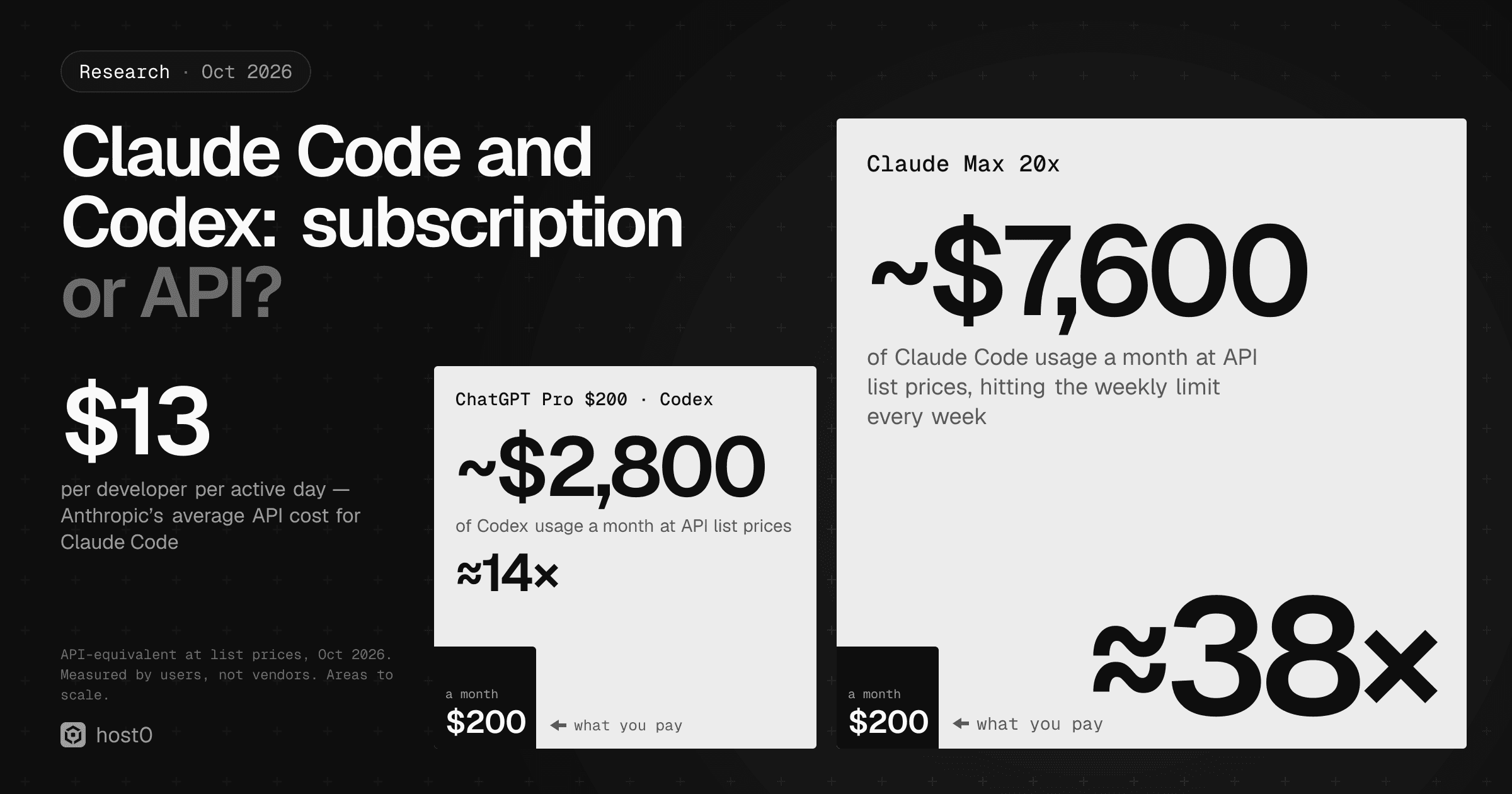
- 2A maxed-out Claude subscription is worth far more than its price. Three separate measurements put a full week of Max 20x at about $1,750–1,860 at API list prices, which is about $7,600 a month on a $200 plan if you hit the weekly limit every week. One developer priced their own transcripts at $1,827.
- 3Codex gives less per dollar, after OpenAI halved its $200 plan. On 29 September OpenAI cut new Pro 200 plans from 20× to 10× Plus usage, and existing subscribers follow on 30 October. On the new allowance, one developer measured about $650 a week of API-priced Codex usage, about 14× the plan's price. Every ChatGPT tier now costs exactly $20 per Plus-sized allowance.
- 4"20x" applies to five-hour sessions, not weeks. Anthropic defines Max as a multiple of Pro's per-session allowance and publishes no weekly multiple. Measured weeks come out at about 10× Pro on Max 20x. A class action filed in June says the plans are mis-sold.
- 5On the API, the average developer pays about the price of Max. Anthropic says Claude Code costs about $13 per developer per active day and $150–250 a month across enterprise deployments, and under $30 a day for 90% of users. By that average, Pro pays off after 1.5 active days a month and Max 20x after about 15.
- 6Cache reads are 87–99% of the tokens but under half the bill. In six logged sessions priced at Opus 5.5, cache reads made up 24–48% of the cost. Cache writes and output made up most of the rest. An agentic session costs about $0.40–0.80 per million tokens on Opus 5.5 and about half that on Sonnet 5.5 or GPT-6.1 Sol.
- 7Limits move every few weeks. Claude Code's five-hour limits doubled in May. Its weekly limits rose 50% for the summer, then settled 17% lower on 14 September. Codex dropped its five-hour window in July and brought it back for Plus in August. GitHub issues about usage limits peaked in June for Claude Code and in September for Codex.
- 8Past the limit, both vendors charge API prices. Claude's usage credits are billed at standard API rates, and Codex credits are priced at API parity. A subscription works as a prepaid bulk discount with a cap, and it only pays if you use most of it.
~$7,600
A month of Claude Max 20x at API list prices, hitting the weekly limit every week ($200 plan, ≈38×)
user-measured
~$2,800
A month of Codex on ChatGPT Pro $200 at API list prices (≈14×) on the new 10× allowance
one account
Source: InventiveHQ
$13
Average Claude Code API cost per developer per active day, enterprise deployments
Source: Anthropic
$20
Price per Plus-sized Codex allowance on every ChatGPT tier since 29 Sep: Plus, Pro 100, Pro 200, Pro 500
Source: ProPakistani
The plans, side by side#
Free Claude has no Claude Code. Every paid Claude plan includes it, and so does every Team seat since January. Pro costs $20 a month, or $200 a year. Max is monthly only: $100 for Max 5x and $200 for Max 20x. Chat and Claude Code draw from the same pool, and since 22 September the default model on every plan is Opus 5.5. Enterprise is the outlier: a seat costs $20 a month, billed annually, with a 20-seat minimum, and it "doesn't include any usage". Every token is billed at API rates.
OpenAI's ladder has one more rung on each end. Go costs $8 and Plus has cost $20 since February 2023. Pro launched at $200 in December 2024, a $100 Pro with 5× Plus's Codex usage followed in April 2026, and a $500 Pro with 25× arrived at DevDay on 29 September. The same day, OpenAI reopened the $200 plan, paused since 10 September, at 10× Plus instead of 20×. Existing subscribers keep 20× through 29 October. The Codex source code names the plans prolite, pro and promax.
Plans that include Claude Code or Codex
US prices per month, October 2026. Multiples are each vendor's own unit: Pro's per-session allowance for Claude, the Plus allowance for ChatGPT
Sources: Claude pricing; Claude Team plan; TechCrunch; ProPakistani
Neither vendor publishes its allowances in tokens or dollars. Anthropic says there is "no fixed message count" and stopped quoting the hours-per-week ranges it gave in 2025. OpenAI publishes ranges for Plus only, per five hours and per model: 5–45 local messages on GPT-6 Astra, 15–160 on GPT-6.1 Sol and 350–3,000 on GPT-6 Luna. It publishes no weekly numbers. So the only way to compare a plan with the API is to measure it, which is what developers have been doing.
What the API charges#
Claude Code and Codex both run on their vendor's API models, and both can be pointed at an API key instead of a subscription. Then you pay list prices. The two companies have priced their workhorse coding models identically. Claude Sonnet 5.5 and GPT-6.1 Sol, Codex's default since 29 September, each cost $2 per million input tokens, $10 per million output tokens and $0.10 for cached input. The top models match too: Claude Fable 5.1 and GPT-6 Astra both list at $10 and $50.
API list prices of the models behind Claude Code and Codex
USD per 1M tokens, standard tier, October 2026
Sources: Anthropic pricing; ProPakistani (GPT-6.1 Sol); OpenAI (GPT-6 Astra)
List prices per token aren't what an agent session costs, though. A coding agent re-sends the whole conversation on every turn, and the provider serves most of it from cache. Developers who logged their sessions found cache reads made up 87.5%, 96% and up to 99.3% of all tokens. Output was under 1%. Anthropic itself says cache reads "make up the majority of agentic and coding work costs", and it cut their price to $0.20 on Opus 5.5 for that reason.
We priced one of those logs, a week of Max 20x use, at every model's list price. Cache reads were 96% of its tokens but only 43% of its cost on Opus 5.5. Cache writes (31%) and output (20%) made up most of the rest.
What a million tokens of agentic coding costs, by model
USD per 1M tokens at list prices, for one logged week of Claude Code (0.7% fresh input, 2.8% cache writes, 96% cache reads, 0.45% output)
| Label | Value |
|---|---|
| GPT-6 Astra | $1.54–1.61 |
| Claude Fable 5.1 | $0.89 |
| Claude Opus 4.6 | $0.80 |
| Claude Opus 5.5 | $0.45 |
| Claude Sonnet 5.5 | $0.23 |
| GPT-6.1 Sol | $0.21–0.23 |
| Claude Haiku 5.5 | $0.08 (over-100K tier) |
Two caveats. Anthropic says its newer tokenizer produces "approximately 30% more tokens for the same text", so per-token prices across vendors aren't per-task prices. And OpenAI's range reflects whether cache writes are billed as plain input or at the separate write price some trackers list.
What a subscription is worth at API prices#
Because neither vendor says how big an allowance is, developers price their own usage. Tools like ccusage read Claude Code's local transcripts and multiply each call by list prices. The results for a full week of Max 20x line up closely:
- A developer who priced every call in their transcripts hit the weekly limit at $1,827 (24–30 September).
- Wokey, a site that measures subscription accounts weekly (and sells its own pay-as-you-go access), puts it at $1,751 across 36 Max 20x accounts (5–12 October), and a Pro week at $170 across 559 accounts.
- FinOpsLLM logged about $1,860 for one heavy user in August and September.
For Codex, a developer who tracked their own account found that each 1% of ChatGPT Pro 200's weekly bar, on the new 10× allowance, was worth about $6.40–6.70 at API prices. That makes a full week about $650, with Pro 100 at about $330–380 and Plus about $66 (a projection). They note the rate shifts with each model release.
A month of each plan at API list prices, if you hit the weekly limit every week
API-equivalent USD per month (weekly measurement × 4.33); multiple of the plan price in brackets; October 2026
| Label | Value |
|---|---|
| Claude Max 20x | $7,582 (38×) |
| Claude Max 5x | $5,066 (51×) (one user, extrapolated) |
| ChatGPT Pro 200 | $2,814 (14×) (new 10× allowance) |
| ChatGPT Pro 100 | ~$1,540 (15×) |
| Claude Pro | $736 (37×) |
| ChatGPT Plus | ~$290 (14×) (projected) |
Sources: GitHub #99330; wokey.ai; InventiveHQ
SemiAnalysis ran a heavier test in June: it maxed out both $200 plans with an agentic workload and reported about $8,000 of API-equivalent usage a month for Claude Max 20x and about $14,000 for ChatGPT Pro, which was the reverse of today's ranking. Since then OpenAI has moved Codex to the cheaper GPT-6.1 Sol and halved Pro 200. OpenAI's Codex lead said the new allowance "nets out at half the dollar in API spend".
Why "20x" isn't 20x a week#
Anthropic's help center defines the multiples narrowly: "Max 5x includes five times the Pro plan's per-session usage allowance". On top of the five-hour session limit, every paid plan has a weekly limit, and Anthropic doesn't say how the weekly limits compare. Measurements say the weekly gap is much smaller than the session gap. Wokey found a single Max 20x five-hour window worth about 19× a Pro window, but a full week only about 10×. The developer behind GitHub #99330 found their 20x week was about 1.6× their 5x week, not 4×: "Per dollar, 20x buys less weekly usage than 5x."
Claude Max 20x compared with Pro: a session vs a week
Multiple of Pro's allowance, advertised and measured, October 2026
| Label | Value |
|---|---|
| Advertised session | 20× |
| Measured session | ~19× |
| Measured week | ~10× |
Source: wokey.ai
This is now in court. A proposed class action, Kahn v. Anthropic, was filed in the Northern District of California in June. It alleges that Max 20x delivers six to eight times Pro's usage and Max 5x about three and a half, and calls the "5x" and "20x" marketing deceptive. Anthropic's terms say advertised limits "assume ordinary, individual usage". Reports say a hearing on Anthropic's motion to dismiss is set for 6 November.
OpenAI took the opposite route on 29 September and made its multiples flat. Each ChatGPT tier now costs $20 per Plus-sized allowance, so there's no bulk discount for buying a bigger plan, only higher limits and, on Pro 500, the Ultrafast mode. OpenAI also lifted the five-hour window entirely for all three Pro tiers, which Plus still has, so on Pro only the weekly cap applies.
When the API is cheaper#
Anthropic publishes what Claude Code costs on the API for real teams: "around $13 per developer per active day and $150-250 per developer per month, with costs remaining below $30 per active day for 90% of users", measured across enterprise deployments. Until about April it said $6 a day. Anthropic said at the time the rise came from the model mix, as Opus became the default, not from a price change.
That average is the cleanest break-even we have. Divide each plan's price by $13 and you get the number of active coding days a month after which the plan beats the API.
Active coding days a month before a Claude plan beats the API
Plan price ÷ Anthropic's average API cost per developer per active day ($13) and its 90th percentile ($30)
| Label | Value |
|---|---|
| Pro, average user | 1.5 |
| Max 5x, average user | 7.7 |
| Max 20x, average user | 15.4 |
| Max 20x, heavy user (p90) | 6.7 |
Source: Anthropic, Manage costs
The API wins in three cases:
- You code with an agent a few days a month. Then $13 a day comes to less than a plan you barely touch, and there's no weekly limit to hit.
- You're a team that needs predictable throughput. On Enterprise, Claude seats include no usage, and Anthropic's own guidance is to budget tokens per minute per user. It suggests 200k–300k for a team of 1–5, down to 10k–15k for 500+. Uber reportedly ran through its 2026 AI coding budget by about April, with heavy users near $2,000 a month. For a team, the bill is about how much engineers use, not which plan they're on.
- You need a model or mode the plan doesn't cover. Fable 5.1 on Claude Pro and fast mode on every plan are usage credits only, billed at API rates anyway. Codex's Fast mode draws on included usage at 2.5× the normal rate, and Ultrafast at 8×.
Past the limit, you're on API prices anyway#
Both vendors sell overage at API prices. Claude's "usage credits" (formerly "extra usage") are prepaid and billed at standard API rates. They cover the five-hour, weekly and Fable limits, in chat and Claude Code alike. Codex credits launched in October 2025 at 1,000 for $40. Since April 2026 they're charged per token at the API price: GPT-6 Astra costs 250 credits per million input tokens and 1,250 per million output, or $10 and $50.
There's one new twist. Since 7 October, Max 5x and Max 20x include $100 and $200 a month in API credits, and Team plans up to $500. But they "don't apply to: Interactive Claude Code in the terminal, IDE, desktop, or web". They're for building on the API, not for coding past your limit.
The two vendors also differ on where a plan can be used. Anthropic doesn't allow third-party developers to route requests through Free, Pro, or Max plan credentials, and it stopped subscriptions from covering third-party harnesses in April. OpenAI went the other way at DevDay: Sign in with ChatGPT lets Plus and Pro users spend their allowance in partner tools.
Limits keep moving#
Neither allowance has stayed fixed for long. In 2026 Anthropic tightened peak-hour limits, admitted a caching bug had drained them, reset everyone in April, doubled the five-hour window in May, ran a summer boost and then cut it back. OpenAI reset Codex limits for everyone again and again: at user milestones, after outages and while it investigated meters that ran fast. It also removed the five-hour window, brought it back for Plus, and halved its most popular high-end plan.
Subscription limits in 2026
26 Mar 2026
26 Mar 2026
Claude: peak-hour five-hour limits tightened
Weekdays 5–11am PT; a caching bug made limits drain faster until 10 April.Source: The Register
2 Apr 2026
2 Apr 2026
Codex: credits move to API token prices
From per-message rates to the API's per-token prices.Source: OpenAI (via search)
9 Apr 2026
23 Apr 2026
23 Apr 2026
Claude: usage limits reset for all subscribers
After a postmortem on the March caching bug.Source: Anthropic
6 May 2026
6 May 2026
Claude Code five-hour limits doubled
Peak-hour reduction removed for Pro and Max.Source: Anthropic
13 May 2026
13 May 2026
Claude Code weekly limits +50%
A temporary boost, later extended through 13 September.12 Jul 2026
25 Aug 2026
14 Sep 2026
14 Sep 2026
Claude Code weekly limits settle at +25%
125% of the old level: a 17% cut from the summer's 150%.Source: BleepingComputer
29 Sep 2026
29 Sep 2026
ChatGPT Pro 500 launches; Pro 200 halved to 10×
Existing Pro 200 subscribers move on 30 October.Source: ProPakistani
7 Oct 2026
7 Oct 2026
Claude Max gets $100–200 of monthly API credits
Not usable in interactive Claude Code.Source: Anthropic
You can see the changes in each tool's GitHub issues. We counted issues mentioning "usage limit" opened each month in both public repositories. Claude Code's peaked at 322 in June, about 4% of all its issues, and fell to under 2% after the summer. Codex's climbed all year and peaked at 307 in September, about 5% of its issues, the month the $200 plan was paused and halved.
GitHub issues mentioning “usage limit”, per month
Issues opened in anthropics/claude-code and openai/codex, Oct 2025 – Sep 2026
| Series | x | y |
|---|---|---|
| Claude Code | Oct 2025 | 63 |
| Claude Code | Nov 2025 | 36 |
| Claude Code | Dec 2025 | 35 |
| Claude Code | Jan 2026 | 88 |
| Claude Code | Feb 2026 | 98 |
| Claude Code | Mar 2026 | 172 |
| Claude Code | Apr 2026 | 277 |
| Claude Code | May 2026 | 220 |
| Claude Code | Jun 2026 | 322 |
| Claude Code | Jul 2026 | 318 |
| Claude Code | Aug 2026 | 148 |
| Claude Code | Sep 2026 | 123 |
| Codex | Oct 2025 | 15 |
| Codex | Nov 2025 | 17 |
| Codex | Dec 2025 | 11 |
| Codex | Jan 2026 | 12 |
| Codex | Feb 2026 | 23 |
| Codex | Mar 2026 | 36 |
| Codex | Apr 2026 | 73 |
| Codex | May 2026 | 83 |
| Codex | Jun 2026 | 138 |
| Codex | Jul 2026 | 162 |
| Codex | Aug 2026 | 113 |
| Codex | Sep 2026 | 307 |
Sources: host0 count of GitHub search results, 15 Oct 2026; openai/codex issues
What this means if you code with agents#
- Measure before you choose. Run a usage tracker (ccusage for Claude Code, and similar tools for Codex) for a week on whatever you have, then price it. Below about $20 of API usage a month, use the API or Pro. Above $200, a top plan is almost certainly cheaper, as long as you stay under its weekly limit.
- Buy for the week, not the session. The weekly limit is what stops heavy users. On Claude, Max 5x may give more weekly usage per dollar than Max 20x. On ChatGPT, every tier now costs the same per unit of usage, so buy the smallest one that gets you through your week.
- Keep the cache warm. Most of your tokens are cache reads, and rebuilding a cold cache costs 20–25× more per token than reading it. Subscriptions keep Claude's cache for an hour, but only five minutes once you're on usage credits. Long pauses and switching models mid-session cost money.
- Pick the model on purpose. On the same week of work, Opus 5.5 costs about twice as much per token as Sonnet 5.5 or GPT-6.1 Sol, Fable 5.1 about twice that again, and GPT-6 Astra more than three times. Plan limits drain at those ratios too.
- Expect the deal to change. In 2026 both vendors changed allowances several times and gave few numbers. Don't budget for a team on a plan's current generosity. Budget on Anthropic's $150–250 per developer per month and treat anything a plan gives beyond that as a bonus.
host0 hosts whatever your agent builds, so we watch what it costs to run agents. If your agent built something worth sharing, host0 gives it a link, with a database if it needs one.
Methodology#
We collected plan prices, limits and API prices on 15 October 2026. Anthropic's pricing page, API pricing, Claude Code docs, help-center articles and release notes were read directly. OpenAI's pages were blocked from our research environment. OpenAI figures come from search results checked against at least two independent outlets (TechCrunch, CIO, 9to5Mac, ProPakistani, BleepingComputer and others), and from the open-source Codex repository at commit bb64b89, whose model catalog and plan types we read directly.
API-equivalent values come from people who priced their own subscription usage at list prices: GitHub issue reports, Wokey, FinOpsLLM and InventiveHQ. We converted weekly figures to months by multiplying by 4.33. The per-model cost chart reprices one published week of Claude Code token counts (GitHub #87646) at each model's list price, with five-minute cache writes. For OpenAI models we show a range: cache writes billed as plain input, or at the write price some trackers list. The issue counts are GitHub search results for issues containing "usage limit" created each month, read on 15 October 2026.
Not included: SemiAnalysis's October retest and leaderboard percentiles quoted by aggregators. We couldn't find either in a primary or second independent source. The full data pack, with every source, tier and exact quote, is in our repository under docs/research/2026-10-15-claude-code-codex-subscription-vs-api.md.
Open questions#
- How big are the allowances? Neither vendor publishes a weekly allowance in tokens or dollars, so every value above is a measurement from outside.
- How much did Claude's limits rise on 22 September? Anthropic raised five-hour limits again with Opus 5.5 but gave no percentage.
- How much does the old 20× Pro 200 allowance really buy? The measurement above is for the new 10× allowance. Doubling it gives about $1,300 a week for subscribers still on 20× until 30 October, but that's a projection, not a measurement.
- Will the class action change how plans are described? The motion to dismiss is due to be heard on 6 November.