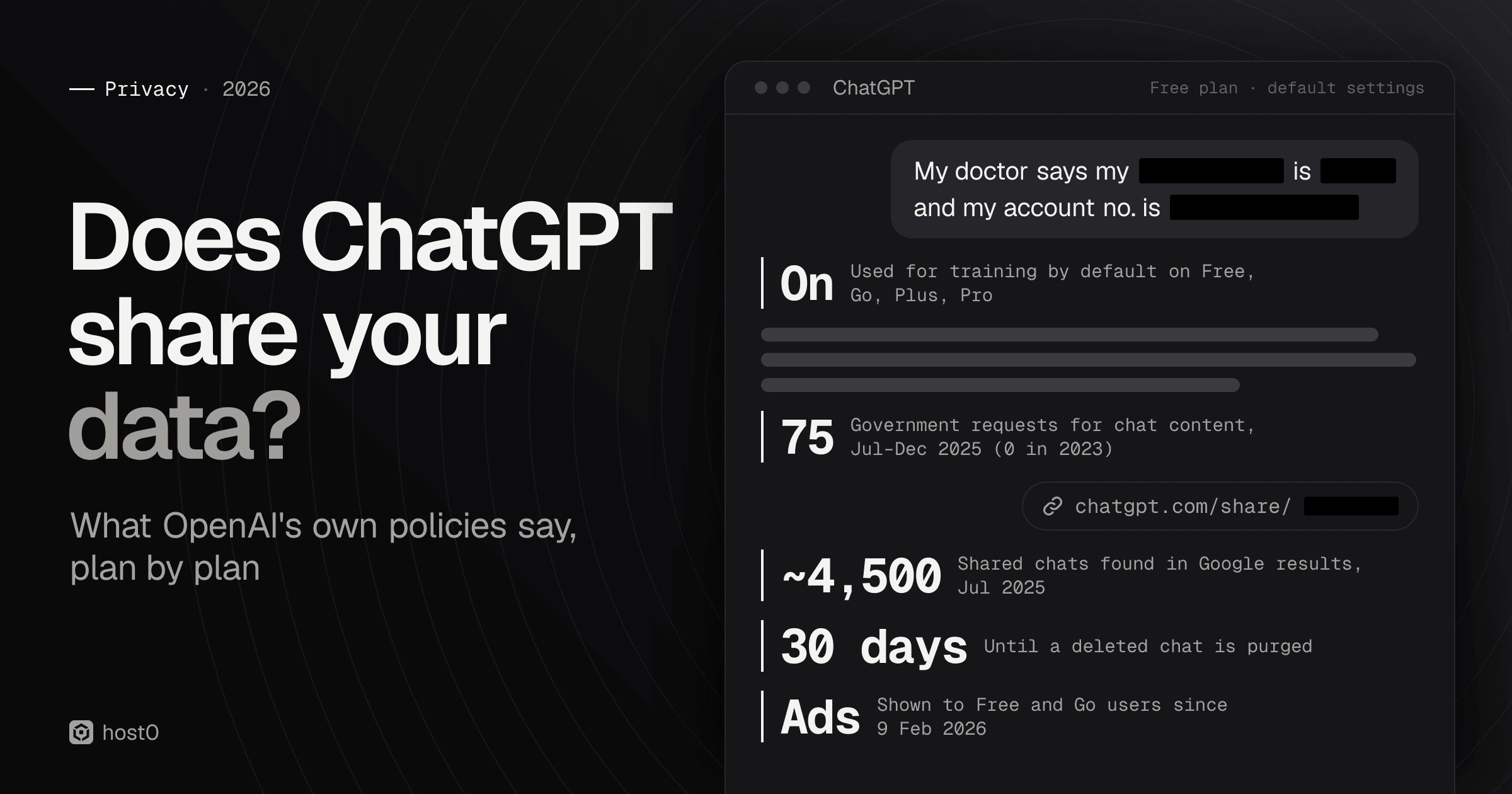
Does ChatGPT share your data? OpenAI says it doesn't sell your data and doesn't hand your conversations to advertisers. But your chats don't stay between you and the model either. On the Free, Go, Plus and Pro plans, OpenAI may use your conversations to train its models unless you turn off "Improve the model for everyone". Authorized OpenAI staff and contracted service providers can read them to investigate abuse, give support, handle legal matters and, unless you opt out, improve the models. OpenAI hands content to governments that serve a warrant: it disclosed content from 84 accounts in the second half of 2025. Apps and GPT actions you use receive parts of your chat, and anyone with a shared link can read that conversation. ChatGPT Business, Enterprise, Edu and the API work differently: OpenAI doesn't train on them by default, and on Business and Enterprise your company's admins can see your chats.
That's the short answer. The longer one depends on your plan, your settings and which features you use, and it has changed several times since mid-2025: a court order made OpenAI keep deleted chats for months, ads arrived in 2026, and the privacy policy was rewritten for Free and Go users. We read OpenAI's own privacy policies, terms, help-center articles, transparency reports and court filings as they stood in early October 2026, and link every claim below to the page that makes it. OpenAI's statements are quoted as its claims. We can't audit what happens inside OpenAI, only what it commits to in writing.
Key findings
- 1Training is on by default for personal plans. OpenAI says it may use content from ChatGPT and Codex to train its models unless you turn off "Improve the model for everyone". Business, Enterprise, Edu and the API aren't used for training by default.
- 2Opting out has gaps. If you rate a reply with thumbs up or down, the entire conversation may still be used for training, and turning training off doesn't delete anything.
- 3People can read your chats. Authorized OpenAI personnel and trusted service providers may access them for abuse, support, legal matters and, unless you opt out, model improvement. OpenAI also sends "select portions" of content to vendors for data annotation and safety.
- 4Advertisers don't get your chats, OpenAI says, but ads use them. Ads started testing on 9 February 2026 for Free and Go users. OpenAI says advertisers see only aggregated views and clicks, while ad targeting can draw on your current chat and, if personalization is on, your past chats and memory.
- 5Deleted means within 30 days, with exceptions. Deleted chats are scheduled for permanent deletion within 30 days. A court order in the New York Times lawsuit suspended that until 26 September 2025, and OpenAI is still holding some April–September 2025 data under legal hold.
- 6Government requests are rising fast. OpenAI received 309 government requests for user data in July–December 2025, up from 6 in January–June 2023. 75 of them asked for chat content.
- 7Shared links are public to anyone who has them. In July 2025, Fast Company found nearly 4,500 shared ChatGPT conversations in Google results after users ticked a "discoverable" box. OpenAI removed the option.
- 8Apps and GPTs are a separate privacy policy. Connected apps can receive relevant conversation context, memories, your IP address and approximate location, handled under each app's own terms.
30 days
Time OpenAI gives itself to purge a deleted chat or a Temporary Chat
Unless held for legal or security reasons
Source: OpenAI Help Center
75
Government requests for chat content, Jul–Dec 2025, up from 0 in 2023
Source: OpenAI transparency report
~4,500
Shared ChatGPT chats found in Google results, Jul 2025
Likely not the full count
Source: Fast Company
20M
De-identified consumer chat logs a court ordered OpenAI to produce in the NYT case
Affirmed 5 Jan 2026
Source: Bloomberg Law
ChatGPT data privacy by plan#
Most of the answer depends on which plan you're on. OpenAI runs two privacy regimes: one for "services for individuals" (Free, Go, Plus, Pro) governed by its privacy policy, and one for business data (Business, Enterprise, Edu, Healthcare, Teachers and the API) governed by customer agreements and its enterprise privacy commitments. The privacy policy says so in its second paragraph: it "does not apply to content that we process on behalf of customers of our business offerings".
What happens to your chats on each ChatGPT plan
OpenAI's stated defaults, as published in early October 2026
Sources: Model training; Enterprise privacy; Ads in ChatGPT; Shared links; NYT order FAQ; API data controls
Two caveats. First, "not used for training by default" leaves room for opt-ins: OpenAI says business data can be used for training if you have "explicitly opted in", for example through its feedback mechanisms. Second, business plans are more private from OpenAI and less private from your employer. The privacy policy says that when you join a business account, "the administrators of that account may access and control your OpenAI account, including being able to access your Content". It also says that if you sign up for a personal account with your work email, OpenAI may tell your employer the account exists.
Does OpenAI train on your ChatGPT conversations?#
Yes, on personal plans, unless you say no. OpenAI's help article is direct: "When you use our services for individuals, such as ChatGPT and Codex, we may use your content to train our models." Content here means more than the text you type. OpenAI's consumer data FAQ lists "the user's prompts, the model's responses, and other content such as images and files". Its memory article says chats and remembered information can be used too. Its apps article says information ChatGPT accesses from connected apps, like your Google Drive or Gmail, may be used for training on Free, Plus, Go and Pro when the setting is on.
You can opt out in two ways, and OpenAI says either one is enough: turn off Improve the model for everyone under Settings → Data controls, or choose Do not train on my content in OpenAI's Privacy Portal (privacy.openai.com). Signed in, the setting follows your account across devices. Signed out, it's saved only in that browser.
The opt-out has four limits worth knowing:
- It only covers new conversations. "After you opt out, we won't use your new conversations to improve our models," OpenAI says. The privacy policy adds that content already "de-identified and disassociated from your account" for training isn't removed when you delete it.
- Feedback overrides it. If you click thumbs up or thumbs down, "the entire conversation associated with that feedback may be used to train our models", even after you opt out.
- Codex has its own switch. An "Include environments" setting controls training on your Codex environments, and the ChatGPT toggle doesn't change it.
- It doesn't delete anything. Turning training off leaves your history in place. Deleting is a separate step.
What does OpenAI do to the data before training? It says it takes "steps to reduce the amount of personal information in training datasets" and works to "identify and remove personal identifiers from training sets wherever possible", per its consumer privacy page. It doesn't publish how well that works.
In the EU, the legal basis matters. OpenAI's EU privacy policy, updated 24 August 2026, relies on "legitimate interests and those of third parties and broader society" to train on your content, not on your consent. Because training rests on legitimate interests, the GDPR gives you a right to object to it, which the same policy lists.
What happens to a chat on a personal plan
Free, Go, Plus and Pro with default settings
You send a message
Stored in your history on OpenAI's systems and its providers' systems, in the US and elsewhere.
Memory
If on, ChatGPT may save details and reuse them in later chats and web searches.
Apps
Connected apps can receive relevant context from the chat.
Automated safety checks
Content is monitored for misuse; flagged content can go to human reviewers.
Threats to others
Reviewed by a small team; may be referred to police.
Training pool
Eligible for model training unless you've opted out. Thumbs up or down opts that chat back in.
De-identified
OpenAI says it reduces personal data before training.
You delete it
Removed from view now; purged within 30 days unless held for legal or security reasons.
Not undone
Copies already de-identified for training, saved memories and Library files stay unless deleted separately.
Sources: Consumer data FAQ; Privacy policy; Memory
Who can see your ChatGPT conversations?#
More people than the chat window suggests. Here are the people and systems OpenAI's own documents say can see some or all of a conversation, and when.
Who can read a ChatGPT conversation, and when
Per OpenAI's privacy policy, help center and enterprise privacy page, Oct 2026
Sources: Consumer data FAQ; Privacy policy; Enterprise privacy; Connected apps; GPTs; Law enforcement policy
OpenAI staff and contractors. OpenAI's consumer FAQ says "a limited number of authorized OpenAI personnel, as well as trusted service providers", may access user content for four reasons: investigating abuse or a security incident, providing support you asked for, handling legal matters, and improving model performance unless you opted out. OpenAI says access is logged and limited to people with a need to know. The same page says OpenAI "may also send select portions of content to trusted service providers… for data annotation and safety purposes". Its advice is blunt: "Please do not enter sensitive information that you would not want reviewed or used."
Safety reviewers, and sometimes the police. In August 2025, OpenAI said that when it detects users planning to harm others, it routes their conversations to a small team of human reviewers, and "if human reviewers determine that a case involves an imminent threat of serious physical harm to others, we may refer it to law enforcement". At the time it said it was "currently not referring self-harm cases to law enforcement". Turning off memory doesn't switch this off: OpenAI says safety features can still use "limited, safety-relevant context in rare, high-risk situations".
Your employer. On ChatGPT Business, workspace admins "can view, access, export, and delete end user conversations". On Enterprise and Edu, admins get an audit log of conversations through the Compliance API.
Apps and GPTs. When you use a connected app, the app "may access and use relevant context from your ChatGPT conversations". OpenAI's example is Canva picking up the names you'd been brainstorming. With Memory on, an app can also use your memories. Apps may see your IP address, device and browser, language and approximate location, and "data shared with apps is handled according to each app's terms of service and privacy policies". GPTs that call outside APIs send "relevant parts of your input" to that service, and OpenAI says it "does not audit or control how those services use or store your data". One reassurance from the same page: the person who built a GPT can't read your conversations with it. Custom GPTs are themselves on the way out. OpenAI says it plans to retire them in favor of plugins, on 11 December 2026 for affected Enterprise workspaces, with other plans expected to follow the same timeline.
Does ChatGPT sell your data or share it with advertisers?#
OpenAI says no, in several places. Its consumer privacy page says: "We don't share your conversations with advertisers or marketing partners, and we never sell your data to anyone." Its consumer FAQ adds: "We do not share your chat content for marketing or advertising purposes."
But ChatGPT has ads now, and the ads do use your chats inside OpenAI. In January 2026, OpenAI announced plans to test ads for the Free and Go tiers alongside bringing the $8-a-month Go plan to the US. Testing began in the US on 9 February 2026. Here's what OpenAI's ads FAQ says:
- Who sees ads: Free and Go users. Plus, Pro, Business, Enterprise and Edu don't get ads, and neither do accounts identified as belonging to people under 18.
- What picks the ad: "the context and intent of your current conversation" plus, if ad personalization is on, "past chats and memory" and how you've interacted with ads. If you turn personalization off, ads still use your current chat but not your other chats.
- What advertisers get: "Advertisers do not have access to your chats, chat history, memories, or personal details. Advertisers only receive aggregated, non-identifying information about how their ads perform, such as total views or clicks." If you message an advertiser through an ad, they see what you send them.
- Where ads don't appear: near personal health, mental health or politics conversations, and never in Temporary Chats.
- How to avoid them: pay for Plus or Pro, or switch the Free plan to an "Ads-Free" mode with lower message limits and fewer tools.
The privacy policies changed to match. The US privacy policy, updated 10 September 2026, says that for Free and Go users OpenAI now collects "information about your ads history and interests" and receives information from advertisers and data partners: "For example, we could receive information about purchases you make from these advertisers." The same policy says OpenAI "may share limited data with select marketing partners for purposes of promoting our products and services to you on third-party properties", which US state privacy laws treat as targeted advertising. You can opt out of that with the marketing privacy control in your account settings. So the precise version of OpenAI's promise is: your chats aren't given to advertisers, but data about you does flow in from advertisers, and some account data goes out to OpenAI's own marketing partners unless you opt out.
In Europe, personalised ads need your consent under the EU policy, and the ads FAQ says personalized ads weren't initially offered in the EEA or Switzerland. For people who don't consent, the policy describes "generic" ads chosen from the current chat, location, time of day and device type.
Shared links and the Google indexing incident#
A shared ChatGPT link is a public page for anyone who has the URL. OpenAI's sharing article is precise about it: for personal accounts, "anyone who has a link created from a personal account can view the shared conversation". There's no way to limit it to specific people and no expiry date. "Shared link pages are not intended for search-engine indexing, but this does not make a link private. Anyone who can access a link can also forward it." Deleting the link stops future access but doesn't remove copies other people saved. Links created in a Business, Enterprise or Edu workspace open only for members of that workspace.
The risk stopped being theoretical in July 2025. For a while, the share dialog had an extra checkbox to make a chat discoverable by search engines. On 30 July 2025, Fast Company reported that "nearly 4,500 conversations come up in results" for a Google site search of shared links. Many held no personal details, but some included people's names, locations and personal circumstances, and the outlet said the count was "likely not the full count". Within days OpenAI's chief information security officer, Dane Stuckey, called it a "short-lived experiment" and said the feature "introduced too many opportunities for folks to accidentally share things they didn't intend to, so we're removing the option", as quoted by Fortune. OpenAI said it was also working to remove indexed pages from search engines.
The checkbox is gone, but every shared link is still readable by whoever holds it. To see and delete yours, go to Settings → Data controls → Shared links → Manage.
ChatGPT privacy: the events that changed the answer
Incidents, court orders, regulator actions and policy changes, Mar 2023 to Sep 2026
20 Mar 2023
20 Mar 2023
A bug shows other users' chat titles
A redis-py bug let some users see titles from another active user's history, and possibly payment details of 1.2% of Plus subscribers active in a nine-hour window.Source: OpenAI
20 Dec 2024
20 Dec 2024
Italy fines OpenAI €15 million
The Garante cites training without a proper legal basis, poor transparency, no age checks and an unreported 2023 breach.Source: Garante
5 Jun 2025
5 Jun 2025
OpenAI discloses an order to keep deleted chats
In the New York Times lawsuit, OpenAI must preserve consumer and API content, deleted chats included. Enterprise, Edu and zero-retention API data are excluded.Source: OpenAI
30 Jul 2025
30 Jul 2025
Shared chats turn up on Google
Fast Company finds nearly 4,500 shared conversations in search results. OpenAI removes the discoverable option within days.Source: Fast Company
26 Sep 2025
26 Sep 2025
The preservation order ends
OpenAI returns to 30-day deletion but keeps some April–September 2025 data under legal hold.Source: OpenAI
12 Nov 2025
12 Nov 2025
OpenAI fights a demand for 20 million chats
News plaintiffs want a random sample of consumer conversations from Dec 2022 to Nov 2024, de-identified.Source: OpenAI
26 Nov 2025
26 Nov 2025
Analytics vendor Mixpanel is breached
Names, emails and coarse locations of API users and some ChatGPT users who filed help tickets. OpenAI says no chats were exposed and drops Mixpanel.Source: OpenAI
5 Jan 2026
5 Jan 2026
Judge affirms the 20-million-log order
District Judge Sidney Stein upholds the magistrate judge's order to produce the de-identified logs.Source: Bloomberg Law
9 Feb 2026
9 Feb 2026
Ads start in ChatGPT
A US test for Free and Go users. Ads can be chosen from your current chat and, with personalization on, past chats and memory.Source: OpenAI
18 Mar 2026
18 Mar 2026
A Rome court annuls the Italian fine
The Garante removes its decision after judgment 4153/2026 upholds OpenAI's appeal.Source: Garante
10 Sep 2026
10 Sep 2026
US privacy policy rewritten for ads
Adds ads history, data from advertisers and data partners, and sharing with marketing partners for OpenAI's own promotion.Source: OpenAI
Are deleted ChatGPT chats really deleted?#
Usually, within 30 days. When you delete a saved chat, OpenAI says it disappears from your account at once and is scheduled "for permanent deletion from its systems within 30 days", unless it "was already de-identified and disassociated from your account" or OpenAI "must retain it longer for security or legal obligations". You can't get it back, even through support. Archiving a chat changes nothing about retention.
A chat isn't the only copy of what you said, though:
- Memories are stored separately. Deleting a chat doesn't delete a memory created from it. To remove something, OpenAI says you need to delete the saved memory and the chat where you shared it, plus any Library files and connected apps that hold it. OpenAI may keep logs of deleted memories for up to 30 days.
- Files can outlive chats. Files saved to Library stay when you delete the chat that used them, and files given to a custom GPT as knowledge stay until the GPT is deleted.
- Temporary Chat isn't zero retention. A Temporary Chat stays out of your history, doesn't create memories and isn't used for training while it stays temporary. But "OpenAI may keep a copy of a temporary chat for up to 30 days for safety purposes".
- Account deletion takes 30 days too. After a full deletion, you can reuse the same email after 30 days.
The "legal obligations" exception is real. In 2025, a court in the New York Times copyright lawsuit ordered OpenAI to preserve consumer ChatGPT and API content, including chats users deleted. OpenAI said the order covered Free, Plus, Pro and Team users and API customers without zero data retention, but not ChatGPT Enterprise or Edu. OpenAI says its obligations under that order "ended on September 26, 2025", and it has gone back to deleting within 30 days. It still stores "limited historical April–September 2025 user data" under legal hold, which only "a small, audited OpenAI legal and security team" can access.
A second fight followed. In November 2025, OpenAI said the news plaintiffs were demanding 20 million consumer conversations, randomly sampled from December 2022 to November 2024. It said they had first asked for 1.4 billion. OpenAI said it would run the sample through a de-identification procedure to strip personal information, and that the plaintiffs' outside lawyers and consultants would get access. On 5 January 2026, District Judge Sidney Stein upheld the order to produce the 20 million anonymized logs, Bloomberg Law reported. Stein noted that users had submitted their conversations voluntarily. Business and API customers weren't in that sample.
Does ChatGPT share your data with the police?#
Yes, with legal process, and increasingly often. OpenAI's law enforcement policy, in effect since 1 January 2026, says US agencies need a subpoena, court order or warrant for account data, and that OpenAI "only discloses requested user content… in response to a valid warrant or equivalent". It may disclose data without legal process in an emergency "involving danger of death or serious physical injury". It says it notifies users before disclosure unless the law forbids it. Users in the EEA and Switzerland are served by OpenAI Ireland, which requires an order from an Irish court.
OpenAI publishes the counts twice a year on its trust and transparency page. Requests for content, meaning legal process for "text or files input or output", went from none in 2023 to 75 in the second half of 2025.
Government requests for ChatGPT content
Legal requests (like search warrants) for text or files, per half-year, 2023–2025
| Label | Value |
|---|---|
| H1 2023 | 0 |
| H2 2023 | 0 |
| H1 2024 | 8 |
| H2 2024 | 13 |
| H1 2025 | 26 |
| H2 2025 | 75 |
Sources: OpenAI, 2023 H1; 2024 H1; 2025 H2
Every government request OpenAI has reported
Requests received, requests where data was disclosed, and accounts disclosed, Jan 2023 to Dec 2025
So far the bigger exposure has come from civil litigation, not the police: one preservation order covered the chats of every Free, Plus, Pro and Team user for months, while warrants reached 84 accounts in the busiest half-year.
Breaches and regulators#
OpenAI has disclosed two incidents that touched ChatGPT users' data, and it has fought one regulator's fine in court.
- March 2023: other users' chat titles. A bug in the open-source redis-py library let some users see titles from another active user's chat history, and possibly the first message of a new chat. The same bug may have exposed the name, email, payment address, card type, last four digits and expiry date of 1.2% of Plus subscribers active in a nine-hour window. OpenAI said full card numbers were never exposed.
- November 2025: an analytics vendor. An attacker exported data from Mixpanel, which OpenAI used for web analytics on its API platform. OpenAI says the data included names, emails, approximate locations, browsers and account IDs of API users, and of "a limited number of ChatGPT users who submitted help center tickets or were logged into platform.openai.com". It says "no chat, API requests, API usage data, passwords, credentials, API keys, payment details, or government IDs were compromised", and it stopped using Mixpanel.
- 2024–2026: Italy. In December 2024, Italy's data protection authority fined OpenAI €15 million and ordered a six-month public information campaign. It found OpenAI had trained ChatGPT on users' personal data without first identifying an adequate legal basis, fallen short on transparency, had no age verification and hadn't notified it of the March 2023 breach. It passed the file to Ireland's Data Protection Commission, now OpenAI's lead EU regulator. On 18 March 2026 the Court of Rome upheld OpenAI's appeal (judgment 4153/2026), and the Garante took its decision down.
Where your data is processed#
OpenAI's consumer FAQ says content is stored "on OpenAI systems and our trusted service providers' systems in the US and around the world". The privacy policy names the categories of providers: hosting, cloud, content delivery, customer service, support and safety, email, web analytics, payments, search and shopping, IT, and age and identity verification. It doesn't name companies for consumer data.
For business data, OpenAI does publish names. Its sub-processor list, last updated 9 July 2026, covers the API, ChatGPT Business, Enterprise and Edu, and names 19 outside companies. They include six cloud providers, five customer-support providers and a moderation platform. OpenAI says flagged content may be shared as samples with moderation sub-processors "to assist OpenAI in its review and enforcement". Two of the support firms also moderate content: TaskUs, which processes data in the Philippines, and Accenture, in the US, Canada and the Philippines.
OpenAI's third-party sub-processors for business data, by role
Count of the 19 companies named, by each one's main listed purpose, list updated 9 Jul 2026
| Label | Value |
|---|---|
| Cloud infrastructure | 6 (Microsoft, CoreWeave, Oracle, Google Cloud, AWS, Cerebras) |
| Customer support | 5 (TaskUs and Accenture also moderate; Intercom, Salesforce, Pylon Labs) |
| Identity and sign-in | 2 (WorkOS, Okta (Auth0)) |
| Infrastructure management | 2 (Confluent, Merge (connectors)) |
| Content delivery | 1 (Cloudflare) |
| Data warehousing | 1 (Snowflake) |
| Moderation platform | 1 (Cinder) |
| ETL | 1 (Fivetran, Assistants API only) |
Source: OpenAI sub-processor list
Is ChatGPT safe for private data?#
It depends on what "private" has to mean. OpenAI says it encrypts business data at rest and in transit (AES-256 and TLS 1.2+), and says its business products have completed SOC 2 Type 2 audits. The questions people actually worry about are different: whether a person, a model, a company or a court can see what they typed. On a personal plan with default settings, the honest answer is that several can.
OpenAI hasn't shipped end-to-end encryption. In November 2025 it said its roadmap includes client-side encryption for ChatGPT messages to make conversations "inaccessible to anyone else, even OpenAI", and fully automated safety detection with human review only for serious misuse. Those were described as "in active development". Until something like that ships, OpenAI can read what you send.
A workable rule of thumb:
- Fine to paste: drafts, public information, code without secrets, questions you'd ask a search engine.
- Think first: health, legal and money questions, anything about other people, unreleased work. Turn training off, consider a Temporary Chat, and don't rate the answer.
- Don't paste: passwords, API keys, full card or bank numbers, government ID numbers, and anything covered by a confidentiality agreement or a law like HIPAA. OpenAI's own sharing article says not to put "health information, financial details, passwords, account numbers, or other sensitive personal information" in shared content. For regulated health data, the routes OpenAI lists are a business associate agreement for the API and ChatGPT for Healthcare. Its enterprise privacy page lists no such option for personal plans.
- Work data: use your company's Business or Enterprise workspace if it has one, and remember your admins can see it. Don't move work data into a personal account to avoid that.
How to stop ChatGPT using your data#
These are the controls OpenAI documents, in rough order of impact. Names are as they appeared in early October 2026; menus differ slightly between web and mobile.
- Turn off model training. Settings → Data controls → Improve the model for everyone → off. Or open OpenAI's Privacy Portal (privacy.openai.com) and choose Do not train on my content. Either works for ChatGPT and Codex, OpenAI says. If you use Codex, also check Include environments in Codex settings.
- Don't rate sensitive chats. A thumbs up or down puts the whole conversation back in the training pool.
- Use Temporary Chat for one-off sensitive questions. Choose Unpersonalized before you start if you don't want it to use your memories. It won't be saved to history or used for training, and it won't show ads, but OpenAI may keep it for up to 30 days.
- Review or turn off memory. Settings → Personalization → Memory. Delete saved memories you don't want, or turn off Reference chat history, which schedules what ChatGPT derived from past chats for deletion within 30 days.
- Delete what you don't need. Delete individual chats or all of them. Delete saved memories and Library files separately; deleting a chat doesn't remove them.
- Audit your shared links. Settings → Data controls → Shared links → Manage, then delete the ones you don't need. There is "Delete all shared links" too.
- Disconnect apps you don't use. Settings → Plugins. Each connected app gets context from your chats and follows its own privacy policy.
- Turn off ad personalization (Free and Go). Settings → Ads controls. Switch off Personalize ads and Past chats and memory, or delete your ads data. In the US, also use the marketing privacy control to opt out of sharing with OpenAI's marketing partners.
- Use your legal rights. Through the Privacy Portal or dsar@openai.com you can ask to access, correct, export or delete your data. In the EEA, UK and Switzerland you can also object to processing based on legitimate interests, including training, and complain to a regulator. You can export your history yourself under Data controls.
- Delete the account if you're done. You can do it from ChatGPT's settings on Free, Go, Plus and Pro. Deletion is permanent, and your data is removed on the same 30-day schedule.
FAQ#
Does ChatGPT sell my data?#
OpenAI says it doesn't. Its consumer privacy page says it "never sell[s] your data to anyone", and its US privacy policy says "We don't 'sell' Personal Data". The same US policy says it may share limited data with marketing partners to advertise OpenAI's own products to you elsewhere, which you can opt out of.
Can OpenAI employees read my ChatGPT chats?#
Yes, in specific cases. Authorized staff and trusted service providers may access content to investigate abuse or security incidents, give support you asked for, handle legal matters, or improve models unless you opted out, per OpenAI. Conversations flagged for planning harm to others go to a small team of human reviewers.
Does turning off "Improve the model for everyone" make my chats private?#
No. It only stops new chats from being used for training. Your chats are still stored, can still be reviewed for safety, legal and support reasons, and stay in your history until you delete them. Rating a response with thumbs up or down puts that conversation back in the training pool.
Is Temporary Chat private?#
More private, not fully. Temporary chats aren't saved to your history, don't create memories, aren't used for training and don't show ads. OpenAI may still keep a copy for up to 30 days for safety, and a "personalized" temporary chat can use your existing memories.
If I delete a ChatGPT chat, is it gone?#
From your account, immediately. From OpenAI's systems, within 30 days, unless it has to be kept for legal or security reasons or was already de-identified for training. In 2025 a court order kept deleted chats for several months. Saved memories and Library files have to be deleted separately.
Can my employer see my ChatGPT conversations?#
If you use your company's ChatGPT Business, Enterprise or Edu workspace, yes. Business admins can view, export and delete conversations; Enterprise and Edu admins get an audit log through the Compliance API. A personal account is not visible to your employer, but if you sign up with a work email, OpenAI may tell your organization the account exists, per its privacy policy.
Does ChatGPT share my conversations with the police?#
With legal process. US agencies need a warrant or equivalent for content and a subpoena or court order for account data. OpenAI received 75 requests for content in July–December 2025 and disclosed content from 84 accounts. It may also refer imminent threats to other people's safety to law enforcement.
Do advertisers see my ChatGPT chats?#
OpenAI says no: advertisers get aggregated views and clicks only. But on Free and Go plans, OpenAI's own ad system uses your current chat to pick ads, and with personalization on, your past chats and memory as well.
Are custom GPTs and apps safe?#
The builder of a GPT can't read your chats with it. But GPTs that call outside APIs, and apps you connect, receive parts of your conversation and follow their own privacy policies, which OpenAI says it doesn't audit. Only connect apps you'd trust with the same information directly.
Is ChatGPT GDPR compliant?#
That's for regulators and courts to decide, and it's contested. OpenAI's EU privacy policy relies on legitimate interests for training and on consent for personalized ads, and names the Irish Data Protection Commission as its lead authority. Italy's €15 million fine over ChatGPT was annulled by a Rome court in March 2026.
Sharing what your agent made#
The same question applies to whatever you build with ChatGPT or another agent. Once you share the result, who can open the link? Most share links, ChatGPT's included, work for anyone who has the URL. On host0, where agents publish what they create, new apps are private by default: only you and the people you invite by email can open them, and making a link public is a separate, deliberate step.
Methodology#
We read every source on this page in October 2026 in a regular browser, because OpenAI's site blocks most automated fetches. That covered OpenAI's privacy policy (the rest-of-world, US and EU versions), terms of use, the enterprise privacy page, the sub-processor list, the help-center articles on training, data controls, retention, Temporary Chat, memory, shared links, GPTs, connected apps and ads, and its blog posts on the New York Times case, the March 2023 bug and the Mixpanel incident. We downloaded all six of OpenAI's government-request reports from its CDN and transcribed the tables, and read its law enforcement policy, which took effect 1 January 2026. For events OpenAI didn't document itself, we used reporting we could read in full: Fast Company and Fortune on the indexing incident, Bloomberg Law on the January 2026 court ruling, and the Italian Garante's own press release for the fine and its annulment.
Limitations:
- These are commitments, not audits. Every statement about what OpenAI does with data is OpenAI's own. We found no independent audit of consumer ChatGPT data handling.
- The pages move. Several help articles were updated in the weeks before we read them, and features (ads, apps, GPTs, memory) are rolling out unevenly by plan and region. Check the linked page for the current wording.
- Requests aren't rates. The government-request counts are absolute numbers over a period when ChatGPT's user base grew a lot, so they don't measure the chance that any one user is affected.
We left out several things we couldn't verify: unconfirmed estimates of how many chats were indexed beyond Fast Company's count, whether the 20 million logs have actually been handed over, and the Rome court's reasoning, which we didn't find published.
Open questions#
- How many chats do humans actually read? OpenAI publishes no count of conversations reviewed by staff or sent to annotation vendors.
- Who processes consumer data? The named sub-processor list covers business data only.
- When does client-side encryption ship? OpenAI described it as in active development in November 2025.
- What did the court decide in Rome, and what is Ireland doing? The Italian annulment's reasoning and the Irish regulator's follow-up are not public.
- How do ads change the data flows over time? OpenAI says it "may explore additional measurement insights" for advertisers beyond views and clicks.