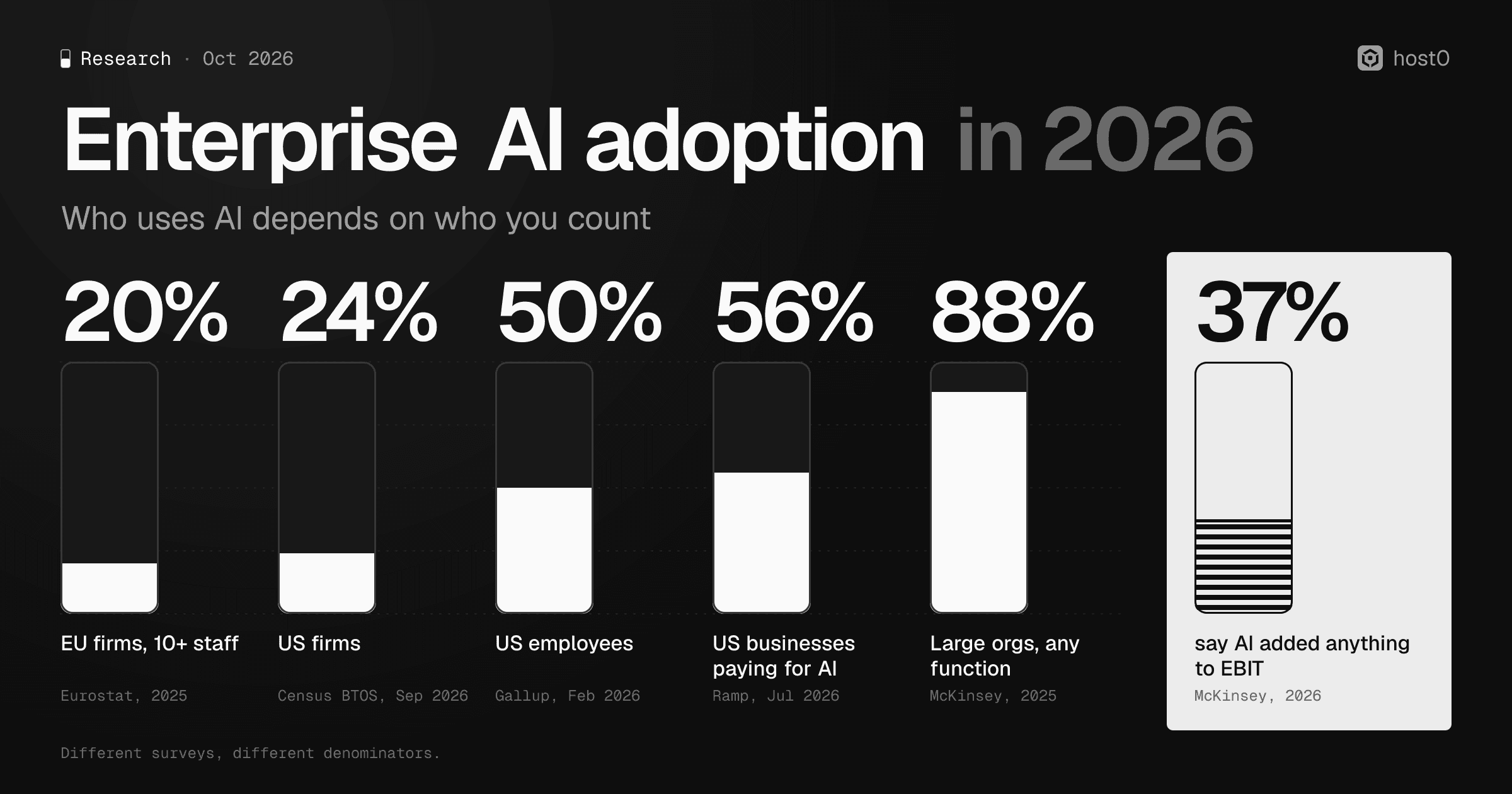
"Is your company using AI?" has at least five correct answers in 2026. About one US firm in four says yes when the Census Bureau asks. One EU firm in five says yes to Eurostat. Ramp, which sees the card and bill-pay spend of tens of thousands of US businesses, says more than half pay for an AI tool. McKinsey's survey of mostly large companies says almost nine in ten use it somewhere. And half of US employees tell Gallup they use it at work, whatever their employer says.
We collected the main adoption, spending, return-on-investment, governance and workforce numbers published up to 15 October 2026: government statistics (US Census, Eurostat), spend data (Ramp, Menlo Ventures), large surveys (McKinsey, Gallup, Wharton, S&P Global, ISACA), security telemetry (Netskope, Verizon, IBM) and vendor disclosures. Vendor and consultancy numbers are their own claims, and every number links to its source. The sandbox we researched from couldn't open most of these sites directly, so we checked each headline number against at least two independent reports. The methodology says what that means.
Key findings
- 1Firm-level adoption roughly doubled in a year, from a low base. About 24% of US firms used AI in a business function in early September 2026, up from 17.3% in November 2025, per trackers of the biweekly Census survey. In the EU it was 20.0% in 2025, up from 13.5% in 2024 and 8.0% in 2023.
- 2Size decides most of it. 55.0% of large EU firms use AI against 17.0% of small ones. Weighted by employees, US adoption is 32%, not 18%.
- 3Workers are ahead of their employers. Half of US employees used AI at work in February 2026, up from 21% in 2023. Personal accounts are fading as companies buy seats, but 30% of AI users still use only personal AI apps at work, and the shift stalled in March.
- 4Spending tripled. Enterprise generative-AI spend reached $37B in 2025, up from $11.5B in 2024 and $1.7B in 2023, per Menlo Ventures. Anthropic's share of enterprise LLM API spend went from 12% to 40% in two years while OpenAI's fell from 50% to 27%.
- 5Profit impact hasn't moved. In McKinsey's 2026 survey, 37% of respondents say AI contributed anything to EBIT, against 39% a year earlier, while large companies scaling AI agents rose from 27% to 40%.
- 6Failure is common and mostly quiet. 42% of companies abandoned most of their AI initiatives in S&P Global's 2025 survey, up from 17%. In Wharton's 2026 survey, 80% of leaders report positive ROI but only 28% strongly positive.
- 7Employees build faster than IT can govern. 84% of CIOs in a Dataiku-sponsored Harris poll say employees create AI agents and apps faster than IT can govern them. Only 38% of organizations have a formal, comprehensive AI policy.
- 8AI became the top stated reason for US layoffs, then faded. Employers cited AI in 112,713 announced job cuts from January to July 2026, twice the 2025 total. It led every month from March to July and dropped to fourth in August.
~24%
US firms using AI in a business function, early Sep 2026 (17.3% in Nov 2025)
Source: Census BTOS via trackers
37%
Respondents who say AI contributed anything to their company's EBIT, 2026 (39% in 2025)
Source: McKinsey
How many companies use AI#
The answer depends on who is counted and what counts as "use". The Census Bureau's Business Trends and Outlook Survey (BTOS) asks a representative sample of US employer firms every two weeks whether they used AI in the past two weeks. Eurostat asks EU firms with 10 or more employees once a year. Ramp counts the businesses on its corporate cards that paid an AI vendor that month. McKinsey surveys people at companies that answer its online questionnaire, which skews large.
The US series has a break. Until autumn 2025 the BTOS asked whether a firm used AI "in producing goods or services", and the answer crept from 3.7% in September 2023 to about 10% in September 2025. In November 2025 the Census Bureau widened the question to AI used "in any of its business functions", and the rate jumped to 17.3%. The Bureau's own May 2026 story says use then "hovered between 17% and 20%" through May, with the growth coming from firms with 20 or more employees. Third-party trackers of the biweekly data put it at 21.7% in July and 23.8% by early September, with about 28% expecting to use AI within six months.
US firms using AI, Census BTOS
Percent of US employer firms using AI in the past two weeks, Sep 2023 to Sep 2026
| Series | x | y |
|---|---|---|
| Old question: producing goods or services | Sep 2023 | 3.7% |
| Old question: producing goods or services | Feb 2024 | 5.4% |
| Old question: producing goods or services | Aug 2025 | 9.7% |
| Old question: producing goods or services | Sep 2025 | 10% |
| New question: any business function | Nov 2025 | 17.3% |
| New question: any business function | May 2026 | 19.8% |
| New question: any business function | Jul 2026 | 21.7% |
| New question: any business function | Sep 2026 | 23.8% |
Sources: Census CES-WP-24-16; EIG; Census; Start Business by State
Firm counts understate how many people work somewhere that uses AI, because large firms adopt first. A one-off Census AI supplement fielded from November 2025 to January 2026 found 18% of firms using AI in a business function but 32% on an employment-weighted basis. Most of those firms use it lightly: 66% only to augment tasks, and 57% in three or fewer functions. The EU shows the same gradient. Eurostat counts 55.0% of large enterprises using AI in 2025, 30.4% of medium ones and 17.0% of small ones, and a spread by country from 42.0% in Denmark to 5.2% in Romania.
EU enterprises using AI, by size
Percent of EU enterprises with 10+ employees using at least one AI technology, 2025
| Label | Value |
|---|---|
| Small (10–49) | 17% (11.2% in 2024) |
| All (10+ employees) | 20% (13.5% in 2024, 8.0% in 2023) |
| Medium (50–249) | 30.4% (20.9% in 2024) |
| Large (250+) | 55% (41.2% in 2024) |
Source: Eurostat
The private measures run higher. Ramp's index, which counts businesses that pay an AI vendor at all, reached 55.7% in July 2026. McKinsey's share of organizations using AI in at least one function was 88% in 2025, and "nearly nine in ten" again in 2026.
Workers got there first#
Workers adopted AI faster than their employers did. Gallup's quarterly workforce survey went from 21% of US employees using AI at work in 2023 to 40% in mid-2025 and 50% in February 2026 (n=23,717). Daily use is much smaller: 13%. Pew found 38% of employed US adults using chatbots for work tasks in February 2026.
US employees using AI at work
Percent of US employees, by frequency, Q2 2023 to Feb 2026
| Series | x | y |
|---|---|---|
| A few times a year or more | Jun 2023 | 21% |
| A few times a year or more | Jun 2025 | 40% |
| A few times a year or more | Sep 2025 | 45% |
| A few times a year or more | Dec 2025 | 46% |
| A few times a year or more | Feb 2026 | 50% |
| A few times a week or more | Jun 2025 | 19% |
| A few times a week or more | Sep 2025 | 23% |
| A few times a week or more | Dec 2025 | 26% |
| A few times a week or more | Feb 2026 | 28% |
| Daily | Jun 2025 | 8% |
| Daily | Sep 2025 | 10% |
| Daily | Dec 2025 | 12% |
| Daily | Feb 2026 | 13% |
Sources: Gallup; Gallup, Q3 2025
Half of employees using AI against a quarter of firms means a lot of use the firm didn't choose. In Microsoft's 2024 Work Trend Index, 78% of AI users said they brought their own AI tools to work. Network telemetry shows companies catching up by buying seats. Netskope saw the share of generative-AI users on personal apps fall from 78% to 47% in the year to October 2025, while use through company-managed accounts rose from 25% to 62%. In its AI Report 2026, 56% of AI users use only company-managed apps, 14% use both, and 30% use only personal apps. The decline stopped around March 2026. Verizon's 2026 breach report counts 45% of employees as regular AI users on corporate devices, up from 15%, and 67% of them reach it through non-corporate accounts.
Where the money goes#
Menlo Ventures, an Anthropic investor, estimates enterprise generative-AI spend from a survey of about 500 US decision-makers plus a bottom-up market model. On its restated method, spend went from $1.7B in 2023 to $11.5B in 2024 and $37B in 2025: $19B on applications and $18B on infrastructure, of which $12.5B was foundation-model APIs. Its 2025 survey also found that 76% of AI use cases were bought rather than built in-house, up from 53% in 2024.
Enterprise generative-AI spend
US$ per year, Menlo Ventures estimate (2025 method)
| Label | Value |
|---|---|
| 2023 | $1.7B |
| 2024 | $11.5B |
| 2025 | $37B |
Source: Menlo Ventures
The model market reversed in two years. By Menlo's estimate of enterprise LLM API spend, OpenAI had 50% at the end of 2023 and Anthropic 12%. By late 2025 Anthropic had 40%, OpenAI 27% and Google 21%, and in coding Anthropic had 54%. Ramp's spend data shows the same crossing on a different measure: in April 2026 more US businesses on Ramp paid Anthropic than OpenAI for the first time, 34.4% against 32.3%, and by July it was 43.5% against 39.7%.
The vendors' own numbers show where enterprise money lands. Microsoft reported 15 million paid Microsoft 365 Copilot seats in January, 20 million in April and more than 30 million in July 2026. Anthropic said the number of customers spending more than $1 million a year went from about a dozen two years earlier to more than 500 in February 2026 and more than 1,000 in April. OpenAI's CFO told investors in August that enterprise revenue had overtaken consumer. Forecasts keep rising too: Gartner's estimate of worldwide AI spending for 2026, which counts data-center hardware, went from $2.52 trillion in January to $2.67 trillion in September.
Agents: many pilots, few left alone#
2026 is the year surveys started asking about agents, and the answers depend on the wording. McKinsey found 40% of large organizations (over $1B in revenue) scaling AI agents in at least one function, up from 27% a year earlier, with smaller companies flat at 22%. KPMG's quarterly pulse of large US companies reports 62% "building, deploying or developing" agents in Q3 2026, a definition that includes development. Microsoft said nearly 40 million agents were registered in Agent 365 two months after launch.
Few of them work alone. In Wharton's 2026 survey, 67% of departments use agents but only 17% let one finish a task without approval at each step. Gartner predicted in June 2025 that over 40% of agentic AI projects will be canceled by the end of 2027, and in April 2026 that an average Fortune 500 company will have more than 150,000 agents by 2028. Both are forecasts, not measurements.
Does it pay off#
McKinsey's annual survey is the longest-running measure of return, and the line that matters didn't move. The share of respondents who say AI contributed anything at all to their company's EBIT was 39% in 2025 and 37% in 2026, "essentially unchanged". The "high performers" who attribute 5% or more of EBIT to AI stayed at about 6%. Meanwhile 80% of respondents say AI improved their own productivity.
Agents scaled, profit impact didn't
Percent of McKinsey survey respondents, 2025 and 2026
| Label | Value |
|---|---|
| Large orgs scaling AI agents, 2025 | 27% |
| Large orgs scaling AI agents, 2026 | 40% |
| AI contributed anything to EBIT, 2025 | 39% |
| AI contributed anything to EBIT, 2026 | 37% |
Source: McKinsey, The state of AI
Other surveys ask the question differently, and none of their numbers can be compared directly. Together they say most AI spending hasn't produced a measurable return yet.
What the ROI surveys say
Percent; each bar is a different question asked of a different sample
| Label | Value |
|---|---|
| Positive ROI from AI | 80% (Wharton–GBK, Jul 2026, 1,416 at US firms with 1,000+ staff) |
| Strongly positive ROI | 28% (Wharton–GBK, same sample) |
| AI contributed anything to EBIT | 37% (McKinsey, May–Jun 2026, 1,719 respondents) |
| AI use cases that fully met ROI expectations | 28% (Gartner, 782 infrastructure and operations leaders) |
| AI use cases that failed outright | 20% (Gartner, same sample) |
| Abandoned most AI initiatives | 42% (S&P Global, 2025, ~1,000 firms; 17% a year earlier) |
| Proofs of concept scrapped, on average | 46% (S&P Global, same sample) |
| No productivity or jobs impact in 3 years | >80% (NBER, ~6,000 executives in 4 countries) |
| Organizations "getting zero return" | 95% (MIT NANDA, 2025, interview-based) |
Sources: Wharton–GBK; McKinsey; Gartner via The Register; S&P Global via CIO Dive; NBER w34836; MIT NANDA via Fortune
Two of these deserve care. MIT NANDA's "95%" was the most-quoted AI statistic of 2025, but the report calls its figures directionally accurate and based on interviews, and it counted success as a deployment with measured KPIs six months after the pilot. S&P's 42% covers AI projects in general, not only generative AI.
Measured studies, as opposed to executives' answers, mostly find small effects so far. In Denmark, Humlum and Vestergaard linked chatbot adoption to administrative records and found no significant effect on earnings or recorded hours in any occupation. The executives in the NBER survey expect AI to raise productivity by 1.4% over the next three years. In METR's 2025 trial, experienced open-source developers were 19% slower with AI while believing they were faster. Its 2026 follow-up says later tools "likely" speed developers up but couldn't measure it cleanly, because developers refused to work without AI.
Shadow AI and governance#
Governance is catching up slowly. In ISACA's 2026 poll of more than 3,400 digital-trust professionals, 38% of organizations had a formal, comprehensive AI policy, up from 28% in 2025, and 25% had none. IBM's breach study found breaches involving AI models or applications at 21% of breached organizations in 2026, up from 13% in 2025, and 92% of those lacked proper AI access controls. Sanctioned tools leak too: in January 2026 a bug let Microsoft 365 Copilot Chat summarize emails marked confidential despite data-loss-prevention policies.
The next wave of unsanctioned AI isn't chat. It's software. In a Harris poll of 685 CIOs sponsored by Dataiku, 84% agree that employees create AI agents and applications faster than IT can govern them (94% in the US), and 81% lack complete oversight of agents built outside approved systems. Retool, surveying 817 of its own customers and builders, found 60% had built software outside IT oversight in the past year. In OneTrust's survey, 33% of organizations saw employees use unapproved AI because approved tools weren't available fast enough. Gartner now forecasts that by 2029 80% of new applications will be "intentionally disposable", built by non-technical staff for short-term needs, and advises tracking them in automated registries.
Shadow AI, by measure
Percent; surveys ask people, telemetry watches traffic, so the denominators differ
| Label | Value |
|---|---|
| AI users bringing their own AI to work | 78% (Microsoft / LinkedIn survey, 2024) |
| AI users on personal AI apps | 78% → 47% (Netskope telemetry, Oct 2024 → Oct 2025) |
| AI users on personal apps only | 30% (Netskope telemetry, to Jul 2026) |
| Corporate-device AI users on non-corporate accounts | 67% (Verizon DBIR 2026) |
| CIOs: staff build agents and apps faster than IT can govern | 84% (Dataiku / Harris, 685 CIOs (vendor)) |
| Builders who made software outside IT oversight | 60% (Retool, 817 of its own users) |
Sources: Microsoft WTI 2024; Netskope via Help Net Security; Netskope via IT Brief; Verizon DBIR 2026; Dataiku; Retool
Jobs: AI as the stated reason#
Challenger, Gray & Christmas counts announced US job cuts by the reason employers give. Employers cited AI in 54,836 cuts in all of 2025. In March 2026 AI became the most-cited reason for the first time, May set the record with 38,579 of 97,006 cuts, and by July the year's total was 112,713, about 23% of all announced cuts. In August AI fell to fourth, with 3,462. These are employers' stated reasons, not a measure of jobs replaced by AI, and some cuts were attributed to AI after the fact.
US job cuts where employers cited AI, 2026
Announced job cuts per month, Jan–Aug 2026
| Label | Value |
|---|---|
| Jan | 7,624 |
| Feb | 4,680 (derived) |
| Mar | 15,341 |
| Apr | 21,490 (derived) |
| May | 38,579 |
| Jun | 14,029 |
| Jul | 10,970 |
| Aug | 3,462 |
Sources: Challenger, Gray & Christmas; May report
The clearest measured effect is on young workers. Stanford's Digital Economy Lab, using ADP payroll data, finds employment of 22- to 25-year-olds in the most AI-exposed occupations 19% below the path of less-exposed peers in its August 2026 update, up from 13% in the first version a year earlier. It comes mostly from fewer hires, with no comparable gap for experienced workers. Some employers made the link explicit: Block cut more than 4,000 of its roughly 10,000 staff in February, citing "intelligence tools", and SAP froze hiring in July except for "mainly core AI roles". Measured across firms, though, the effect is small so far: the Census supplement found AI-related employment decreases at only 2% of firms.
Regulation slowed down#
The rules that were supposed to bite in 2026 mostly moved. The EU's "digital omnibus", Regulation (EU) 2026/1744, in force since 27 July 2026, pushed the AI Act's obligations for high-risk systems from August 2026 to December 2027, and to August 2028 for AI built into regulated products. In the US, Colorado's AI Act was due on 30 June 2026 and was replaced in May by a narrower disclosure law that takes effect in 2027.
AI rules for companies, as of October 2026
2 Aug 2025
2 Aug 2025
EU: obligations for general-purpose AI models apply
Providers of models like GPT, Claude and Gemini.14 May 2026
14 May 2026
Colorado replaces its AI Act
SB 26-189 swaps risk programs and impact assessments for a narrower disclosure law, effective 1 Jan 2027. The 30 June 2026 date never took effect.Source: Holland & Knight
27 Jul 2026
27 Jul 2026
EU digital omnibus enters into force
Regulation (EU) 2026/1744 postpones the high-risk obligations.Source: EUR-Lex
2 Aug 2026
2 Aug 2026
EU: transparency duties apply
Article 50: telling people they're dealing with AI, labelling AI-generated content. Not postponed.2 Dec 2027
2 Dec 2027
EU: high-risk obligations, stand-alone systems
AI used in hiring, credit, education and similar areas. Originally 2 August 2026.Source: Council of the EU
2 Aug 2028
2 Aug 2028
EU: high-risk obligations, AI in regulated products
Originally 2 August 2027.
What this means if you run AI at a company#
- Measure the denominator you care about. "Do we use AI?" is answered. The useful questions are how many people use it weekly, for which tasks, and what changed afterwards. Almost every public statistic is binary, and the few that measure depth (share of work hours, number of functions) say use is still shallow.
- Budget for the long tail, not the pilot. Deloitte's respondents say a typical AI use case takes two to four years to reach satisfactory ROI. A pilot judged at six months will usually look like a failure.
- Sanctioned tools beat bans. Personal-account use fell fastest where companies bought seats, and a third of organizations saw shadow AI because approved tools came too slowly. A ban moves the use somewhere you can't see it.
- Plan for software, not just chat. Employees now build agents, dashboards and internal apps with coding agents. Decide where those live, who can open them, and how one gets retired, before there are hundreds of them.
- Keep a person in the loop where it's cheap to. Most departments still approve each agent step, and Gartner expects many agentic projects to be canceled. Start agents on reversible work.
- Don't wait for regulation to set your policy. The EU's high-risk rules moved to late 2027, but its transparency duties already apply, and breaches involving AI are rising regardless of the law.
The tools employees build with AI are usually small: a tracker, a report, a calculator for one team. We built host0 to give them a private link that only invited colleagues can open, with a shared database and one-click restore, so they don't end up on a personal account.
Methodology#
We gathered these numbers on 15 October 2026 with three parallel research passes: adoption rates, spend and ROI, and shadow AI, governance and jobs. The network we researched from blocked most primary sites (census.gov, Eurostat, Ramp, McKinsey, Gallup, Gartner, Menlo), so for each headline number we required either the primary page's own text in search results plus one independent report, or two or more independent reports that agree. Menlo's 2025 figures were read directly in an earlier research pass. Where a newer figure couldn't be confirmed this way, we used the latest confirmed one: Ramp's July index instead of September, Gallup's February survey instead of May, and Challenger's totals through July and the August month instead of September.
- Firm adoption comes from the Census BTOS (a representative biweekly sample of about 200,000 US employer firms) and Eurostat's annual ICT survey of EU firms with 10+ employees. The BTOS question changed in November 2025, so the two US lines can't be joined. The BTOS readings after May 2026 come from third-party trackers of the published biweekly estimates.
- Ramp counts firms using its corporate cards and bill pay that paid an AI vendor in a month. They skew toward tech-forward mid-market US companies, and Ramp revises past months.
- McKinsey, Wharton, KPMG, Gartner, S&P, ISACA, Dataiku, Retool and OneTrust are surveys of executives or practitioners, often at large companies, and their answers are self-reported. Dataiku, Retool and OneTrust sell governance or building tools, and Retool surveyed its own users.
- Menlo Ventures is an Anthropic investor. Its spend and share figures are estimates from a survey plus a market model.
- Netskope, Verizon and IBM report what their security products and breach investigations see, which differs from what employees say in surveys.
- Challenger counts announced cuts by the reason the employer gives. February and April 2026 are derived from its year-to-date totals.
The full data pack, with tiers, quotes, spot-check log and a do-not-cite list, is in our repository at docs/research/2026-10-15-enterprise-ai-adoption.md.
Open questions#
- What gets built. No survey counts the internal apps, dashboards and agents employees build with AI, or asks where they're hosted and who can open them. Vendor surveys say most of it happens outside IT, but nobody measures how much there is.
- Depth of use. Almost every adoption number is yes-or-no. The St. Louis Fed's estimate of the share of work hours spent with AI, the Census count of functions and the frequency splits are the only depth measures, and they're thin.
- Agents in production. No official statistic asks about agents. Consultancy surveys define "using agents" differently every quarter.
- ROI from data, not answers. "EBIT impact" is self-reported. Large measured studies (Denmark, METR) cover chatbots and coding, and most stop in 2025.
- A bridged BTOS series. The Census Bureau hasn't published one across the November 2025 question change, so the true 2023 to 2026 growth in US firm adoption is unknown.