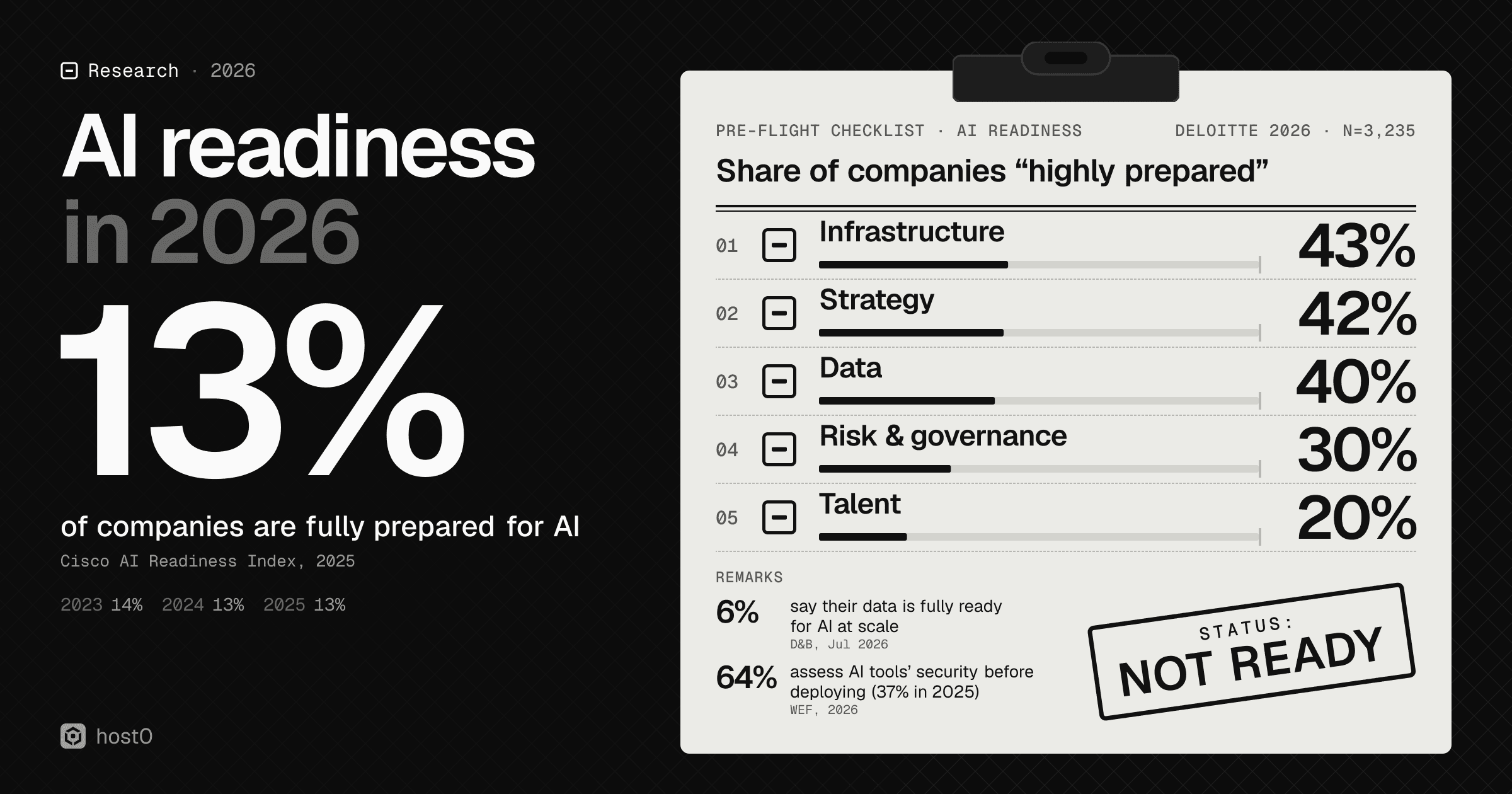
Most companies now use AI somewhere, and most of them plan to use more. Whether they're ready for it is a different question, and the answer has barely moved in three years. Cisco has asked about 8,000 leaders the same readiness questions every year since 2023, and the share it calls fully prepared went from 14% to 13% and stayed there. When surveys offer "fully ready" as an answer about company data, fewer than one company in ten picks it.
This post collects the readiness numbers published up to 16 October 2026 across five areas: data, security, governance and boards, skills, and regulation. They come from large surveys (Cisco, Deloitte, WEF, ISACA, Gallup), security telemetry (Netskope, Verizon, Cyberhaven, LayerX), breach studies (IBM), board disclosures (Conference Board, EY) and regulators. How many companies use AI, what they spend and what they get back is in our sibling post, Enterprise AI adoption in 2026. Almost every number here comes from a firm that sells the fix, so we name the sponsor and treat vendor numbers as their claims. The methodology says how we checked them.
Key findings
- 1Overall readiness is flat. Cisco's share of "Pacesetters", the companies it calls fully prepared, was 14% in 2023, 13% in 2024 and 13% in 2025, while 83% planned to deploy AI agents.
- 2Data is rarely ready. Only 6% of 10,000 firms told Dun & Bradstreet in July 2026 that their data is fully ready for AI at scale. In other surveys that offer the option, 7% to 9% say so.
- 3Talent and governance trail strategy. In Deloitte's 2026 survey of 3,235 leaders, 42% call their AI strategy highly prepared, but only 30% say that of risk and governance and 20% of talent.
- 4Security reviews caught up fast. The share of respondents with a process to assess AI tools' security before deploying them went from 37% to 64% in a year, per the World Economic Forum. 29% still have none.
- 5Data protection didn't. Netskope says half of organizations still have no enforceable data-loss-prevention policy for AI apps, while AI-related policy violations doubled to 223 per organization per month.
- 6Boards list the risk more than they govern it. 83% of the S&P 500 disclosed AI as a risk by the end of 2025, up from 12% in 2023. Only 23% of boards in an NACD survey had audited where AI is used in their company.
- 7Employees lack a plan and training. 25% of US employees say their organization has communicated a clear AI plan, and 36% of workers in BCG's surveys feel adequately trained, unchanged from 2025 to 2026.
- 8The rules slipped, the paperwork is thin. The EU pushed its high-risk AI obligations to December 2027. Only 271 accredited ISO/IEC 42001 certificates for AI management systems existed worldwide at the end of 2025.
13%
Companies fully prepared for AI (Cisco Pacesetters), 2025; 14% in 2023, 13% in 2024
Source: Cisco AI Readiness Index
6%
Firms saying their data is fully ready for AI at scale, Jul 2026 (10,000 firms)
Source: Dun & Bradstreet
64%
Organizations assessing AI tools' security before deploying them, 2026 (37% in 2025)
Source: WEF Global Cybersecurity Outlook
Overall readiness hasn't moved#
Two large surveys score readiness area by area. Cisco's AI Readiness Index asks about 8,000 leaders at companies with 500 or more employees in 30 markets the same questions each year, across six pillars: strategy, infrastructure, data, governance, talent and culture. It puts companies scoring 86 or more out of 100 in a top tier it calls "Pacesetters" and describes as fully prepared. That tier was 14% in 2023, 13% in 2024 and 13% in 2025. Cisco sells the networking and security gear that its pillars measure, so read its framing with that in mind, but the method hasn't changed and the result is the same three years running.
Companies fully prepared for AI
Percent of companies in Cisco's top readiness tier (Pacesetters), 2023–2025
| Label | Value |
|---|---|
| 2023 | 14% |
| 2024 | 13% |
| 2025 | 13% |
Sources: Cisco 2023; Cisco 2024; Cisco 2025
Deloitte's State of AI in the Enterprise 2026, fielded in August and September 2025 with 3,235 director-to-C-suite leaders in 24 countries, asks how prepared each area is to adopt AI broadly. Strategy and governance, which depend mostly on executive decisions, improved. Infrastructure, data and talent, which take years to change, slipped. Talent comes last, and Deloitte names insufficient worker skills as the biggest barrier to integrating AI into workflows. Only 21% have a mature model for governing autonomous agents.
Where companies say they're highly prepared for AI
Percent of leaders rating each area highly prepared, Deloitte 2026 (n=3,235)
| Label | Value |
|---|---|
| Technology infrastructure | 43% (−4 pts) |
| Strategy | 42% (+3 pts) |
| Data management | 40% (−3 pts) |
| Risk and governance | 30% (+6 pts) |
| Talent | 20% (−2 pts) |
The Pacesetters are not the only way to read Cisco's 2025 data. Looking at all respondents, most have a strategy but few have the plumbing under it: 59% have a clear AI strategy, 35% have clean, centralized data with real-time integration for agents, and 24% control agent actions with guardrails and live monitoring. Among Pacesetters, each of those is above 80%.
Strategy is ahead of the foundations
Percent of all companies in Cisco's 2025 index with each capability
| Label | Value |
|---|---|
| Have a clear AI strategy | 59% (Pacesetters 99%) |
| Clean, centralized data for AI agents | 35% (Pacesetters 93%) |
| Fully capable of securing agentic AI | 31% |
| Guardrails and live monitoring on agent actions | 24% (Pacesetters 84%) |
| In-house data fully centralized | 19% (Pacesetters 76%) |
Source: Cisco AI Readiness Index 2025
Other indices agree on the shape if not the numbers. McKinsey found 1% of leaders calling their companies "mature" in AI deployment, and Accenture counts 8% as front-runners that are scaling AI.
Data: few say it's fully ready#
Data is where surveys get the starkest answers, because many of them offer a clear "fully ready" option. Dun & Bradstreet, which sells business data, runs a quarterly survey of 10,000 businesses in 32 countries. In July 2026, 47% called their data partially ready for AI, 36% mostly ready and 6% fully ready. Its earlier 2026 wave had 5%. In a Cloudera-sponsored Harvard Business Review Analytic Services survey, 7% said their data was completely ready, and siloed data was the top obstacle.
Is our data ready for AI? It depends how you ask
Percent of respondents; each bar is a different survey question, 2025–2026
| Label | Value |
|---|---|
| Data fully ready for AI at scale (D&B) | 6% (Jul 2026) |
| Data completely ready (Cloudera, HBR-AS) | 7% (Mar 2026) |
| All data usable for AI (Cloudera) | 9% (Sep 2025) |
| Data fully governed (Cloudera) | 18% (Apr 2026) |
| In-house data fully centralized (Cisco) | 19% (Oct 2025) |
| CDOs confident data supports AI revenue (IBM) | 26% (Nov 2025) |
| High or full data preparedness (Cisco) | 34% (Oct 2025) |
Sources: D&B; Cloudera / HBR-AS; Cloudera 2025; Cloudera 2026; Cisco; IBM
Confidence runs well ahead of these answers. In Cloudera's own index of 1,270 IT leaders, 84% felt confident in their data but 18% said it was fully governed. A Gartner survey of data management leaders found 63% either lack or aren't sure they have the right data management practices for AI, and Gartner predicts companies will abandon 60% of AI projects that aren't supported by AI-ready data through 2026.
The problems are old ones. Cisco found 81% of companies with data in silos in 2023 and 82% with fragmented data in 2024, "exactly the same number as last year". Salesforce's survey of 3,800 data and analytics leaders, fielded in mid-2025, has them estimating that 26% of their data is untrustworthy and 19% siloed, inaccessible or unusable. Only 43% have formal data governance, and 84% say their data strategy needs a complete overhaul before their AI plans can work. Unstructured data is harder still. A Gartner analyst estimated 70% to 90% of enterprise data is unstructured, and only 26% of chief data officers in IBM's study were confident they could use it to deliver value.
When AI projects stall, data is the usual suspect. Every bar below is a different question asked of a different sample.
Data as the reason AI stalls
Percent of respondents; each bar is a different question from a vendor survey, 2024–2026
| Label | Value |
|---|---|
| Data reliability is a barrier to moving gen AI to production | 91% (Informatica) |
| Seen inaccurate or misleading AI outputs, AI in production | 89% (Salesforce) |
| Data strategy needs a complete overhaul for AI | 84% (Salesforce) |
| Avoided some gen-AI use cases over data issues | 55% (Deloitte) |
| Over half of AI projects hit by data readiness | 42% (Fivetran) |
Sources: Informatica via IntelligentCIO; Salesforce; Deloitte; Fivetran via IT Brief
Informatica's survey of 600 data leaders, run with Deloitte, also found 76% saying their company's visibility and governance haven't fully kept pace with employees' use of AI. One counterpoint: when Gartner asked AI leaders in late 2023, the top barrier was estimating and demonstrating value (49%), not data.
Security: reviews improved, controls lag#
The clearest improvement in any readiness series is in security reviews. The World Economic Forum's Global Cybersecurity Outlook asks whether organizations have a process to assess the security of AI tools before deploying them. 37% said yes in the 2025 edition and 64% in 2026. The samples differ (321 qualified respondents, then 804), so this is the share of respondents, not the same companies improving. The same 2026 survey found 87% naming AI-related vulnerabilities as the fastest-growing cyber risk of 2025, and data leaks overtook attackers' new capabilities as the top worry about generative AI.
Checking AI tools before deploying them
Percent of WEF Global Cybersecurity Outlook respondents, 2025 and 2026
| Label | Value |
|---|---|
| Have a process, 2025 | 37% (n=321) |
| Have a process, 2026 | 64% (n=804) |
| Review AI tools periodically, 2026 | 40% |
| Reviewed once before deploying, 2026 | 24% |
| No process, 2026 | 29% |
| Don't know, 2026 | 7% |
Sources: WEF GCO 2025; WEF GCO 2026
Controls on the data flowing into AI tools moved much more slowly. Netskope, which sells data-loss prevention (DLP), sees its customers' traffic. The share using DLP to control what goes into generative-AI apps went from 42% in summer 2024 to 45% at the end of 2024, 47% in mid-2025 and 50% by October 2025. The other half have no enforceable data-protection policy for AI, though 63% use DLP for personal cloud apps. Meanwhile AI data-policy violations doubled to 223 per organization per month, mostly source code (42%) and regulated data (32%).
Organizations using DLP on AI apps
Percent of Netskope customers using data-loss prevention to control data sent to generative-AI apps, 2024–2025
| Label | Value |
|---|---|
| Summer 2024 | 42% |
| End 2024 | 45% |
| Mid-2025 | 47% |
| Oct 2025 | 50% |
Sources: Netskope C&T 2025; Netskope GenAI 2025; Netskope C&T 2026
What goes into those tools is increasingly sensitive. Cyberhaven, which watches data movement for its customers, says the sensitive share of corporate data employees put into AI tools rose from 10.7% to 27.4% to 34.8% over two years, measured across 7 million workers. Much of it leaves through accounts the company doesn't control. Verizon's 2026 breach report counts 45% of employees as regular AI users on corporate devices, up from 15% a year earlier, and 67% of users reach AI services from those devices through non-corporate accounts. LayerX's browser telemetry finds 77% of users pasting data into AI tools, mostly from unmanaged accounts, which makes generative AI the top channel (32%) for corporate data moving to personal accounts.
Data flowing into AI tools
Percent; telemetry from each vendor's customers, 2025–2026
| Label | Value |
|---|---|
| Users who paste data into AI tools | 77% (LayerX) |
| AI users on non-corporate accounts | 67% (Verizon) |
| Employees regularly using AI on work devices | 45% (Verizon) |
| Sensitive share of data put into AI tools | 34.8% (Cyberhaven) |
| AI's share of corporate-to-personal data exfiltration | 32% (LayerX) |
Sources: LayerX; Verizon DBIR 2026; Cyberhaven
The AI systems themselves are now targets. IBM's breach study, which covers only organizations that had a breach, found 13% reporting breaches of AI models or applications in 2025, and 97% of those lacked proper AI access controls. In 2026 IBM says more than 20% did (21% in summaries of the report). In a Gartner survey of 302 cybersecurity leaders, 32% had an attack on AI applications that leveraged the application prompt in the previous 12 months, which is prompt injection in practice, and 29% an attack on generative-AI app infrastructure. Identity is the other gap: 68% of organizations in CyberArk's survey lack identity security controls for AI, with 82 machine identities for every human.
AI security gaps, by measure
Percent; surveys and breach studies, 2025–2026
| Label | Value |
|---|---|
| AI-breached orgs lacking AI access controls | 97% (IBM 2025) |
| Lack data and AI security practices | 77% (Accenture) |
| Lack identity security controls for AI | 68% (CyberArk) |
| Had an attack that used the app's prompt | 32% (Gartner) |
| Had an attack on gen-AI app infrastructure | 29% (Gartner) |
| Breached orgs with a breach of AI models or apps | >20% (IBM 2026) |
Governance and boards#
Written AI policy is spreading but still a minority. In ISACA's polls of digital-trust professionals, the share of organizations with a formal, comprehensive AI policy went from 28% in 2025 to 38% in 2026, and the share training all employees on AI from 22% to 33%. In 2024 only 15% "had AI policies" at all, a looser question. The 2026 poll also found that 56% don't know how long it would take to halt an AI system during a security incident. The sibling post covers how far employee AI use runs ahead of these policies.
AI policy and training
Percent of organizations, ISACA AI Pulse Poll, 2025 and 2026
| Label | Value |
|---|---|
| Policy, 2025 | 28% |
| Policy, 2026 | 38% |
| Training, 2025 | 22% |
| Training, 2026 | 33% |
Source: ISACA
Boards moved faster on disclosure than on oversight. The Conference Board counts S&P 500 companies naming AI as a risk in their filings: 12% in 2023, 58% in 2024, 72% in filings to mid-August 2025 and 83% by December 2025. The same report found the share of directors with disclosed AI expertise went from 1.5% in 2021 to 2.7% in 2025.
S&P 500 companies disclosing AI as a risk
Percent of S&P 500 companies, 2023–2025
| Label | Value |
|---|---|
| 2023 | 12% |
| 2024 | 58% |
| 2025, to mid-Aug | 72% |
| 2025, full year | 83% |
Sources: Conference Board, Oct 2025; Fortune (2024 figure); Conference Board, Apr 2026
EY's review of 80 Fortune 100 companies' 2025 filings shows the same pattern at the largest companies. Almost nine in ten list AI as a risk factor. Fewer say who on the board oversees it, and almost none describe training directors on it.
AI in Fortune 100 filings
Percent of 80 Fortune 100 companies, 2025 filings (2024 in notes)
| Label | Value |
|---|---|
| AI as a risk factor | 89% (69% in 2024) |
| AI in board risk oversight | 48% (16% in 2024) |
| AI expertise sought or held on the board | 44% (26% in 2024) |
| A board committee charged with AI | 40% (11% in 2024) |
| AI as a stand-alone risk factor | 36% (14% in 2024) |
| Board AI education disclosed | 11% (8% in 2024) |
Source: EY Center for Board Matters
Directors' own answers line up. In a 2025 NACD survey of 146 public-company directors, 62% of boards had set aside agenda time for AI and 49% had assessed AI risks, but 36% had adopted an AI governance framework, 23% had audited where AI is used in the company and 18% had an AI education plan for directors. Without that audit, a board can't know what its AI risk disclosure covers.
Skills: plans and training trail use#
Employees are using AI faster than their employers explain it. Gallup's surveys of US employees show the share saying their organization has communicated a clear plan for AI rising from 15% in 2024 to 22% in 2025 and 25% in May 2026. In the same 2026 reading, 47% said their organization had integrated AI tools.
Employees told of a clear AI plan
Percent of US employees saying their organization has communicated a clear AI plan, 2024–2026
| Label | Value |
|---|---|
| 2024 | 15% |
| 2025 | 22% |
| May 2026 | 25% |
Sources: Gallup 2024; Gallup 2025; Gallup indicator
Training is the same story. BCG's 2025 survey of more than 10,600 workers found 36% feel adequately trained, and its June 2026 edition reported the same 36% while regular use among frontline workers jumped from 51% to 74%. BCG links five or more hours of training to regular use. The KPMG and University of Melbourne study of 48,340 people in 47 countries found 47% had received any AI training and 40% said their workplace had a policy or guidance on generative AI, and "almost half" admitted using AI in ways that break company policy.
AI training, by who is asked
Percent; each bar is a different survey and denominator, 2024–2026
| Label | Value |
|---|---|
| Employees who received any AI training | 47% (KPMG) |
| AI users trained by their company | 39% (Microsoft, 2024) |
| Workers who feel adequately trained | 36% (BCG) |
| Organizations training all employees | 33% (ISACA, 2026) |
| German workers trained by their employer | 20% (Bitkom, 2025) |
Sources: KPMG / University of Melbourne; Microsoft WTI 2024; BCG; ISACA; Bitkom via CIO.de
Regulation: deadlines moved, readiness didn't#
The EU's digital omnibus, Regulation (EU) 2026/1744, entered into force on 27 July 2026 and pushed the AI Act's obligations for stand-alone high-risk systems from August 2026 to 2 December 2027, and for AI built into regulated products to 2 August 2028. It didn't defer the bans or the duties on general-purpose models, and most transparency duties still apply from 2 August 2026; machine-readable marking of AI-generated content moved to 2 December 2026. Companies weren't ready for the original dates: in Littler's survey of more than 400 European employers in late 2025, only 18% were very prepared to comply with the AI Act and 20% not at all.
AI rules and readiness markers, as of October 2026
2 Feb 2025
2 Feb 2025
EU: AI literacy duty and bans apply
Article 4 asks companies to make sure staff using AI have enough AI literacy.2 Aug 2025
2 Aug 2025
EU: duties for general-purpose AI models apply
Providers of models like GPT, Claude and Gemini.19 Nov 2025
19 Nov 2025
18% of European employers very prepared
Littler's survey of 400+ employers on AI Act compliance.Source: Littler
27 Jul 2026
27 Jul 2026
EU digital omnibus enters into force
Regulation (EU) 2026/1744 postpones the high-risk obligations.Source: EUR-Lex
2 Aug 2026
2 Aug 2026
EU: most transparency duties apply
Telling people they're dealing with AI and labelling deepfakes. Machine-readable marking of AI output moved to 2 December 2026.Source: William Fry
2 Dec 2027
2 Dec 2027
EU: high-risk obligations, stand-alone systems
AI used in hiring, credit, education and similar areas. Originally 2 August 2026.2 Aug 2028
2 Aug 2028
EU: high-risk obligations, AI in regulated products
Originally 2 August 2027.
In the US, rules arrive state by state. The NYU Center on Technology Policy counted 159 AI laws enacted by states in 2025, and 109 by 1 July 2026, against 121 by the same date a year earlier. Colorado's broad AI Act, due on 30 June 2026, was replaced in May by a narrower disclosure law that takes effect in 2027. Only 9% of executives in a Conference Board survey of 130, mostly at US public companies, said they were very prepared for AI regulation.
Formal certification is rare. ISO/IEC 42001, the standard for an AI management system, had 271 accredited certificates worldwide at the end of 2025, its first year in the ISO Survey, out of about 3.3 million accredited ISO certificates. The count includes only certificates in the IAF CertSearch database, so the real number is somewhat higher.
What this means if you're rolling out AI#
- Find out what you already run. Only 23% of boards in NACD's survey had audited where AI is used. An inventory of tools, agents and the data they touch comes before any policy can be enforced.
- Fix data for one use case at a time. Almost nobody says their data is fully ready, and Gartner's research says AI-ready data "cannot be achieved through one-time data preparation". Pick the use case, then make that data clean, governed and reachable.
- Put controls where the data leaves. Assessment processes nearly doubled in a year; DLP on AI apps grew eight points in fifteen months. A review at purchase time doesn't see what employees paste into a personal account afterwards.
- Give agents and AI tools their own identities and access controls. In IBM's 2025 study, 97% of organizations whose AI systems were breached lacked proper AI access controls. Treat an agent like a new employee with a scoped account, not a shared key.
- Train before you mandate. A third or fewer of employees are trained or have heard a clear plan, and BCG links five hours of training to regular use. Budget for it like any other rollout.
- Don't plan around the regulatory delay. The EU's high-risk deadline moved to December 2027, but most of its transparency duties already apply, US state laws keep coming, and attackers aren't waiting for either.
A lot of what employees now build with AI is small software: a tracker, a dashboard, a report for one team. We built host0 to host whatever your agent creates at a link that's private by default and shared with colleagues by email, so an agent-built tool doesn't end up on someone's personal account.
Methodology#
We gathered these numbers on 16 October 2026 with three parallel research passes (data readiness, security readiness, and governance, boards, skills and regulation), then merged and checked them. We read these primary documents in full: the Cisco AI Readiness Index 2023, 2024 and 2025, Deloitte's State of AI in the Enterprise 2026, the WEF Global Cybersecurity Outlook 2025 and 2026, Verizon's DBIR 2025 and 2026, LayerX's and Cyberhaven's reports, EY's Fortune 100 review, and Netskope's Cloud and Threat reports. Several sites blocked us (Gartner, McKinsey, BCG, ServiceNow, PwC), so for those we required the primary page's text in search results plus an independent report, or two reports that agree. We then re-checked about 20 headline numbers against the live pages.
- Composite indices (Cisco, Deloitte) are self-assessments by senior leaders at large companies. Cisco's Pacesetters are companies scoring 86+ out of 100 across six weighted pillars; Deloitte's "highly prepared" is the top of a four-point scale.
- Data readiness surveys are mostly sponsored by data vendors (D&B, Cloudera, Salesforce, Informatica, Fivetran), who have an interest in data being the bottleneck. We show them as separate bars, never as one series.
- Security numbers mix self-reported surveys (WEF, Gartner, CyberArk, Accenture), breach studies that only include breached organizations (IBM), and telemetry from each vendor's own customers (Netskope, Verizon's partners, Cyberhaven, LayerX). The WEF samples changed from 321 to 804 respondents between editions. IBM's 2026 figures beyond "more than 20%" come from summaries of the report, which is gated.
- Governance includes the S&P 500 and Fortune 100 filings counted by the Conference Board and EY, which measure what companies disclose, not what they do. NACD's board survey has 146 respondents.
- Skills surveys use different denominators: all employees, AI users, or organizations.
- Regulation dates come from the EU Official Journal and law-firm summaries of it. The ISO 42001 count comes from a certification body reproducing the ISO Survey table.
The full data pack, with tiers, quotes, the conflicts we resolved, a spot-check log and a do-not-cite list, is in our repository at docs/research/2026-10-16-ai-readiness.md.
Open questions#
- What employees build. No survey counts the internal apps, dashboards and agents employees build with AI, where they're hosted, or who can open them. The closest measures are NACD's 23% of boards that audited AI use and a vendor's 38% of companies with a complete AI inventory.
- A 2026 readiness reading. Cisco's index for 2026 wasn't out by mid-October. It's the next point on the 14, 13, 13 series.
- Readiness after the EU delay. No survey has asked about AI Act readiness since the omnibus took effect in July 2026.
- Attacks on AI apps in production. Gartner's 32% is self-reported by security leaders. Nobody publishes measured prompt-injection rates per application.
- Gartner's sample. Its 63% figure on AI-ready data practices is published with two different sample sizes on the same page.