Agencies sell people's time. An ad agency bills for the hours its strategists, copywriters, designers and media buyers spend on a client's work, and a PR firm, an SEO shop, a translation agency or an IT outsourcer works the same way. Generative AI makes much of that production cheap, and the ad platforms now automate the media buying that agencies used to do by hand. So the agency business is where you'd expect AI to show up first, and the question is whether it has.
We collected the numbers published up to 16 October 2026: US government jobs and pay data read from the Bureau of Labor Statistics' own files, job postings from Indeed, holding-company filings, Meta's earnings calls, share prices, client and agency surveys, freelance marketplaces' filings and the academic studies. For how companies in general adopt AI, see Enterprise AI adoption in 2026 and Small business AI adoption in 2026. The data show who is losing and who isn't. They don't show that AI caused the losses: rates, the ad cycle and mergers moved at the same time, and we say where. Vendor and survey numbers are their sponsors' claims. The methodology says how we checked them.
Key findings
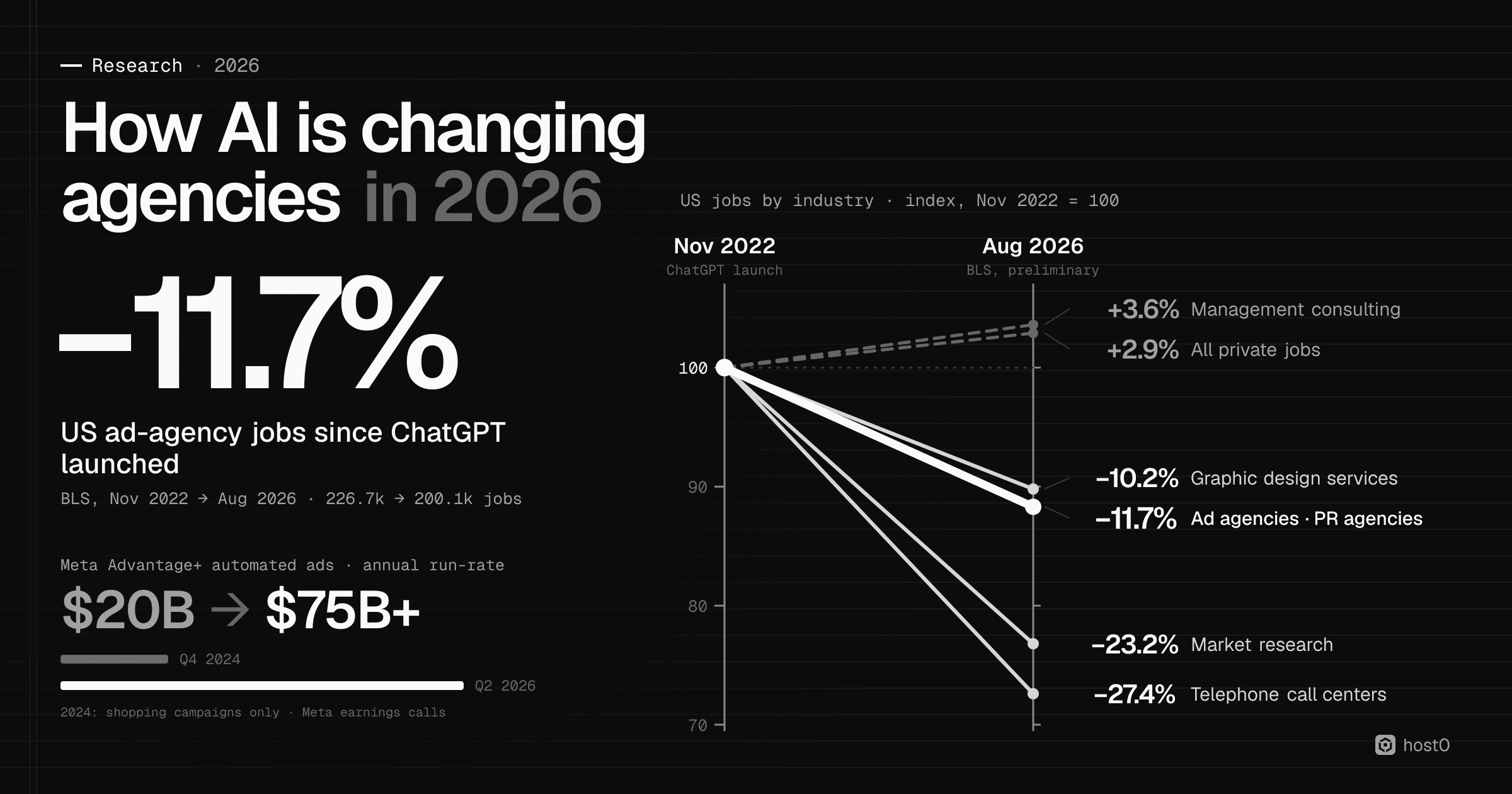
- 1Agency jobs shrank while the economy grew. US advertising-agency employment fell 11.7% between November 2022 and August 2026 (preliminary), per BLS payroll data, and PR agencies fell by the same share. Graphic design services fell 10.2% and market research 23.2%. Private employment rose 2.9%.
- 2The platforms are doing the media job. The annual revenue run-rate through Meta's automated Advantage+ campaigns went from $20 billion (Q4 2024, shopping campaigns only) to more than $75 billion in Q2 2026, and automation is now on by default.
- 3The holding companies split. WPP's headcount fell 15.7% from end-2022 to mid-2026 and its shares halved. Publicis kept growing 5.6% to 6.3% a year organically, added staff and calls AI a growth driver; its shares are up 72%.
- 4Production roles shrink, in-house marketing roles grow. Between 2022 and 2025, US employment of writers fell 11.2% and web developers 20.8%, while marketing managers rose 20.3%, per BLS occupation data. 82% of ANA members had an in-house agency in 2023.
- 5Clients want to pay less, agencies mostly haven't cut prices. 58% of big advertisers in a WFA survey link AI to lower agency fees. About one agency in three says it has been asked for an "AI discount", and 13% say they have cut prices, per a vendor survey. 61% of US agencies treat AI as a cost of doing business; 6% sell it.
- 6Call centres fell furthest. US call-center employment is down 27.4% from November 2022 to August 2026 (preliminary), and contact-centre outsourcers' shares are down 58% to 77%. Management consulting employment is near its highest, and Accenture employs more people than ever.
- 7Freelance buyers are leaving the marketplaces. Fiverr's active buyers fell 37% from 2022 to mid-2026 while each remaining buyer spends more. A study of a large freelance platform found posts for automatable writing and coding jobs fell 21% within eight months of ChatGPT.
- 8The industry is fragmenting. The number of US ad-agency establishments nearly doubled between 2019 and 2026 while employment didn't grow: the average agency went from 9.6 employees to 5.1.
$75B+
Annual run-rate through Meta's automated Advantage+ ads, Q2 2026 ($20B in Q4 2024, shopping only)
Source: Meta Q2 2026 call
Agency jobs since ChatGPT#
The Bureau of Labor Statistics' payroll survey counts jobs by industry every month. We indexed each agency industry to November 2022, the month ChatGPT launched, and read the values for August 2026, the latest month for these detailed series, which BLS marks as preliminary. Advertising agencies went from 226,700 jobs to 200,100, down 11.7% and below their February 2020 level. PR agencies fell by the same share, graphic design services by 10.2%, and market research and polling firms by 23.2%. Over the same months private employment grew 2.9% and management consulting 3.6%.
US jobs by industry since ChatGPT
Employment index, Nov 2022 = 100, value in Aug 2026 (preliminary), seasonally adjusted
| Label | Value |
|---|---|
| Management consulting | 103.6 (+3.6%) |
| All private jobs | 102.9 (+2.9%) |
| Graphic design services | 89.8 (−10.2%) |
| Advertising agencies | 88.3 (−11.7%) |
| PR agencies | 88.3 (−11.7%) |
| Market research and polling | 76.8 (−23.2%) |
| Telephone call centers | 72.6 (−27.4%) |
The timing fits AI, but so do other things. Ad agencies had boomed before ChatGPT: their payrolls grew about 17% between January 2021 and November 2022, so ChatGPT launched close to a peak. Interest rates rose through 2023, ad budgets slowed that year, and the holding companies restructured (WPP's cost programme, Omnicom's takeover of IPG, Dentsu's international cuts). Call centres were shrinking long before generative AI, from an index of 119.6 in January 2019. None of these series can say how much of the fall is AI.
Ad agencies and call centres vs all jobs
US employment index, Nov 2022 = 100, Jan 2019 – Aug 2026 (preliminary), seasonally adjusted
| Series | x | y |
|---|---|---|
| Ad agencies | Jan 2019 | 90.6 |
| Ad agencies | Jul 2019 | 90.5 |
| Ad agencies | Jan 2020 | 90.3 |
| Ad agencies | Jul 2020 | 83.2 |
| Ad agencies | Jan 2021 | 85.3 |
| Ad agencies | Jul 2021 | 91.1 |
| Ad agencies | Jan 2022 | 95.1 |
| Ad agencies | Jul 2022 | 98.8 |
| Ad agencies | Nov 2022 | 100 |
| Ad agencies | Jan 2023 | 99.8 |
| Ad agencies | Jul 2023 | 99.5 |
| Ad agencies | Jan 2024 | 98.1 |
| Ad agencies | Jul 2024 | 95 |
| Ad agencies | Jan 2025 | 93.3 |
| Ad agencies | Jul 2025 | 92.4 |
| Ad agencies | Jan 2026 | 90.2 |
| Ad agencies | Jul 2026 | 89.1 |
| Ad agencies | Aug 2026 | 88.3 |
| Call centers | Jan 2019 | 119.6 |
| Call centers | Jul 2019 | 117.3 |
| Call centers | Jan 2020 | 115.3 |
| Call centers | Jul 2020 | 110.4 |
| Call centers | Jan 2021 | 114.1 |
| Call centers | Jul 2021 | 111.5 |
| Call centers | Jan 2022 | 111.2 |
| Call centers | Jul 2022 | 106.6 |
| Call centers | Nov 2022 | 100 |
| Call centers | Jan 2023 | 99 |
| Call centers | Jul 2023 | 94.7 |
| Call centers | Jan 2024 | 87.2 |
| Call centers | Jul 2024 | 84.1 |
| Call centers | Jan 2025 | 79.8 |
| Call centers | Jul 2025 | 76.8 |
| Call centers | Jan 2026 | 73.8 |
| Call centers | Jul 2026 | 73 |
| Call centers | Aug 2026 | 72.6 |
| All private jobs | Jan 2019 | 96.7 |
| All private jobs | Jul 2019 | 97.3 |
| All private jobs | Jan 2020 | 98 |
| All private jobs | Jul 2020 | 89.3 |
| All private jobs | Jan 2021 | 91.9 |
| All private jobs | Jul 2021 | 94.6 |
| All private jobs | Jan 2022 | 97 |
| All private jobs | Jul 2022 | 99.2 |
| All private jobs | Nov 2022 | 100 |
| All private jobs | Jan 2023 | 100.3 |
| All private jobs | Jul 2023 | 101 |
| All private jobs | Jan 2024 | 101.5 |
| All private jobs | Jul 2024 | 101.9 |
| All private jobs | Jan 2025 | 102.2 |
| All private jobs | Jul 2025 | 102.3 |
| All private jobs | Jan 2026 | 102.6 |
| All private jobs | Jul 2026 | 102.8 |
| All private jobs | Aug 2026 | 102.9 |
Source: BLS CES, series CES6054181001, CES6056142001, CES0500000001
In 2023 Forrester forecast that US "advertising agencies and related services companies" would lose 32,000 jobs to automation by 2030, 7.5% of their workforce. The matching BLS group, advertising, PR and related services, is down 21,900 jobs from November 2022 to September 2026 (preliminary), about two-thirds of that number with four years to go. Not all of it is AI, and Forrester's base was smaller than the BLS group's, so treat the comparison as rough. Announced layoffs point the same way across the economy: employers named AI as the reason for 116,175 planned US job cuts from January to August 2026, about 22% of the total and the most-cited reason, per Challenger, Gray & Christmas.
The occupation data show which jobs moved. BLS's occupational survey compares May 2022, the last reading before ChatGPT, with May 2025. The jobs that produce content and code shrank: writers, editors, graphic designers and web developers. The jobs that run marketing inside companies grew: marketing managers, marketing specialists and PR specialists. Writers are the only occupation here whose average pay also fell, by 6.0% before inflation. The survey can't separate agency staff from in-house staff, and it leaves out the self-employed, who are many of the writers and designers.
US jobs by occupation, 2022 to 2025
Change in wage-and-salary employment, May 2022 → May 2025
| Label | Value |
|---|---|
| Web developers | −20.8% |
| Writers and authors | −11.2% |
| Customer service representatives | −9.9% |
| Editors | −9.6% |
| Graphic designers | −6.6% |
| Public relations specialists | +7.0% |
| Market research analysts and marketing specialists | +12.6% |
| Web and digital interface designers | +16.4% |
| Marketing managers | +20.3% |
Pay tells a quieter story. Average hourly earnings in advertising, PR and related services rose 4.8% between November 2022 and August 2026 (preliminary), against 15.1% for all private jobs and 12.5% for consumer prices, per BLS earnings and CPI data. That's a real pay cut of about 7% in the agency group, while the average private worker stayed about 2% ahead of prices.
Agency pay has fallen behind prices
Change in average hourly earnings and in consumer prices, Nov 2022 → Aug 2026 (preliminary)
| Label | Value |
|---|---|
| All private jobs | 15.1% |
| Computer systems design | 13.8% |
| Consumer prices (CPI-U) | 12.5% |
| Advertising agencies | 7.7% |
| Advertising, PR and related | 4.8% |
Sources: BLS CES earnings; BLS CPI
At the same time, agencies are getting smaller and more numerous. BLS's quarterly census of employers counted 21,312 US ad-agency establishments in early 2019 and 39,801 in early 2026, while their employment barely moved. Most of that jump came between 2019 and 2022, before ChatGPT, in the pandemic boom in new businesses, so AI is continuing a trend rather than starting it. Marketing consulting establishments nearly doubled too, from 52,588 to 98,456. These counts cover employers only; one-person shops aren't in them.
More, smaller ad agencies
US ad-agency establishments in the first quarter of each year, with average employees per establishment
| Label | Value |
|---|---|
| 2019 | 21,312 (9.6 each) |
| 2022 | 31,781 (6.9 each) |
| 2023 | 36,644 (6.1 each) |
| 2024 | 38,658 (5.6 each) |
| 2025 | 38,903 (5.4 each) |
| 2026 | 39,801 (5.1 each) |
Job postings fell harder than jobs. On Indeed, US postings for marketing roles stood at 75.3 on 9 October 2026, against 100 in February 2020, and media and communications postings at 68.7, while all postings were at 104.2. Most of that drop happened in 2022 and 2023, as the post-pandemic hiring boom ended, and it has slowed since mid-2024. In the UK, marketing postings fell to 46.5, but all UK postings are down to 68.2, so the gap there is smaller than it looks.
US job postings for marketing and media
Indeed postings index, Feb 1, 2020 = 100, seasonally adjusted, Jan 2022 – Oct 2026
| Series | x | y |
|---|---|---|
| Marketing | 31 Jan 2022 | 180.3 |
| Marketing | 30 Apr 2022 | 174.8 |
| Marketing | 30 Nov 2022 | 122.2 |
| Marketing | 30 Jun 2023 | 90.2 |
| Marketing | 31 Dec 2023 | 83.7 |
| Marketing | 30 Jun 2024 | 79.7 |
| Marketing | 31 Dec 2024 | 81.9 |
| Marketing | 30 Jun 2025 | 74.5 |
| Marketing | 31 Dec 2025 | 79.4 |
| Marketing | 31 Mar 2026 | 74.3 |
| Marketing | 30 Jun 2026 | 73.9 |
| Marketing | 9 Oct 2026 | 75.3 |
| Media and communications | 31 Jan 2022 | 163.1 |
| Media and communications | 30 Apr 2022 | 164.3 |
| Media and communications | 30 Nov 2022 | 124.2 |
| Media and communications | 30 Jun 2023 | 95.7 |
| Media and communications | 31 Dec 2023 | 84.8 |
| Media and communications | 30 Jun 2024 | 80.3 |
| Media and communications | 31 Dec 2024 | 75.6 |
| Media and communications | 30 Jun 2025 | 64.5 |
| Media and communications | 31 Dec 2025 | 66.9 |
| Media and communications | 31 Mar 2026 | 62.4 |
| Media and communications | 30 Jun 2026 | 65.2 |
| Media and communications | 9 Oct 2026 | 68.7 |
| All US postings | 31 Jan 2022 | 157.4 |
| All US postings | 30 Apr 2022 | 159.8 |
| All US postings | 30 Nov 2022 | 146.7 |
| All US postings | 30 Jun 2023 | 130.3 |
| All US postings | 31 Dec 2023 | 120.6 |
| All US postings | 30 Jun 2024 | 113.3 |
| All US postings | 31 Dec 2024 | 110.6 |
| All US postings | 30 Jun 2025 | 104.8 |
| All US postings | 31 Dec 2025 | 103.4 |
| All US postings | 31 Mar 2026 | 102.2 |
| All US postings | 30 Jun 2026 | 101 |
| All US postings | 9 Oct 2026 | 104.2 |
UK agencies are cutting juniors. The IPA's census of its member agencies counted 24,963 staff on 1 September 2025, down 6.8% in a year. Creative and other non-media agencies lost 14.3% of their staff while media agencies grew 2.4%, and staff aged 25 and under fell 19.2%. 8% of agencies said they had cut staff as a direct result of AI in the past year, and 24% expect to in the next.
UK agency staff, 2024 and 2025
Employees of IPA member agencies on 1 September
| Label | Value |
|---|---|
| Creative and non-media, 2024 | 14,775 |
| Creative and non-media, 2025 | 12,659 (−14.3%) |
| Media agencies, 2024 | 12,012 |
| Media agencies, 2025 | 12,304 (+2.4%) |
| Aged 25 and under, 2024 | 3,632 |
| Aged 25 and under, 2025 | 2,936 (−19.2%) |
Source: IPA Agency Census 2025
The holding companies#
The six listed advertising groups have gone two ways. WPP had 115,473 people at the end of 2022 and 97,388 on 30 June 2026, down 15.7%. Its like-for-like revenue less pass-through costs fell 5.4% in 2025 and 4.7% in the first half of 2026, and it is in a restructuring it calls Elevate28 that promises "a simpler, lower-cost, AI-enabled business". Omnicom closed its takeover of IPG in November 2025 and announced more than 4,000 job cuts the next week, retiring the DDB, FCB and MullenLowe names. The two employed about 132,600 people at the end of 2022 and about 120,000 combined at the end of 2025, per their 10-K filings; their US staff fell 25.5%, from 50,600 to 37,700. Dentsu is cutting about 3,400 roles, roughly 8% of its international business, and had made about 3,000 of those cuts by August 2026, Campaign reported. S4 Capital, Martin Sorrell's digital group, had 10.5% fewer staff in June 2026 than a year earlier and now describes itself as a partner in "the post-agency era".
Publicis is the exception. It grew organic net revenue 5.8% in 2024 and 5.6% in 2025, and had 114,079 staff at the end of 2025, up from "more than 108,000" a year earlier, per its registration document. Publicis says AI "is not a headwind for Publicis, but a strategic driver of growth and margin expansion". It also has large data and technology businesses and, it says, 25,000 engineers, so its growth isn't evidence that AI helps agencies in general.
Holding-company headcount
Change in group headcount, end-2022 to latest, except where noted
| Label | Value |
|---|---|
| Omnicom + IPG, US staff | −25.5% |
| WPP | −15.7% |
| S4 Capital | −10.5% |
| Omnicom + IPG | −9.5% |
| Publicis | ~+5% |
Sources: WPP; Omnicom 10-K; IPG 10-K; S4 Capital; Publicis
Investors priced the split in. From the end of November 2022 to 16 October 2026, WPP's shares fell 52% and S4 Capital's 73%, while Publicis's rose 72%. Omnicom's barely moved, and Dentsu's fell 7%. Meta's shares rose sixfold and Alphabet's more than tripled. When the Wall Street Journal reported in June 2025 that Meta wanted brands to be able to create and target ads entirely with AI by the end of 2026, Omnicom, Publicis and WPP fell between 2.9% and 4.0% that day in our share-price data.
The platforms are doing the media job#
Buying media, deciding who sees an ad, where and at what bid, used to be a large part of what agencies sold. The ad platforms now do it themselves. Meta's Q4 2024 call put its automated Advantage+ shopping campaigns at a $20 billion annual revenue run-rate. Three quarters later Meta counted all its end-to-end automated campaigns, for sales, apps and leads, and said the run-rate had reached $60 billion, with automation "turned on from the beginning" for new campaigns of those types. In Q2 2026 it passed $75 billion. A run-rate is the revenue flowing through those tools, not revenue AI created, and the scope widened after the first reading.
Meta's automated ads
Annual revenue run-rate through Advantage+ campaigns, as stated on Meta's earnings calls
| Label | Value |
|---|---|
| Q4 2024 | $20B (shopping only) |
| Q3 2025 | $60B (all end-to-end) |
| Q2 2026 | $75B+ (all end-to-end) |
Sources: Meta Q4 2024 call; Q3 2025 call; Q2 2026 call
The creative work is next. Meta said 4 million advertisers were using at least one of its generative AI ad-creative tools at the end of 2024, up from 1 million six months earlier, and by Q2 2026 it counted 9 million small businesses. Its video-generation tools alone reached a $10 billion run-rate in Q4 2025. Amazon unveiled an ad-making agent in late 2025 and TikTok one in 2026, and Google says about half a million advertisers use AI Max for Search. Meta said in mid-2025 that agencies still have a role with larger brands: they "will continue the important work" of applying these tools strategically. The money follows the platforms: WPP Media forecasts the 2026 ad market growing 8.9% to $1.3 trillion, with Alphabet, Meta and Amazon taking 57.6% of it outside China, in a year when WPP's own revenue is shrinking.
How the platforms took over ad buying and making
Jul 2024
Jul 2024
1M advertisers on Meta's AI creative tools
Up to 4M by the end of 2024.29 Jan 2025
2 Jun 2025
2 Jun 2025
WSJ: Meta aims for fully automated ads by end-2026
A brand supplies a product image and a budget; agency shares fall.Source: Campaign Asia
Sep 2025
Sep 2025
Amazon Ads unveils Creative Agent
Brainstorms, storyboards and makes video and display ads, at no extra cost.Source: eMarketer
29 Oct 2025
29 Oct 2025
Automation on by default, $60B run-rate
Sales, app and lead campaigns start fully automated.Source: Meta
Jan 2026
Jun 2026
Jun 2026
TikTok unveils Symphony Agent at Cannes
Automated campaign creation, plugged into Dentsu's platform.Source: Shopifreaks
22 Jul 2026
29 Jul 2026
29 Jul 2026
Advantage+ passes a $75B run-rate
9 million small businesses use Meta's AI creative tools.Source: Meta
Clients are taking work in-house#
Brands had been moving work in-house for 15 years before ChatGPT. 82% of the Association of National Advertisers' members had an in-house agency in 2023, up from 42% in 2008, per the ANA's five-yearly survey, which expects the share to peak at 85% to 90%. Generative AI adds to the pull. In Gartner's 2025 CMO survey of 402 marketing leaders, 39% planned to cut agency budgets and 22% said generative AI had reduced their reliance on external agencies for creativity and strategy. In its 2026 survey, the share of marketing budgets spent on the company's own staff rose from 21.9% to 24.5%.
Brands with an in-house agency
Percent of ANA member companies, survey every five years, 2008–2023
| Label | Value |
|---|---|
| 2008 | 42% |
| 2013 | 58% |
| 2018 | 78% |
| 2023 | 82% |
Source: ANA, The Continued Rise of the In-House Agency, 2023
Individual brands report big savings on production. Klarna said AI helped it cut marketing-agency spend by 25% in early 2024, per Marketing Dive. Unilever's marketing chief said product "digital twins" halve the time and cost of product imagery, per Adweek, and Mondelez built a generative AI ad tool with Publicis and Accenture that it expects to cut content production costs by 30% to 50%, FoodBev reported.
Advertisers expect to pay less where AI is used, but not necessarily less overall. In a WFA and MediaSense survey of more than 80 multinationals with over $60 billion of ad spend, 58% linked AI deployment to lower agency fees, and 58% expected more of those fees to be tied to outcomes. Yet 61% expected their total agency fees to rise, paying for strategy, data and AI talent. Clients also care about more than price: in a survey of 400 client-side decision-makers by the Agency Management Institute, which sells consulting to agencies, 89% expected agencies to stay fully accountable for work done with AI. 79% agreed that fees should fall when AI cuts the time a job takes, but only 29% expected their agencies to cut fees because of AI in the coming year.
What clients say about AI and agency fees
Percent of respondents in each survey, 2024–2026
| Label | Value |
|---|---|
| Expect lower fees if AI saves time | 79% (AMI) |
| Expect total agency fees to rise | 61% (WFA) |
| Link AI to lower agency fees | 58% (WFA) |
| Plan to cut agency budgets | 39% (Gartner) |
| Expect AI fee cuts next year | 29% (AMI) |
| GenAI cut reliance on agencies | 22% (Gartner) |
Sources: WFA / MediaSense; Gartner; AMI Agency Edge 2026
Pricing and margins#
Most agencies still sell hours, and AI makes the hours shorter. That's the pressure. A Forrester and 4A's study found 9 in 10 US marketing agencies using generative AI in 2026, but 61% still classify AI as a "cost of business", and only 6% sell it to clients as a line of business, MediaPost reported. Owners are worried: in the Agency Management Institute's survey of agency owners, mostly small independents, the share calling AI's impact on agency relevance a severe threat went from 20% in 2025 to 46% in 2026.
The price cuts so far are smaller than the worry. Productive.io, which sells agency software, says about a third of the 180-plus agencies it surveyed in 2025 were asked for an "AI discount" and 13% lowered prices; in its March 2026 follow-up, only 3% of 174 agencies reported significant staff cuts from AI. Margins are slipping, though. Promethean Research put the average net margin of the digital agencies it surveys at 13% in 2025, against about 15% over the long run, and says some of the squeeze "appears to be due to pricing pressure from clients expecting cheaper services due to AI". Agencies that narrowed their services grew 13% at 30% margins.
What agencies say about AI
Percent of agencies or agency owners in each survey, 2025–2026
| Label | Value |
|---|---|
| AI is a cost of doing business | 61% (Forrester/4A's) |
| AI is a severe threat, 2026 | 46% (AMI) |
| AI is a severe threat, 2025 | 20% (AMI) |
| Lowered prices because of AI | 13% (Productive) |
| Cut staff because of AI, past year | 8% (UK IPA) |
| Sell AI as a line of business | 6% (Forrester/4A's) |
| Significant staff cuts from AI | 3% (Productive) |
Sources: Forrester; MediaPost; AMI Agency Core 2026; Productive; IPA
Outcome-based pricing is spreading fastest at the top of the market. About a quarter of McKinsey's global fees now come from pricing tied to results, a UK partner said in November 2025, per Business Insider. TCS's chief executive told Reuters about 80% of its finance, HR and business-services contracts are now based on outcomes.
Beyond advertising#
PR#
PR adopted AI early and is still growing. 76% of PR professionals used generative AI in December 2025, about the same as a year earlier, and 75% paid for an AI service, up from 57%, per Muck Rack's survey of 564 PR pros. Only 23% of PR pros at agencies tell clients when they use AI every time. PRovoke Media estimates the global PR agency business grew 5% to 6% in 2025, with revenue per employee of about $205,000, up from $196,000, per its ranking analysis. Part of the pitch is AI search: Muck Rack, which sells PR software, says earned media makes up 84% of the sources AI answers cite, per its own research. US PR-agency payrolls still fell 11.7% between November 2022 and August 2026 (preliminary) in the BLS data, so the growth in the self-reported rankings hasn't shown up as jobs.
SEO and content#
Search agencies are losing the clicks they used to sell. When Google showed an AI summary, users clicked a traditional result on 8% of visits, against 15% without one, and clicked a link inside the summary on 1%, per a Pew Research study of 900 US adults' browsing. Across 42 client organizations, Seer Interactive measured organic click-through on informational searches with an AI Overview falling from 1.76% to 0.61% in 15 months. The work is shifting to getting brands cited in AI answers: 66% of agencies in AgencyAnalytics' 2026 benchmark survey of 494 agency staff say clients are asking for more of it, the top new request.
Clicks on Google results, with and without AI Overviews
Organic click-through rate on informational queries, Jun 2024 vs Sep 2025
| Label | Value |
|---|---|
| No AI Overview, Jun 2024 | 2.72% |
| No AI Overview, Sep 2025 | 1.62% |
| With an AI Overview, Jun 2024 | 1.76% |
| With an AI Overview, Sep 2025 | 0.61% |
Source: Seer Interactive, Nov 2025
IT services and dev shops#
The largest IT services firm is growing through AI rather than shrinking. Accenture's generative AI bookings grew from $300 million over two quarters in mid-2023 to $1.8 billion in a single quarter two years later, per its earnings releases, and it stopped reporting the number after $2.2 billion of "advanced AI" bookings in late 2025. Its headcount went from 733,000 in August 2023 to 814,000 in August 2026. It also booked $923 million of restructuring costs over two quarters to November 2025, mostly severance, as it was "exiting people" for whom "reskilling is not a viable path", per its September 2025 release and the next quarter's.
Accenture's generative AI bookings
New bookings per quarter, fiscal Q1 2024 – Q1 2026 (quarters end Nov, Feb, May, Aug)
| Label | Value |
|---|---|
| Q1 FY24 | >$450M |
| Q2 FY24 | >$600M |
| Q3 FY24 | >$900M |
| Q4 FY24 | $1.0B |
| Q1 FY25 | $1.2B |
| Q2 FY25 | $1.4B |
| Q3 FY25 | $1.5B |
| Q4 FY25 | $1.8B |
| Q1 FY26 | $2.2B |
Clients want the same work for less. Clients are demanding the same work for 25% to 30% less, Persistent Systems' chief executive told Reuters, and a former Infosys finance chief said "the pyramid model is gone", in an August 2026 Reuters story, the pyramid being the large base of junior engineers that Indian IT firms bill out. TCS's headcount fell by 30,906 in two quarters to 582,163 at the end of 2025, after it announced about 12,000 cuts, and recovered to 598,056 by September 2026, per its quarterly fact sheets as reported by Business Today; it says AI now brings in $3.1 billion a year, more than a tenth of its revenue. In the US, payrolls at custom computer programming firms are down 6.1% since November 2022 (August 2026, preliminary). Investors have marked down the outsourcers that sell engineering hours hardest: Globant's shares are down 79% and EPAM's 67%.
Translation#
Translators were among the first to say they had lost work. 36% of translators in a Society of Authors survey in January 2024 had already lost work to generative AI, and 77% expected their future income to suffer (787 self-selected responses from authors of all kinds). US translation and interpretation firms' employment fell 14.9% in the year to early 2026, in BLS's preliminary quarterly census, to 34,668. Duolingo cut about a tenth of its contractors at the end of 2023, and one of them said AI had taken over the translation work, TechCrunch reported. RWS, the largest listed language-services firm, saw revenue slip 4% and adjusted pre-tax profit fall 43% in its 2025 financial year, while it grew a business selling AI training data, per its results.
Contact centres#
Contact centres show both the cut and the limits. Klarna said in February 2024 that its AI assistant did the work of 700 full-time agents in its first month. In 2025 it started hiring human agents again, per Entrepreneur, after its chief executive said, in remarks reported by Bloomberg, that cost had been "a too predominant evaluation factor" and quality had suffered. Gartner predicts that half the organizations planning big customer-service workforce cuts will drop those plans by 2027. Meanwhile US call-center payrolls are down 27.4% since November 2022 (August 2026, preliminary), on a decline that began years earlier. Teleperformance's revenue fell 2.2% like-for-like in the first quarter of 2026 with "heightened pricing pressure" on lower-value services, per its results. Since November 2022 the shares of Concentrix are down 77%, Teleperformance 66% and TaskUs 58%; TaskUs shareholders voted down a buyout at $16.50 a share in October 2025, and it now trades near $8. The Philippines, the largest offshore market, keeps growing: its IT and business-process industry passed $40 billion of revenue in 2025 with about 1.9 million workers, up from 1.82 million, per its industry group IBPAP.
Consulting and staffing#
Consulting is the counter-example in the US data: management-consulting payrolls were at their highest since at least 2019 in June 2026 and in August 2026 (preliminary) were 3.6% above November 2022. Firms are hiring fewer graduates, though. The UK Big Four have cut graduate intakes, KPMG from 1,399 in 2023 to 942 and Deloitte by 18%, City AM reported, citing offshoring and cost cuts as well as AI. Staffing firms went through a long slump: ManpowerGroup returned to growth in late 2025 after 11 straight quarters of organic decline and grew 6% in the third quarter of 2026, per its results, a cycle in hiring rather than a measure of AI.
Freelancers#
The freelance marketplaces are where small creative jobs used to go, and they're losing buyers. Fiverr had 4.3 million annual active buyers at the end of 2022 and 2.7 million in June 2026, while the average buyer's annual spend rose from $262 to $368. Its chief executive says "AI absorbs high-volume, low-value, transactional tasks", and Fiverr expects its 2026 revenue to fall 14% to 17%. Upwork's active clients peaked at 851,000 in 2023 and were 763,000 in June 2026; it cut about 24% of its own staff in May 2026.
Buyers on Fiverr and Upwork
Fiverr annual active buyers and Upwork active clients, year-end 2021 – Jun 2026
| Series | x | y |
|---|---|---|
| Fiverr buyers | Dec 2021 | 4.2M |
| Fiverr buyers | Dec 2022 | 4.3M |
| Fiverr buyers | Dec 2023 | 4.1M |
| Fiverr buyers | Dec 2024 | 3.6M |
| Fiverr buyers | Dec 2025 | 3.1M |
| Fiverr buyers | Jun 2026 | 2.7M |
| Upwork clients | Dec 2021 | 771K |
| Upwork clients | Dec 2022 | 814K |
| Upwork clients | Dec 2023 | 851K |
| Upwork clients | Dec 2024 | 832K |
| Upwork clients | Dec 2025 | 785K |
| Upwork clients | Jun 2026 | 763K |
Sources: Fiverr filings (SEC); Upwork filings (SEC)
The research on freelancers is the closest thing to causal evidence in this post, because it compares jobs AI can do with jobs it can't on the same platforms.
What studies of freelancers found
Peer-reviewed and working papers, 2023–2026
- Hui, Reshef and Zhou (Organization Science, 2024). Writing freelancers on Upwork saw monthly jobs fall 2% and earnings 5.2% after ChatGPT; image freelancers lost 3.7% and 9.4% after image generators. Higher-quality freelancers lost more, not less, which the authors call suggestive.
- Demirci, Hannane and Zhu (Management Science, 2025). Posts for automation-prone writing and coding jobs fell 21% against manual-intensive jobs within eight months of ChatGPT; image-creation posts fell 17%.
- Teutloff and others (Journal of Economic Behavior and Organization, 2025). Demand for substitutable skills such as writing and translation fell 20% to 50% against its expected trend, most in short jobs; demand for machine-learning programming rose 24%.
- Brynjolfsson, Chandar and Chen (Stanford, revised August 2026). In US payroll data, employment of 22- to 25-year-olds in AI-exposed occupations is 19% below where it would be had it kept pace with less-exposed peers, with no economy-wide displacement.
Sources: Hui, Reshef & Zhou; Demirci, Hannane & Zhu; Teutloff et al.; Brynjolfsson, Chandar & Chen
AI-native agencies#
A new kind of agency is being funded on the opposite bet: that AI makes agency work more profitable, not less. Y Combinator's Spring 2026 Request for Startups asked for "AI-native agencies" that sell the finished product rather than tools, and said agencies of the future "will look more like software companies, with software margins". Some have raised venture money: daydream, an AI-native SEO agency, says it raised a $15 million Series A in April 2026, and Profound, which sells software for tracking brands in AI answers, raised $96 million at a $1 billion valuation. The BLS establishment counts fit the same picture from the other side: twice as many US ad agencies as in 2019, with about half as many people each.
What this means if you run or hire an agency#
- Price the output, not the hour. Clients expect AI to cut what they pay for production, and most say so. If an agency still bills hours, every efficiency it finds goes to the client. Outcome and deliverable pricing is already about a quarter of McKinsey's fees and most of TCS's business-services contracts.
- Sell what the platforms don't. Meta, Google, Amazon and TikTok now buy and make ads for the advertisers who just want results. The work they leave is strategy, brand, measurement across platforms and accountability for what the AI made, which is what clients in the surveys say they want.
- Narrow down. In Promethean's data, agencies that cut their service list grew faster and kept 30% margins. A small, specialist shop with AI does what a large generalist one used to.
- Don't cut the bottom of the pyramid without a plan. UK agencies' staff aged 25 and under fell by a fifth in a year, and the Big Four hire fewer graduates. The juniors of 2026 are the strategists of 2035.
- If you hire agencies, ask how they use AI. Only 23% of PR pros at agencies always tell clients, per Muck Rack. Put AI use, disclosure and data handling in the contract; in the UK only 8% of advertisers had, per ISBA.
- Show work as a working thing. Clients increasingly bring work in-house. What still sells is a prototype, a dashboard or a tool the client can open and use, which coding agents can now build quickly.
host0 hosts whatever your agent creates. An agency can put the client dashboards, prototypes and reports its agents build at a private link the client opens, with a shared database when the app needs one.
Methodology#
We gathered these numbers on 16 October 2026 in three parallel research passes (advertising agencies and holding companies; agencies beyond advertising; labour market and freelancers), then re-checked the headline numbers ourselves.
- BLS employment and pay come from the Current Employment Statistics API (seasonally adjusted payroll jobs by NAICS industry). We indexed every series to November 2022, ChatGPT's launch month, and recomputed the values from the raw files. Detailed industries run to August 2026 and totals to September 2026; BLS marks August (and September for totals) as preliminary. Real pay uses the all-items CPI-U. Occupations come from the Occupational Employment and Wage Statistics (May 2022 vs May 2025; wage-and-salary jobs only), and establishment counts from the Quarterly Census of Employment and Wages (first quarters, employers only).
- Job postings are Indeed Hiring Lab's open data (seasonally adjusted, February 2020 = 100).
- Company numbers come from filings and results releases (SEC, the FCA's national storage mechanism, company PDFs) and Meta's earnings-call transcripts. Organic growth isn't defined the same way across holding companies, and headcount dates differ. Numbers reported only by trade press (Dentsu's, TCS's headcount) are attributed to the outlet.
- Share prices are monthly closes from Yahoo Finance, price only (no dividends), from the end of November 2022 to 16 October 2026, each in its home currency.
- Surveys (Gartner, WFA, ANA, Forrester and the 4A's, AMI, Productive, Promethean, Muck Rack, AgencyAnalytics, IPA) use their sponsors' samples; several sponsors sell to agencies. Their numbers are their claims.
- Causation. Nothing here isolates AI from interest rates, the 2023 ad slowdown, the end of the 2021–22 hiring boom, holding-company mergers and offshoring. The freelancer studies come closest, because they compare exposed and unexposed work on the same platforms.
- Tiers: in the data pack every number is marked as computed by us from a public file, spot-checked against a primary document or a second outlet, or single-source. We re-checked every headline number that rested on one source.
The full data pack, with tiers, quotes, resolved conflicts and a do-not-cite list, is in our repository at docs/research/2026-10-16-ai-and-agencies.md.
Open questions#
- How much is AI? No study separates AI's effect on agency jobs from the ad cycle, rates and mergers. The freelancer studies are the best evidence, and they cover platforms, not agencies.
- Agency or in-house? BLS publishes occupations by industry, which would show whether writers and designers moved from agencies to brands, but we couldn't download that cut. It's the most direct test of in-housing.
- One-person agencies. The establishment counts cover employers only. Census nonemployer statistics would show how many solo agencies there are, and they lag by years.
- How agencies price. There's no public time series on how much agency work is billed by the hour, by deliverable or by outcome. The 4A's, SoDA and ANA studies that might have one are members-only.
- Did Meta ship full automation? Meta's goal, as the WSJ reported it, was fully automated ad creation and targeting by the end of 2026. Its next call, in late October, and WPP's and Omnicom's third-quarter results land after this post's data.