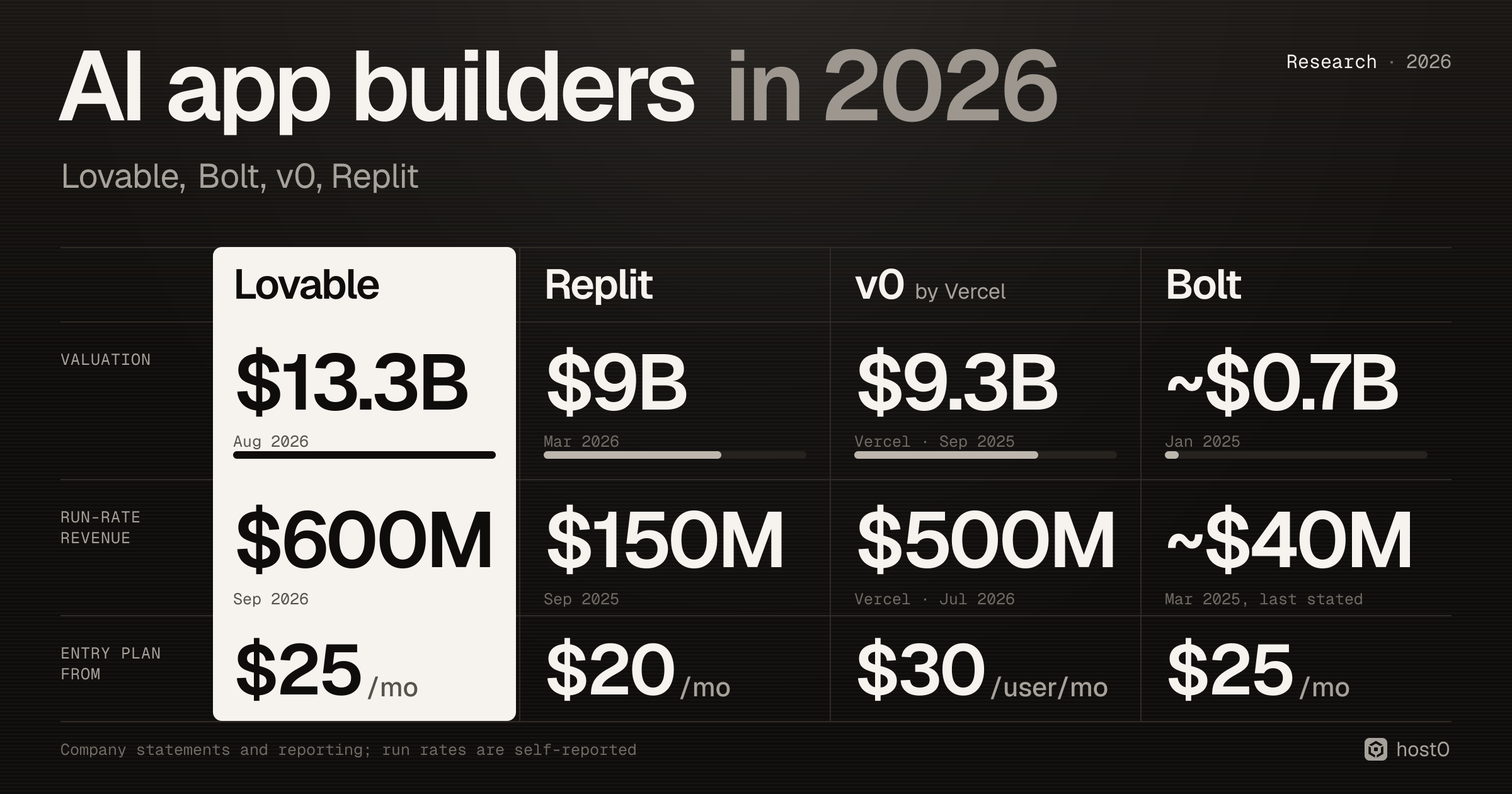
Two years ago "build me an app" meant hiring someone. Now four products take that sentence and return a working app with a URL: Lovable, Bolt, v0 and Replit. They sit next to the coding agents developers use, but they sell to a different person, often someone who has never opened a terminal, and they do more than write code: they host the app, give it a database and sign-in, and bill for all of it on one meter.
We wanted the four side by side, in numbers. So we gathered every revenue, valuation, margin and headcount figure the companies or their filings have published, read their pricing pages and docs on 8 October 2026, and measured what they leave in public ourselves: where their hosting domains rank on the web, how many of their apps a public web crawl finds, and how many exports reach GitHub. Vendor numbers are the vendor's claims and are labelled that way, and every number below links to its source.
Key findings
- 1Lovable pulled away. Its run rate went from $17M in February 2025 to $600M in September 2026, and it raised at $13.3B in August. Since February 2026 it has added about $30M of run rate a month, a third of February's pace, by our arithmetic.
- 2The others went quiet on revenue. Replit's last stated run rate is $150M from September 2025; it targets $1B by the end of 2026. Bolt's last figure is about $40M, from March 2025. Vercel has never broken v0 out of its $500M company run rate.
- 3Investors pay 12 to 35 times run rate. Lovable's last round was 26.6 times its run rate at the time and its staff bring in about $2.74M of run rate each, by our arithmetic. Wix, which bought Base44 outright, has paid about one times its current run rate.
- 4Margins were the 2025 problem. Replit's gross margin swung between 36% and −14% as its agent burned tokens, and Wix says Base44 started 2026 at near-zero gross margin. In 2026 the builders that talk about margins say 60% to 70%.
- 5Lovable's apps now out-rank Lovable.
lovable.app, where Lovable hosts what people build, rose from #376,351 to #3,084 in the Tranco ranking of popular domains, pastlovable.devandreplit.com. A public web crawl found 14 Lovable-hosted apps in January 2025 and 4,485 in September 2026, by our count. - 6Prices settled at $20 to $30 a month, metered. Replit Core is $20, Lovable Pro and Bolt Pro $25, v0 Plus $30 per user. All four moved from flat message counts to credits or tokens that track usage in 2025.
- 7Business adoption has stalled. On Ramp's card data, 10.0% of businesses buying site builders paid Lovable in September, the same as in May, and its share of first-time buyers halved. Of consumers who paid Lovable last winter, about one in ten was still paying this summer.
- 8
$600M
Lovable annual run-rate revenue, stated 24 Sep 2026
Company claim, two outlets
Source: TechCrunch
10.0%
Businesses buying site builders on Ramp that paid Lovable, Sep 2026; flat since May
Source: Ramp
The money#
Every revenue figure in this section is a run rate: a recent month's revenue times twelve, unaudited, and usually disclosed around a fundraise. Only Base44, inside the listed company Wix, reports through SEC filings.
Lovable's curve is the steepest of the four. It said it had $17M of annual recurring revenue at its February 2025 seed extension, $75M in July, and a week later that it had passed $100M, eight months after launch. It passed $200M in November, then said it reached $300M in January 2026 and $400M in February, adding $100M in one month. After that the pace slowed: $500M in June and $600M on 24 September, when co-founder Fabian Hedin gave the figure on stage in Amsterdam. That's about $30M of new run rate a month since February, by our arithmetic. The Swedish business paper Realtid points out that no audited accounts back the figure.
Replit's record is shorter. It made $2.8M in all of 2024, reported $100M of run rate in June 2025 and $150M in September. Since then it has given only a direction: its March 2026 funding post says it is "on track to hit $1 billion in run-rate revenue by the end of 2026", and in May its CEO said it was "tracking toward" that number. We found no primary source for the "$250M at the end of 2025" figure that circulates, so Replit's line below stops in September 2025. Base44, the builder Wix bought in June 2025, is the one with filed numbers: $100M of ARR by early March 2026 and "~$150 million of ARR as of May".
Run-rate revenue: Lovable and Replit
Annualized revenue as stated by each company or its parent's filings, US dollars, Feb 2025 to Sep 2026
| Series | x | y |
|---|---|---|
| Lovable | 25 Feb 2025 | $17M |
| Lovable | 17 Jul 2025 | $75M |
| Lovable | 23 Jul 2025 | $100M |
| Lovable | Nov 2025 | $200M |
| Lovable | Jan 2026 | $300M |
| Lovable | Feb 2026 | $400M |
| Lovable | 9 Jun 2026 | $500M |
| Lovable | 24 Sep 2026 | $600M |
| Replit | Jun 2025 | $100M |
| Replit | 10 Sep 2025 | $150M |
Sources: TechCrunch (Lovable); TechCrunch (Lovable, Sep 2026); TechCrunch (Replit); Wix 6-K
The other two went quiet. Bolt's CEO Eric Simons said Bolt went from zero to $40M of ARR in about five months with a team of 15 to 20 people, and has published no revenue figure since March 2025. In February 2026 he told Sacra that Bolt is "around 70% plus right now. As a company, we are profitable", with businesses about a quarter of revenue. v0 belongs to Vercel, which crossed $500M of company-wide run rate in early July 2026, up from $340M at the end of February. Most of that is hosting, and Vercel doesn't say how much is v0.
What investors pay#
Lovable's $400M Series C in August valued it at $13.3B, double the $6.6B of December and 7.4 times the $1.8B of July 2025. Replit tripled to $9B in March. Bolt's maker StackBlitz hasn't raised a priced round since about $700M in January 2025.
Latest valuations of AI app builders
Post-money valuation at the latest priced round, or acquisition price, US dollars, Jan 2025 to Aug 2026
| Label | Value |
|---|---|
| Lovable | $13.3B (Series C, Aug 2026) |
| Vercel (v0) | $9.3B (Series F, Sep 2025; whole company) |
| Replit | $9B (Series D, Mar 2026) |
| Emergent | $1.5B (Series C, Jul 2026) |
| Bolt (StackBlitz) | ~$0.7B (Series B, Jan 2025) |
| Base44 | ~$80M (Bought by Wix, Jun 2025; plus earn-outs) |
Sources: Lovable; Vercel; Replit; TechCrunch (Emergent); Bloomberg (StackBlitz); Wix
Divide each valuation by the run rate the company had at the time and the range is wide. Lovable's Series C was 26.6 times its June run rate; Bolt's 2025 round was about 35 times, two months after launch. Emergent, a Bengaluru-based builder, raised at 12.5 times. At the low end is Base44: by Calcalist's count its founder is set to receive more than $150M including earn-outs, about one year of its May run rate. For comparison, SpaceX paid about 15 times run rate for Cursor, as we covered in State of AI coding agents 2026.
Valuation as a multiple of run rate
Latest valuation ÷ run-rate revenue at the time, our arithmetic, Jan 2025 to Aug 2026
| Label | Value |
|---|---|
| Bolt | ~35× ($0.7B ÷ ~$20M, Jan 2025) |
| Lovable | 26.6× ($13.3B ÷ $500M, Aug 2026) |
| Replit | 20× ($3B ÷ $150M, Sep 2025) |
| Vercel | 18.6× ($9.3B (Sep 2025) ÷ $500M (Jul 2026)) |
| Cursor (comparison) | 15× ($60B ÷ ~$4B, SpaceX deal) |
| Emergent | 12.5× ($1.5B ÷ $120M, Jul 2026) |
| Base44 | ~1× (>$150M paid ÷ ~$150M ARR) |
Sources: TechCrunch (Lovable); TechCrunch (Replit); Vercel; Calcalist (Base44); host0 arithmetic
Revenue per person#
The builders are small. Lovable had 146 full-time employees at $400M of run rate, $2.74M each by our arithmetic (TechCrunch printed $2.77M), and plans to reach about 450 by the end of 2026. Bolt was at about $2M a head at its last disclosure, in March 2025. Replit, with 110 employees in October 2025, was at $1.36M. Emergent, with about 200 staff, is at $0.6M.
Run-rate revenue per employee
Run rate ÷ full-time headcount stated in the same period, US dollars, our arithmetic, Mar 2025 to Jul 2026
| Label | Value |
|---|---|
| Lovable | $2.74M ($400M ÷ 146, Feb 2026) |
| Lovable, a year earlier | $2.22M ($100M ÷ 45, Jul 2025) |
| Bolt | ~$2.0M ($40M ÷ 15–20 people, Mar 2025) |
| Replit | $1.36M ($150M ÷ 110, Sep–Oct 2025) |
| Emergent | $0.60M ($120M ÷ ~200, Jul 2026) |
Sources: TechCrunch (Lovable); Lenny's Newsletter (Bolt); TechCrunch (Replit); TechCrunch (Emergent); host0 arithmetic
Margins#
An app builder resells model tokens, and in 2025 the tokens ate the margin. The Information reported that as Replit's revenue surged, its gross margins "fluctuated between 36% and negative 14%", the low point after a more autonomous agent began spending more on models. Wix's filing says Base44 entered 2026 at "near-zero non-GAAP gross margin". The 2026 statements are all better and mostly unverifiable: Replit's CEO says it has been "gross margin positive for over a year", which overlaps the negative month The Information reported, and Bolt's says 70%-plus. Wix expects Base44 to reach about 60% in the second half of 2026 after it switched to its own model, Base 1. We cover where the token bills come from in AI token spending in 2026.
Gross margin, then and now
Gross margin as reported, claimed or targeted, by builder, 2025 to 2026
Sources: The Information (Replit); TechCrunch (Replit); Sifted (Lovable); Wix 6-K (Base44); Sacra (Bolt)
What a paying customer is worth#
Divide run rate by paying customers and the builders land in the same place: roughly $35 to $52 a month per payer. That's close to the $20 to $30 list prices once top-ups and team plans are added, so most of the growth is more payers, not bigger ones. Lovable's July 2025 figures also give a conversion rate: 180,000 paying subscribers out of 2.3 million active users, 7.8%.
Run-rate revenue per paying customer
Run rate ÷ paying customers, per month, US dollars, our arithmetic on company figures, Feb 2025 to Jul 2026
| Label | Value |
|---|---|
| Lovable, Feb 2025 | $47 ($17M ÷ 30,000) |
| Lovable, Jul 2025 | $35 ($75M ÷ 180,000) |
| Lovable, Dec 2025 | $52 ($200M ÷ 320,000) |
| Emergent, Jul 2026 | $50 ($120M ÷ 200,000) |
| Rocket.new, Sep 2025 | $38 ($4.5M ÷ 10,000) |
Sources: TechCrunch (Lovable); Entrepreneur (Lovable); TechCrunch (Emergent); TechCrunch (Rocket.new); host0 arithmetic
Usage and footprint#
The builders' own usage numbers don't compare. Lovable counts more than 60 million projects created and 900 million monthly visits to the apps; Replit counts "over 50 million users"; Vercel says "more than 4 million people" have used v0. A project isn't an app and a user isn't a payer, so we measured three things nobody controls: how popular each builder's hosting domain is, how many of its apps turn up in a public web crawl, and how many exports reach GitHub.
Lovable's apps out-rank Lovable#
Tranco is a research ranking of the top million domains, built from five traffic and DNS sources. It ranks a domain as one entry, so lovable.app stands for every app Lovable hosts on its default domain, while lovable.dev is the builder itself. In January 2025 the hosting domain was #376,351. In the list of 7 October 2026 it was #3,084, past lovable.dev since April and past replit.com since July. That matches the direction of what co-founder Fabian Hedin said in September, that Lovable's apps get "an order of magnitude more" visits than Lovable itself, though a rank can't confirm the size.
Where builder domains rank on the web
Tranco rank of each builder's site and its app-hosting domain, lower is more popular, Jan 2025 to Oct 2026
Sources: Tranco research list; host0 analysis, 22 monthly lists
A rank can't go on a line chart honestly when lower means better, so the next chart shows how many times each domain's rank improved.
How far each domain climbed
Earliest Tranco rank ÷ Oct 2026 rank, times, Jan 2025 to Oct 2026
| Label | Value |
|---|---|
| lovable.app | 122× (376,351 → 3,084) |
| lovable.dev | 45× (140,042 → 3,102) |
| base44.app | 38× (from Apr 2025) |
| replit.app | 4.1× (84,866 → 20,798) |
| bolt.host | 4.0× (from Sep 2025) |
| replit.com | 1.8× (6,468 → 3,556) |
| v0 | 1.7× (v0.dev → v0.app) |
| bolt.new | 1.6× (44,881 → 27,903) |
Sources: Tranco research list; host0 analysis
Apps a public crawl can find#
Certificate logs can't count these apps (each builder serves one wildcard certificate), so we counted distinct app hostnames in Common Crawl, the open web crawl, one crawl per quarter. Common Crawl only finds pages something else links to, so this is a count of apps that were shared in public, not of apps that exist. In the January 2025 crawl it found 14 Lovable-hosted apps; in September 2026, 4,485, a 320-fold rise. Replit-hosted apps grew five-fold, and Base44 went from none to about the same as Replit.
Builder-hosted apps found by Common Crawl
Distinct app hostnames on each builder's default domain in Common Crawl's Sep 2026 crawl (CC-MAIN-2026-39)
| Label | Value |
|---|---|
| lovable.app | 4,485 (Jan 2025: 14) |
| base44.app | 1,135 (Jan 2025: 0) |
| replit.app | 1,133 (Jan 2025: 221) |
| bolt.host | 19 (first crawled Oct 2025) |
Sources: Common Crawl index; host0 count, 8 Oct 2026
Exports are not usage#
GitHub tells a different story, because it measures which builders send code out rather than which are used. Most builders' exports carry a default README, so we counted new public repositories with each one, month by month, with GitHub's search API. Google AI Studio leads by far: 557,470 new public repositories since January 2025, against 326,483 with Lovable's README. Lovable's apps stay on lovable.app: in December 2025 its README repositories were 0.7% of the projects it said it created that month, by our arithmetic. v0 changed how it exports in early 2026, from syncing a repository to opening pull requests from v0/ branches, which rose to 20,422 in September.
Builder exports to public GitHub
New public repositories with each builder's default README, and pull requests from v0 branches, per month, Jan 2025 to Sep 2026
| Series | x | y |
|---|---|---|
| AI Studio | Jan 2025 | 20 |
| AI Studio | Feb 2025 | 34 |
| AI Studio | Mar 2025 | 37 |
| AI Studio | Apr 2025 | 81 |
| AI Studio | May 2025 | 926 |
| AI Studio | Jun 2025 | 2.5K |
| AI Studio | Jul 2025 | 3.7K |
| AI Studio | Aug 2025 | 6.5K |
| AI Studio | Sep 2025 | 13.1K |
| AI Studio | Oct 2025 | 18.5K |
| AI Studio | Nov 2025 | 45.3K |
| AI Studio | Dec 2025 | 63.8K (63.8K) |
| AI Studio | Jan 2026 | 59.4K |
| AI Studio | Feb 2026 | 48.3K |
| AI Studio | Mar 2026 | 54.1K |
| AI Studio | Apr 2026 | 54K |
| AI Studio | May 2026 | 55.7K |
| AI Studio | Jun 2026 | 54K |
| AI Studio | Jul 2026 | 41.9K |
| AI Studio | Aug 2026 | 19.8K |
| AI Studio | Sep 2026 | 15.7K |
| Lovable | Jan 2025 | 2.7K |
| Lovable | Feb 2025 | 3.7K |
| Lovable | Mar 2025 | 11.3K |
| Lovable | Apr 2025 | 15.9K |
| Lovable | May 2025 | 16K |
| Lovable | Jun 2025 | 17.3K |
| Lovable | Jul 2025 | 18.8K |
| Lovable | Aug 2025 | 19.3K |
| Lovable | Sep 2025 | 22.8K |
| Lovable | Oct 2025 | 22.7K |
| Lovable | Nov 2025 | 21.3K |
| Lovable | Dec 2025 | 21.8K |
| Lovable | Jan 2026 | 24.8K |
| Lovable | Feb 2026 | 26K |
| Lovable | Mar 2026 | 32.2K |
| v0 (PRs) | Jan 2025 | 10 |
| v0 (PRs) | Feb 2025 | 15 |
| v0 (PRs) | Mar 2025 | 9 |
| v0 (PRs) | Apr 2025 | 4 |
| v0 (PRs) | May 2025 | 3 |
| v0 (PRs) | Jun 2025 | 3 |
| v0 (PRs) | Jul 2025 | 5 |
| v0 (PRs) | Aug 2025 | 8 |
| v0 (PRs) | Sep 2025 | 14 |
| v0 (PRs) | Oct 2025 | 32 |
| v0 (PRs) | Nov 2025 | 30 |
| v0 (PRs) | Dec 2025 | 15 |
| v0 (PRs) | Jan 2026 | 1.3K |
| v0 (PRs) | Feb 2026 | 8.8K |
| v0 (PRs) | Mar 2026 | 14.8K |
| v0 (PRs) | Apr 2026 | 13.3K |
| v0 (PRs) | May 2026 | 14.4K |
| v0 (PRs) | Jun 2026 | 15.3K |
| v0 (PRs) | Jul 2026 | 14.5K |
| v0 (PRs) | Aug 2026 | 12.4K |
| v0 (PRs) | Sep 2026 | 20.4K |
Sources: GitHub search API; host0 count, 8 Oct 2026
Bolt and Replit barely show up on GitHub at all: Replit's agent trailer appears on at most a few hundred pull requests a month, and Bolt writes no README. Their apps stay on their own hosts, like Lovable's.
Pricing#
The four ask about the same price to start. Replit Core is $20 a month, Lovable Pro and Bolt Pro $25, and v0 Plus $30 per user, after v0 closed its $20 Premium plan to new users. What the money buys differs, because each meters something different: Lovable sells credits, Bolt tokens, and v0 and Replit dollars of credit that drain by model and effort. Lovable says a small edit like "make the button gray" costs 0.50 credits and a landing page with images 1.70, about $0.13 and $0.43 on Pro.
What the entry plans cost
Free tier, cheapest paid plan and team pricing, monthly billing, as shown on 8 Oct 2026
Sources: Lovable pricing; Lovable plans; Bolt pricing; Bolt billing; v0 pricing; Replit pricing; Replit Starter
Every one of them moved off flat message counts in 2025, after agents started doing more work per message: v0 switched to token-metered credits in May, Replit replaced its flat $0.25 per checkpoint with effort-based pricing in June, and Lovable made credit costs vary with the task that summer. Bolt always metered tokens and raised its entry price from $20 to $25 when it launched Bolt Cloud in August 2025. In 2026 the direction reversed toward cheaper usage. Replit cut its hosting prices on 1 August, autoscale compute by 81%, and added a Free Mode that doesn't draw credits; Bolt added a $9 Lite plan on open-source models.
Replit's own price cut has two dates. Its Pro-plan post, dated 24 February 2026, says "Core drops from $25/month to $20/month", but the pricing page kept showing $25 a month in every archived snapshot until August, and first shows $20 on 1 September. We describe it as announced in February and live by September.
How app-builder pricing changed
Entry prices and billing models, Nov 2024 to Sep 2026
Nov 2024
25 Apr 2025
13 May 2025
18 Jun 2025
14 Aug 2025
29 Sep 2025
24 Feb 2026
Apr 2026
18 Jun 2026
1 Aug 2026
18 Aug 2026
Sep 2026
14 Sep 2026
14 Sep 2026
Open-source models with “up to 50x more” usage; Lite by waitlist.
Sources: Lovable changelog; Vercel; Replit; Bolt; Wayback Machine snapshots of each pricing page
Where the apps live#
Each builder now bundles hosting, a database and sign-in, and each ties them to its own meter. Three of the four host apps on their own domain; v0 deploys to Vercel. The bigger difference is who can open the result. Lovable's docs say "by default, anyone with the link can visit your published app, on every plan"; Bolt's that "the default visibility is public", and every site on its free plan is public; Replit's that apps in a personal workspace "default to Public". Keeping a live app private costs a Business plan on Lovable and a paid plan on Bolt, where a site with a custom domain can only be public.
After generation: what each builder does with the app
Hosting, data, sign-in and access defaults, from each builder's docs, as of 8 Oct 2026
Sources: Lovable hosting; Bolt publish; Bolt hosting plans; v0 deployments; v0 databases; Replit app access; Replit SQL database
Under the builders sit the same few backends, and they're growing fast. Supabase, which Lovable and Bolt use for their databases, went from more than 40,000 new databases a day in September 2025 to more than a million a week in August 2026, 3.6 times as many by our arithmetic. Fewer of the builders' business customers pay for a database of their own: Brex found that 9.6% of companies whose first app-builder purchase came in 2025 or 2026 added a paid database within 90 days.
The backends under the builders
The open defaults matter because many of these apps hold data. We collected the scans of vibe-coded apps, including how many let a stranger read the database, in Vibe-coded app security in 2026.
Retention and who uses them#
The best independent data on paying customers comes from spend panels. Ramp publishes, from its corporate cards and bill pay, the share of businesses buying in a software category that paid a given vendor over the past 12 months. In "web hosting and site builders", Lovable went from 1.0% in January 2025 to 10.1% in May 2026, then stopped: 10.0% in September. Replit peaked at 7.5% in May and has slipped to 7.2%. Vercel, where code from any agent gets deployed, kept climbing to 21.8%. Ramp has no pages for Bolt, v0 or Base44.
Businesses paying for app builders on Ramp
% of businesses buying web hosting and site-builder software that paid each vendor in the trailing 12 months, Ramp card and bill-pay data, Jan 2025 to Sep 2026
| Series | x | y |
|---|---|---|
| Vercel | Jan 2025 | 15.1% |
| Vercel | Feb 2025 | 15.2% |
| Vercel | Mar 2025 | 15.4% |
| Vercel | Apr 2025 | 15.8% |
| Vercel | May 2025 | 16.1% |
| Vercel | Jun 2025 | 16.4% |
| Vercel | Jul 2025 | 16.9% |
| Vercel | Aug 2025 | 17.1% |
| Vercel | Sep 2025 | 17.1% |
| Vercel | Oct 2025 | 17.2% |
| Vercel | Nov 2025 | 17.4% |
| Vercel | Dec 2025 | 17.5% |
| Vercel | Jan 2026 | 17.7% |
| Vercel | Feb 2026 | 18% |
| Vercel | Mar 2026 | 18.7% |
| Vercel | Apr 2026 | 19.4% |
| Vercel | May 2026 | 19.9% |
| Vercel | Jun 2026 | 20.5% |
| Vercel | Jul 2026 | 20.9% |
| Vercel | Aug 2026 | 21.4% |
| Vercel | Sep 2026 | 21.8% |
| Lovable | Jan 2025 | 1% |
| Lovable | Feb 2025 | 1% |
| Lovable | Mar 2025 | 1.4% |
| Lovable | Apr 2025 | 2.1% |
| Lovable | May 2025 | 2.8% |
| Lovable | Jun 2025 | 3.5% |
| Lovable | Jul 2025 | 4.3% |
| Lovable | Aug 2025 | 5% |
| Lovable | Sep 2025 | 5.5% |
| Lovable | Oct 2025 | 6.1% |
| Lovable | Nov 2025 | 6.6% |
| Lovable | Dec 2025 | 7.1% |
| Lovable | Jan 2026 | 7.9% |
| Lovable | Feb 2026 | 8.7% |
| Lovable | Mar 2026 | 9.3% |
| Lovable | Apr 2026 | 9.7% |
| Lovable | May 2026 | 10.1% |
| Lovable | Jun 2026 | 10% |
| Lovable | Jul 2026 | 10.1% |
| Lovable | Aug 2026 | 10.1% |
| Lovable | Sep 2026 | 10% (10.0%) |
| Replit | Jan 2025 | 1.9% |
| Replit | Feb 2025 | 2.3% |
| Replit | Mar 2025 | 2.5% |
| Replit | Apr 2025 | 2.8% |
| Replit | May 2025 | 3.2% |
| Replit | Jun 2025 | 3.6% |
| Replit | Jul 2025 | 4% |
| Replit | Aug 2025 | 4.5% |
| Replit | Sep 2025 | 4.7% |
| Replit | Oct 2025 | 5% |
| Replit | Nov 2025 | 5.4% |
| Replit | Dec 2025 | 5.8% |
| Replit | Jan 2026 | 6.3% |
| Replit | Feb 2026 | 6.7% |
| Replit | Mar 2026 | 7.1% |
| Replit | Apr 2026 | 7.3% |
| Replit | May 2026 | 7.5% |
| Replit | Jun 2026 | 7.4% |
| Replit | Jul 2026 | 7.4% |
| Replit | Aug 2026 | 7.4% |
| Replit | Sep 2026 | 7.2% |
Sources: Ramp: Lovable; Ramp: Replit; Ramp: Vercel
The first-time buyers explain the plateau. Ramp also tracks which vendor a business picks when it buys in the category for the first time. Lovable's share of those first purchases peaked at 8.4% in February 2026 and was 3.5% in September; Replit's fell to about 3%. Vercel's rose to 14.3%.
Who first-time buyers pick
% of businesses making their first purchase in web hosting and site builders that chose each vendor, Ramp, Jan 2025 to Sep 2026
| Series | x | y |
|---|---|---|
| Vercel | Jan 2025 | 5.8% |
| Vercel | Feb 2025 | 7.2% |
| Vercel | Mar 2025 | 6.9% |
| Vercel | Apr 2025 | 9.8% |
| Vercel | May 2025 | 9.2% |
| Vercel | Jun 2025 | 8.6% |
| Vercel | Jul 2025 | 10.1% |
| Vercel | Aug 2025 | 9.6% |
| Vercel | Sep 2025 | 8.5% |
| Vercel | Oct 2025 | 8.5% |
| Vercel | Nov 2025 | 9% |
| Vercel | Dec 2025 | 9.2% |
| Vercel | Jan 2026 | 9.4% |
| Vercel | Feb 2026 | 9.8% |
| Vercel | Mar 2026 | 12% |
| Vercel | Apr 2026 | 13.1% |
| Vercel | May 2026 | 12.1% |
| Vercel | Jun 2026 | 15% |
| Vercel | Jul 2026 | 12.2% |
| Vercel | Aug 2026 | 14.5% |
| Vercel | Sep 2026 | 14.3% |
| Lovable | Jan 2025 | 0.3% |
| Lovable | Feb 2025 | 0.3% |
| Lovable | Mar 2025 | 2.7% |
| Lovable | Apr 2025 | 3.2% |
| Lovable | May 2025 | 3.5% |
| Lovable | Jun 2025 | 5.6% |
| Lovable | Jul 2025 | 4.3% |
| Lovable | Aug 2025 | 5.3% |
| Lovable | Sep 2025 | 3.9% |
| Lovable | Oct 2025 | 4.9% |
| Lovable | Nov 2025 | 5.2% |
| Lovable | Dec 2025 | 5.9% |
| Lovable | Jan 2026 | 7.2% |
| Lovable | Feb 2026 | 8.4% (8.4%) |
| Lovable | Mar 2026 | 7.1% |
| Lovable | Apr 2026 | 5.2% |
| Lovable | May 2026 | 7.4% |
| Lovable | Jun 2026 | 4.5% |
| Lovable | Jul 2026 | 4.7% |
| Lovable | Aug 2026 | 5.6% |
| Lovable | Sep 2026 | 3.5% |
| Replit | Jan 2025 | 0.8% |
| Replit | Feb 2025 | 1.7% |
| Replit | Mar 2025 | 1.8% |
| Replit | Apr 2025 | 1.5% |
| Replit | May 2025 | 3.3% |
| Replit | Jun 2025 | 3% |
| Replit | Jul 2025 | 3.1% |
| Replit | Aug 2025 | 4.3% |
| Replit | Sep 2025 | 2.8% |
| Replit | Oct 2025 | 3.8% |
| Replit | Nov 2025 | 4.3% |
| Replit | Dec 2025 | 4.3% |
| Replit | Jan 2026 | 5.1% |
| Replit | Feb 2026 | 5.1% |
| Replit | Mar 2026 | 3.4% |
| Replit | Apr 2026 | 4.9% |
| Replit | May 2026 | 3.8% |
| Replit | Jun 2026 | 2.6% |
| Replit | Jul 2026 | 3% |
| Replit | Aug 2026 | 2.8% |
| Replit | Sep 2026 | 3.2% |
Sources: Ramp: Lovable; Ramp: Replit; Ramp: Vercel
Individual payers leave faster. YipitData, which reads a panel of US consumers' e-receipts, followed 1,720 people who paid Lovable between September 2025 and January 2026. Only 168 had a Lovable receipt between May and August 2026: about 9.8%, by our arithmetic. Those who stayed were more likely to also pay for another AI tool (56.5% against 34.1%), most often Claude.
Developers know these tools, but few use them. Stack Overflow's 2026 survey asked which no-code builders people had used in the past year. Only 2,219 of its 30,903 respondents answered, against 12,255 for the coding-agent question, and among them Lovable led with 38.3%. That's about 2.8% of all respondents, by our arithmetic. Lovable says 80% of the people building on it are in non-technical roles, so a developer survey sees only a slice.
No-code app builders developers used in the past year
% of respondents who answered the question, Stack Overflow Developer Survey 2026, n = 2,219, fielded Jun–Aug 2026
| Label | Value |
|---|---|
| Lovable | 38.3% |
| Replit | 28.3% |
| v0 | 27.5% |
| Bolt.new | 17.2% |
| Base44 | 11.3% |
| Langflow | 7.8% |
| Stack AI | 7.2% |
The 2025 side of this story, Barclays' traffic data and Bolt's "20–40%" churn remark, is in our State of vibe coding 2026.
The competition#
The builders' rivals are no longer only each other. Every large AI company now builds and hosts apps from a prompt, often for free. Anthropic has had Artifacts since June 2024 and added Claude Design in April 2026. Google's AI Studio gained full-stack apps and, in May, "New users can deploy up to two full-stack applications to the Google Cloud Starter Tier, no billing account required", while Google shut the door on its other builder, Firebase Studio. OpenAI's Sites builds and hosts apps from ChatGPT with a database and sign-in. Figma says about 60% of its customers paying more than $100,000 a year used Figma Make weekly in early 2026, and Bolt's CEO named it as the pressure on prototyping: Figma is "shipping that with every Figma license".
The coding agents are the other front. On Ramp, 87% of businesses buying a coding agent buy Claude Code, and their output is deployed on hosts like Vercel, which says agents now trigger around 29% of its deployments. The agent side is in State of AI coding agents 2026. Lovable's answer, from the stage where it announced $600M: coding agents "output code", while "Lovable does not output code. The output is a product".
The labs and incumbents move in
App-building and hosting launches from AI labs and incumbents, Jun 2024 to Jun 2026
Jun 2024
7 May 2025
18 Jun 2025
25 Jun 2025
Oct 2025
Oct 2025
19 Mar 2026
17 Apr 2026
22 May 2026
2 Jun 2026
18 Jun 2026
What this means if you build with AI#
The builders are good at the first hour and expensive to leave after the first month. The numbers point to a few habits.
- Price the project by the meter, not the sticker. Entry plans cost $20 to $30, but every builder bills usage: a landing page is 1.70 credits on Lovable, tokens on Bolt grow with project size, and v0 and Replit drain dollars by model. Payers end up around $35 to $52 a month on average. Set a spend cap where the builder offers one.
- Decide who should see the app before you publish. Lovable's default is anyone with the link, Bolt's and Replit's personal default is public, and a private live app needs a Business plan on Lovable or a paid plan on Bolt. If the app holds anyone's data, check its access rules and its database first (what the scans found).
- Connect GitHub on day one. All four sync code to GitHub, but most projects never get there: by our count Lovable's public exports are under 1% of the projects it says people create. The code in a repository is the part you can take anywhere.
- Treat the database and sign-in as the lock-in. Code moves easily; the running app's data and users live in the builder's own backend or one it provisioned. Know how to export them before you have real users.
- Expect to switch. Bolt's CEO says the switching cost between these tools is zero, Lovable's share of first-time business buyers halved in seven months, and labs now give away hosting. Keep your app portable enough to move.
- Read revenue headlines as run rates. Every figure here is a month times twelve, self-reported and timed with a raise. Replit and Bolt haven't updated theirs in a year or more.
host0 is hosting for whatever your agent creates: a link you can share, private by default, with a shared database, from any agent, and free during the beta. It's the step the builders bundle, offered on its own.
Methodology#
This post draws on four research passes, one per angle: money, usage and footprint, pricing and product, and retention and competition. Each was limited to primary sources: company posts and docs, SEC filings, the companies' statements to the press, survey results pages and card-spend panels. We used aggregator and "statistics" sites only as leads. Live pricing pages and docs were read on 8 October 2026, and price history comes from Wayback Machine snapshots of each pricing page. Before publishing we re-opened the single-source pages the post leans on for its headline numbers and confirmed the figures were still there.
Our own counts, all run on 8 October 2026:
- Tranco: the research list dated the 15th of each month from January 2025, plus 7 October 2026 (22 lists), via
tranco-list.eu/api/lists/date/<date>, exact match on each domain. - Common Crawl: distinct hostnames ending in each builder's hosting domain in the CDX index (
index.commoncrawl.org/<crawl>-index?url=*.<domain>&output=json), one crawl per quarter from CC-MAIN-2025-05 to CC-MAIN-2026-39. Counts only; no page contents fetched. - GitHub: the authenticated search API,
total_countper creation month. Repositories:"Welcome to your Lovable project" OR "lovable.dev/projects" in:readme,"Run and deploy your AI Studio app" in:readme,"This is a code bundle for" in:readme(Figma Make),"Welcome to your Base44 project" in:readme, andis:publicfor all repositories. Pull requests:is:pr head:v0/. Control:"npm install" in:readme. - Ramp: the monthly adoption and first-time-buyer series embedded in each vendor page.
- Arithmetic: every multiple, per-employee and per-customer figure divides two published numbers from the same period; the pairs are in the chart notes.
We dropped claims that didn't hold up: a "$250M at the end of 2025" run rate for Replit (only a podcast summary), Sacra's estimates of Replit's 2026 revenue and of builders' margins, Similarweb visit counts (the page we read labels the figure inconsistently), and v0 revenue figures (Vercel has never disclosed one).
Limitations:
- Run rates are not revenue. They are unaudited, and the companies choose when to publish them.
- Footprints are proxies. Tranco ranks domains, not apps, and isn't traffic; Common Crawl finds only linked pages; GitHub sees only exports with a default README. Apps on custom domains are invisible to all three.
- Panels are panels. Ramp sees businesses on Ramp, YipitData consumers who forward receipts; neither is a census.
- Prices change monthly. The pricing table is a snapshot of 8 October 2026.
Open questions#
- How much of what gets built is ever used. No builder says what share of its projects is published, shared or still visited after a month.
- Where Replit's revenue is now. It targets $1B of run rate by the end of 2026 and hasn't stated a figure since September 2025.
- What v0 earns. Vercel reports only its company-wide run rate.
- Whether the margins landed. Lovable's 65% target and Base44's 60% guidance are for the second half of 2026; Wix's next results should show Base44's.
- Business retention. The consumer panel shows heavy churn and the vendors claim expanding accounts; nobody publishes business cohorts.
- Why exports fell. AI Studio, Figma Make and Base44 exports to GitHub all dropped 70–90% between June and September 2026.