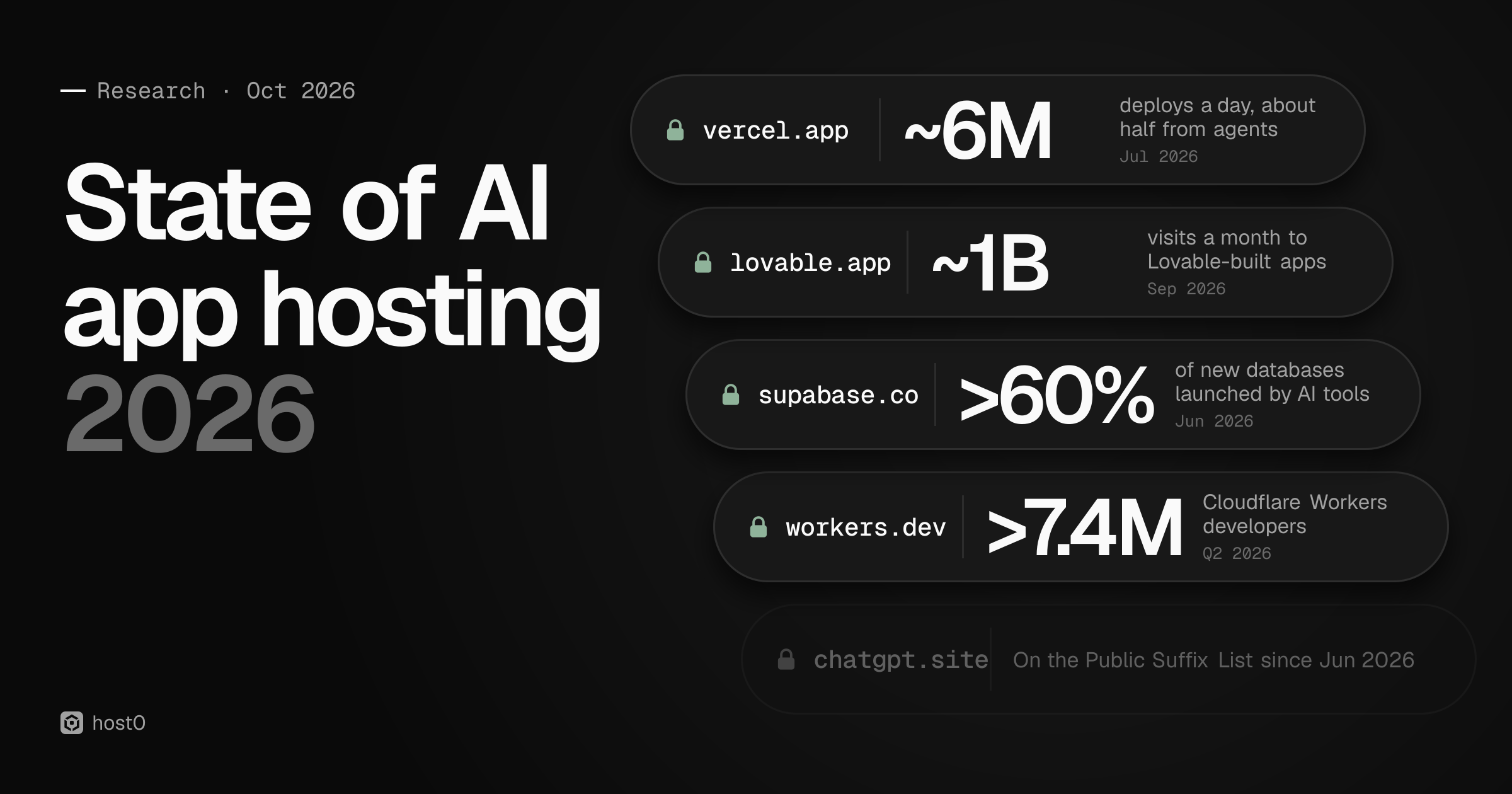
Agents now make things people want to open: dashboards, landing pages, team tools, decks, whole apps. Each one needs a place to live, a URL, and somebody deciding who can see it. That job used to belong to a developer with a cloud account. In 2026 it is increasingly done by the agent itself, and the hosts are changing to suit it. Vercel's CEO told TechCrunch in July that about half of its roughly 6 million deployments a day were triggered by coding agents. Lovable says the apps built on it get close to a billion visits a month, about ten times the traffic of Lovable itself.
The market has split four ways. Builder-hosts (Lovable, Replit, Bolt, Base44) generate the app and keep it on their own domain. Developer clouds (Vercel, Netlify, Cloudflare, with Supabase as the database underneath) have rebuilt their front doors for agents. Chat apps now host their own output: ChatGPT Sites and Claude artifacts. And a set of small link hosts (here.now, tiiny.host, ShipStatic, Hostsmith, Static.app) sell a link for whatever an agent made. This post collects their numbers as of 18 October 2026: the money, how much they host, what they offer, and what goes wrong. Vendor numbers are the vendor's own claims, and most of them are run rates disclosed around a fundraise.
Key findings
- 1Two hosts are at about $600M of run rate, one by an unconfirmed report. Lovable's co-founder put it there in September 2026; The Information reported Vercel at about $600M, up 148% in a year, citing a person close to the company. Vercel itself confirmed $500M in early July.
- 2About half of Vercel's deployments come from agents, by its CEO's account. In July Guillermo Rauch told TechCrunch it was about half of ~6M a day; Vercel's own 17 June post had put it at about 29%, so treat the share as an estimate. By our arithmetic, that's about 3 million agent deploys a day, or 35 a second.
- 3The clouds underneath are growing fast, and agents are a big part of it. Cloudflare ended Q2 2026 with more than 7.4 million Workers developers after adding nearly 2 million in the quarter, more than in all of 2025. Supabase says more than 60% of its new databases are launched by an AI tool.
- 4The hosted apps get more traffic than the builder, Lovable says. By its count, visits to Lovable-built apps went from 200 million a month in December 2025 to over 900 million in August 2026, 4.5× in eight months. But in the September 2026 Common Crawl we found only 4,485 distinct
lovable.apphosts, about one for every 13,000 projects Lovable says exist. - 5The chat apps now host what they make. OpenAI says people created over 5M ChatGPT Sites in about three months; Claude says users had made over half a billion artifacts by June 2025. Both tie the work to the chat app: Sites needs a paid ChatGPT plan to build and starts private, and since 16 September 2026 a newly shared Claude artifact needs a Claude account to open.
- 6A private app is where the paywall sits. Lovable keeps a live app private only on its $50 Business plan; Bolt, Base44, Netlify, tiiny.host and Hostsmith charge for it too. Replit, Vercel, Cloudflare, here.now and ShipStatic offer some form of it free.
- 7
- 8Shared hosting domains are a phishing channel. Proofpoint has seen "tens of thousands of Lovable URLs detected as threats each month" in email since February 2025.
lovable.app,bolt.host,base44.app,chatgpt.siteandhere.nowjoined the Public Suffix List between February 2025 and August 2026; the domains of tiiny.host, ShipStatic, Static.app and Hostsmith aren't on it.
~6M
Vercel deployments a day, about half triggered by coding agents, Jul 2026
CEO interview
Source: TechCrunch
~1B
Monthly visits to apps built on Lovable, Sep 2026; 200M in Dec 2025
Self-reported
Source: TechCrunch
>7.4M
Cloudflare Workers developers, Q2 2026, after adding nearly 2M in the quarter
Source: Cloudflare Q2 call
The money#
Every revenue figure here is a run rate: a recent month's revenue times twelve, unaudited, usually given around a fundraise or leaked. Only Wix (for Base44) and Cloudflare report through filings and earnings calls.
The two largest run rates disclosed for hosting agent-made work are now about the same size. Lovable passed $500M in June and co-founder Fabian Hedin said on stage in Amsterdam on 24 September that it had crossed $600M. Vercel, where v0 apps and much of what coding agents deploy end up, reported a $340M run rate at the end of February 2026 and crossed $500M in early July. In October The Information reported $600M, up 148% from a year earlier, with coding agents about half of new business. That figure rests on one anonymous source; Vercel hasn't confirmed it. If it holds, Vercel grew its run rate 76% in about seven months, by our arithmetic.
Run-rate revenue: Lovable and Vercel
Annualized revenue as stated by each company or reported, US dollars, Jan 2024 to Oct 2026
| Series | x | y |
|---|---|---|
| Lovable | 25 Feb 2025 | $17M |
| Lovable | 23 Jul 2025 | $100M |
| Lovable | Nov 2025 | $200M |
| Lovable | Jan 2026 | $300M |
| Lovable | Feb 2026 | $400M |
| Lovable | 9 Jun 2026 | $500M |
| Lovable | 24 Sep 2026 | $600M |
| Vercel | Jan 2024 | $100M (~$100M) |
| Vercel | 28 Feb 2026 | $340M |
| Vercel | Jul 2026 | $500M |
| Vercel | 4 Oct 2026 | $600M (~$600M) |
Sources: TechCrunch (Lovable); TechCrunch (Vercel); BusinessWire; The Information via Dealroom
The others are smaller or quiet. Base44, inside Wix, had about $150M of ARR as of May, per Wix's filing. Replit last gave a number in September 2025, $150M, and since then only a target: "on track to hit $1 billion in run-rate revenue by the end of 2026". Bolt's last figure was $40M in March 2025. Netlify hasn't published revenue since its 2021 round. Cloudflare, which runs under several of the small hosts, made $696.1M in Q2 2026, up 36%, across everything it sells. At the small end, tiiny.host says it makes about $1.5M a year; here.now, ShipStatic, Static.app and Hostsmith publish nothing.
Investors price the database under these apps almost as high as the apps themselves. Supabase went from $2B in April 2025 to $10.5B in June 2026, 5.25× in about 14 months.
Latest valuations
Post-money valuation at the latest priced round, or acquisition price, US dollars, Nov 2021 to Aug 2026
| Label | Value |
|---|---|
| Lovable | $13.3B (Aug 2026) |
| Supabase | $10.5B (Jun 2026) |
| Vercel | $9.3B (Sep 2025) |
| Replit | $9B (Mar 2026) |
| Netlify | ~$2B (Nov 2021) |
| Bolt (StackBlitz) | ~$0.7B (Jan 2025) |
| Base44 | ~$80M (acquired) |
Sources: Lovable; Supabase; Vercel; Replit; Bloomberg (StackBlitz); Wix
The builders' revenue story is covered in more depth, with multiples and revenue per head, in AI app builders in 2026.
Agents now drive the deploys#
Vercel is the only big host that has put a number on how much of its work comes from agents, and it has given several, each measuring something slightly different. In April TechCrunch reported that 30% of the apps running on the platform came from agents. In June, launching its eve agent framework, Vercel said agents triggered around 29% of deployments. In July Guillermo Rauch told TechCrunch the platform handled about 6 million deployments a day, half of them triggered by coding agents. And in October The Information reported coding agents were about half of Vercel's new business.
What agents drive on Vercel, as reported
Share attributed to AI agents, four different measures, Apr to Oct 2026
| Label | Value |
|---|---|
| Apps on Vercel that came from agents | 30% (Apr 2026) |
| Deployments triggered by agents | ~29% (Jun 2026) |
| Deployments by coding agents | ~50% (Jul 2026) |
| New business from coding agents | ~50% (Oct 2026) |
Sources: TechCrunch (Apr); Vercel (Jun); TechCrunch (Jul); The Information via Dealroom (Oct)
Half of 6 million is about 3 million agent deployments a day, roughly 35 a second. No other host gives a comparable share. Netlify has given absolute counts instead: in early 2025 it said more than 1,000 sites a day were being created on it directly from ChatGPT, and over 10,000 a day from AI codegen platforms such as Bolt.
The developer counts tell the same story from below. Cloudflare said it added about 1 million developers in Q1 2026 and nearly 2 million in Q2, ending June with more than 7.4 million, and that Q2 alone beat the roughly 1.5 million it added in all of 2025. Supabase claimed nearly 10 million developers at its June round, up from 2 million in April 2025. Netlify crossed 10 million on Christmas Eve 2025, five million of them in a single year, and called it the start of the "agent experience" era.
Developers on the platforms agents deploy to
Developers each company says use or build on it, millions, Dec 2024 to Jun 2026
| Series | x | y |
|---|---|---|
| Cloudflare Workers | Mar 2025 | 3M (>3M) |
| Cloudflare Workers | Mar 2026 | 5.5M (>5.5M) |
| Cloudflare Workers | Jun 2026 | 7.4M (>7.4M) |
| Supabase | 22 Apr 2025 | 2M |
| Supabase | 3 Oct 2025 | 4M |
| Supabase | 4 Jun 2026 | 10M (~10M) |
| Netlify | Dec 2024 | 5M |
| Netlify | 24 Dec 2025 | 10M |
Sources: Cloudflare Q1 call; Cloudflare Q2 call; Zacks; Fortune (Supabase); TechCrunch (Supabase); Netlify
The database layer is where agents dominate most clearly. When Databricks agreed to buy Neon in May 2025, Neon said more than 80% of its databases were created by AI agents. Supabase, which sits under Lovable and Bolt, said in June 2026 that more than 60% of its new databases are launched "by some sort of AI tool", with Claude Code the largest single contributor. Its CEO later said Supabase was deploying more than a million new Postgres databases a week, up from 40,000 a day in September 2025: about 3.6 times as many, by our arithmetic, if the two counts are defined the same way.
The databases under agent-made apps
>1M
New Supabase Postgres databases a week, Aug 2026
40,000 a day in Sep 2025
Source: Supabase CEO on X
How much is actually hosted#
Lovable is the one builder that reports traffic to the apps it hosts, and the number has grown much faster than its project count. Visits went from 200 million a month in December 2025 to 720 million in June 2026, per its "build economy" report, then over 900 million in August and "close to a billion" in September. Hedin added that this is "an order of magnitude more than Lovable itself" gets.
Monthly visits to apps built on Lovable
Visits a month to published Lovable apps, as stated by Lovable, Dec 2025 to Sep 2026
| x | y |
|---|---|
| 18 Dec 2025 | 200M |
| 9 Jun 2026 | 720M |
| 12 Aug 2026 | 900M |
| 24 Sep 2026 | 1B (~1B) |
Sources: Lovable Series B; The Next Web; Lovable Series C; TechCrunch
The other counts are of things made, not things visited. They're big, and they measure different units.
What the hosts say has been made
Cumulative count each company has stated, latest figure, Mar 2025 to Sep 2026
| Label | Value |
|---|---|
| Claude artifacts created | 500M+ (Jun 2025) |
| Lovable projects | 60M+ (Aug 2026) |
| ChatGPT Sites created | 5M+ (Sep 2026) |
| Bolt sites deployed on Netlify | 1M+ (Mar 2025) |
| here.now sites | 500K+ (Sep 2026) |
Sources: Claude; Lovable; ChatGPT on X; Netlify; here.now
What the public web sees is much smaller. Common Crawl, the open web archive, only finds pages someone has linked to, so it is a floor. In its September 2026 crawl, which we counted for our AI app builders post, there were 4,485 distinct lovable.app hosts, up from 14 in January 2025. Against 60 million projects, that's about one crawled app for every 13,000 projects. Most projects are drafts, private, never published, or never linked; apps on custom domains don't show up at all. The domains still climbed the popularity rankings: lovable.app reached #3,084 on the Tranco list of 7 October 2026, from #376,351 in January 2025.
Builder apps the public web can see
Distinct hosts on each builder's default domain in Common Crawl, crawl of Sep 2026 (2026-39)
| Label | Value |
|---|---|
| lovable.app | 4,485 |
| base44.app | 1,135 |
| replit.app | 1,133 |
| bolt.host | 19 |
Sources: Our analysis of Common Crawl; Lovable
So the honest summary is: agents make millions of things a month, a small fraction get published, and a smaller fraction get most of the traffic. No host discloses how many projects are ever shared or still visited a month later.
What each host offers#
On paper every host now publishes to a URL. The differences are in who can open it, what it costs to keep it private, and how an agent gets the work there. As of mid-October 2026:
Where agent-made work can live
Default access, private apps, data and agent surfaces, from each host's docs, as of mid-October 2026
- Lovable. Hosting on every plan with no cap on visitors. Free and Pro apps are open to anyone with the link; a private or workspace-only app needs Business at $50 a month. Lovable Cloud (Supabase-based) for data. An MCP server in research preview can deploy projects.
- Replit. Since May 2026, Starter and Core can publish privately with a password, a workspace or invites. The free plan's one app goes down after 30 days. Postgres built in.
- Bolt. Public by default; free sites are always public and carry a "Made in Bolt" badge. Private sites need a paid plan, and a site with a custom domain can only be public.
- Base44. Public, workspace or invite-only; invite-only is on paid plans. A built-in backend, plus a remote MCP server and CLI.
- Vercel and v0. Vercel Authentication on every plan, including the free, non-commercial Hobby plan. Data comes from marketplace partners. Since July 2026 its MCP server deploys.
- Netlify. Password protection on Pro. An MCP server that deploys since June 2025, Agent Runners since October 2025, and anonymous CLI deploys since March 2026.
- Cloudflare. Access gates a Worker free for up to 50 users. D1, KV and R2 for data. Temporary accounts let an agent deploy with no login.
- ChatGPT Sites. Private by default (owner and workspace admins), with a database, storage and sign-in. Plus and above only; built and managed only inside ChatGPT and Codex.
- Claude artifacts. Made and shared inside Claude and Claude Code. Since 16 September 2026 a newly shared artifact needs a Claude account to open. No custom domain or analytics documented.
- here.now, tiiny.host, ShipStatic, Static.app, Hostsmith. Link hosts for any agent's output. here.now and ShipStatic offer private links free; the others charge. here.now and Static.app have a data layer of sorts (records; forms); tiiny.host, ShipStatic and Hostsmith have MCP servers that deploy; here.now takes deploys through a skill and REST API.
Sources: Lovable; Replit; Bolt; Base44; Vercel; Netlify; Cloudflare; ChatGPT Sites; Claude; here.now
The clearest dividing line is privacy. Most agent-made apps are for a team, a client or one person, and on most of the hosts below keeping them private is the upgrade.
The cheapest way to keep a live app private
Monthly price of the cheapest plan that can restrict who opens a published app, US dollars, as of mid-October 2026
| Label | Value |
|---|---|
| Replit | $0 (password, invites) |
| Vercel | $0 (non-commercial) |
| Cloudflare | $0 (up to 50 users) |
| here.now | $0 (email allowlist) |
| ShipStatic | $0 (password) |
| Static.app | $5 (password) |
| Hostsmith | $9 ($5 yearly) |
| tiiny.host | $13 (password) |
| Base44 | $16–20 (Starter) |
| Netlify | $20 (password, Pro) |
| ChatGPT Sites | $20 (Plus) |
| Bolt | $25 (Pro) |
| Lovable | $50 (Business) |
Sources: Replit; Vercel; Cloudflare; Netlify; Base44; Lovable; Bolt; ChatGPT; Hostsmith; tiiny.host; here.now; ShipStatic; Static.app
The other change is how work arrives. In 2025 a host needed a dashboard and a CLI. By late 2026 it needs a way for an agent to deploy unattended: an MCP server, a skill, or an anonymous deploy a human can claim later.
Agents learn to deploy
Launches that let an agent or chat app publish work, May 2025 to Sep 2026
20 May 2025
20 May 2025
AI Studio deploys to Cloud Run
One click from Google AI Studio, plus a Cloud Run MCP server.3 Jun 2025
14 Aug 2025
23 Sep 2025
23 Sep 2025
An open-source vibe-coding platform that deploys each app as its own Worker.1 Oct 2025
27 Mar 2026
27 Mar 2026
netlify deploy --allow-anonymous: a live URL, claimable within an hour.~May 2026
~May 2026
Research preview; create, edit and deploy Lovable projects from other agents.18 Jun 2026
19 Jun 2026
19 Jun 2026
wrangler deploy --temporary: no account, live for 60 minutes unless claimed.9 Jul 2026
9 Jul 2026
Build, host and share sites inside ChatGPT, after a June preview in Codex.13 Jul 2026
23 Jul 2026
23 Jul 2026
deploy_to_vercel creates the project, builds it and returns a URL.16 Sep 2026
16 Sep 2026
Claude artifacts need an account
A newly shared artifact opens only for people signed in to Claude.
Source: Vendor changelogs, blogs, docs and press releases
Anonymous deploys started with the small hosts and reached the big clouds in 2026. The unclaimed lifetime varies 72-fold.
How long an unclaimed anonymous deploy lives
Hours a deploy made with no account stays up unless someone claims it, as of mid-October 2026
| Label | Value |
|---|---|
| ShipStatic | 3 days |
| here.now | 24 h |
| tiiny.host | 1 h |
| Netlify | 1 h (since Mar 2026) |
| Cloudflare | 60 min (since Jun 2026) |
Sources: ShipStatic; here.now; tiiny.host; Netlify; Cloudflare
For the chat apps specifically, we walked through publishing in How to use ChatGPT Sites and How to use Claude artifacts. Who inside a company builds these tools, and for whom, is in Internal tools built by non-engineers.
The dark side#
A shared hosting domain with free, instant, TLS-protected subdomains is exactly what a phisher wants, and agent-made hosting made it faster to fill one with convincing pages. Proofpoint wrote in August 2025 that it had observed "tens of thousands of Lovable URLs detected as threats each month" in email since February 2025; one Tycoon phishing campaign using them hit more than 5,000 organizations. Okta caught v0 being used to clone its sign-in page in July 2025. Kaseya's INKY team blocked at least 6,283 phishing emails across more than 2,030 organizations that used vercel.app pages between December 2025 and May 2026. Netcraft said in July 2026 it built two working phishing pages with public vibe-coding tools and found identity checks "inconsistent".
Fake-CAPTCHA phishing pages by host
Pages Trend Micro found on each platform's default domain, Jan to Apr 2025
| Label | Value |
|---|---|
| vercel.app | 52 |
| lovable.app | 43 |
| netlify.app | 3 |
Source: Trend Micro
The chat apps aren't exempt. In June 2026 Zscaler found paid Google ads leading to shared Claude chats named "Apple Support" that told Mac users to paste a command installing an infostealer. The sharing feature was abused rather than broken, and the pages inherited claude.ai's reputation. Exposure runs the other way too: in May 2026 Axios reported researchers finding exposed vibe-coded apps with plain web searches on builder domains. We collected the scans in Vibe-coded app security in 2026.
Platform responses are mostly unmeasured. Lovable said in 2025 that it blocks about 1,000 malicious projects a day and removed more than 300 sites in two weeks; we found no 2026 takedown statistics from any host.
One structural fix is the Public Suffix List, which browsers use to treat each subdomain as its own site: cookies don't cross between apps, and one bad app's Safe Browsing reputation doesn't sink its neighbours. It doesn't stop phishing or spam. GitHub Pages joined in 2013; the AI-era hosts joined between February 2025 and August 2026.
When each host's domain joined the Public Suffix List
Date the entry was added to publicsuffix/list, 2013 to 2026
23 Apr 2013
23 Apr 2013
github.io
GitHub Pages; the model for user content on its own domain.28 Mar 2019
28 Mar 2019
workers.dev
Cloudflare Workers.8 Apr 2020
8 Apr 2020
netlify.app
22 May 2020
22 May 2020
vercel.app
Also where v0 apps deploy.8 Sep 2020
8 Sep 2020
pages.dev
Cloudflare Pages.1 Mar 2024
1 Mar 2024
replit.app
18 Feb 2025
18 Feb 2025
lovable.app
The month Proofpoint dates the Lovable phishing wave from.29 Sep 2025
29 Sep 2025
bolt.host
Six weeks after Bolt Cloud put hosting on bolt.host.13 Jan 2026
13 Jan 2026
base44.app
About seven months after Wix bought Base44.9 Jun 2026
9 Jun 2026
chatgpt.site
30 days before the ChatGPT Sites public beta.17 Aug 2026
17 Aug 2026
here.now
Source: publicsuffix/list on GitHub
Listing isn't a cure. In an Ahrefs pull we ran on 10 October 2026, both here.now, which is on the list, and tiiny.site, which isn't, ranked for Indonesian gambling spam on user subdomains. Spam is about what search engines are allowed to index, not about cookies.
Reliability is the other risk. Most hosts in this post run on someone else's infrastructure, so the long outages of the last year mostly came from upstream.
Outages that hit agent-app hosting
Selected incidents, Oct 2025 to Oct 2026; durations only where a post-mortem gives them
20 Oct 2025
20 Oct 2025
A DNS and DynamoDB failure in AWS's biggest region knocked over many services built on it.18 Nov 2025
18 Nov 2025
An oversized Bot Management file broke its proxy from about 11:20 UTC; core traffic mostly recovered by 14:30, everything by 17:06. Not an attack.5 Dec 2025
5 Dec 2025
A firewall change meant to mitigate a React Server Components flaw served errors for about 25 minutes, on about 28% of its HTTP traffic.20 Feb 2026
4 Mar 2026
4 Mar 2026
Lovable Cloud projects couldn't be edited; published Lovable apps kept working.Apr 2026
Apr 2026
A compromised third-party AI tool led to the exposure of non-sensitive environment variables for a limited subset of customers.12 Oct 2026
12 Oct 2026
Builds failed or were delayed, partly from an upstream GitHub incident; live deployments weren't the failing part.
Sources: Cloudflare post-mortems; Status pages via IsDown; Help Net Security; Proton
The pattern is reassuring for anything already published: in the Supabase incident under Lovable and in Vercel's October build outage, the serving path kept working while editing or building stopped. The serving outages that did happen, like Cloudflare's on 18 November 2025, came from infrastructure that sits under a large share of this market.
What this means if you're choosing where your agent's work lives#
- Decide who should see it before you publish. Defaults range from public and indexable to private to the owner. If the app holds team or customer data, check the default and what a private app costs; on several builders it's the most expensive plan.
- Keep the deploy step separate from the builder if you can. A host that takes a deploy from any agent (an MCP server, a skill, a CLI) lets you change agents without moving the app. Builder-hosts are easiest when you stay in their editor and hardest to leave.
- Check whether your viewers need an account. Since September 2026 a newly shared Claude artifact opens only for people signed in to Claude, and ChatGPT Sites start private. That's fine inside a company on one plan and a problem for clients and outsiders.
- Know where the data lives. Most builders put the app's data in Supabase or their own backend. Find out how you export it and who can read it before people start typing into the app.
- Prefer a host whose domain is on the Public Suffix List, or use your own domain. It won't stop phishing, but it keeps your app's cookies and reputation separate from strangers' apps on the same domain.
- Treat anonymous deploys as previews. They vanish in an hour to three days unless claimed. Claim the ones you mean to keep, and don't put anything sensitive in them.
- Read the fine print on what happens when you stop paying. Some hosts keep the app live on a free plan; some take it offline or delete it. The costs side is in What it costs to run a vibe-coded app in 2026.
host0 hosts what your agent made, from any agent: sites, apps and files, private by default, shared with people by email, with a shared records database and a free plan. It's built for the step after generation, so the tool you build with doesn't decide where the work lives or who can open it.
Methodology#
We gathered the numbers between 30 September and 18 October 2026 from company blogs, filings, earnings-call summaries, changelogs, docs and press coverage, and from our earlier research packs. Most vendor pages couldn't be opened from our research environment, so many rows come from search-engine extracts of the named pages; we spot-checked the 20-odd numbers this post leans on with independent searches and dropped or attributed what we couldn't confirm. Everything is dated on or before 18 October 2026.
Run rates are a recent month times twelve, self-reported and unaudited; Vercel's ~$600M is one outlet's report from an anonymous source. Visit, project, site and developer counts are each company's own definitions and can't be compared across companies. The Common Crawl host counts and Tranco ranks are our own pulls from 8 October 2026: Common Crawl only sees publicly linked pages, and Tranco ranks registrable domains, so lovable.app aggregates every app on it. The Public Suffix List dates come from the list's own Git history, read on 18 October 2026. Outage durations come only from the provider's post-mortem; where we only had a status-page mirror, we give the event without a duration. Prices and plan features are as of mid-October 2026 and change often.
Open questions#
- How many agent-made projects are ever published or shared, and how many are still visited a month later. No host discloses it.
- How much of Netlify's, Cloudflare's or Replit's traffic comes from agents. Vercel is the only big host to give a share, and its own figures measure different things.
- When Vercel's agent share was under 3%. Vercel's June post says a year earlier; its CEO and The Information have said the start of 2026.
- What ChatGPT Sites looks like after 5 million. A higher figure from OpenAI's September DevDay has circulated secondhand; we couldn't confirm it.
- How many Claude artifacts are shared publicly, and any count after the half-billion of June 2025.
- What the hosts take down. Lovable's 2025 numbers are the only abuse statistics we found; no host publishes them regularly.