In October 2024 an essay on Latent Space declared that the GPU rental bubble had burst. A year earlier, it said, "H100s were $8/hr if you could get them"; now there were "7 different resale markets selling them under $2". Its advice to anyone thinking of buying H100s to rent out was blunt: don't. For most of the year after that, the essay looked right. Neocloud list prices kept falling, AWS cut its H100 price by 44%, and by the middle of 2025 an H100 at a well-known GPU cloud cost about $3 an hour.
Then prices turned. We tracked 366 H100 and other GPU prices from 20 providers: today's prices from their pricing APIs and pages, and history from archived pricing pages and Google's public billing catalog. We set those next to the published GPU price indices, Big Tech's capital spending and the economics of owning a GPU. The methodology explains how, and where the data falls short.
Key findings
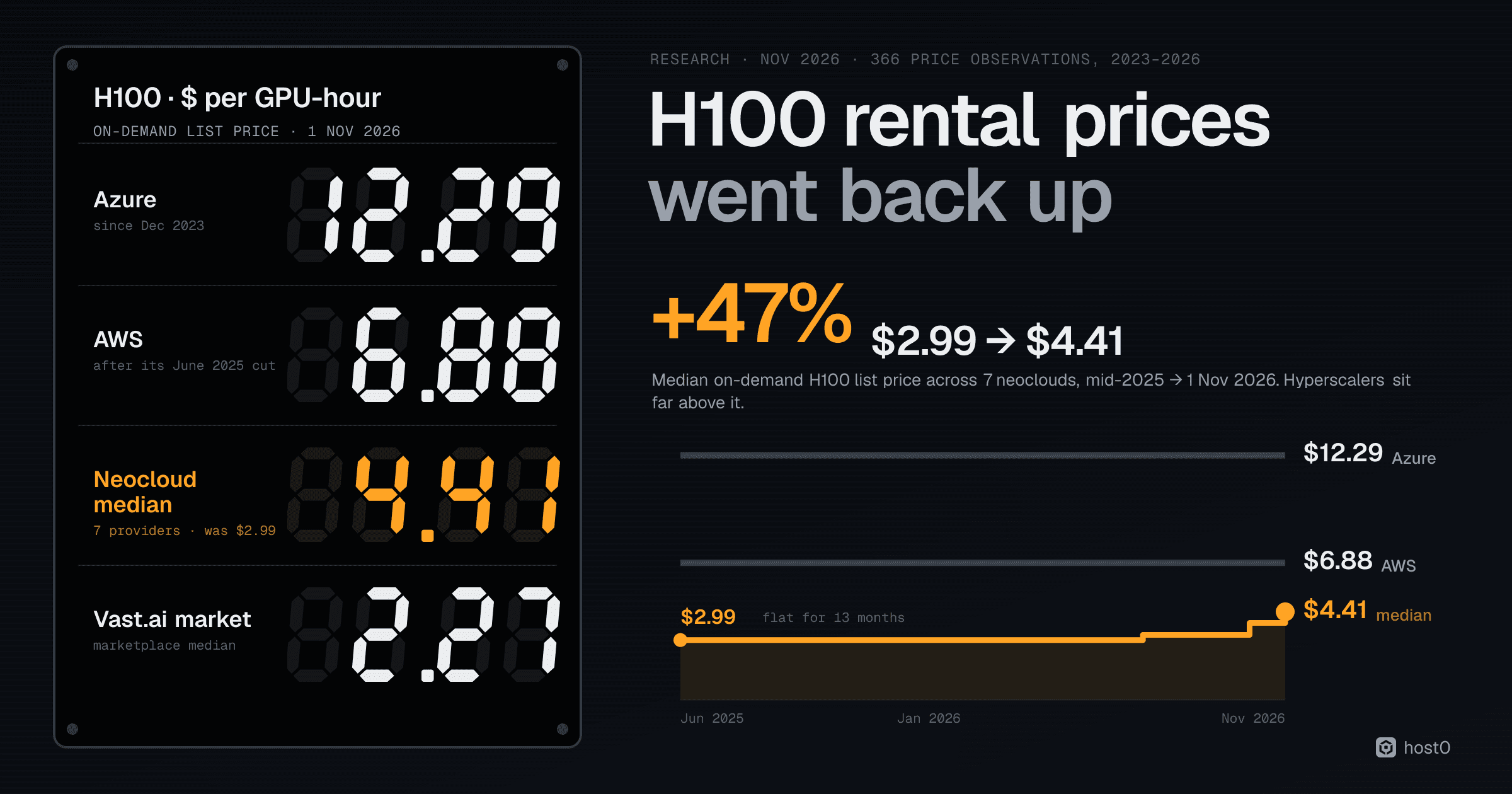
- 1The H100 got more expensive in 2026. The median on-demand H100 list price across a fixed panel of seven neoclouds was $2.99 an hour in every month of our captures from June 2025 to June 2026. On 1 November 2026 it was $4.41, up 47%. Five of the seven raised their price in 2026 and none cut it. Verda's went from $1.77 in August 2025 to $4.79.
- 2Contract and spot prices moved first. SemiAnalysis says 1-year H100 contracts rose from $1.70 an hour in October 2025 to $2.35 in March 2026, and its index marked on-demand H100s "sold out" from February. Google Cloud's H100 spot price rose 160%, from $2.55 in January to $6.64 in August and September. Posted neocloud prices followed; the first rise we can date is Lambda's, between February and March.
- 3Hyperscalers barely moved. AWS's 44% cut in June 2025, to $6.88 per GPU-hour, is the only change to a big cloud's on-demand H100 list price in our data. Azure has listed $12.29 since December 2023 and Google Cloud $11.06 since June 2024: 2.8× and 2.5× the neocloud median now.
- 4The indices agree on the direction, not the level. Silicon Data's neocloud H100 index rose from $2.57 on 4 May to $2.93 on 1 November, 14%. It's lower than our panel because it covers many more providers and normalizes their offers; list prices are the top of the range.
- 5Where you rent matters more than when. On 1 November the cheapest on-demand H100 list price, Crusoe's $3.90, was a third of Azure's $12.29. The median H100 listed on the Vast.ai marketplace cost $2.27, and spot capacity was a median 50% below the same provider's on-demand price.
- 6Newer GPUs cost more per hour and less per unit of compute. A B200 costs a median 87% more than an H100 at the same provider and an H200 12.5% more. Per dense BF16 petaFLOP-hour, the B200's median on-demand price is $3.82 against the H100's $4.70.
- 7The demand behind it is still growing. Microsoft, Alphabet, Amazon and Meta spent $201.9 billion on capital expenditure in the third quarter of 2026, up 107.6% on a year earlier, by our count from their filings. CoreWeave's contracted backlog reached $103.7 billion in June 2026, seven times its level 15 months earlier.
$4.41
Median on-demand H100 list price at 7 neoclouds, 1 Nov 2026; $2.99 from Jun 2025 to Jun 2026 (+47%)
Source: host0 analysis of provider pricing
$12.29
Azure's H100 on-demand list price per GPU-hour, unchanged since Dec 2023; 3.2× Crusoe's $3.90
Source: Azure Retail Prices API
+160%
Google Cloud H100 spot price, $2.55 (Jan 2026) to $6.64 (Aug–Sep 2026)
Source: host0 analysis of the Cloud Billing Catalog
$201.9B
Microsoft, Alphabet, Amazon and Meta capex in Q3 2026, up 107.6% year on year
Source: host0 analysis of SEC filings
Neocloud list prices rose 47% in 2026#
Neoclouds are the GPU-first clouds: CoreWeave, Lambda, Nebius, Crusoe, RunPod and the like. They sell most of their capacity on contracts, but they also post an on-demand price that anyone can pay by the hour. We followed seven of them, the ones with a recorded price both before July 2025 and today, and took the median of their on-demand H100 SXM list prices each month. A price stays in the series until a newer capture shows a different one.
On-demand H100 list price at seven neoclouds
US$ per GPU-hour, median and mean of CoreWeave, Crusoe, DigitalOcean, Lambda, Nebius, RunPod and Verda, Jun 2025 to 1 Nov 2026
| Series | x | y |
|---|---|---|
| Median | Jun 2025 | $2.99 |
| Median | Jul 2025 | $2.99 |
| Median | Aug 2025 | $2.99 |
| Median | Sep 2025 | $2.99 |
| Median | Oct 2025 | $2.99 |
| Median | Nov 2025 | $2.99 |
| Median | Dec 2025 | $2.99 |
| Median | Jan 2026 | $2.99 |
| Median | Feb 2026 | $2.99 |
| Median | Mar 2026 | $2.99 |
| Median | Apr 2026 | $2.99 |
| Median | May 2026 | $2.99 |
| Median | Jun 2026 | $2.99 |
| Median | Jul 2026 | $3.25 |
| Median | Aug 2026 | $3.25 |
| Median | Sep 2026 | $3.25 |
| Median | Oct 2026 | $3.85 |
| Median | 1 Nov 2026 | $4.41 |
| Mean | Jun 2025 | $3.59 |
| Mean | Jul 2025 | $3.59 |
| Mean | Aug 2025 | $3.35 |
| Mean | Sep 2025 | $3.35 |
| Mean | Oct 2025 | $3.35 |
| Mean | Nov 2025 | $3.38 |
| Mean | Dec 2025 | $3.38 |
| Mean | Jan 2026 | $3.38 |
| Mean | Feb 2026 | $3.38 |
| Mean | Mar 2026 | $3.45 |
| Mean | Apr 2026 | $3.45 |
| Mean | May 2026 | $3.49 |
| Mean | Jun 2026 | $3.49 |
| Mean | Jul 2026 | $3.67 |
| Mean | Aug 2026 | $3.67 |
| Mean | Sep 2026 | $3.67 |
| Mean | Oct 2026 | $4.07 |
| Mean | 1 Nov 2026 | $4.53 |
Source: host0 analysis of provider pricing pages, APIs and Wayback captures
The rise is broad. Five of the seven raised their price in 2026: Lambda in March, RunPod in May and again in October, Verda by July, DigitalOcean in August and Nebius on 1 October. The other two, CoreWeave at $6.16 and Crusoe at $3.90, held theirs. None cut. Drop the biggest mover, Verda, and the median still rises 40%; drop CoreWeave, the most expensive, and it rises from $2.97 to $4.20.
How much each neocloud raised its H100 price
Change in on-demand H100 SXM list price from its 2025–26 low to 1 Nov 2026
| Label | Value |
|---|---|
| Verda | +171% ($1.77 → $4.79) |
| Nebius | +52.5% ($2.95 → $4.50) |
| RunPod | +48.3% ($2.69 → $3.99) |
| DigitalOcean | +47.5% ($2.99 → $4.41) |
| Lambda | +33.4% ($2.99 → $3.99) |
| CoreWeave | 0% ($6.16) |
| Crusoe | 0% ($3.90) |
Sources: Verda; Nebius (Wayback, 1 Oct 2026); DigitalOcean; Lambda
Down from 2024, back up in 2026#
Archived pricing pages go back further, though not for every provider. The earliest neocloud H100 SXM prices we could read are Verda's $3.50 in September 2023 and Nebius's $4.85 in November 2023. Silicon Data, which publishes a daily H100 rental index, says early rentals "routinely exceeded $7–$10 per GPU‑hour", and Latent Space put the 2023 price at over $8. We have no capture that shows a neocloud list price that high, so we can't say exactly where the 2023 peak was.
What the captures do show is the shape. Three providers with the longest records fell by a third to a half through 2024 and 2025, then turned up in 2026.
H100 list price at three neoclouds, 2023–2026
On-demand H100 SXM, US$ per GPU-hour, at each archived or live capture, Nov 2023 to 1 Nov 2026
| Series | x | y |
|---|---|---|
| Nebius | 1 Nov 2023 | $4.85 |
| Nebius | 27 May 2024 | $4.85 |
| Nebius | 7 Sep 2024 | $3.5 |
| Nebius | 15 Nov 2024 | $2.95 |
| Nebius | 26 Aug 2025 | $2.95 |
| Nebius | 1 Oct 2026 | $4.5 |
| Nebius | 1 Nov 2026 | $4.5 |
| RunPod | 13 Jun 2024 | $4.69 |
| RunPod | 27 Jul 2024 | $3.99 |
| RunPod | 1 Dec 2024 | $2.99 |
| RunPod | 2 Aug 2025 | $2.69 |
| RunPod | 9 May 2026 | $2.99 |
| RunPod | 3 Oct 2026 | $3.49 |
| RunPod | 1 Nov 2026 | $3.99 |
| DigitalOcean | 7 Oct 2024 | $5.95 |
| DigitalOcean | 11 Jun 2025 | $2.99 |
| DigitalOcean | 1 Aug 2026 | $4.41 |
| DigitalOcean | 1 Nov 2026 | $4.41 |
Verda is the exception. Its $4.79 today is above its $3.50 of September 2023, so for one provider at least, 2026 prices are higher than early ones.
Hyperscalers barely moved#
The big clouds price H100s differently. AWS launched its P5 instance, eight H100s, in July 2023. Applying AWS's own 44% figure to today's price puts its pre-cut price at about $98.30 an hour, or $12.29 per GPU. On 1 June 2025 it cut on-demand P5 prices by 44%, to $55.04, or $6.88 per GPU. That's the only change to a hyperscaler's on-demand H100 list price in our data, in either direction. Azure's ND H100 v5 has cost $98.32 an hour, the same $12.29 per GPU, since 1 December 2023. Google Cloud's a3-highgpu-8g has cost $88.49, $11.06 per GPU, since it first appeared in the billing catalog in June 2024.
On-demand H100 list price at the hyperscalers
US$ per GPU-hour, 8-GPU instance ÷ 8, US East / us-central1, Jul 2023 to 1 Nov 2026
| Series | x | y |
|---|---|---|
| Azure | 1 Dec 2023 | $12.29 |
| Azure | 1 Nov 2026 | $12.29 |
| Google Cloud | 13 Jun 2024 | $11.06 |
| Google Cloud | 1 Nov 2026 | $11.06 |
| AWS | 26 Jul 2023 | $12.29 |
| AWS | 1 Jun 2025 | $6.88 |
| AWS | 1 Nov 2026 | $6.88 |
Sources: AWS News Blog; Azure Retail Prices API; Cloud Billing Catalog mirror
So the gap between the two kinds of cloud narrowed without the hyperscalers doing anything. In June 2025 the median of the three hyperscaler list prices, $11.06, was 3.7 times the neocloud median. On 1 November it was 2.5 times. Azure lists 2.8 times the neocloud median and AWS 1.6 times.
The hyperscalers' prices did move where they're set by the market. Google sets spot prices by supply and demand, and its billing catalog has a new snapshot every month. The H100 spot price fell from $7.80 in June 2024 to $2.55 in April 2025 and stayed there for nine months. In February 2026 it started to climb, and by August it was $6.64, 160% above January. Spot went from 77% below the on-demand price to 40% below.
Google Cloud H100 spot vs on-demand
a3-highgpu-8g ÷ 8, us-central1, US$ per GPU-hour, monthly catalog snapshot, Jun 2024 to Oct 2026
| Series | x | y |
|---|---|---|
| On-demand | 13 Jun 2024 | $11.06 |
| On-demand | 8 Oct 2026 | $11.06 |
| Spot | 13 Jun 2024 | $7.8 |
| Spot | 8 Jul 2024 | $6.1 |
| Spot | 1 Aug 2024 | $6.1 |
| Spot | 5 Sep 2024 | $6.1 |
| Spot | 3 Oct 2024 | $6.1 |
| Spot | 1 Nov 2024 | $4.45 |
| Spot | 5 Dec 2024 | $4.45 |
| Spot | 2 Jan 2025 | $4.45 |
| Spot | 9 Feb 2025 | $4.42 |
| Spot | 6 Mar 2025 | $4.42 |
| Spot | 3 Apr 2025 | $2.55 |
| Spot | 1 May 2025 | $2.55 |
| Spot | 1 Jun 2025 | $2.55 |
| Spot | 3 Jul 2025 | $2.55 |
| Spot | 7 Aug 2025 | $2.55 |
| Spot | 4 Sep 2025 | $2.55 |
| Spot | 2 Oct 2025 | $2.55 |
| Spot | 6 Nov 2025 | $2.55 |
| Spot | 4 Dec 2025 | $2.55 |
| Spot | 1 Jan 2026 | $2.55 |
| Spot | 5 Feb 2026 | $3.22 |
| Spot | 5 Mar 2026 | $3.38 |
| Spot | 2 Apr 2026 | $3.9 |
| Spot | 7 May 2026 | $4.3 |
| Spot | 4 Jun 2026 | $4.74 |
| Spot | 2 Jul 2026 | $5.48 |
| Spot | 6 Aug 2026 | $6.64 |
| Spot | 3 Sep 2026 | $6.64 |
| Spot | 8 Oct 2026 | $6.29 |
Source: host0 analysis of the Cloud Billing Catalog (Cyclenerd mirror)
AWS's market-priced product moved too. EC2 Capacity Blocks reserve GPUs for a fixed window at prices AWS says move with supply and demand, and in January 2026 The Register reported that AWS had raised them about 15% over a weekend: an 8-GPU H200 instance went from $34.61 to $39.80 an hour in most regions.
Every index points the same way#
Our panel is a set of sticker prices, so it's worth checking against the people who measure the market for a living. Three publish H100 indices, and all three say prices rose in 2026.
Silicon Data's index, launched in May 2025 and carried by Bloomberg, is built from millions of price points across rental platforms. On 5 December 2025 it revised its method to normalize for "interconnect type, cluster scale, geography, and performance variance" and added a hyperscaler tier. In 2026 its neocloud H100 index went from $2.57 on 4 May to $2.75 on 27 July, and, in the daily values we rebuilt from its site, from $2.65 on 17 September to $2.93 on 1 November. Its hyperscaler tier stayed between $7.14 and $7.20 over those 46 days.
Our neocloud panel vs Silicon Data's neocloud index
H100, US$ per GPU-hour, May to 1 Nov 2026
| Series | x | y |
|---|---|---|
| host0 panel, list price | May 2026 | $2.99 |
| host0 panel, list price | Jun 2026 | $2.99 |
| host0 panel, list price | Jul 2026 | $3.25 |
| host0 panel, list price | Aug 2026 | $3.25 |
| host0 panel, list price | Sep 2026 | $3.25 |
| host0 panel, list price | Oct 2026 | $3.85 |
| host0 panel, list price | 1 Nov 2026 | $4.41 |
| Silicon Data index | 4 May 2026 | $2.57 |
| Silicon Data index | 5 Jun 2026 | $2.79 |
| Silicon Data index | 27 Jul 2026 | $2.75 |
| Silicon Data index | 17 Sep 2026 | $2.65 |
| Silicon Data index | 24 Sep 2026 | $2.61 |
| Silicon Data index | 1 Oct 2026 | $2.77 |
| Silicon Data index | 8 Oct 2026 | $2.8 |
| Silicon Data index | 15 Oct 2026 | $2.81 |
| Silicon Data index | 22 Oct 2026 | $2.88 |
| Silicon Data index | 29 Oct 2026 | $2.9 |
| Silicon Data index | 1 Nov 2026 | $2.93 |
Sources: Silicon Data; host0 analysis of provider pricing
SemiAnalysis, which also has an H100 index on Bloomberg, tracks contract prices. In April it wrote that 1-year H100 contracts had risen from $1.70 an hour in October 2025 to $2.35 by March 2026, and that "all capacity coming online until August to September 2026 has already been booked". Its index table marks on-demand H100s "Sold Out" from February to April 2026. Its weighted composite, which leans on hyperscalers, stayed flat at $2.80–2.84 from October 2025 to March 2026, as flat as the hyperscalers' list prices.
H100 one-year contract price
Midpoint of SemiAnalysis's 25th–75th percentile range, US$ per GPU-hour, Jul 2025 to Apr 2026
| x | y |
|---|---|
| Jul 2025 | $1.85 |
| Aug 2025 | $1.75 |
| Sep 2025 | $1.75 |
| Oct 2025 | $1.7 |
| Nov 2025 | $1.73 |
| Dec 2025 | $1.73 |
| Jan 2026 | $1.78 |
| Feb 2026 | $2.08 (sold out) |
| Mar 2026 | $2.35 |
| Apr 2026 | $2.4 |
Source: SemiAnalysis GPU rental index
The third, Ornn's compute price index, is what Kalshi's H100 markets settle on. Its H100 SXM monthly average settled at $2.77 for August 2026 and $2.83 for September. ICE has announced planned H100 and B200 futures on it, with no listing date set. The order of events across all of these is consistent: contracts and spot prices tightened first, around February 2026, and posted list prices caught up from March to October.
The money behind the demand#
The reason is not mysterious. In November 2025 Nvidia's Jensen Huang said "Blackwell sales are off the charts, and cloud GPUs are sold out". Since then the four biggest buyers have kept accelerating. We added up the cash capital expenditure that Microsoft, Alphabet, Amazon and Meta report to the SEC, by calendar quarter. It was $36.9 billion in the third quarter of 2023 and $201.9 billion in the third quarter of 2026. In the first nine months of 2026 they spent $496.7 billion, already 32% more than in all of 2025.
Big Tech capex and Nvidia's data center revenue
US$ per quarter, Microsoft + Alphabet + Amazon + Meta cash capex by calendar quarter, and Nvidia Data Center revenue by fiscal quarter, 2023 to latest reported
| Series | x | y |
|---|---|---|
| Big-4 capex | 31 Mar 2023 | $33.9B |
| Big-4 capex | 30 Jun 2023 | $33.4B |
| Big-4 capex | 30 Sep 2023 | $36.9B |
| Big-4 capex | 31 Dec 2023 | $42.9B |
| Big-4 capex | 31 Mar 2024 | $44.3B |
| Big-4 capex | 30 Jun 2024 | $52.9B |
| Big-4 capex | 30 Sep 2024 | $58.9B |
| Big-4 capex | 31 Dec 2024 | $72.3B |
| Big-4 capex | 31 Mar 2025 | $71.9B |
| Big-4 capex | 30 Jun 2025 | $88.2B |
| Big-4 capex | 30 Sep 2025 | $97.3B |
| Big-4 capex | 31 Dec 2025 | $118.6B |
| Big-4 capex | 31 Mar 2026 | $129.8B |
| Big-4 capex | 30 Jun 2026 | $165.1B |
| Big-4 capex | 30 Sep 2026 | $201.9B |
| Nvidia data center revenue | 30 Apr 2023 | $4.3B |
| Nvidia data center revenue | 30 Jul 2023 | $10.3B |
| Nvidia data center revenue | 29 Oct 2023 | $14.5B |
| Nvidia data center revenue | 28 Jan 2024 | $18.4B |
| Nvidia data center revenue | 28 Apr 2024 | $22.6B |
| Nvidia data center revenue | 28 Jul 2024 | $26.3B |
| Nvidia data center revenue | 27 Oct 2024 | $30.8B |
| Nvidia data center revenue | 26 Jan 2025 | $35.6B |
| Nvidia data center revenue | 27 Apr 2025 | $39.1B |
| Nvidia data center revenue | 27 Jul 2025 | $41.1B |
| Nvidia data center revenue | 26 Oct 2025 | $51.2B |
| Nvidia data center revenue | 25 Jan 2026 | $62.3B |
| Nvidia data center revenue | 26 Apr 2026 | $75.2B |
| Nvidia data center revenue | 26 Jul 2026 | $89B |
The neoclouds are borrowing to keep up. CoreWeave, the largest, reported $103.7 billion of remaining performance obligations, its contracted backlog, at the end of June 2026, up from $14.7 billion in March 2025. Its debt rose from $8.0 billion to $35.6 billion over 18 months. Its annual report says its committed contracts run "approximately five years" on average. Contracts that long are why most capacity never reaches the on-demand price list, and why the on-demand list is where a shortage shows first.
CoreWeave's backlog and debt
US$ at quarter end, remaining performance obligations and debt, Dec 2024 to Jun 2026 (latest reported)
| Series | x | y |
|---|---|---|
| Backlog | 31 Mar 2025 | $14.7B |
| Backlog | 30 Jun 2025 | $30.1B |
| Backlog | 30 Sep 2025 | $50B |
| Backlog | 31 Dec 2025 | $60.7B |
| Backlog | 31 Mar 2026 | $98.8B |
| Backlog | 30 Jun 2026 | $103.7B |
| Debt | 31 Dec 2024 | $8B |
| Debt | 31 Mar 2025 | $8.8B |
| Debt | 30 Jun 2025 | $11.2B |
| Debt | 30 Sep 2025 | $14.2B |
| Debt | 31 Dec 2025 | $21.6B |
| Debt | 31 Mar 2026 | $25.2B |
| Debt | 30 Jun 2026 | $35.6B |
How long a GPU stays useful is a live argument. From 2022 to 2025, every change the big four made to the accounting life of their servers lengthened it, to between five and six years, with one exception in our reading of their annual reports: from 1 January 2025, Amazon moved "a subset of our servers and networking equipment" from six years to five. A shortage that lifts the rent on three-year-old H100s supports the longer lives, for now.
Where to rent an H100 today#
Put every kind of H100 price side by side and the spread is wide. On 1 November 2026 the cheapest on-demand list price among the 12 providers we checked, Crusoe's $3.90, was less than a third of the most expensive, Azure's $12.29. Below the list prices sit marketplaces and spot capacity; above the neoclouds sit the hyperscalers' discounts, which still cost more than most neocloud sticker prices.
What an H100 costs, by where and how you rent it
H100 SXM, US$ per GPU-hour, 1 Nov 2026
| Label | Value |
|---|---|
| Vast.ai, interruptible | $1.71 (median bid) |
| Together, preemptible | $1.99 |
| Vast.ai, on-demand | $2.27 (median listed) |
| Azure, spot | $2.27 |
| Verda, spot | $2.40 |
| CoreWeave, spot | $2.46 |
| RunPod Community | $2.69 (third-party hosts) |
| Together, 91–180 days | $3.19 |
| DigitalOcean, 12 months | $3.26 |
| Crusoe, on-demand | $3.90 |
| Lambda, on-demand | $3.99 (8 GPUs) |
| RunPod Secure, on-demand | $3.99 |
| Together, on-demand | $3.99 |
| DigitalOcean, on-demand | $4.41 |
| Nebius, on-demand | $4.50 |
| Verda, on-demand | $4.79 |
| AWS, 3-year plan | $5.05 |
| AWS, 1-year plan | $5.42 |
| CoreWeave, on-demand | $6.16 |
| Google Cloud, spot | $6.29 (8 Oct) |
| AWS, on-demand | $6.88 |
| Google Cloud, 1-year | $7.67 (8 Oct) |
| Azure, 1-year | $7.87 |
| Oracle, on-demand | $10.00 |
| Google Cloud, on-demand | $11.06 (8 Oct) |
| Azure, on-demand | $12.29 |
Sources: Provider APIs and pricing pages; host0 analysis
The marketplaces are where the "$2 H100" still lives. On Vast.ai, where independent hosts list their machines, the median H100 SXM listed on 1 November cost $2.27 an hour, with 10% of GPUs under $1.97 and 10% over $3.36. That's 117 GPUs on 27 machines, a sliver of the market, and counting only the ones still free to rent that day, the median was $2.40.
Spot is the other way down. Across 24 GPU and provider pairs, spot or preemptible capacity was a median 50% cheaper than the same provider's on-demand price on 1 November. For H100s the discount ranged from a quarter on Vast.ai's interruptible bids to 81.5% on Azure, whose $2.27 spot price is the cheapest way into a hyperscaler H100. The catch is that spot capacity can be taken back at any time, and as Google's line shows, its price can move a lot.
How much cheaper spot H100s are
Spot or preemptible discount vs the same provider's on-demand H100 SXM price, 1 Nov 2026
| Label | Value |
|---|---|
| Azure | 81.5% ($2.27 vs $12.29) |
| CoreWeave | 60% ($2.46 vs $6.16) |
| Together | 50.1% ($1.99 vs $3.99) |
| Verda | 50% ($2.40 vs $4.79) |
| Google Cloud | 43.1% ($6.29 vs $11.06) |
| Vast.ai | 24.7% (median bid vs listed) |
Source: host0 analysis of provider pricing APIs and pages
Newer GPUs cost more per hour, less per unit of compute#
The H100 is no longer the newest chip, and its successors are priced at a premium. At the providers that list both, an H200 costs a median 12.5% more than an H100, a B200 87% more and a B300 127.5% more. The H200 has the same compute as the H100 with more and faster memory, and the premium is modest; some providers barely charge one (DigitalOcean 1.4%, CoreWeave 2.4%).
Per unit of compute, though, the newer chip wins. Dividing each GPU's median on-demand price by its dense BF16 throughput from Nvidia's datasheets, a B200 costs $3.82 per petaFLOP-hour against $4.70 for an H100 SXM, 19% less. The H200 costs more per FLOP than either, because its extra money buys memory, not compute. AMD's MI300X is the cheapest on paper.
Price per unit of compute
Median on-demand price ÷ dense BF16 TFLOPS from the datasheet, US$ per petaFLOP-hour, 1 Nov 2026
| Label | Value |
|---|---|
| A100 80GB | $8.80 (10 quotes) |
| GB200 | $6.40 (3 quotes) |
| H200 | $6.06 (11 quotes) |
| B300 | $5.00 (5 quotes) |
| H100 SXM | $4.70 (14 quotes) |
| RTX 5090 | $4.44 (2 quotes) |
| RTX 4090 | $4.11 (2 quotes) |
| H100 PCIe | $3.82 (3 quotes) |
| B200 | $3.82 (9 quotes) |
| MI300X | $2.64 (5 quotes) |
Source: host0 analysis of provider prices and Nvidia and AMD datasheets
When owning beats renting#
At $4.41 an hour, is it time to buy? Nvidia publishes no list prices for its data center GPUs, so anyone's cost is an estimate; Huang told CNBC in 2024 that Blackwell would cost "between $30,000 and $40,000" a unit. We built a simple model of what an owner needs to charge per GPU-hour to break even: an all-in cost of $35,000 to $55,000 per GPU (the chip plus its share of the server, network and installation), a four- to six-year life, data center space at $150 per kW-month, power at $0.08 per kWh and nothing left at the end. These are our assumptions, not data.
What an owner needs to charge to break even
Our model of an H100 owner's break-even price, US$ per GPU-hour, 9% cost of capital
| Label | Value |
|---|---|
| $55k, 4 years, 80% busy | $2.88 |
| $45k, 5 years, 60% busy | $2.77 |
| $55k, 5 years, 80% busy | $2.48 |
| $45k, 5 years, 80% busy | $2.11 |
| $45k, 6 years, 80% busy | $1.89 |
| $45k, 5 years, 95% busy | $1.80 |
| $35k, 6 years, 80% busy | $1.57 |
Source: host0 model (assumptions in the data pack)
The model says two things. At today's list prices, renting H100s out clears the break-even comfortably, as long as they stay busy. And for a buyer with steady, round-the-clock work, owning has a much lower hourly cost than any list price, before counting the staff, networking and risk that the model leaves out. Latent Space's 2024 essay put the line at $2.85: above it, renting out H100s beat the stock market. Every on-demand list price in our panel is above that today.
For a single consumer card the arithmetic is simpler. The median RTX 5090 on Vast.ai cost $0.67 an hour on 1 November. At its $1,999 launch price plus power, a 5090 pays for itself after about 3,500 hours of rental you didn't buy: five months around the clock, or about 14 months at eight hours a day. An RTX 4090 ($1,599, $0.47 an hour) takes about 4,100 hours. That ignores the rest of the PC and what the card is worth when you're done, and we found no survey that measures how many people actually rent rather than buy.
What this means if you build with AI#
- Don't budget for 2025 prices. If your plan assumes $2–3 per H100-hour at a neocloud, recheck it: the median list price is $4.41, and five of seven providers we track raised theirs this year. Lock in a quote before you commit to a training run or a launch.
- Shop the price, not the brand. The same H100-hour costs $3.90 at Crusoe and $12.29 at Azure. If you don't need to sit inside a hyperscaler for data or compliance reasons, most neoclouds' on-demand prices are below even the hyperscalers' one-year reservations.
- Use spot and marketplaces for work that can restart. Batch jobs, evals, fine-tunes with checkpoints and experiments run fine on capacity that can be taken back, at around half the on-demand price. Keep anything user-facing on on-demand or reserved capacity.
- Compare chips by work done, not by hourly price. A B200 costs 87% more per hour but 19% less per unit of compute. If your job is compute-bound and your software runs on it, the pricier chip can be the cheaper run. If it's memory-bound, price the H200.
- Commit only for steady load. A one- to three-year commitment is how most capacity is sold, and contract prices rose 38% between October 2025 and March 2026. Commit for the baseline you're sure of, and rent the peaks.
- Buy a card when it will be busy. A consumer GPU that runs eight hours a day pays for itself in 14 to 17 months at today's marketplace rates. One that runs a few hours a week never will.
- Most apps don't need a GPU of their own. If you call a model through an API, you pay per token, not per GPU-hour, and the price of a given level of capability has kept falling. Rent GPUs when you serve your own weights or train.
If what you're building is the app around the model, host0 hosts it at a private link with a shared database, and no GPU is involved.
Methodology#
We used public data only, with a cutoff of 1 November 2026, and re-opened the sources we lean on before writing. Every price is a US$ list price per GPU per hour, on Linux, without storage or egress; 8-GPU instances are divided by 8. "H100" means H100 SXM unless stated.
- Today's prices (1 Nov 2026). AWS from its public price-list files (on-demand and Compute Savings Plans, us-east-1). Azure from the Retail Prices API (eastus; on-demand, spot and reservations). Oracle from its products API. RunPod from its GraphQL API. Vast.ai from its public offers API, every listed offer, with percentiles weighted by GPU. Google Cloud from the latest snapshot (8 October 2026) of its Cloud Billing Catalog in a public mirror. Lambda, CoreWeave, Nebius, Crusoe, Together, DigitalOcean, Verda and Voltage Park from their live pricing pages, every price read by hand.
- History. Google's catalog month by month since 2022, from the mirror's git history. Azure's current price and the date it took effect, from the API. AWS's pre-cut price derived from its own 44% figure. Everything else from the Internet Archive: one capture per provider per quarter before July 2025 and per month after, 306 captures in all, with every price read by eye from the archived text (RunPod's 2025–26 prices from the price attributes in its page code). In total, 366 price observations from 20 providers.
- The neocloud panel. The seven neoclouds with a recorded on-demand H100 price both before July 2025 and on 1 November 2026. Each provider's last observed price carries forward until a capture shows a new one, so a change can be dated up to one capture interval late. Marketplaces, "from" prices, clusters and reservations are excluded.
- Indices and filings. Silicon Data's 2026 daily values were rebuilt from the 30-day series embedded in its index page, from the live page and archived captures from October; they cover 17 September to 1 November only, and overlapping captures never disagreed. Earlier values are from its blog. SemiAnalysis values are from its index table and its April 2026 article; Ornn values are from Kalshi settlements. Capex, Nvidia revenue and CoreWeave's backlog and debt come from companies' XBRL filings at the SEC, by calendar quarter, latest filing winning.
- Per-FLOP and premiums. Premium is the same provider's on-demand price on the same day. Price per FLOP is the median on-demand quote for each GPU divided by dense BF16 throughput (half the sparse figure Nvidia's datasheets print).
- Limits. These are list prices, not what large buyers pay: most capacity is sold on multi-year contracts below list. Regions differ (Verda and Nebius in Europe, most others in the US). Archive coverage of 2023–24 is thin for Lambda, CoreWeave, RunPod and Together. The break-even figures are a model with stated assumptions, not a measurement.
The data pack, with every source, tier, the reconciliation of our panel against the indices and a do-not-cite list, is in our repository at docs/research/2026-11-01-gpu-rental-prices.md. Every price, with a link to the page or capture it came from, is in docs/research/2026-11-01-gpu-rental-prices-data/prices.csv, next to the scripts and series behind each chart.
Open questions#
- What do big buyers actually pay? List prices are the visible tip. Contract prices for thousands of GPUs over three to five years aren't published, and the indices only sample them.
- Where was the 2023 peak? Accounts say $7 to $10 an hour, but the archived neocloud pages we could read start at $3.50–4.85. The rest of the 2023 captures exist and haven't been read.
- Will the hyperscalers move? Their on-demand H100 list prices haven't changed in the 17 months since AWS's one cut. Their spot and capacity-block prices have.
- How long will H100s stay worth renting? The price rise says demand outran supply in 2026. As Blackwell supply grows, the H100's price per unit of compute is already worse than the B200's.
- Do people rent or buy? We found no survey with a sample size that asks AI builders which they do, or why.