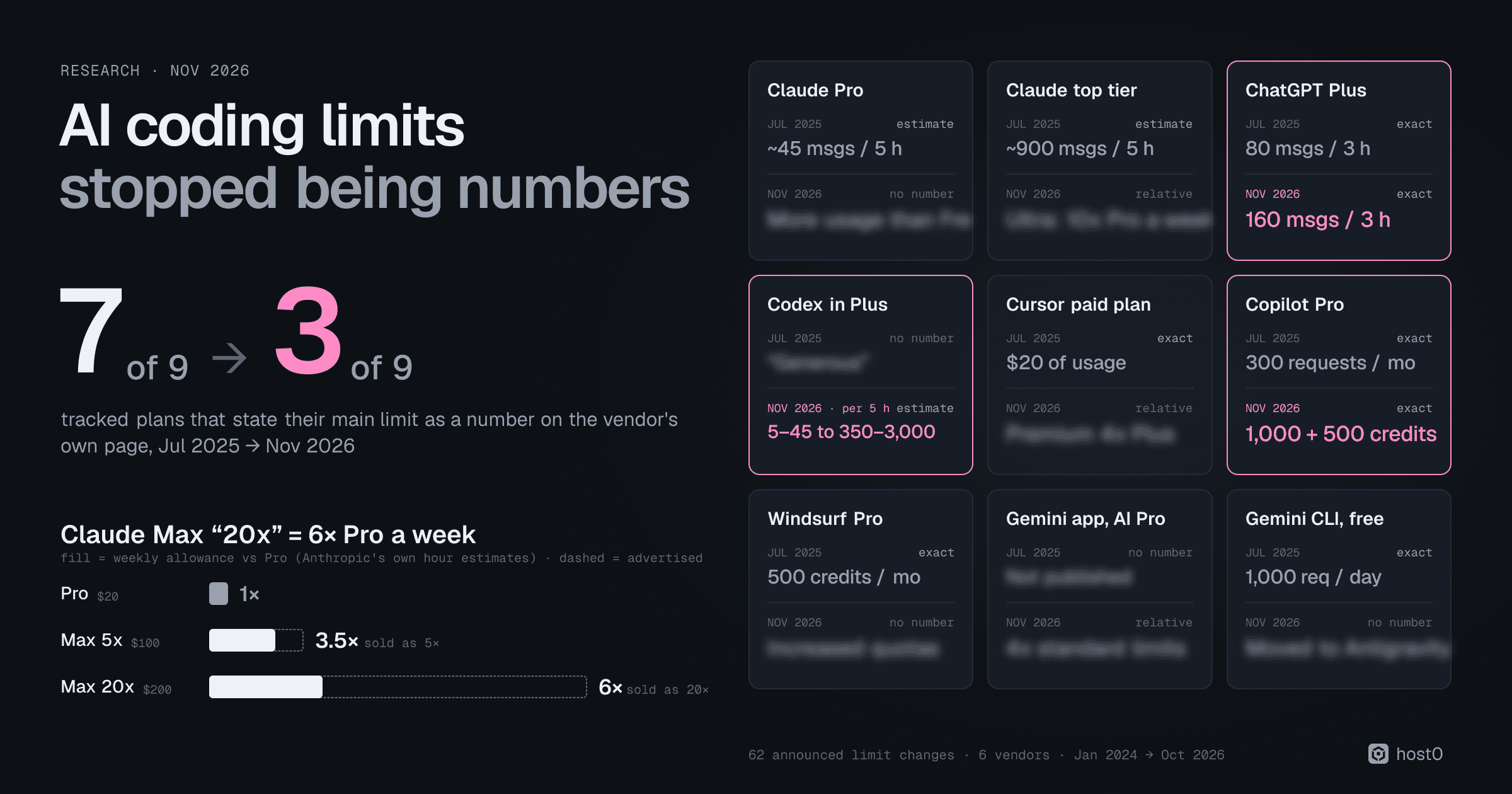
In April 2024 Anthropic told Claude Pro subscribers they could expect to send "around 45 messages every 5 hours". Today Claude's pricing page promises Pro "more usage than Free", every five hours and every week. Its top plan, Ultra at $200 a month, offers "10x Pro usage every week" and no five-hour limit. That's not one plan. It's how the whole category moved: limits that used to be a count of messages or requests became windows, weekly caps, multiples of another plan and credits.
We tracked it. We read the archived versions of 19 help-center, pricing and docs pages from Anthropic, OpenAI, Cursor, GitHub, Google and Windsurf from January 2024 to 1 November 2026, plus the git history of GitHub's Copilot docs and Google's Gemini CLI. That gave us 62 announced changes to a published limit, each dated and quoted. Then we counted how people reacted: GitHub issues, Hacker News stories, Cursor's forum and downloads of a tool that meters your own usage. The methodology explains how, and what the archive misses.
Key findings
- 1The numbers went away. In July 2025, 7 of the 9 plans we tracked stated their main limit as a number on the vendor's own page. In November 2026, 3 do: ChatGPT Plus (160 messages every 3 hours), Copilot Pro (AI credits) and Codex in Plus (per-model estimates of messages per five hours).
- 2Limits change all the time. We counted 62 announced changes to published limits across six vendors: 5 in 2024, 26 in 2025 and 31 in the first ten months of 2026. Anthropic made 19, OpenAI 17 and GitHub 11.
- 3They didn't simply get tighter. Of 51 changes to existing plans, 21 tightened a limit, 18 loosened one and 10 were mixed. What changed reliably is how limits are stated: 76% of changes in the second half of 2025 published the new limit as a number, against 17% so far in the second half of 2026.
- 4"20x" was a per-session promise. By Anthropic's own weekly estimates, Max "20x" gave about 6 times Pro's usage a week and Max "5x" about 3.5 times: 240–480 and 140–280 hours of Sonnet 4, against Pro's 40–80.
- 5Every big plan now has a week. A short rolling window plus a weekly cap is now the shape at Anthropic, OpenAI's Codex, Google's Gemini app and Windsurf; Cursor's new plans have a weekly pool. GitHub alone still counts by the month.
- 6Users noticed the week. Claude Code GitHub issues with "weekly limit" in the title went from none before July 2025 to 286 by October 2026. Hacker News stories about AI coding-tool limits went from 15 in 2024 to 96 in 2025 and 327 in January–October 2026.
- 7Cuts and billing changes get the attention. The biggest Hacker News limit thread was GitHub's move to usage-based billing (767 points). Limit stories in the week of Anthropic's holiday 2x boost drew 12 points in all; the week it ended drew 31.
7 → 3
Of 9 tracked plans, those whose page states the main limit as a number, Jul 2025 → Nov 2026
Source: host0 analysis of vendor pages
6×
Claude Max 20x's weekly allowance vs Pro, by Anthropic's own estimates (Max 5x: 3.5×)
Source: Anthropic via TechCrunch
62
Announced limit changes across six vendors, Jan 2024 – Oct 2026 (31 in 2026)
Source: host0 changelog of archived pages
0 → 286
Claude Code issues with "weekly limit" in the title, before Jul 2025 → total by Oct 2026
Source: host0 count of GitHub issues
62 changes in 34 months#
A "change" here is an announced change to a published limit, to how a plan's limit is structured (a new window, credits instead of messages), to its top tier, or to whether the limit is disclosed at all. One-off counter resets don't count, and several rows from one announcement count once.
Announced limit changes per vendor
Changes to published plan limits, Jan 2024 – Oct 2026
| Label | Value |
|---|---|
| Anthropic | 19 (2 · 8 · 9) |
| OpenAI | 17 (2 · 6 · 9) |
| GitHub | 11 (1 · 2 · 8) |
| 7 (0 · 4 · 3) | |
| Cursor | 5 (0 · 4 · 1) |
| Windsurf | 3 (0 · 2 · 1) |
Source: host0 changelog of archived vendor pages (changes.csv)
Anthropic changed Claude's limits most often. In 2024 it cut Pro's reset from eight hours to five and its estimate from "at least 100" messages to "around 45". In 2025 it launched Max, added Claude Code to Pro, then announced weekly limits on 28 July. In 2026 it tightened peak hours, doubled the five-hour window, ran and ended a weekly boost, and by 1 November had replaced Max 20x with Ultra. GitHub's eight changes in 2026 were mostly one long move from premium requests to usage-based AI credits.
It would be easy to read all this as limits getting stingier. Our count doesn't say that. We classified every change to an existing plan by a rule written before counting: fewer units per window, a new cap, a higher multiplier or work starting to count is "tightened"; the reverse is "loosened"; a change of unit with no published conversion is "mixed".
Which way the changes went
Changes to existing plans' limits and structure, Jan 2024 – Oct 2026 (n = 51)
| Label | Value |
|---|---|
| Tightened | 21 (1 · 10 · 10) |
| Loosened | 18 (1 · 8 · 9) |
| Mixed | 10 (0 · 1 · 9) |
| Neutral | 2 (1 · 1 · 0) |
Source: host0 analysis of changes.csv
Dropping the changes we couldn't verify in our own archive (sourced only from news reports or a vendor announcement) gives 17 tightened, 14 loosened and 10 mixed: still about even. The robust trend is the mixed column, and the one in the next section.
The numbers disappeared#
For each of nine plans we checked how the vendor's own page stated its main limit in July 2025 and in November 2026: as an exact number per window, as an estimate (a range, "about", "average users"), only as a multiple of another plan ("5x Pro"), or not at all.
How each plan states its main limit
Vendor's own page, July 2025 → November 2026
- Claude Pro: estimate (about 45 messages, 10–40 Claude Code prompts per 5 h) → none ("more usage than Free")
- Claude's top plan: estimate (Max 20x: 200–800 prompts per 5 h) → relative (Ultra: 10x Pro a week)
- ChatGPT Plus: exact (80 per 3 h) → exact (160 per 3 h)
- Codex in Plus: none ("generous") → estimate (5–45 to 350–3,000 messages per 5 h, by model)
- Cursor's entry plan: exact ($20 of usage) → relative (Premium: 4x Plus)
- Copilot Pro: exact (300 premium requests) → exact (1,000 + 500 AI credits)
- Windsurf Pro: exact (500 prompt credits) → none ("increased quotas")
- Gemini app, AI Pro: none → relative (4x standard)
- Gemini CLI, free: exact (1,000 requests a day) → none (moved to Antigravity CLI)
Source: host0 analysis of archived and live vendor pages (disclosure_checkpoints.csv)
The pages that dropped numbers mostly replaced them with multiples. Cursor's plans are now sold inside the X Subscription, where Premium is "4x the usage" of Plus, and Plus is a weekly pool of unstated size. Google's Gemini app has "compute-based usage limits": AI Pro is "4x higher than standard limits", and standard isn't a number either. Windsurf, now Devin Desktop, sells "increased quotas" that refresh daily and weekly.
Even where a number survives, it's hedged. OpenAI's Codex page gives Plus users between 5 and 45 local messages per five hours on its flagship model, and adds: "These estimates are not fixed message limits". The same shift shows in the changes themselves.
Changes that published the new limit as a number
Share of announced changes whose new limit is an exact number or an estimate, by half-year
| Label | Value |
|---|---|
| 2024 H1 | 100% (n=3) |
| 2024 H2 | 50% (n=2) |
| 2025 H1 | 73% (n=15) |
| 2025 H2 | 76% (n=17) |
| 2026 H1 | 42% (n=26) |
| 2026 H2 | 17% (n=12) |
Source: host0 analysis of changes.csv
"20x" was a per-session promise#
When Anthropic launched Max in April 2025, its help center offered "20x more usage than Pro". On 28 July it announced weekly limits from 28 August, and by the capture of 29 July the line read "20x more usage per session than Pro". The weekly estimates Anthropic gave TechCrunch, and later put in its own help center, show what that qualifier was worth.
Claude Max: advertised vs weekly multiple of Pro
Multiple of Pro's allowance, Anthropic's own figures, Aug 2025 – Jan 2026
| Label | Value |
|---|---|
| Max 5x, advertised | 5× |
| Max 5x, per week | 3.5× |
| Max 20x, advertised | 20× |
| Max 20x, per week | 6× |
Source: Anthropic via TechCrunch
Anthropic deleted all six per-plan numbers from its Claude Code plans article between mid-January and early February 2026. Today it says only that Pro and Max "have a five-hour session limit and a weekly limit". The new Max, at $100, is "5x Pro usage" every five hours and every week, so for the first time the multiple is stated for the week too. We looked at what each plan is worth at API prices, and at outside measurements of the weekly gap, in Claude Code and Codex: subscription or API?.
Every big plan now has a week#
In 2024 most plans had one limit: messages per few hours, or requests per month. By November 2026 almost every vendor had stacked a second, longer cap on top, and several had switched the unit from messages to money.
From message counts to windows and credits
Mar 2025
Mar 2025
Windsurf replaces "unlimited" with credits
Codeium's $12 plan becomes Windsurf Pro at $15, with credits.16 Jun 2025
16 Jun 2025
Cursor Pro: from 500 requests to $20 of usage
Model usage billed at API prices; Cursor estimated about 225 Sonnet 4 requests.18 Jun 2025
18 Jun 2025
Copilot enforces premium requests
300 a month on Pro, 1,500 on Pro+, $0.04 each after that.28 Aug 2025
Sep 2025
Sep 2025
Codex: five-hour window plus a weekly limit
Plus 30–150 local messages per 5 h, Pro 300–1,500.Nov 2025
Nov 2025
Codex sells credits past the limit
They "kick in once you hit the 5-hour or the weekly usage limit".Mar 2026
Mar 2026
Windsurf moves to daily and weekly quotas
Now Devin Desktop; credits stay only on legacy Enterprise plans.Apr 2026
Apr 2026
Codex credits priced per token
From a per-message rate card to API-style token prices.1 Jun 2026
Jun 2026
Oct 2026
Oct 2026
Cursor's X Subscription: a weekly pool
Claude, GPT and Gemini at API list price, on Premium and up.Oct 2026
Oct 2026
Claude Ultra: no five-hour limit
10x Pro a week; Free gets a weekly limit too. First archived 1 Nov.
Source: host0 changelog of archived vendor pages; dates are announcement dates or the first capture that shows the change
Two models came out of this. Anthropic, OpenAI, Google and Windsurf sell time windows: a short rolling allowance plus a weekly cap, with the size of each stated loosely or as a multiple. GitHub and Cursor sell metered usage: an allowance in dollars of tokens at API prices, which is precise about money and vague about how much work it buys. Several vendors now combine both. Claude sells extra usage past the limit and gives Max and Ultra monthly API credits; Claude Enterprise is $20 a seat plus "usage at API rates". We covered the wider move from unlimited plans to credits in AI pricing in 2026.
Multipliers do the work#
When the unit is a request, the real limit is set by how much each model costs per request, and vendors change that without touching the headline number. Cursor's Pro plan went from 500 premium requests for $20, or 25 a dollar, to $20 of API-priced usage that Cursor said, "based on median token usage", covered about 225 Sonnet 4 requests: about 11 a dollar.
GitHub's docs history shows the same lever at its clearest. From 1 June 2026, most Copilot subscribers moved to AI credits. Annual Pro and Pro+ subscribers who stayed on request billing got a new table of model multipliers instead. Of 16 models in both tables, 12 went up and none went down; the median rose 4.3 times.
Copilot model multipliers for annual subscribers
Premium requests charged per interaction, before → from 1 Jun 2026 (annual Pro and Pro+ on request billing)
| Label | Value |
|---|---|
| GPT-5.4 mini | 0.33 → 6 |
| Claude Sonnet 4.6 | 1 → 9 |
| Claude Opus 4.6 | 3 → 27 |
| Claude Sonnet 4.5 | 1 → 6 |
| GPT-5.4 | 1 → 6 |
| Gemini 3.1 Pro | 1 → 6 |
| Claude Opus 4.5 | 3 → 15 |
| Claude Opus 4.7 | 7.5 → 27 |
| GPT-5.2 | 1 → 3 |
Cursor's forum shows how the complaints followed the unit. Until mid-2025, titles were about request counts: "500 fast requests", the "slow pool". After the switch to dollars of usage they were about billing. Titles about plan limits peaked at 36.6 per 1,000 new topics in January 2025 and fell to 2.6 in November 2025. Pricing and billing titles peaked at 37.9 per 1,000 in July 2025, the month Cursor wrote that its changes "were not communicated clearly, and we take full responsibility" and offered "usage refunds for those with unexpected usage between June 16 and July 4".
Cursor forum: what people complain about
New topics per 1,000 whose title is about plan limits or about pricing and billing, Jan 2024 – Oct 2026
| Series | x | y |
|---|---|---|
| Plan limits | Jan 2024 | 0 |
| Plan limits | Feb 2024 | 19 |
| Plan limits | Mar 2024 | 31.2 |
| Plan limits | Apr 2024 | 16.3 |
| Plan limits | May 2024 | 32.9 |
| Plan limits | Jun 2024 | 20.8 |
| Plan limits | Jul 2024 | 17 |
| Plan limits | Aug 2024 | 11 |
| Plan limits | Sep 2024 | 11.2 |
| Plan limits | Oct 2024 | 11.7 |
| Plan limits | Nov 2024 | 25.3 |
| Plan limits | Dec 2024 | 20.7 |
| Plan limits | Jan 2025 | 36.6 |
| Plan limits | Feb 2025 | 16.3 |
| Plan limits | Mar 2025 | 13.6 |
| Plan limits | Apr 2025 | 22.2 |
| Plan limits | May 2025 | 26.2 |
| Plan limits | Jun 2025 | 25.2 |
| Plan limits | Jul 2025 | 22.5 |
| Plan limits | Aug 2025 | 10.4 |
| Plan limits | Sep 2025 | 6.9 |
| Plan limits | Oct 2025 | 10.1 |
| Plan limits | Nov 2025 | 2.6 |
| Plan limits | Dec 2025 | 9.5 |
| Plan limits | Jan 2026 | 10.6 |
| Plan limits | Feb 2026 | 11 |
| Plan limits | Mar 2026 | 3.8 |
| Plan limits | Apr 2026 | 7.1 |
| Plan limits | May 2026 | 8.1 |
| Plan limits | Jun 2026 | 9.8 |
| Plan limits | Jul 2026 | 13.5 |
| Plan limits | Aug 2026 | 11.7 |
| Plan limits | Sep 2026 | 18.8 |
| Plan limits | Oct 2026 | 13.6 |
| Pricing and billing | Jan 2024 | 6.4 |
| Pricing and billing | Feb 2024 | 12.7 |
| Pricing and billing | Mar 2024 | 15.6 |
| Pricing and billing | Apr 2024 | 21.7 |
| Pricing and billing | May 2024 | 9.4 |
| Pricing and billing | Jun 2024 | 26 |
| Pricing and billing | Jul 2024 | 17 |
| Pricing and billing | Aug 2024 | 22 |
| Pricing and billing | Sep 2024 | 19.3 |
| Pricing and billing | Oct 2024 | 19.9 |
| Pricing and billing | Nov 2024 | 8.4 |
| Pricing and billing | Dec 2024 | 18 |
| Pricing and billing | Jan 2025 | 13.5 |
| Pricing and billing | Feb 2025 | 16.8 |
| Pricing and billing | Mar 2025 | 9.9 |
| Pricing and billing | Apr 2025 | 10.1 |
| Pricing and billing | May 2025 | 22.1 |
| Pricing and billing | Jun 2025 | 29.4 |
| Pricing and billing | Jul 2025 | 37.9 |
| Pricing and billing | Aug 2025 | 28.7 |
| Pricing and billing | Sep 2025 | 16.5 |
| Pricing and billing | Oct 2025 | 17.1 |
| Pricing and billing | Nov 2025 | 14.1 |
| Pricing and billing | Dec 2025 | 14.6 |
| Pricing and billing | Jan 2026 | 17.6 |
| Pricing and billing | Feb 2026 | 17.5 |
| Pricing and billing | Mar 2026 | 15.8 |
| Pricing and billing | Apr 2026 | 16.8 |
| Pricing and billing | May 2026 | 16.9 |
| Pricing and billing | Jun 2026 | 14.4 |
| Pricing and billing | Jul 2026 | 24.5 |
| Pricing and billing | Aug 2026 | 19.1 |
| Pricing and billing | Sep 2026 | 18.2 |
| Pricing and billing | Oct 2026 | 21.6 |
The top of the ladder went up#
As limits got vaguer, the plans got bigger. In January 2024 the most one person could pay any of these six vendors was $20 a month. By October 2026 Anthropic, Cursor and Windsurf sold a $200 plan, Google one at $199.99, and OpenAI one for $500.
Highest monthly plan one person can buy
US dollars a month, as of October 2026, with the earliest archived price in the note
| Label | Value |
|---|---|
| OpenAI | $500 (was $20) |
| Anthropic | $200 (was $20) |
| Cursor | $200 (was $20) |
| Windsurf | $200 (was $12) |
| $199.99 (was $19.99) | |
| GitHub | $100 (was $10) |
Source: host0 analysis of vendor pricing pages (top_tier_prices.csv)
The top plans are where the limits are least specified. Claude Ultra is "10x Pro usage every week" with no five-hour limit for verified accounts. OpenAI's Pro tiers have no five-hour limit, only weekly ones. None of the $200 plans we read states its allowance as a number.
Complaints moved to the week#
Anthropic said its weekly limits would affect "less than 5% of subscribers based on current usage", and gave its reason: "Some of the biggest Claude Code fans are running it continuously in the background, 24/7," and "one user consumed tens of thousands in model usage on a $200 plan." The Claude Code repository shows how many people ran into the week anyway.
Claude Code issues with "weekly limit" in the title
Issues opened per month in anthropics/claude-code, title match only, Feb 2025 – Oct 2026
| x | y |
|---|---|
| Feb 2025 | 0 |
| Mar 2025 | 0 |
| Apr 2025 | 0 |
| May 2025 | 0 |
| Jun 2025 | 0 |
| Jul 2025 | 1 (caps announced) |
| Aug 2025 | 1 |
| Sep 2025 | 0 |
| Oct 2025 | 9 |
| Nov 2025 | 12 |
| Dec 2025 | 5 |
| Jan 2026 | 9 |
| Feb 2026 | 11 |
| Mar 2026 | 19 |
| Apr 2026 | 37 |
| May 2026 | 30 |
| Jun 2026 | 25 |
| Jul 2026 | 31 |
| Aug 2026 | 24 |
| Sep 2026 | 31 |
| Oct 2026 | 41 |
Issue volume in both agent repositories exploded over the period (Claude Code went from 232 issues a month to more than 13,000 at its peak), so for the trend we divide by it. Titles with "rate limit", "usage limit" or "weekly limit" were 1,582 of Claude Code's 103,224 issues since February 2025. They peaked in March 2026, the month Anthropic tightened peak-hour limits: 281 issues, 24.8 per 1,000.
Limit complaints per 1,000 issues
Issues whose title has "rate limit", "usage limit" or "weekly limit", per 1,000 issues opened, by month
| Series | x | y |
|---|---|---|
| Claude Code | Feb 2025 | 0 |
| Claude Code | Mar 2025 | 0 |
| Claude Code | Apr 2025 | 0 |
| Claude Code | May 2025 | 5.6 |
| Claude Code | Jun 2025 | 11.7 |
| Claude Code | Jul 2025 | 18.2 |
| Claude Code | Aug 2025 | 8.2 |
| Claude Code | Sep 2025 | 8.2 |
| Claude Code | Oct 2025 | 18.5 |
| Claude Code | Nov 2025 | 15.3 |
| Claude Code | Dec 2025 | 8.4 |
| Claude Code | Jan 2026 | 12.2 |
| Claude Code | Feb 2026 | 17.5 |
| Claude Code | Mar 2026 | 24.8 |
| Claude Code | Apr 2026 | 17.1 |
| Claude Code | May 2026 | 17.5 |
| Claude Code | Jun 2026 | 17.8 |
| Claude Code | Jul 2026 | 13.7 |
| Claude Code | Aug 2026 | 8.8 |
| Claude Code | Sep 2026 | 12.4 |
| Claude Code | Oct 2026 | 12.9 |
| Codex | Aug 2025 | 24.4 |
| Codex | Sep 2025 | 24 |
| Codex | Oct 2025 | 20.3 |
| Codex | Nov 2025 | 18 |
| Codex | Dec 2025 | 13.4 |
| Codex | Jan 2026 | 22.7 |
| Codex | Feb 2026 | 9.8 |
| Codex | Mar 2026 | 14.6 |
| Codex | Apr 2026 | 21.7 |
| Codex | May 2026 | 15.5 |
| Codex | Jun 2026 | 19.6 |
| Codex | Jul 2026 | 18.6 |
| Codex | Aug 2026 | 11 |
| Codex | Sep 2026 | 16.8 |
| Codex | Oct 2026 | 7.2 |
Codex's worst month since its launch by the looser title-or-body count was September 2026, when 475 of 6,070 issues (7.8%) mentioned a limit phrase. That month OpenAI paused new $200 Pro sign-ups, with Thibault Sottiaux writing that these plans "put the most strain on our systems", and at the end of the month halved the $200 plan's limits.
Cuts get the attention#
On Hacker News, stories about the limits and pricing of AI coding tools went from a rarity to a regular feature. We matched story titles that name one of the products and a limit or pricing term.
Hacker News stories about AI coding-tool limits
Stories per year whose title names a product and a limit or pricing term, 2024 – Oct 2026
| Label | Value |
|---|---|
| 2024 | 15 (0.7 per 1,000) |
| 2025 | 96 (3.2 per 1,000) |
| 2026 | 327 (8.1 per 1,000) |
The two biggest threads were GitHub Copilot's move to usage-based billing (27 April 2026: 767 points, 553 comments) and "Claude Code weekly rate limits" (28 July 2025: 609 points, 705 comments). Raises barely registered.
Hacker News reaction to limit changes
Points across all limit stories in the week after each change (from the day before to six days after)
| Label | Value |
|---|---|
| Copilot usage-based billing | 814 (Apr 2026) |
| Claude weekly limits | 754 (Jul 2025) |
| Claude 5-hour limits doubled | 553 (May 2026) |
| Claude peak-hour cut | 519 (Mar 2026) |
| Codex 5-hour window back | 404 (Aug 2026) |
| Codex token rate card | 335 (Apr 2026) |
| Copilot credits go live | 53 (Jun 2026) |
| Holiday 2x ends | 31 (Jan 2026) |
| Claude holiday 2x | 12 (Dec 2025) |
The reasons vendors gave fall into a few groups: demand and capacity (Anthropic in July 2025: Claude Code "has experienced unprecedented demand since launch"), heavy or abusive use (running it around the clock, sharing accounts and reselling access), and cost per request growing with agentic work. Cursor: "New models can spend more tokens per request on longer-horizon tasks." GitHub: "a quick chat question and a multi-hour autonomous coding session can cost the user the same amount." None of the statements we found mentions margins. GitHub's "sustainable, reliable Copilot business" comes closest.
People started metering themselves#
If the vendor won't say how much you get, you can measure how much you use. ccusage, an open-source tool that reads Claude Code's local logs and reports your usage, including per five-hour window, went from 1,406 npm downloads in May 2025 to 880,682 in October 2026.
Monthly npm downloads of ccusage
Downloads per month of the ccusage package, May 2025 – Oct 2026
| x | y |
|---|---|
| May 2025 | 1K |
| Jun 2025 | 68K |
| Jul 2025 | 105K |
| Aug 2025 | 178K |
| Sep 2025 | 122K |
| Oct 2025 | 75K |
| Nov 2025 | 74K |
| Dec 2025 | 106K |
| Jan 2026 | 144K |
| Feb 2026 | 114K |
| Mar 2026 | 201K |
| Apr 2026 | 187K |
| May 2026 | 330K |
| Jun 2026 | 420K |
| Jul 2026 | 461K |
| Aug 2026 | 384K |
| Sep 2026 | 481K |
| Oct 2026 | 881K |
Source: npm downloads API
What this means if you build with AI#
- Measure your own usage before you pick a plan. A week of your real workload, read from a local meter like ccusage or from the vendor's usage dashboard, tells you more than any plan page. Note the tokens per day and how close you came to each window.
- Compare plans by the week, not the session. The weekly cap is what stops a heavy user. Max "20x" was 6× Pro a week by Anthropic's own numbers. When a plan quotes a multiple, ask "per what window?"
- Prefer a published number, or the API, when cost has to be predictable. ChatGPT Plus still states 160 messages every three hours, Copilot states its allowance in dollars of tokens, and API billing is exact per token. A budget you can put in a spreadsheet beats a "5x" you can't check.
- Watch the multipliers and units, not just the price. Copilot's annual subscribers kept their price and request count while Claude Sonnet 4.6 went from 1 request to 9. Cursor's $20 went from 25 requests a dollar to about 11. Re-check when a new model launches or the unit changes.
- Save the page when you subscribe. Limits changed 31 times across these six vendors in the first ten months of 2026. A dated copy (the Wayback Machine's "save page now" works) is the only way to know what you were promised.
- Keep a fallback. Cuts arrive with little notice and land on the busiest days. Keep a second agent, or an API key with a spending cap, configured, so a hit limit is a switch rather than a stop.
- Don't pay a year up front for a limit that isn't written down. Annual plans lock the price, not the allowance.
Whichever plan or agent wrote it, host0 puts what it made at a private link you can share, with a shared database it doesn't need to set up.
Methodology#
We used public data only, collected up to 1 November 2026, and re-opened the main pages we quote before writing.
- Pages. 19 help-center, pricing and docs pages from Anthropic, OpenAI, Cursor, GitHub, Google and Windsurf, each under all its successive URLs. For each we fetched the first Wayback Machine capture of every month from January 2024, reduced each capture to the lines that state a limit, and bisected any month-to-month difference down to two adjacent captures. Arquivo.pt filled gaps. GitHub Copilot and Gemini CLI were dated from the git history of
github/docsandgoogle-gemini/gemini-cli, which gives exact commit dates. - Dates. "First seen" is the first capture with the new text, so it's an upper bound on when a page changed; captures are 1 to 30 days apart. Announcement dates are kept separately, and changes are counted by announcement date where one exists. Six 2026 changes reuse sources from our earlier posts, some of them news reports.
- Classification. Each change was coded for direction (tightened, loosened, mixed, neutral) by a rule written before counting, and for the precision of the new limit (exact, estimate, relative, none). Every quote in the changelog was checked word for word against the archived text.
- Checkpoints. For nine plans we coded how the vendor's page stated the main limit in July 2025 and November 2026. "A number" means exact or estimate. The result depends on the plan list: dropping Codex and Gemini CLI gives 6 of 7 → 2 of 7.
- Limits of the archive. The Wayback Machine holds few 2024 captures of help-center articles, so 2024 is under-counted. Pages rendered with JavaScript (parts of the Codex pricing page, the Gemini API rate-limit table, chatgpt.com/pricing) hide numbers from the archive. Vendors also change limits without changing a page, through promotions and peak-hour adjustments; those only appear through announcements.
- GitHub issues. Counts from the GitHub search API, one query per repository and month, all with complete results. In a hand check, 41 of 41 sampled title matches were about plan or rate limits; title-or-body matches were right 74 times in 105, so we use them only as an upper bound.
- Hacker News. Every story naming one of ten products (91,155), from Algolia's search API, split into weekly windows wherever a month hit its 1,000-result cap. A limit story's title names a product and a limit or pricing term (438 stories). Points and comments are as of 1 November 2026.
- Cursor forum. All 42,806 public topics from
forum.cursor.com, titles only; the plan-limit pattern was right on 37 of 40 sampled titles. npm: monthly sums from the npm downloads API.
The data pack, with every change, source, tier and quote, is in our repository at docs/research/2026-11-01-ai-plan-limits.md. The changelog (changes.csv), the series behind every chart and the scripts that compute them are in docs/research/2026-11-01-ai-plan-limits-data/.
Open questions#
- How big is a "weekly limit"? No vendor in this set publishes its weekly cap in a unit you can check. Outside measurements exist, but they disagree and go out of date with each change.
- How many subscribers hit the limits? Anthropic's "less than 5%" is the only figure we found, from July 2025. Nobody has published one since.
- What did 2024 look like? The archive is thin before 2025, and the o-series caps OpenAI set in 2024 and 2025 aren't in our changelog.
- Will the week stick? OpenAI dropped the five-hour window for Codex in July 2026 and brought it back for Plus in August; Claude Ultra dropped it in November. The next round may be weeks only, or a return to plain credits.