In April 2023, AutoGPT gained 110,668 GitHub stars in a single month. That one month is 59% of all the stars it has today. The same spring, GitHub's daily trending page was mostly AI: on an average day in April 2023, nearly two in three repos on it were AI projects. A star is the internet's cheapest vote of confidence, and the people who give one rarely come back to check what happened next.
So we checked. We rebuilt the cohort of every repo that appeared on GitHub's daily trending page from January 2023 to April 2026, using 1,199 daily captures from the Wayback Machine: 5,341 repos, 1,910 of them AI. Then we asked GitHub's API, on 1 November 2026, what happened to each one: is it archived, gone, still getting commits, and from how many people. The other 3,431 repos from the same pages are the control, so both groups faced the same page in the same months. The methodology explains how, and where the method falls short.
Key findings
- 1Two in three hyped AI repos from 2023 are abandoned. Of the 947 AI repos that trended on GitHub in 2023, 64.7% are archived, gone, or haven't had a commit on their default branch in 12 months. For the 1,624 non-AI repos that trended in the same months it's 40.0%.
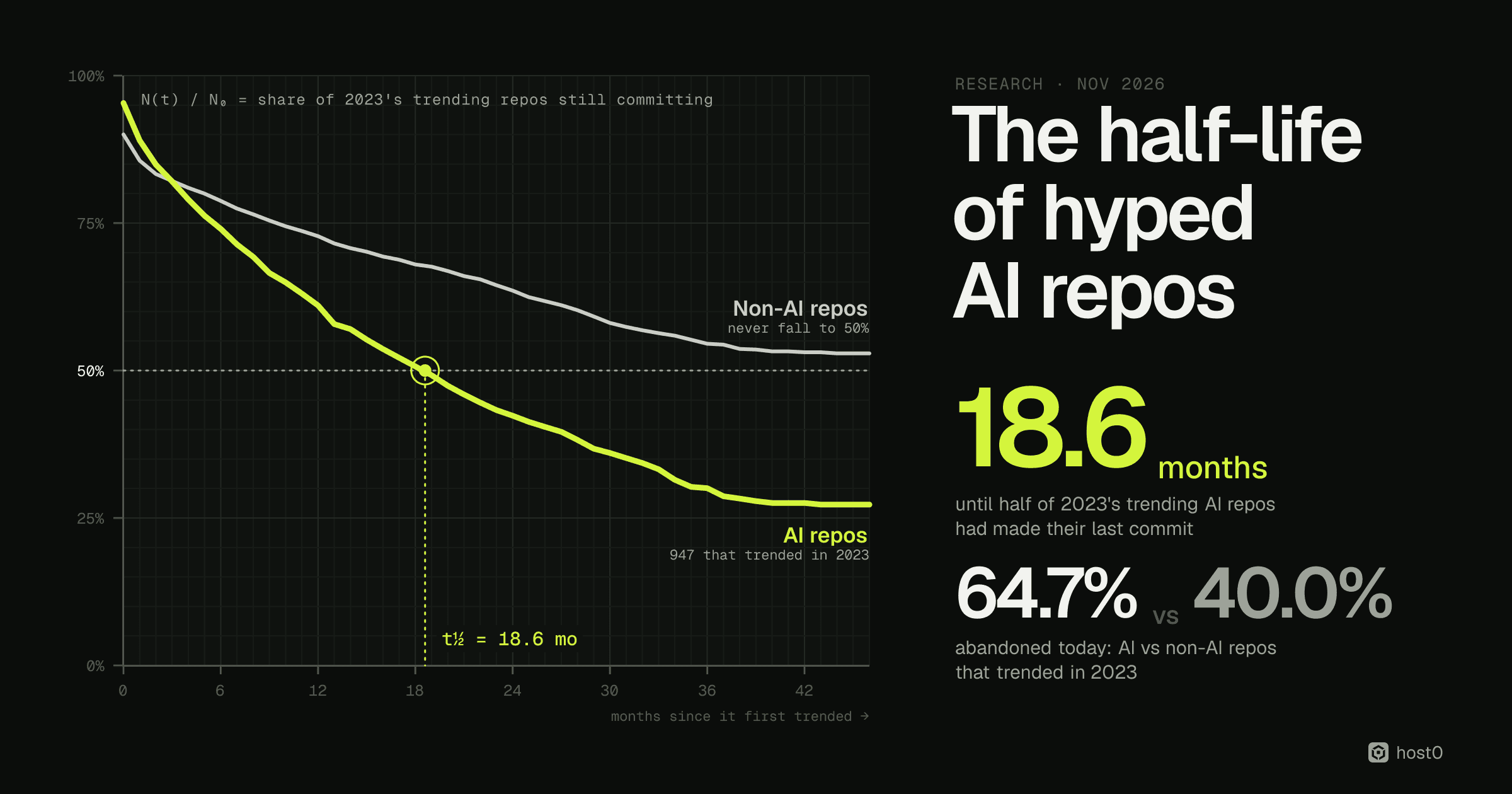
- 2The half-life is 18.6 months. Half of 2023's trending AI repos made their last commit within 18.6 months of first trending. The non-AI control never gets to half: 63.6% were still committing two years on.
- 3Only 16.2% are alive. That's the share of 2023's AI repos where at least two people committed in the last 90 days. For the control it's 37.3%.
- 4Abandoned repos don't look abandoned. Only 10.0% of 2023's AI repos carry GitHub's archived flag and 1.2% are gone. The other 53.5 points of the 64.7% are still up with no archived banner, so nothing on the page says they've stopped.
- 5Six million stars point at dead projects. 6.0 million of the 30.2 million stars on every trending AI repo in our data (19.8%) sit on repos that are now abandoned. For the non-AI repos it's 11.3%.
- 6Bigger hits and company backing help, but not enough. Among 2023's trending repos, the 10 AI repos a month that gained the most stars are abandoned 56.7% of the time, against 35.8% for the control's top 10. AI repos from personal accounts: 71.2%. From GitHub-verified organisations: 46.5%, against 19.6% for verified organisations outside AI.
- 7A star count records one week. Among 25 well-known AI repos we traced week by week, most of the ones that went quiet got most of their stars in a single launch burst. gpt-engineer got 18,514 stars in its peak week and gets about 8.5 a week now. Repos like llama.cpp and LangChain kept collecting stars for years.
- 8Some stars aren't real. A peer-reviewed study found 6.0 million suspected fake stars on GitHub from July 2019 to December 2024, and AI/LLM was the largest category among the campaign repos that reached the trending page.
64.7%
Of the 947 AI repos that trended on GitHub in 2023 are abandoned today, vs 40.0% of other trending repos
Source: host0 analysis of GitHub trending and the GitHub API
18.6 months
Half-life: half of 2023's trending AI repos made their last commit within this time of first trending
Source: host0 analysis
16.2%
Of 2023's trending AI repos are alive, with ≥ 2 people committing in the last 90 days (control: 37.3%)
Source: host0 analysis
6.0M
Stars (19.8% of 30.2M on all trending AI repos, 2023–26) that sit on abandoned repos
Source: host0 analysis
AI took over the trending page, twice#
GitHub's trending page lists the repos that collected the most stars in a day. It's where a lot of people first see a new project, and it's a fair sample of what was hyped: not every AI repo on GitHub, but the ones a crowd noticed at once. In January 2023 about a fifth of the repos on it were AI. By April it was 64.1%, the month of AutoGPT, BabyAGI and AgentGPT.
Then it ebbed, to 24.1% in July 2024, and came back harder: 83.1% in March 2026, with coding agents, Claude Code and Codex skills and OpenClaw on top. For scale, GitHub's own Octoverse 2025 counted more than 4.3 million AI-related repositories, and 1.13 million public repos importing an LLM SDK, 693,867 of them created in the 12 months to August 2025. Our 40 months of trending pages hold 1,910 AI repos: the ones a crowd noticed at once.
Two in three are abandoned#
We call a repo abandoned when GitHub has archived it, when it's gone (deleted, made private or blocked), or when nobody has committed to its default branch in the 12 months to 31 October 2026. By that measure 64.7% of the AI repos that trended in 2023 are abandoned. Of the non-AI repos that trended in the same months, 40.0% are.
Trending repos that are abandoned today, by the year they trended
Share archived, gone, or with no default-branch commit in the 12 months to 31 Oct 2026, AI vs other repos from the same trending pages
| Label | Value |
|---|---|
| AI, 2023 | 64.7% (n = 947) |
| Other, 2023 | 40% (n = 1,624) |
| AI, 2024 | 47.4% (n = 420) |
| Other, 2024 | 30.4% (n = 1,093) |
| AI, 2025 | 14.2% (n = 337) |
| Other, 2025 | 8.3% (n = 615) |
Source: host0 analysis of 5,341 trending repos, GitHub API on 1 Nov 2026
Read the chart pairwise. A repo that trended in 2025 has had at most two years to go quiet, so the low 2025 numbers mostly mean "not yet". But the ratio holds every year: 1.6 times the control in 2023, 1.6 in 2024, 1.7 in 2025. The definition doesn't drive it either. With a 24-month threshold instead of 12, 49.9% of 2023's AI repos are abandoned against 32.8% of the control; counting pushes to any branch instead of the default one, 62.4% against 38.4%. And our classifier probably left about 140 AI repos in the control, which makes the gap look smaller, not bigger.
For context, two studies of ordinary open source put the background rate lower. Coelho and colleagues found that 16% of 2,927 active GitHub projects became unmaintained within a year, and Avelino and colleagues that 16% of 1,932 popular projects were abandoned by their core developers, 41% of which survived when new core developers took over. Their definitions differ from ours, so the comparison that holds is our own control: same page, same months, same cutoff.
A half-life of 18 months#
Abandonment is a snapshot. To see how fast it happens, we followed each repo from the first day it trended to its last default-branch commit, and treated a repo as stopped once it had been quiet for six months, or was archived or gone. Repos still committing in the last six months count as still going.
Trending repos still committing, months after they first trended
Share of repos that trended in 2023 still committing, Kaplan–Meier estimate, by months since first trending
| Series | x | y |
|---|---|---|
| AI repos | 0 | 95% |
| AI repos | 3 | 82% |
| AI repos | 6 | 74% |
| AI repos | 9 | 67% |
| AI repos | 12 | 61% |
| AI repos | 15 | 55% |
| AI repos | 18 | 51% |
| AI repos | 21 | 46% |
| AI repos | 24 | 42% |
| AI repos | 27 | 40% |
| AI repos | 30 | 36% |
| AI repos | 33 | 33% |
| AI repos | 36 | 30% |
| AI repos | 39 | 28% |
| AI repos | 42 | 28% |
| Other repos | 0 | 90% |
| Other repos | 3 | 82% |
| Other repos | 6 | 79% |
| Other repos | 9 | 75% |
| Other repos | 12 | 73% |
| Other repos | 15 | 70% |
| Other repos | 18 | 68% |
| Other repos | 21 | 66% |
| Other repos | 24 | 64% |
| Other repos | 27 | 61% |
| Other repos | 30 | 58% |
| Other repos | 33 | 56% |
| Other repos | 36 | 55% |
| Other repos | 39 | 54% |
| Other repos | 42 | 53% |
Source: host0 analysis of 947 AI and 1,624 other repos that trended in 2023
Three months in, both groups are at 82.1%. After that the AI line keeps falling at the same pace while the control flattens out. Half of 2023's AI repos had stopped by 18.6 months. The control never reaches half in the time we can see: at 24 months 63.6% were still committing, and at 42 months 53.1%. For AI repos that trended in 2024 the half-life is 23.6 months, again with the control above half.
Most of the dying isn't instant, either. Of the 2023 AI repos that are abandoned now, 26.5% made their last commit before they trended or within three months of it. 40.5% kept going for more than a year first.
How long abandoned AI repos kept going after they trended
Time from first trending day to last default-branch commit, 2023 AI repos now abandoned (n = 602)
| Label | Value |
|---|---|
| Last commit before trending | 4.7% |
| Less than 1 month after | 10.8% |
| 1–3 months | 11% |
| 3–6 months | 12.6% |
| 6–12 months | 20.4% |
| More than 12 months | 40.5% |
Source: host0 analysis of 2023 trending repos
Abandoned doesn't look abandoned#
You'd hope a dead repo would say so. GitHub has a flag for it: archiving makes a repo read-only and puts a banner across the top. Only 10.0% of 2023's trending AI repos are archived, and 1.2% are gone. The rest of the abandoned share, 53.5 points, is a repo with no banner or notice, which looks like a live one until you check the dates.
Where the 2023 AI cohort is today
947 AI repos that trended on GitHub in 2023, by status on 1 Nov 2026
| Label | Value |
|---|---|
| Gone | 1.2% (control 4.1%) |
| Archived | 10% (control 6.7%) |
| No commit in 12 months, still up | 53.5% (control 29.3%) |
| No commit in 6–12 months | 7.3% (control 6.4%) |
| Committing, but not 2 people lately | 11.8% (control 16.3%) |
| Alive: 2+ people in 90 days | 16.2% (control 37.3%) |
Source: host0 analysis of the GitHub API, 1 Nov 2026
The other end of the chart is as telling. Only 16.2% of the 2023 AI cohort has two or more people committing in the last 90 days, against 37.3% of the control. Another 11.8% are still committing, but with fewer than two people in the last three months, often a single maintainer.
The stars stay behind. A dead project keeps the social proof of its best week. Across all 1,910 trending AI repos in our data there are 30.2 million stars, and 6.0 million of them, 19.8%, are on repos that are now abandoned. Another 2.2 million are on repos that have been quiet for six months.
Stars that sit on abandoned repos
Share of all current stars on trending repos (Jan 2023 to Apr 2026) that sit on abandoned or inactive repos, 1 Nov 2026
| Label | Value |
|---|---|
| AI, abandoned | 19.8% · 6.0M |
| Other, abandoned | 11.3% · 7.1M |
| AI, quiet 6+ months | 27.1% · 8.2M |
| Other, quiet 6+ months | 15.2% · 9.5M |
Source: host0 analysis of the GitHub API, 1 Nov 2026
What dies and what lasts#
The survivors aren't random. Among the AI repos still alive from 2023 are the ones that became infrastructure, communities or companies: LangChain, llama.cpp, Ollama, ComfyUI, and AutoGPT itself, which had 2,782 commits in the last 12 months and 9 people committing in the last 90 days. The highest abandonment rates are among coding demos, research code and chat wrappers.
2023 AI trending repos abandoned, by type
Share abandoned on 31 Oct 2026, AI repos that trended in 2023, by category
| Label | Value |
|---|---|
| Coding agents and dev tools | 73% (n = 37) |
| Model, training and research code | 71.1% (n = 201) |
| UI wrappers and chat apps | 70.9% (n = 117) |
| Image, video, audio and vision | 67.8% (n = 245) |
| Agents | 64.6% (n = 65) |
| Local inference and serving | 55.8% (n = 52) |
| Prompts, skills, lists, courses | 53.8% (n = 104) |
| RAG, frameworks and LLM tooling | 50.5% (n = 99) |
Source: host0 analysis of 947 AI repos that trended in 2023
Two other things matter: who owns the repo, and how big the hype was. Repos owned by a GitHub-verified organisation (one with a confirmed company, lab or foundation domain) survive far more often than repos on a personal account. But even here AI is worse: 46.5% of 2023's AI repos from verified organisations are abandoned, against 19.6% for verified organisations outside AI. Many of those are lab repos from Meta, Microsoft and Google research that shipped a paper and moved on.
2023 trending repos abandoned, by who owns them
Share abandoned on 31 Oct 2026, repos that trended in 2023, by owner account type
| Label | Value |
|---|---|
| AI, personal account | 71.2% (n = 479) |
| Other, personal account | 51.5% (n = 712) |
| AI, unverified organisation | 62.5% (n = 341) |
| Other, unverified organisation | 38.4% (n = 554) |
| AI, verified organisation | 46.5% (n = 127) |
| Other, verified organisation | 19.6% (n = 358) |
Source: host0 analysis of the GitHub API, 1 Nov 2026
More hype buys a little more life, not much. Among 2023's repos, the 10 AI repos each month that gained the most stars on the trending page are abandoned 56.7% of the time; repos that stayed on the page four days or more, 54.4%. Both are still well above the non-AI top 10, at 35.8%.
Bigger hits fade too
Share abandoned on 31 Oct 2026, repos that trended in 2023, by how big the hype was
| Label | Value |
|---|---|
| All AI repos | 64.7% (n = 947) |
| AI, on the page 4+ days | 54.4% (n = 331) |
| AI, top 10 of their month | 56.7% (n = 120) |
| AI, on a monthly trending list | 49.2% (n = 130) |
| Other, top 10 of their month | 35.8% (n = 120) |
| All other repos | 40% (n = 1,624) |
Source: host0 analysis of 2023 trending repos
A star count records one week#
Stars are how most people judge a repo at a glance, and they mostly measure one moment. GitHub added a star-history API endpoint in September 2026 that returns stars per week for any repo. We pulled it for 25 well-known AI repos, picked by hand for the story, so read them as examples, not a sample.
Stars per month: a launch burst vs steady growth
New stars per month (log scale), Mar 2023 to Oct 2026, by star date
| Series | x | y |
|---|---|---|
| AutoGPT | Mar 2023 | 104 |
| AutoGPT | Apr 2023 | 110.7K |
| AutoGPT | May 2023 | 15.8K |
| AutoGPT | Jun 2023 | 5.4K |
| AutoGPT | Jul 2023 | 3.4K |
| AutoGPT | Aug 2023 | 2.5K |
| AutoGPT | Sep 2023 | 2.2K |
| AutoGPT | Oct 2023 | 2.7K |
| AutoGPT | Nov 2023 | 2.1K |
| AutoGPT | Dec 2023 | 1.8K |
| AutoGPT | Jan 2024 | 1.8K |
| AutoGPT | Feb 2024 | 1.5K |
| AutoGPT | Mar 2024 | 2.1K |
| AutoGPT | Apr 2024 | 1.5K |
| AutoGPT | May 2024 | 1.4K |
| AutoGPT | Jun 2024 | 1.1K |
| AutoGPT | Jul 2024 | 2K |
| AutoGPT | Aug 2024 | 993 |
| AutoGPT | Sep 2024 | 1.2K |
| AutoGPT | Oct 2024 | 1K |
| AutoGPT | Nov 2024 | 1K |
| AutoGPT | Dec 2024 | 1.4K |
| AutoGPT | Jan 2025 | 1.3K |
| AutoGPT | Feb 2025 | 1.3K |
| AutoGPT | Mar 2025 | 2.2K |
| AutoGPT | Apr 2025 | 1.1K |
| AutoGPT | May 2025 | 1.1K |
| AutoGPT | Jun 2025 | 968 |
| AutoGPT | Jul 2025 | 1.1K |
| AutoGPT | Aug 2025 | 998 |
| AutoGPT | Sep 2025 | 822 |
| AutoGPT | Oct 2025 | 824 |
| AutoGPT | Nov 2025 | 813 |
| AutoGPT | Dec 2025 | 933 |
| AutoGPT | Jan 2026 | 1.2K |
| AutoGPT | Feb 2026 | 874 |
| AutoGPT | Mar 2026 | 1.4K |
| AutoGPT | Apr 2026 | 1.3K |
| AutoGPT | May 2026 | 1.2K |
| AutoGPT | Jun 2026 | 856 |
| AutoGPT | Jul 2026 | 894 |
| AutoGPT | Aug 2026 | 1.6K |
| AutoGPT | Sep 2026 | 714 |
| AutoGPT | Oct 2026 | 840 |
| LangChain | Mar 2023 | 9.3K |
| LangChain | Apr 2023 | 13.4K |
| LangChain | May 2023 | 9.9K |
| LangChain | Jun 2023 | 7.3K |
| LangChain | Jul 2023 | 5.2K |
| LangChain | Aug 2023 | 3.5K |
| LangChain | Sep 2023 | 2.9K |
| LangChain | Oct 2023 | 2.8K |
| LangChain | Nov 2023 | 3.5K |
| LangChain | Dec 2023 | 2.7K |
| LangChain | Jan 2024 | 3K |
| LangChain | Feb 2024 | 2.3K |
| LangChain | Mar 2024 | 2.9K |
| LangChain | Apr 2024 | 2.8K |
| LangChain | May 2024 | 2.6K |
| LangChain | Jun 2024 | 2.1K |
| LangChain | Jul 2024 | 1.9K |
| LangChain | Aug 2024 | 1.8K |
| LangChain | Sep 2024 | 1.4K |
| LangChain | Oct 2024 | 1.4K |
| LangChain | Nov 2024 | 1.5K |
| LangChain | Dec 2024 | 1.8K |
| LangChain | Jan 2025 | 2.2K |
| LangChain | Feb 2025 | 2.7K |
| LangChain | Mar 2025 | 2.9K |
| LangChain | Apr 2025 | 2.1K |
| LangChain | May 2025 | 2K |
| LangChain | Jun 2025 | 2K |
| LangChain | Jul 2025 | 2.3K |
| LangChain | Aug 2025 | 2K |
| LangChain | Sep 2025 | 2K |
| LangChain | Oct 2025 | 2.2K |
| LangChain | Nov 2025 | 2.4K |
| LangChain | Dec 2025 | 2.4K |
| LangChain | Jan 2026 | 2.6K |
| LangChain | Feb 2026 | 2.3K |
| LangChain | Mar 2026 | 4.3K |
| LangChain | Apr 2026 | 3.9K |
| LangChain | May 2026 | 2.9K |
| LangChain | Jun 2026 | 2.7K |
| LangChain | Jul 2026 | 2.8K |
| LangChain | Aug 2026 | 2.5K |
| LangChain | Sep 2026 | 2K |
| LangChain | Oct 2026 | 2K |
| llama.cpp | Mar 2023 | 14.7K |
| llama.cpp | Apr 2023 | 7.6K |
| llama.cpp | May 2023 | 3.4K |
| llama.cpp | Jun 2023 | 3.9K |
| llama.cpp | Jul 2023 | 3.7K |
| llama.cpp | Aug 2023 | 2.7K |
| llama.cpp | Sep 2023 | 1.8K |
| llama.cpp | Oct 2023 | 1.8K |
| llama.cpp | Nov 2023 | 2.1K |
| llama.cpp | Dec 2023 | 2.4K |
| llama.cpp | Jan 2024 | 2.2K |
| llama.cpp | Feb 2024 | 2.1K |
| llama.cpp | Mar 2024 | 2.1K |
| llama.cpp | Apr 2024 | 3.1K |
| llama.cpp | May 2024 | 2.2K |
| llama.cpp | Jun 2024 | 1.7K |
| llama.cpp | Jul 2024 | 1.9K |
| llama.cpp | Aug 2024 | 1.6K |
| llama.cpp | Sep 2024 | 1.4K |
| llama.cpp | Oct 2024 | 1.5K |
| llama.cpp | Nov 2024 | 1.4K |
| llama.cpp | Dec 2024 | 1.5K |
| llama.cpp | Jan 2025 | 2.5K |
| llama.cpp | Feb 2025 | 3K |
| llama.cpp | Mar 2025 | 2K |
| llama.cpp | Apr 2025 | 1.7K |
| llama.cpp | May 2025 | 2.2K |
| llama.cpp | Jun 2025 | 1.3K |
| llama.cpp | Jul 2025 | 1.4K |
| llama.cpp | Aug 2025 | 2.2K |
| llama.cpp | Sep 2025 | 1.4K |
| llama.cpp | Oct 2025 | 1.5K |
| llama.cpp | Nov 2025 | 2.2K |
| llama.cpp | Dec 2025 | 1.8K |
| llama.cpp | Jan 2026 | 2K |
| llama.cpp | Feb 2026 | 2.1K |
| llama.cpp | Mar 2026 | 4.5K |
| llama.cpp | Apr 2026 | 7.2K |
| llama.cpp | May 2026 | 6.5K |
| llama.cpp | Jun 2026 | 5K |
| llama.cpp | Jul 2026 | 3.6K |
| llama.cpp | Aug 2026 | 4.6K |
| llama.cpp | Sep 2026 | 3.7K |
| llama.cpp | Oct 2026 | 3.6K |
AutoGPT is the extreme. Its peak day, 13 April 2023, brought about 13,640 stars, and in October 2026 it got about 200 a week. It survived anyway, as a company product. Several repos with a shape like that didn't. In our 25, the share of all stars that arrived in the 90 days around the peak week splits the list: most of the repos with 60% or more in that window have had five or fewer commits in the last year, and most of those under 25% are still shipping.
The burst repos now collect almost nothing. In October 2026, gpt-engineer got about 8.5 stars a week, against 18,514 in its peak week of June 2023. It's archived, and its description now reads "Precursor to: https://lovable.dev". Lovable raised $400 million at a $13.3 billion valuation in August 2026. The archived repo still shows its 54,993 stars.
Rises, pivots and quiet exits
13 Apr 2023
13 Apr 2023
AutoGPT's peak day
About 13,640 stars in one day; 110,668 in April.20 Jun 2023
20 Jun 2023
gpt-engineer's peak day
About 4,895 stars; 18,514 that week.Sep 2024
Sep 2024
The repo was reused for a new framework; the original moved to babyagi_archive.24 Sep 2024
24 Sep 2024
AutoGPT's platform goes source-available
The platform folder moved to the PolyForm Shield license; the rest stayed MIT.17 Nov 2024
17 Nov 2024
gpt-engineer's last commit
Later archived, "Precursor to lovable.dev".29 Apr 2025
29 Apr 2025
AgentGPT's last commit
Now archived.Oct 2025
Oct 2025
AutoGen enters maintenance mode
Microsoft points users to Agent Framework. GitHub's archived flag is still off.21 Oct 2025
21 Oct 2025
26 Jan 2026
26 Jan 2026
OpenClaw's peak day
About 25,636 stars; 115,878 that week.20 Feb 2026
Source: GitHub API, star-history API and README histories; linked announcements
Some stars weren't earned at all. StarScout, a study presented at ICSE 2026, scanned all GitHub event data from July 2019 to December 2024 and reports 6.0 million suspected fake stars and 18,617 repos with fake-star campaigns (3.81 million stars after its post-processing step). Few of those repos were seen on the trending page, 78 in all (the paper's trending archive covers only five languages), but AI/LLM was the largest category among them. The authors found that fake stars help for less than two months and hurt afterwards. They're cheap: star merchants charged $0.10 to $2.00 a star in July 2024, by the paper's count, and Dagster found a seller offering 1,000 for $64 in 2023.
What fake-star campaigns promoted on GitHub's trending page
Repos with suspected fake-star campaigns that reached GitHub Trending, by category (n = 78), Jul 2019 to Dec 2024
| Label | Value |
|---|---|
| AI/LLM | 25 · 32.1% |
| Spam or phishing | 16 |
| Tool or app | 15 |
| Blockchain | 10 |
| Web framework | 5 |
| Tutorial or demo | 4 |
| Other | 3 |
Source: He et al., StarScout, arXiv 2412.13459v2 (ICSE 2026), Table 5
Fake stars are unlikely to explain our numbers: the paper saw only 78 campaign repos on the trending page in five and a half years, and 90.42% of all campaign repos were later deleted, by the paper's count. But they're one more reason a star count says little about whether anyone maintains the code.
The license can change too#
A repo that survives by becoming a company sometimes changes its terms. The shift in AI open source is rarely to a business-source license. More often it's a custom "Apache-plus" license, or an enterprise folder carved out of a permissive repo. We read the license-file histories of 19 popular AI and automation repos.
License changes in AI open source
From each repo's license-file commit history, 2023 to Oct 2026
- Dify: its own "Dify Open Source License" from day one (Apache 2.0 plus no multi-tenant SaaS and logo retention), reworded five times through March 2025.
- FastGPT: Apache 2.0 to a custom license with no competing multi-tenant SaaS, August 2023.
- AutoGPT: the platform folder to PolyForm Shield, September 2024; the rest MIT.
- LobeChat: MIT to "Apache 2.0 with additional conditions" at v1.0, June 2024; derivative works need a commercial license.
- Open WebUI: BSD-3 plus a branding clause for deployments over 50 users, April 2025.
- Flowise: an enterprise folder under a company license, May 2025.
- MindsDB: core under the Elastic License 2.0 in November 2023, back to MIT in June 2026.
Source: host0 analysis of license-file histories via the GitHub API
None of this is unusual for a company built on open source. But a repo you depend on can change its terms at the moment it starts to matter, so read the license file at the version you pin, not the one in the README badge.
What this means if you build with AI#
- Check the last commit, not the star count. Two in three AI repos that trended in 2023 have had no commit in a year, and most of them aren't archived. Open the commit history before you depend on anything.
- Look for at least two people. Only 16.2% of 2023's hyped AI repos have two or more people committing in the last 90 days. A single maintainer is one job change from a dead repo. The contributors graph or the last 20 commits will tell you in a minute.
- Look for releases and answered issues. 58.0% of 2023's trending AI repos never published a release, against 44.3% of the control. Tagged releases and recent maintainer replies on issues are signs that someone plans for other people to use the code.
- Weigh the owner. AI repos from GitHub-verified organisations were abandoned at 46.5%, from personal accounts at 71.2%. That's still high, and lab repos often ship a paper and stop, so a big name isn't a guarantee.
- Read the star curve. If most of a repo's stars arrived in one week, you're looking at a launch, not a community. Steady weekly stars, like llama.cpp's or LangChain's, are a better sign than a big total.
- Pin what you use. Pin a release, a tag or a commit hash, not a branch. If the repo goes quiet, archived or private, your build still works, and you can read the license at that exact version.
- Have an exit plan. Keep a fork or a vendored copy of anything small you rely on, and wrap anything large behind your own interface so you can swap it. Plan for the half-life: within about a year and a half, half of these projects had stopped.
Agents make it easy to pull in a hyped repo and build on it in an afternoon; we built host0 so the app you build gets a private link and a database that don't depend on any of them staying alive.
Related: AI models have a shelf life too, about 18 months on first-party APIs; new benchmarks hit their first milestone in about a year; and SDK downloads show which AI libraries people actually install.
Methodology#
All data is public; the GitHub API was queried on 1 November 2026. Every "in the last N months" window ends on 31 October 2026.
- The cohort. We listed every Wayback Machine capture of
github.com/trending(daily, all languages) and took one a day from January 2023 to April 2026: 1,199 of 1,216 days. Parsing each listing gave 23,606 rows and 5,341 distinct repos, merged across renames by GitHub's repository id. A repo's cohort month is the month it collected the most "stars today" on captured days; its clock starts on the first day it trended. Captures are mostly taken in the early hours UTC, so they show the previous day's list. The page lists fewer repos since June 2024 (about 15 instead of 25), which lowers counts, not rates. - What counts as AI. The repo name and the description shown on the trending page when it trended, matched against a list of strong AI terms; 446 repos with weak terms ("agent", "assistant", "OCR", "bot") were decided by hand. All 60 repos in a verification sample were correctly AI. Two random checks of non-AI repos suggest 4–5% of the control are AI repos we missed, about 140, which makes the gap look smaller. "AI" includes classic machine learning and computer vision, not only LLMs. Categories are rule-based with 58 hand fixes and were 85% right in a hand check.
- Status. From the GitHub GraphQL API on 1 November 2026: the archived flag, whether the repo still exists, the date of the latest commit on the default branch, commit counts, and the people who authored commits in the last 90 days (bots excluded by name and a list). Abandoned: archived, gone, or no default-branch commit since 31 October 2025. Inactive: none since 30 April 2026. Alive: at least two human accounts committed to the default branch since 2 August 2026. An independent REST re-check of 60 repos matched the status of 59.
- Survival. Kaplan–Meier per group: a repo's duration is the time from its first trending day to its last default-branch commit if it's been quiet six months or more (or is archived or gone), and is censored on 31 October 2026 otherwise. The half-life is the median.
- Stars. Current stargazer counts from the API. The 25 named repos' weekly histories come from GitHub's star-history endpoint, which counts only current stargazers: against Wayback captures, totals run 0.3–7.3% low, and up to about 7% for 2023. Peak-day numbers are approximate because GitHub's day boundaries aren't guaranteed to be UTC.
- Limits. "Last commit" can miss a repo developed on another branch or moved to a new home (GPT-Engineer and MetaGPT both moved on to company products). Commits made by AI agents under a person's account count as human. Paper and model-release repos often were never meant to be maintained. This is the trending cohort, the repos a crowd starred at once, not all AI repos on GitHub, and it only includes days the Wayback Machine captured.
The data pack, with every source, the sensitivity tables and a do-not-cite list, is in our repository at docs/research/2026-11-01-ai-repo-half-life.md. One row per repo (repos.csv), the series behind every chart and the scripts are in docs/research/2026-11-01-ai-repo-half-life-data/.
Open questions#
- Do users of dead repos move to a fork? An abandoned project can live on in a community fork. We didn't trace forks, so part of "abandoned" may be "moved".
- Is the LLM-only rate higher still? Our AI group includes classic machine learning and computer vision. An LLM-only cut wasn't computed.
- Will the 2026 wave last longer? AI took 83.1% of the trending page in March 2026. Those repos are too young to judge; the same measurement a year from now will say whether agent tooling ages better than 2023's wrappers.
- How many stars on dead repos are fake? StarScout's data stops in December 2024, and since mid-2026 GitHub no longer lets outsiders list a repo's stargazers, so that check is now hard to repeat.