Every app built on a model API is built on something with an expiry date. OpenAI scheduled the API name gpt-4 to stop answering on 23 October 2026, 1,319 days after GPT-4 launched. Most models don't get anywhere near that long. Providers ship a new generation every few months, and each one sends an older model toward a deprecation notice, a shutdown date and, for whoever still calls it, a migration.
We put every public model retirement we could date into one dataset: 341 model ids from OpenAI, Anthropic, Google (the Gemini API and Vertex AI), Mistral, xAI, Cohere and Amazon Bedrock, read from the providers' own deprecation pages, changelogs and archived copies of them, up to 23 October 2026. Our headline numbers come from the 204 generally available models with a known launch date on six first-party APIs. The answers to three questions are below: how long a model lives, how much notice you get, and whether it's getting shorter. The methodology explains how we counted.
Key findings
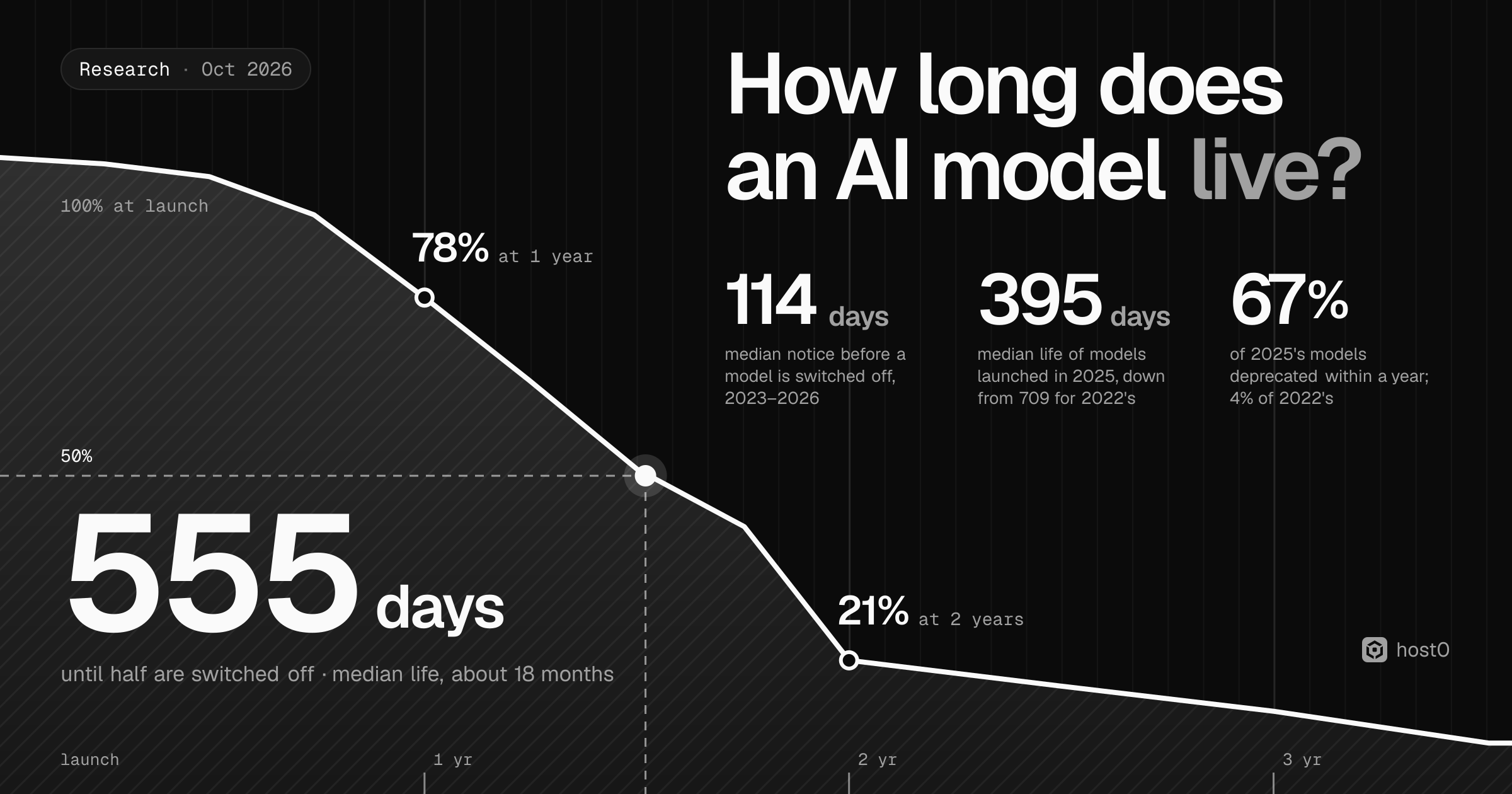
- 1The median AI model lives about 18 months. Half of the 204 GA models were switched off or redirected within 555 days of launch, by our survival estimate. 78% were still served on their first birthday, and 21% on their second.
- 2Lifespans are shrinking. By the same estimate, the median life fell from 709 days for models launched in 2022 to 487 days for 2024's and 395 days for 2025's. Of the models launched in 2025, 39 of 58 were deprecated within a year, against 1 of 27 from 2022.
- 3Notice is under four months, and falling. The median deprecation announcement gave 114 days before the shutoff (47 announcements, 2023–2026). The median was 312 days in 2023 and 95 days in 2026. Only 21 of the 47 gave six months.
- 4The provider matters more than the model. OpenAI's models live longest (a survival-estimate median of 709 days) and usually get six months' notice. Claude models live 495 days with about two months' notice, Mistral's 349 days with about three, and xAI gave 9 to 17 days.
- 5Anthropic cut its promise from six months to 60 days in August 2025, archived copies of its deprecations page show. Five of its last six announcements gave 60–62 days. It has never given less than it promised.
- 6OpenAI wrote down a six-month minimum in June 2026. Four months later it gave its GA GPT-4o and GPT-4.1 snapshots 92 days.
- 7A retired model doesn't always return an error. Google routed Gemini 3.7 Flash to its successor 56 days after it went GA. xAI redirected eight Grok ids to a newer model and billed them at its price.
- 8The weights outlive the endpoint. Llama 2 7B was downloaded 462,392 times on Hugging Face in the 30 days to 23 October 2026, two years after Amazon Bedrock retired its Llama 2 models.
555 days
Median lifetime of a GA model on a first-party API (204 models, six APIs)
Source: host0 analysis of provider deprecation pages
114 days
Median notice per deprecation announcement, 2023–2026 (47 announcements)
Source: host0 analysis
395 days
Median lifetime of models launched in 2025, down from 709 for 2022's
Source: host0 analysis
67%
Models launched in 2025 deprecated within a year (39 of 58); 4% of 2022's
Source: host0 analysis
How long a model lives#
A model's life here runs from the day its id could first be called on the provider's own API to the day requests stopped being served by it. Many models in the dataset are still running, so a plain average of retired models would read too short: the recent ones that are still alive would be missing. We used a Kaplan–Meier survival estimate instead, the standard method when some subjects haven't reached the end yet. It counts every model for as long as we've watched it.
The curve is flat for the first six months: almost nothing is retired before it's half a year old. The drop starts around the first birthday. That is when Anthropic's "not sooner than" dates and Google's 12-month floor on Vertex AI expire, and when a model's successor has usually shipped. By two years, four in five models are gone.
The providers differ a lot. OpenAI keeps models running longest. Its 2022 embedding and GPT-3 models ran for close to two years, and the GPT-3 base models it opened the API with in 2020 lasted 1,302 days. Mistral's models had the shortest lives of the labs with many retirements: half were gone within a year. xAI's five retired model ids lived shorter still, but that rests on one retirement event.
Median model lifetime by API
Kaplan–Meier median, days from launch to retirement, GA models
| Label | Value |
|---|---|
| OpenAI API | 709 days (n=105) |
| Claude API | 495 days (n=29) |
| Gemini API | 463 days (n=17) |
| Vertex AI (Google) | 455 days (n=15) |
| Mistral API | 349 days (n=33) |
| xAI API | 273 days (n=5) |
| All six | 555 days (n=204) |
Source: host0 analysis of provider deprecation pages, data to 23 Oct 2026
The pooled 555 days holds up within about a hundred days when we change how we count. Treating the 10 OpenAI ids in the set that were scheduled to shut down on 23 October as still alive gives 562 days. Counting each release batch once instead of each model id gives 487. Dropping Mistral, whose launch dates are approximate, gives 660.
Is it getting shorter#
Yes. Grouped by the year a model launched, the median lifetime has fallen by almost half in three years.
Median lifetime by launch year
Kaplan–Meier median, days, GA models on six first-party APIs
| Label | Value |
|---|---|
| 2022 | 709 days (n=27) |
| 2023 | 684 days (n=28) |
| 2024 | 487 days (n=40) |
| 2025 | 395 days (n=74) |
Source: host0 analysis
The clearest sign is how soon a model gets its deprecation notice. Among models launched in 2022, one in 27 had been deprecated within a year. For 2025's launches, it was two in three. Among models that have been deprecated, the time from launch to the announcement fell from a median of 527 days for 2022's models to 295 days for 2025's. Retirement within the first year didn't happen in our data until 2024: no 2022 or 2023 model was switched off before its first birthday, but 20% of 2024's and 37% of 2025's were.
Models deprecated within a year of launch
Share of each launch-year cohort, GA models with a full year of follow-up
| Label | Value |
|---|---|
| 2022 | 4% (1 of 27) |
| 2023 | 38% (9 of 24) |
| 2024 | 40% (14 of 35) |
| 2025 | 67% (39 of 58) |
Source: host0 analysis
Claude shows the trend most cleanly because Anthropic retires models in tidy generations. Each Claude 3 model ran for 500 to 770 days. The Claude 4 generation got about a year: Sonnet 4 and Opus 4 were retired 389 days after launch, and Opus 4.1 exactly 365 days after its own. None has lived less than 360 days. Each Claude model now lists a "not sooner than" retirement date about a year after its release, and the most recent retirements land close to it.
How long each retired Claude model was served
Days on the Claude API, launch to retirement, in launch order
| Label | Value |
|---|---|
| Claude 1.0 | 603 days |
| Claude Instant 1.0 | 603 days |
| Claude 2.0 | 741 days |
| Claude Instant 1.2 | 455 days |
| Claude 2.1 | 608 days |
| Claude 3 Sonnet | 504 days |
| Claude 3 Opus | 672 days |
| Claude 3 Haiku | 768 days |
| Claude 3.5 Sonnet (Jun) | 495 days |
| Claude 3.5 Sonnet (Oct) | 371 days |
| Claude 3.5 Haiku | 472 days |
| Claude 3.7 Sonnet | 360 days |
| Claude Sonnet 4 | 389 days |
| Claude Opus 4 | 389 days |
| Claude Opus 4.1 | 365 days |
Source: Anthropic model deprecations
More models also means more retirements. Across the six APIs, 35 model ids were retired in 2024, 44 in 2025 and 61 in 2026 to 23 October, 10 of them scheduled for that day. New generations arrive fast: in our state of AI coding agents we found frontier models' METR time horizon doubling about every four months, and each step makes the previous model easier to retire. Anthropic gives a reason for retiring models at all: the cost of serving them "scales roughly linearly with the number of models we serve."
Model ids retired per year
GA models on six first-party APIs
| Label | Value |
|---|---|
| 2023 | 3 |
| 2024 | 35 |
| 2025 | 44 |
| 2026 | 61 (to 23 Oct) |
Source: host0 analysis
How much notice you get#
Notice is the time between a provider announcing a retirement and switching the model off. We counted it per announcement: when OpenAI retired 28 models on one date with one notice, that's one decision, not 28. The median across 47 announcements is 114 days, a little under four months. Counted per model id it's 181 days, because OpenAI retires models in large batches with six months' notice.
Median notice before a model is retired
Days from the deprecation announcement to the shutoff, per announcement
| Label | Value |
|---|---|
| OpenAI API | 183 days (21 events) |
| Amazon Bedrock | 181 days (reseller) |
| Gemini API (GA) | 103 days (3 events) |
| Mistral API | 92.5 days (12 events) |
| Claude API | 62.5 days (10 events) |
| Gemini API previews | 28 days (11 models) |
| xAI API | 9–17 days (1 event) |
Source: host0 analysis of provider deprecation pages and Wayback Machine captures
The notice has been getting shorter. In 2023, the median announcement gave 312 days. In 2026 it gave 95. OpenAI's median per model has stayed near six months, so most of the decline comes from the other providers. Their median fell from 182 days in 2024 to 69 in 2025 and 62 in 2026.
Median notice by year it was announced
Days, per deprecation announcement, five first-party APIs (Vertex AI has no announcement dates)
| Label | Value |
|---|---|
| 2023 | 312 days (n=5) |
| 2024 | 189 days (n=6) |
| 2025 | 113 days (n=14) |
| 2026 | 95 days (n=22) |
Source: host0 analysis
Anthropic is the clearest case. Until August 2025 its deprecations page promised "at least 6 months" of notice; the 7 August capture still says so. By the 10 August capture it said 60 days, and three days later Anthropic deprecated both Claude 3.5 Sonnet models with 76 days' notice. We found no announcement of the change outside the docs. Anthropic has kept the new promise: all 20 of its GA deprecations gave at least 60 days. It now gives almost exactly the minimum.
Anthropic's notice per deprecation announcement
Days from announcement to retirement, Claude API
| Label | Value |
|---|---|
| Sep 2024 | 63 days |
| Jan 2025 | 181 days |
| Jun 2025 | 189 days |
| Aug 2025 | 76 days |
| Oct 2025 | 114 days |
| Dec 2025 | 62 days |
| Feb 2026 | 60 days |
| Apr 2026 | 62 days |
| Jun 2026 | 61 days |
| Sep 2026 | 61 days |
OpenAI moved the other way, at least on paper. Its deprecations page had no written minimum until June 2026: the 29 May capture has none, and the 3 June capture says GA models get "at least 6 months", specialized variants three months, and previews possibly as little as two weeks. On 14 October 2026 OpenAI notified developers that GPT-4o, GPT-4o mini, GPT-4.1 and GPT-4.1 mini snapshots would be removed on 14 January 2027: 92 days for GA models. That falls short of the minimum the same page states, which allows exceptions only for "safety or compliance concerns". The entry doesn't cite either.
Short notice has a history. In March 2023 OpenAI turned off its Codex models with what Simon Willison called "only giving three days notice". Previews get less still. The 11 retired Gemini API preview models got a median of 28 days, and Gemini 3 Pro Preview got 11 days between its 26 February 2026 deprecation and 9 March shutdown. A developer on Google's forum pointed out that this was less than the two weeks Google's own docs promised previews.
Notable model retirements
23 Mar 2023
23 Mar 2023
OpenAI switches off Codex
Three days after the notice. Researchers later kept access.Source: Simon Willison
4 Jan 2024
4 Jan 2024
28 OpenAI models off in one day
The GPT-3 base models, InstructGPT and first-generation embeddings, after 182 days' notice.Source: OpenAI
Aug 2025
Aug 2025
Anthropic cuts its notice to 60 days
From at least six months, between the 7 and 10 August captures of its docs.Source: Wayback Machine
13 Feb 2026
13 Feb 2026
ChatGPT retires GPT-4o
Fifteen days after the announcement; the API kept it.Source: The Register
15 May 2026
15 May 2026
xAI redirects eight Grok ids
After 9–17 days' notice, to grok-4.3, at grok-4.3's prices.Source: xAI
Jun 2026
Jun 2026
OpenAI writes a six-month minimum
For GA models; three months for specialized variants.Source: Wayback Machine
8 Oct 2026
8 Oct 2026
Google reroutes Gemini 3.5 and 3.7 Flash
Requests go to newer models with no notice; 3.7 Flash had been GA for 56 days.Source: Gemini API changelog
14 Oct 2026
23 Oct 2026
23 Oct 2026
gpt-4 and gpt-3.5-turbo scheduled to end
Along with 11 model ids, including gpt-4-0613, o1, o3-mini and o4-mini. We couldn't confirm the shutdown happened.Source: OpenAI
What the providers promise#
Every provider now publishes a lifecycle policy, except xAI. The policies differ in the two numbers that matter: how long a model is guaranteed to stay up, and how far ahead you hear about its end.
Model lifecycle policies, as of October 2026
Minimum life and minimum notice for generally available models
- OpenAI API: at least 6 months' notice for GA models, 3 for specialized variants, possibly 2 weeks for previews. Written down in June 2026.
- Anthropic: at least 60 days' notice (6 months until August 2025). Each model lists a "not sooner than" date about a year after its release.
- Google Gemini API: listed shutdown dates are "the earliest possible dates". Gemini 2.5 isn't deprecated, but since September 2026 only past users can call it.
- Google Vertex AI: stable models stay at least 12 months after release; a new short-term class gets at least 45 days' notice.
- Azure OpenAI: the retirement date is set 18 months after launch, new customers are shut out at 12 months, and GA notice is at least 60 days. Dates "aren't extendable".
- Amazon Bedrock: at least 12 months on the platform and 6 months in Legacy. The last 3 months or more can cost more, at a price set by the model's maker.
- Mistral: 6 months for GA models, 1 month for Labs, previews and third-party models.
- Cohere: deprecated models close to new customers and run for existing ones until a shutdown date is set.
- xAI: no standing policy found. One migration page per event.
Sources: OpenAI; Anthropic; Gemini API; Vertex AI; Azure; Amazon Bedrock; Mistral; Cohere
Two of these are more predictable than the rest because the end date is known on launch day: Azure's 18 months and Vertex AI's 12-month floor. Mistral's six-month rule for GA models is newer than it looks. The earliest archived copy of its lifecycle page is from 13 August 2026, and every Mistral GA deprecation we counted was announced before then. Only 4 of those 33 retirements gave six months, and the median for 2025 announcements was 29 days.
Dates also move after they're published, usually later. On Vertex AI, Gemini 2.5 Pro's retirement date was 17 June 2026 until at least March 2026, then "not before 16 October", then 16 October, and finally 20 October, the day it was retired. Gemini 1.0 Pro, 2.0 Flash and 2.5 Pro each retired 65 to 125 days after the first date Google posted. OpenAI's gpt-4-0314 had four end dates. Its launch post promised support "until June 14" 2023, and it was finally switched off on 26 March 2026. Extensions help whoever hasn't migrated yet, but they make the dates hard to plan around.
Retirement without an error#
The classic retirement is a hard stop: after the date, calls to the old id fail. A newer pattern keeps the id working and changes what's behind it.
On 8 October 2026 Google deprecated Gemini 3.5 Flash and Gemini 3.7 Flash on the Gemini API, with no notice period. In the changelog's words, "API requests to gemini-3.7-flash are automatically routed to gemini-3.8-flash." Gemini 3.7 Flash had been generally available for 56 days. Code calling it kept running, against a different model. Code that tuned sampling may also behave differently: Gemini 3.6 Flash, where 3.5 Flash requests now go, deprecated the temperature, top_p and top_k parameters.
xAI did the same on 15 May 2026. Eight Grok ids, including grok-3 and grok-4-0709, began redirecting to grok-4.3 after 9 to 17 days' notice. The migration page warns that requests to old ids are billed "at grok-4.3 pricing of $1.25 per 1M input tokens and $2.50 per 1M output tokens rather than the rates of the original model." A forgotten integration changed model and price at once. (We traced how much prices move between model generations in the price of AI tokens.)
For uptime, a redirect is kinder than a 404. But a pinned model id no longer guarantees a fixed model.
One model, several lifespans#
The same model can retire on different dates in different places. ChatGPT retires models much faster than the API, and with far less notice. Cloud resellers keep their own calendars.
The same models, different end dates
Median life and notice by channel, and examples
- ChatGPT: retired models lived a median of 275 days in the model picker, with 20 days' notice (12 retirements).
- OpenAI API: retired model ids lived a median of 610 days (92 ids, previews and aliases included), with a median of 182 days' notice per deprecated id.
- Azure OpenAI: a planned life of 548 days, with at least 60 days' notice.
- GPT-4: left ChatGPT after 778 days; the
gpt-4API name was scheduled to end after 1,319. gpt-4-0613: Azure retired it on 6 June 2025, 504 days before OpenAI's scheduled shutdown.- Claude 3.5 Haiku: off the Claude API on 19 February 2026, served on Bedrock until 19 June.
- Claude 3 Haiku: 768 days on the Claude API, 910 on Bedrock.
ChatGPT's notice is the shortest of any channel. When OpenAI retired GPT-4o from ChatGPT on 13 February 2026, it gave about two weeks; The Register reported OpenAI's figure that only 0.1% of users still chose GPT-4o each day. The API kept serving it. Some providers also soften a retirement after the fact. Anthropic retired Claude 3 Opus from its API on 5 January 2026, then kept it on claude.ai for paid users and available by request on the API.
The weights outlive the endpoint#
A retirement ends one vendor's endpoint, not the model. Where the weights are public, the model keeps running wherever someone hosts it. Anthropic, whose weights aren't public, has committed to preserving the weights of every publicly released Claude model for at least the company's lifetime, but not to serving them.
Open-weight models still in use after their hosted versions retired
Hugging Face downloads in the 30 days to 23 Oct 2026
| Label | Value |
|---|---|
| Llama 2 7B | 462K (Llama 2 off 2024) |
| Mistral 7B v0.1 | 311K (off 2025) |
| Llama 3 8B | 143K (Legacy 2026) |
| Mixtral 8x7B v0.1 | 41K (off 2025) |
Sources: Hugging Face API; Amazon Bedrock; Mistral
What this means if you build with AI#
- Budget a model migration every year or so. Plan for about 18 months on a model, and closer to 13 for one launched recently. A model that's already a year old is in the window where most retirements happen.
- Pin a dated snapshot, and know its end date. Aliases like
gpt-4or*-latestmove under you. A dated id makes the switch your decision. Put the retirement floor (Anthropic's "not sooner than", Azure's 18-month date, Vertex AI's 12 months) in your calendar the day you adopt a model. - Watch the deprecation pages, not just your inbox. Notices go by email to active accounts, but the pages are the record. OpenAI exposes a
shutdown_datefield in its models list and Azure exposes retirement dates in its Models API, so a weekly job can check every model you use. - Keep an eval set ready. With a median of 114 days' notice, and 60 at Anthropic, the migration has to fit in a few weeks of engineering time. A saved set of real prompts and expected outputs turns "will the new model break us?" into an afternoon.
- Log which model actually answered. Redirects (Gemini, xAI) mean a pinned id can start returning a different model's output at a different price. Check the model name in responses, and alert when it changes.
- Keep previews out of production. Gemini API previews got a median of 28 days' notice, and OpenAI's own page says a preview can go with two weeks'.
- Weigh notice when you pick a provider. For a workload that's slow to migrate, six months' notice (OpenAI, Bedrock) or a fixed end date set at launch (Azure, Vertex AI) is worth something. So is an open-weight fallback you could host yourself: those weights don't get retired.
The small apps people share on host0 usually call a model their author picked months ago. Every host0 app keeps numbered versions, so when a model retires you can redeploy with the new one and restore the old version in one click if it misbehaves.
Methodology#
We built one dataset of 341 model ids, one row per model per platform, from the providers' own deprecation pages, changelogs, release notes and launch posts, read on 23 October 2026, plus Wayback Machine captures of those pages to date policy changes and moved deadlines. The providers are OpenAI (API, plus ChatGPT and Azure OpenAI in separate tables), Anthropic, Google (Gemini API and Vertex AI), Mistral, xAI, Cohere and Amazon Bedrock. We re-checked 20 headline numbers against the live pages and archive captures before writing.
- Launch is the first day a model id could be called on that provider's API: first public availability for OpenAI (GA or beta), GA for the others. Mistral and xAI launch dates are month-level.
- Retirement is the day the id stopped being served, or started redirecting to another model. Notice is the retirement date minus the announcement date, including retirements that are scheduled but haven't happened.
- The headline set is 204 generally available models with a known launch date on six first-party APIs: OpenAI 105, Claude 29, Gemini API 17, Vertex AI 15, Mistral 33 and xAI 5. It leaves out previews, lab, gated and third-party models, moving aliases, API endpoints, Cohere (no shutdown dates) and Bedrock (a reseller).
- Lifetimes are Kaplan–Meier estimates. Models still live, or deprecated with a future date, count as surviving up to 23 October 2026. The median of retired models alone is 481 days and reads short, because recent models that are still running are left out.
- Eleven OpenAI ids were scheduled to shut down on 23 October 2026, 10 of them in the headline set. We couldn't confirm they did, so we counted them as retired that day; treating them as alive moves the median from 555 to 562 days.
- Limits. OpenAI ids dominate the pool (105 of 204). Our list of OpenAI models still running covers headline models only, which biases OpenAI's lifetime slightly short. Google models appear twice, once per platform. Counting per model id weights big batches; per release batch, the median life is 487 days.
The data pack, with every source, tier, the spot-check log and a do-not-cite list, is in our repository at docs/research/2026-10-23-ai-model-lifespan.md. The merged CSV and the scripts that compute every number in this post are in docs/research/2026-10-23-ai-model-lifespan-data/.
Open questions#
- Did the 23 October shutdowns happen on time? OpenAI's page scheduled 11 model ids for that day, along with the
gpt-4andgpt-3.5-turbonames. - Why did Anthropic cut notice to 60 days? We found only the documentation edit, no announcement.
- What does a retirement cost? No provider publishes how many customers were still calling a model when it retired, or how long migrations took.
- Will redirects become the norm? Google and xAI now reroute retired ids instead of failing them. Nobody has said how much output changes for the code that never noticed.