In 2020 Robin Sloan wrote about a messaging app he built for his family. It had, he said, "four daily active users, with zero churn", and nobody else would ever use it. He called it a home-cooked meal. Six years later the idea has several names (personal software, home-cooked apps, micro apps, small software), Y Combinator has a request for startups about "purpose-built tools that will only ever have one or a small handful of users", and AI coding tools have made building one a matter of asking.
Nobody counts personal software, because by design almost nobody sees it. So we counted the places where it surfaces. We downloaded all 188,027 Show HN posts since 2015 and tagged the ones that say they were built for the author's own use, read every reply in Hacker News's four big "what have you built for yourself" threads, sorted 300 random sites on the default domains of Lovable, Replit and Base44 from Common Crawl's October crawl, checked how many sites from older crawls are still online, and counted Simon Willison's AI-written tools in his repository's history. We set that next to what the builders themselves say. The methodology explains how, and where the counts fall short.
Key findings
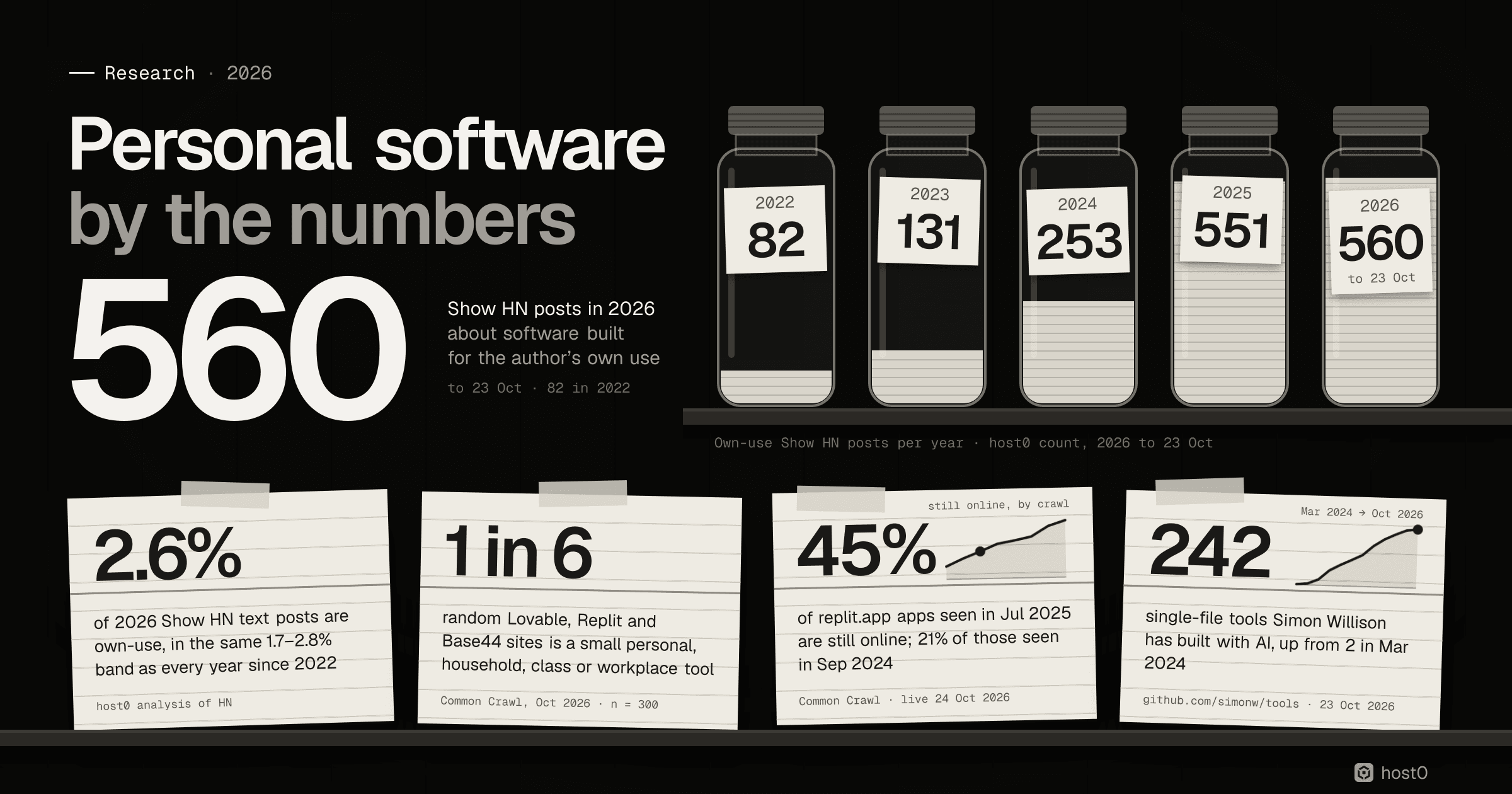
- 1More people are posting software they built for themselves. Show HN posts that say a project was made for the author's own use, their family or a small group went from 82 in 2022 to 560 in 2026 (to 23 October), by our count. That's a floor: we only catch people who say so.
- 2The share hasn't moved. Those posts were 1.7% to 2.8% of Show HN posts with text in every year from 2022 to 2026. Show HN itself quadrupled, from 10,091 posts in 2022 to 40,797 in 2026 by 23 October. People aren't more likely to build for themselves; far more people are building.
- 3AI has moved into the story. In HN's 2021 thread on tools people made for themselves, 1.4% of replies mentioned AI. In 2023 and 2024 it was 7–9%. In a June 2026 thread that asked about tools made "since the advent of AI", it was about half.
- 4Most AI-built apps aren't personal tools. Of 300 random sites on Lovable, Replit and Base44 in the October 2026 crawl, about one in six is a small tool for a person, a household, a class or one workplace. Half are marketing sites for a business. In Lovable's own survey, 9% of builders said their project was personal and 54.6% said it was a business.
- 5They don't last long. 45% of the
replit.appapps Common Crawl saw in July 2025 are still online, and 21% of those it saw in September 2024. Replit's CEO said in March 2025 that of the more than 2 million apps its agent had made in six months, 100,000 were "hosted in production and being used by people": 5%, by Replit's own count. - 6The audience is tiny, on purpose. Only 4% of the replies in the 2026 thread say the tool is shared with family, friends or a team. About 91% of the public, non-fork GitHub repositories created in early 2025 have no star and no fork from anyone, and only 8% of Show HN posts in 2026 so far reached 10 points, against 22% in 2022.
- 7The idea is old; building is the new part. In 2005, Carnegie Mellon researchers forecast 55 million American workers using spreadsheets or databases by 2012, against fewer than 3 million professional programmers. That crowd can now make apps. Getting one online and keeping it there is still the hard part.
560
Show HN posts in 2026 (to 23 Oct) saying the project was built for the author's own use; 82 in 2022
Source: host0 analysis of Algolia HN Search
2.6%
Share of 2026 Show HN text posts (to 23 Oct) that are own-use, in the same 1.7–2.8% band as every year since 2022
Source: host0 analysis
1 in 6
Random Lovable, Replit and Base44 sites that are small tools for a person, household, class or workplace (n = 300)
Source: host0 analysis of Common Crawl, Oct 2026
45%
replit.app apps seen in the July 2025 crawl that are still online on 24 Oct 2026
Source: host0 analysis of Common Crawl
More personal software, at a steady rate#
Show HN is where Hacker News readers post things they made. Since 2022 a third or more of posts, and most since 2023, carry a paragraph of text, and that's where people explain why they built something. We matched explicit phrases: "for myself", "for my own use", "for my wife", "for my kids", "for my friends", "scratch my own itch", "a personal tool" and a dozen more, with licence wording like "free for personal use" excluded. Two hand checks of a random sample of matches found that about nine in ten (92 of 98, and 88 of 100 on a stricter second read) really were projects that began as a tool for the author, their family or friends.
So the count grew almost sevenfold while the share stayed between 1.7% and 2.8%. Personal projects grew exactly as fast as everything else. Show HN went from 10,091 posts in 2022 to 28,276 in 2025 and 40,797 in 2026 so far, with a peak of 6,217 in February 2026 alone. The fall after that coincides with HN's top moderator discussing how to throttle Show HN in March, by one report.
How many of these personal projects were built with AI is harder to pin down. Between 7% and 19% of 2026's own-use posts say so, depending on how strictly you count, and both of our flags over-count: they also catch tools built for Claude Code. The vocabulary moved faster than the share. On HN, "personal software" appeared in 131 comments in 2026 by late October, against about 30 a year from 2022 to 2024. "Vibe coded" appeared in 5,825.
Hacker News comments using the phrase "personal software"
Comments per year containing the exact phrase, 2015 to Oct 2026
| x | y |
|---|---|
| 2015 | 17 |
| 2016 | 17 |
| 2017 | 8 |
| 2018 | 7 |
| 2019 | 12 |
| 2020 | 16 |
| 2021 | 26 |
| 2022 | 29 |
| 2023 | 30 |
| 2024 | 34 |
| 2025 | 68 |
| 2026 | 131 (131 · to Oct) |
There's a second change: each project gets less attention. In 2022, 22% of Show HN posts reached 10 points. In 2026 it's 8%, and the median post gets 2 points. Own-use posts fare the same as the rest. For software made for one person, that may be the right number.
Show HN posts that reach 10 points
Share of all Show HN posts per year scoring 10 or more, 2015 to Oct 2026
| x | y |
|---|---|
| 2015 | 22% |
| 2016 | 20% |
| 2017 | 18% |
| 2018 | 19% |
| 2019 | 18% |
| 2020 | 17% |
| 2021 | 22% |
| 2022 | 22% |
| 2023 | 19% |
| 2024 | 16% |
| 2025 | 11% |
| 2026 | 8% (8%) |
What people build for themselves#
Hacker News has a recurring thread that asks people what they've made for themselves. Four of them drew hundreds of replies: June 2021, December 2023, July 2024 and June 2026, the last one asking about tools made "since the advent of AI". We tagged every top-level reply of 40 characters or more with keywords for what the tool does and where it runs. The tags are crude, so read them as contrasts, not decimals.
Replies that mention AI
Share of top-level replies in HN's "built for yourself" threads, by thread
| Label | Value |
|---|---|
| Jun 2021 | 1.4% (n=277) |
| Dec 2023 | 8.5% (n=497) |
| Jul 2024 | 6.7% (n=282) |
| Jun 2026 | 49.3% (n=487) |
Source: host0 analysis of HN threads
What the tools do barely changed. Notes, tasks and calendars, media and reading (RSS readers, music, books), and tooling for the author's own work lead every thread. Health, family and money follow. Where they run did change. In 2021 more than a third of the replies described a script, a command-line tool or a cron job. In 2026 it's 15%, with more of them self-hosted on a home server.
What the tools do, 2026
Share of top-level replies in the June 2026 thread, by keyword tag (n = 487)
| Label | Value |
|---|---|
| Media and reading | 20% (2021: 17%) |
| Dev and work tooling | 20% (2021: 23%) |
| Notes, tasks, calendar | 19% (2021: 16%) |
| Health and fitness | 11% (2021: 9%) |
| Family and home | 9% (2021: 4%) |
| Learning | 6% (2021: 10%) |
| Money | 6% (2021: 5%) |
| Food and recipes | 1% (2021: 1%) |
Source: host0 analysis of HN threads
Where the tools run, 2026
Share of top-level replies in the June 2026 thread, by keyword tag (n = 487)
| Label | Value |
|---|---|
| Script, CLI or cron job | 15% (2021: 35%) |
| Hosted web app or site | 13% (2021: 13%) |
| Phone app | 10% (2021: 7%) |
| Home server, self-hosted | 8% (2021: 4%) |
| Browser extension | 4% (2021: 3%) |
| Says it's shared | 4% (2021: 4%) |
| Desktop app | 3% (2021: 3%) |
| Spreadsheet or no-code | 1% (2021: 4%) |
Source: host0 analysis of HN threads
One builder, 242 tools#
The clearest single record of personal software built with AI is Simon Willison's. Since March 2024 he has kept small single-page tools (OCR, format converters, clipboard helpers, API explorers) in one public repository and published them at tools.simonwillison.net. In December 2025 he wrote that he had built "over 150 of these in the past two years, almost all of them written by LLMs". We counted the HTML files at the end of each month in the repository's git history.
Simon Willison's single-file HTML tools
Top-level HTML files in github.com/simonw/tools at each month end, Mar 2024 to 23 Oct 2026
| x | y |
|---|---|
| Mar 2024 | 2 |
| Jun 2024 | 6 |
| Sep 2024 | 24 |
| Dec 2024 | 63 |
| Mar 2025 | 87 |
| Jun 2025 | 108 |
| Sep 2025 | 130 |
| Dec 2025 | 169 ("over 150") |
| Mar 2026 | 198 |
| Jun 2026 | 219 |
| Sep 2026 | 237 |
| Oct 2026 | 242 |
Two things stand out. The pace is steady, not a burst: a tool every four days or so, for 31 months. And they last. Each one is a single file with no server and no build step, so there's very little to break. Fewer than ten have left the repository, and those were renamed or moved to a separate site, not lost.
Most AI-built apps aren't personal tools#
It's easy to assume that personal software is most of what the AI app builders make. The numbers they publish say something different. In Lovable's survey of more than 14,300 users in May 2026, 9% said their project was personal. More than half said they were building a business.
What Lovable users say they're building
Project purpose, survey of 14,300+ Lovable users, 22–29 May 2026
| Label | Value |
|---|---|
| A business | 54.6% |
| Side project | 24.6% |
| Personal | 9% |
| Not sure | 7.7% |
Source: Lovable, The Build Economy
To see what actually gets published, we took 100 random sites from each of lovable.app, replit.app and base44.app in Common Crawl's October 2026 crawl, read each one's title and description, and sorted them by hand. Half were marketing sites for a business or an organisation. About one in six were small tools: 25 for a person, a household, a class or a club, and 22 internal tools for a single business.
What a random AI-built site is
300 random sites on lovable.app, replit.app and base44.app (100 each), Common Crawl Oct 2026
| Label | Value |
|---|---|
| Business or org site | 49% (147) |
| Public product | 17% (52) |
| Tool for a person or group | 8% (25) |
| Internal tool, one business | 7% (22) |
| Personal or hobby site | 6% (17) |
| Unreadable | 9% (27) |
| Gone | 3% (10) |
The small tools are what Sloan described. A private appreciation app for a couple. A volunteer fire company's member database. A church youth group's schedule. A pastry workshop's gift-card manager. They are real, and they are a minority of what gets published. Most personal software is probably never published at all: Anthropic said in June 2025 that people had made "over half a billion artifacts" in Claude, and artifacts start private to their creator.
How long it lasts#
Personal software gets thrown away. Andrej Karpathy, who coined "vibe coding" in February 2025 and called it "not too bad for throwaway weekend projects", wrote in December 2025 that code is now "discardable after single use". TechCrunch's January 2026 piece on micro apps described apps "intended to be used only by the creator" or a select few, kept only as long as the creator wants them. We measured how fast.
For each Common Crawl vintage since September 2024 we drew random sites on the builders' domains and requested each one on 24 October 2026. A site counts as live if it answers with a real page, not an error, a takedown or a login wall.
AI-built apps still online, by when the crawl saw them
Share of random replit.app and lovable.app sites live on 24 Oct 2026, by crawl month
| Series | x | y |
|---|---|---|
| Replit | Sep 2024 | 21% |
| Replit | Jan 2025 | 34% |
| Replit | Jul 2025 | 45% |
| Replit | Oct 2025 | 57% |
| Replit | Jan 2026 | 62% |
| Replit | Apr 2026 | 68% |
| Replit | Jul 2026 | 85% |
| Replit | Oct 2026 | 94% |
| Lovable | Jul 2025 | 60% |
| Lovable | Oct 2025 | 85% |
| Lovable | Jan 2026 | 89% |
| Lovable | Apr 2026 | 87% |
| Lovable | Jul 2026 | 95% |
| Lovable | Oct 2026 | 100% |
Source: host0 analysis of Common Crawl
Replit's apps decay steadily: about half are gone after 13 to 15 months, and four in five after two years. Lovable's last longer in our sample. That fits what Replit's CEO, Amjad Masad, told Growth Unhinged in March 2025: its agent had made more than 2 million apps in six months, and 100,000 were "hosted in production and being used by people". That's 5%.
Platforms die too. Glitch, where people hosted small apps for years, counted "millions of users running tens of millions of apps" when it announced in May 2025 that project hosting would end on 8 July 2025. A sample Glitch app we requested now answers 410 Gone. Heroku deleted its free databases in November 2022. Show HN projects don't fare much better over time: of the Show HN links we checked from 2015 to 2017, four in ten are dead.
Show HN links that still work
Share of 60 random Show HN links per year that load on 24 Oct 2026
| Label | Value |
|---|---|
| 2015 | 57% |
| 2016 | 55% |
| 2017 | 57% |
| 2018 | 76% |
| 2019 | 73% |
| 2020 | 70% |
| 2021 | 59% |
| 2022 | 69% |
| 2023 | 75% |
| 2024 | 88% |
| 2025 | 74% |
| 2026 | 97% |
For scale, Pew found that 38% of web pages that existed in 2013 were gone a decade later. Small software dies at about the rate of the web it lives on, and apps on Replit's domain die faster.
Small software is an old idea#
Almost nothing here is new except the tools. In 2004 Clay Shirky described "situated software", built for a specific group, and noticed that it had become easy to build for "dozens of users, an absurd target population". The longest-running form of personal software isn't an app at all. It's the spreadsheet.
Who could build software at work, US, 2012 forecast
Millions of people, Scaffidi, Shaw and Myers (Carnegie Mellon), Feb 2005
| Label | Value |
|---|---|
| Use a computer at work | 90M |
| Use spreadsheets or databases | >55M |
| Call themselves programmers | >13M |
| Professional programmers | <3M |
Code has always had small audiences, too. In 2014, researchers studying GitHub found that 67% of projects had only one committer and 93% had three or fewer. That hasn't changed with AI. Of the public, non-fork repositories created in the first half of 2025, 91% have no star and no fork from anyone today, up from 88% for 2022's. Older repositories have had longer to collect a star, so part of that rise is just time. GitHub's volume is another story, which we covered in our post on the app-store flood.
How the idea of personal software spread
30 Mar 2004
Feb 2005
Feb 2020
25 Mar 2023
May 2024
2 Feb 2025
27 Apr 2025
8 Jul 2025
10 Dec 2025
16 Jan 2026
16 Jan 2026
Jul 2026
Source: Linked essays and announcements
What's new is who can build, and what's left over. Karpathy's account of building MenuGen, an app he made for his own use, is the best description of the gap. With the first version running on his laptop, he wrote, "I felt like I was 80% done but … it was a bit closer to 20%." The rest was hosting, sign-in, domains and payments. For software with four users, that's most of the work. We looked at what that last step costs in our post on vibe-coded app costs, and at the same pattern inside companies in internal tools built by non-engineers.
What this means if you build with AI#
- Decide who it's for before you build. Just you, your household, or your team. That one answer decides whether you need sign-in, where the data lives and how you share it. Most personal tools have one user, so start private and open it up later.
- Pick the format that lasts. Willison's 242 tools are single HTML files with no server, and almost none of them has been lost. A static page or a script has less to break than an app with a backend. Ask your agent for the simplest thing that works.
- Keep the source somewhere you control. About half of the Replit apps in our sample were gone after 13–15 months, and Glitch switched off tens of millions of apps at once. Put the code in a git repository or at least download it, so the tool can be redeployed when the host changes.
- Make the data exportable from day one. A JSON or CSV export is a few lines for an agent to write. It's the difference between moving a tool and losing a year of your habit log.
- Budget for the last 80%. Running it on your laptop is the start. Getting it to your phone, signing your partner in and keeping it up is the rest, and that's where most personal projects stall.
- Don't measure it in attention. The median Show HN post gets 2 points. Four daily users and zero churn is a success for a family app.
- Let it go on purpose. When the need is gone, archive the code and its data and turn the app off, rather than leaving a broken link behind. Most models these tools call have a shelf life too: we found the median AI model is retired after about 18 months.
We build host0 for the step after the build: an app your agent made goes live at a private link you can share by email, with a shared database it doesn't need to set up.
Methodology#
We used public data only, collected between 23 and 24 October 2026, and re-checked 20 headline numbers against the primary pages before writing.
- Show HN. Every Show HN story from 1 January 2015 to 23 October 2026 (188,027), downloaded through the Algolia HN Search API in weekly windows, each halved until it fit under the API's 1,000-result cap. "Own-use" is a match on explicit phrases in the title or text ("for myself", "for my own use", "for my kids", "for my friends", "scratch my own itch", "personal tool" and similar), with licence wording excluded. In two hand checks of a random sample, 92 of 98 and 88 of 100 matches were right; recall is unknown, so the counts are a floor. Before 2022 almost no Show HN post had text in Algolia, so shares start in 2022. The "built with AI" flags are rough: the strict one was right 22 times in 40, the loose one 22 in 50.
- Threads. The full comment trees of four Ask HN threads (2021, 2023, 2024, 2026). The unit is a top-level reply of 40 characters or more, tagged by keyword regex; a reply can carry several tags. The 2026 thread's title asks about AI.
- Common Crawl. For each crawl, a sample of 100 random hosts per platform with an HTTP 200 capture (43 for Replit in September 2024), each requested once on 24 October 2026. Live means a real page, not an error, takedown or login wall. For October 2026 we also coded each site by hand, from its hostname, live title and description, into seven types. The crawl only sees linked pages, so it under-counts private and personal tools.
- Link rot. 60 random Show HN posts with a link per year, plus 60 own-use posts per year from 2022, requested once on 24 October 2026. Bot walls (401, 403, 429, 503) are left out of the denominator.
- GitHub. Public, non-fork repositories created per month, counted through the search API on 24 October 2026; stars and forks are as of that day. We use January to June of 2022–2025, the months that had finished counting.
- Willison's tools. Top-level HTML files at the last commit of each month in
github.com/simonw/tools, through 23 October 2026; files that left the repository were traced in its commit log. - Vendor numbers (Replit, Lovable, Anthropic, Glitch) are the companies' own claims, and "apps" or "projects" means created, not live or used, unless they say otherwise.
The data pack, with every source, tier, the spot-check log and a do-not-cite list, is in our repository at docs/research/2026-10-24-personal-software.md. The series behind every chart and the scripts that compute them are in docs/research/2026-10-24-personal-software-data/.
Open questions#
- How much personal software is never posted or linked? Every count here sees only what someone chose to show. The tools behind a login or on a laptop are the dark matter.
- Who actually uses AI-built apps? No survey we found asks builders whether an app is used by them alone, their family, their team or customers. Lovable's 17.7% "a tool my team uses daily" is the closest.
- How many Claude artifacts, ChatGPT Sites or Lovable projects are ever shared? The vendors publish how many are created, never how many are opened by a second person.
- Does personal software last longer when its owner controls the code? Willison's tools suggest so, but one collection isn't a study.