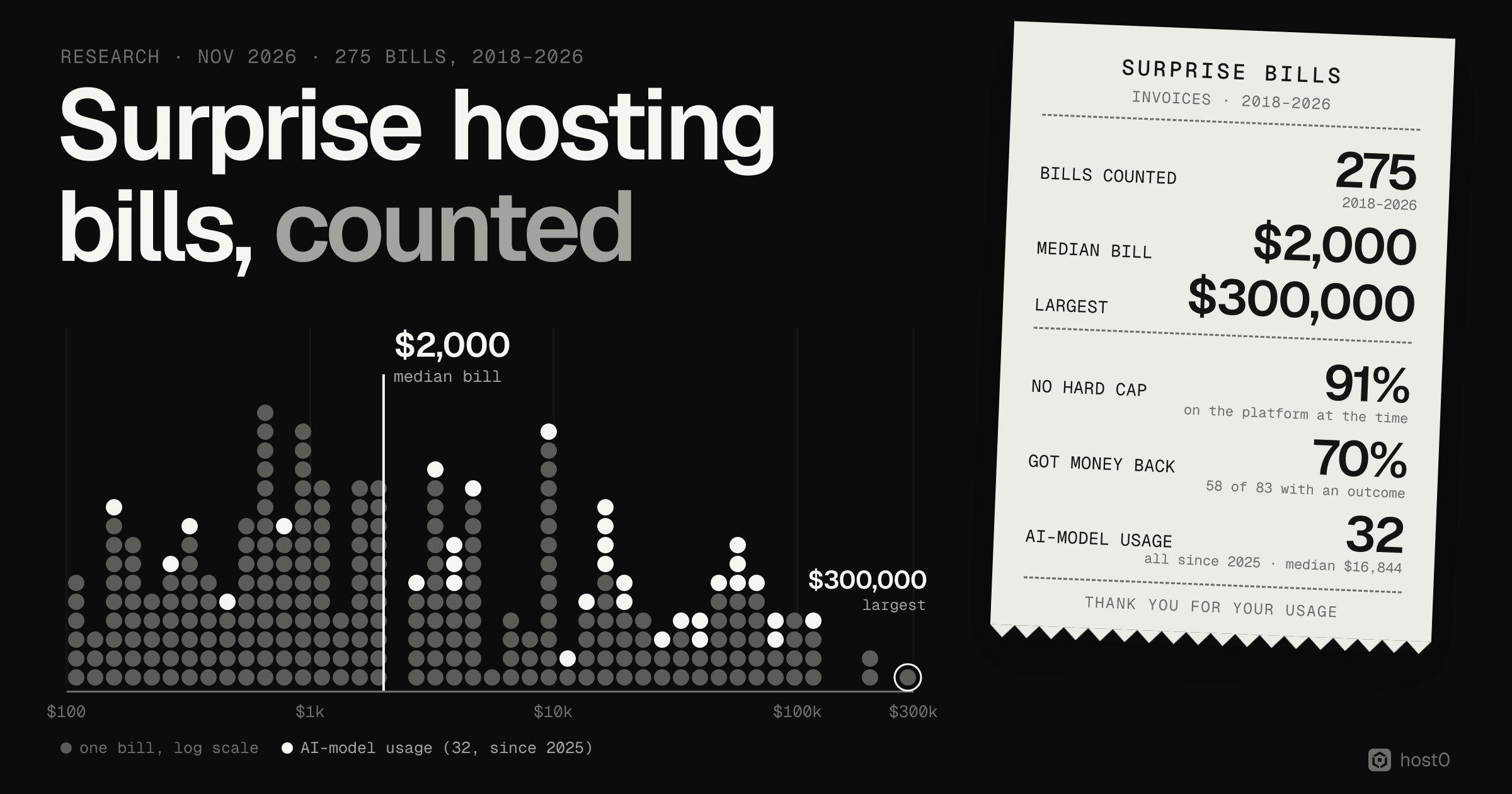
Everyone has seen one of these stories: a static site gets a $104,500 Netlify bill, a Firebase function loops overnight, a leaked key runs up six figures on AWS. What nobody has is a count. So we built one. We collected every public, first-person report of a surprise bill from a hosting, cloud, serverless or backend platform we could find between January 2018 and November 2026, on Hacker News, Reddit, vendor forums and blogs. We read and coded 748 candidates by hand and merged duplicates. That left 275 distinct incidents, each linked to the post where the person who got the bill described it.
This is a census of bills people chose to post about, not a sample of all bills. Loud cases are overrepresented, and quiet refunds are underrepresented, because few people start a thread to say support fixed it. Our Reddit coverage is partial, too. So the counts say what these bills look like, what causes them and how often the reported ones were forgiven. They can't say how often surprise bills happen. The methodology explains how we did it and where it falls short.
Key findings
- 1The typical bill is $2,000; the largest is $300,000. Of 275 surprise bills, 83 (30%) were $10,000 or more and 9 were $100,000 or more. The largest was an AWS account taken over with leaked keys, later partly reduced.
- 291% hit a platform with no hard spending cap at the time. That's 250 of 275, judged by vendor launch dates rather than by whether the person had a cap on. Of the 20 bills where a cap existed, 18 were on Vercel, where it's opt-in.
- 3Leaked credentials are the most common named cause. 60 bills (22%), with a median of $10,942. The biggest bucket, though, is a mix we call "other" (44%): free tiers or credits ending, resources left running, pricing surprises, unexplained charges and bills whose cause wasn't stated.
- 4AI-model usage is the new shape. 32 bills were for AI models billed through a cloud account (Gemini and Vertex AI on Google Cloud, Bedrock on AWS, Microsoft Foundry on Azure), all from 2025 on, with a median of $16,844. They make up 23 of the 77 bills from 2026, and only 1 of the 12 with a known outcome was waived in full.
- 5AI crawlers are not a big cause. Since 2024, 6 of 175 bills came from bots or crawlers, and an AI crawler is named in 2. The new risk is AI-model usage on leaked or forgotten keys.
- 670% of bills with a known outcome got money back. Of 83, 41 were waived in full (49%), 17 reduced (20%) and 25 refused (30%). That's likely on the high side: without incidents known only from a Hacker News comment, it's 36% waived and 62% with any relief.
- 7In the cases we could follow, fewer bills are waived. 24 of 35 (69%) bills from 2018–2023 were waived in full, against 17 of 48 (35%) from 2024–2026. On Google Cloud and Firebase it went from 6 of 6 to 4 of 25.
- 8Bills run up fast, and caps are new. 41 of the 175 bills with a stated time (23%) ran up within a day. Google Cloud's spend caps went GA on 30 October 2026, and Cloudflare's Workers limits launched in beta on 13 November 2026.
275
Surprise hosting bills counted, Jan 2018 to Nov 2026. Median $2,000, largest $300,000
Source: host0 analysis
91%
Hit a platform with no hard spending cap at the time (250 of 275)
Source: host0 analysis
70%
Of 83 with a known outcome got money back: 41 waived in full, 17 reduced
Source: host0 analysis
32
Bills from AI-model usage billed by a cloud, all from 2025 on. Median $16,844
Source: host0 analysis
What counts as a surprise bill#
An incident is in the set when the person or company that got the bill reports it themselves, the charge wasn't planned, an amount of $100 or more is stated, and the platform is a host or cloud: AWS, Google Cloud, Firebase, Azure, Vercel, Netlify, Cloudflare, Supabase, Render, Fly.io, Railway, Heroku, DigitalOcean, Webflow, Framer and the like. LLM vendors billed directly (the OpenAI or Anthropic API) and SaaS tools are out. A Gemini or Bedrock bill is in, because it arrives on the cloud account. Amounts are the bill as first reported, before any refund.
AWS dominates, with 159 of the 275, followed by Google Cloud with 68. That partly reflects where we looked: r/aws was one of the six subreddits we reached, and r/CloudFlare, r/Supabase, r/render and r/flyio weren't. Supabase, Railway, Render, Heroku and DigitalOcean have no incidents in the set. That's a gap in coverage, not evidence that they have none.
Surprise bills by platform
Incidents, Jan 2018 to Nov 2026, n = 275
| Label | Value |
|---|---|
| AWS | 159 (median $1,500) |
| Google Cloud | 68 (median $8,423) |
| Vercel | 21 (median $949) |
| Firebase | 9 (median $16,510) |
| Cloudflare | 8 (median $4,623) |
| Azure | 5 (median $2,000) |
| Netlify | 2 (median $52,360) |
| Webflow | 1 ($1,189) |
| Framer | 1 ($250) |
| Fly.io | 1 ($600) |
Source: host0 analysis of 275 first-person reports
How big the bills get#
The median bill is $2,000, and it barely moves when we cut the data differently: $2,056 for primary posts only, and $2,056 for rows we coded with high or medium confidence. The middle half runs from $600 to $14,000. The 275 add up to $4.36 million as first reported.
Surprise bills by size
Incidents by amount as first reported, USD, n = 275
| Label | Value |
|---|---|
| $100–$1k | 96 (35%) |
| $1k–$10k | 96 (35%) |
| $10k–$100k | 74 (27%) |
| $100k+ | 9 (3%) |
Source: host0 analysis
Who gets the bill matters. 181 incidents were individuals or side projects, with a median of $1,100. 79 were companies, with a median of $10,000.
Six of the ten largest bills are leaked credentials or runaway code. In the $127,000 Google Cloud case, a reporter on The Register's podcast said the developer told him the API key had been "hidden from everybody" and suspected it was brute-forced. Cara, a social app for artists, posted a Vercel bill of about $96,000 in June 2024 after a surge in use. No waiver was reported, and InfoQ's write-up, which puts the bill at $98,280, mentions none.
The ten largest surprise bills
Amount as first reported, USD
| Label | Value |
|---|---|
| AWS · keys leaked, servers in many regions | $300,000 (Jan 2023 · reduced) |
| AWS · account hacked | $200,000 (Nov 2022 · not reported) |
| Azure · account hacked | $200,000 (Dec 2022 · pending) |
| Google Cloud · AI API key abused | $127,000 (May 2026 · pending) |
| Firebase · function loop calling Translate | $121,000 (Nov 2023 · pending) |
| Google Cloud · script hammering Geocoding | $120,000 (Jul 2020 · waived) |
| AWS · cause not stated in the comment | $120,000 (Jul 2021 · waived) |
| Netlify · 190 TB of bandwidth in 4 days | $104,500 (Feb 2024 · waived) |
| Firebase · one object requested 100M+ times | $100,000 (May 2025 · waived) |
| Vercel · Cara's surge in use | ~$96,000 (Jun 2024 · no waiver reported) |
Source: host0 analysis
How fast they run up#
175 of the bills say how long the spending took. 41 of them (23%) ran up within a day, 31 within hours. A Firebase-provisioned Android key from 2016 was used for about $67,000 of Gemini calls in 19 hours. A test of recursion on Cloud Run burnt $72,000 in a few hours. An alert email that arrives the next morning is too late for these.
How long the bill took to run up
Incidents with a stated time, n = 175
| Label | Value |
|---|---|
| Hours | 31 |
| A day | 10 |
| Days | 39 |
| A week | 5 |
| Weeks | 13 |
| A month | 50 |
| Months | 27 |
Source: host0 analysis
What causes them#
We gave each bill one main cause, as the person who got it described it. Leaked or stolen credentials lead the named causes, with 60 bills (22%): AWS keys pushed to a public repo, hijacked accounts, and lately browser keys used for Gemini. They are also expensive, with a median of $10,942, and 34 of the 60 were $10,000 or more. Misconfiguration (a public bucket, a NAT gateway, a full BigQuery scan) and runaway code (loops, recursion, retry storms) tie at 34 bills each.
The biggest bucket is "other", 121 bills (44%). We split it by the coder's note: 27 were a free tier or credits that ended or weren't what the person thought, 20 were resources left running and forgotten, 20 were pricing surprises like extended support fees or paid features switched on by default, 11 were vendor errors or charges nobody could explain, and 43 didn't say. These are mostly small, with a median of $738.
What caused the bill
Incidents by main cause, n = 275
| Label | Value |
|---|---|
| Leaked or stolen credentials | 60 (22%) |
| Cause not stated | 43 (16% · other) |
| Misconfiguration | 34 (12%) |
| Runaway code | 34 (12%) |
| Free tier or credits ended | 27 (10% · other) |
| Resources left running | 20 (7% · other) |
| Pricing surprise | 20 (7% · other) |
| Attack traffic | 14 (5%) |
| Vendor error or unexplained | 11 (4% · other) |
| Bots and crawlers | 7 (3%) |
| Viral traffic | 5 (2%) |
Source: host0 analysis
Median bill by cause
USD, as first reported
| Label | Value |
|---|---|
| Attack traffic | $12,000 (n = 14) |
| Leaked or stolen credentials | $10,942 (n = 60) |
| Runaway code | $9,970 (n = 34) |
| Viral traffic | $1,500 (n = 5) |
| Bots and crawlers | $1,142 (n = 7) |
| Misconfiguration | $1,112 (n = 34) |
| Other | $738 (n = 121) |
Source: host0 analysis
AI crawlers aren't the story#
We expected bots and AI crawlers to be a growing cause. In first-person reports they aren't. Since 2024, 6 of 175 bills came from bots or crawlers, and an AI crawler is named in only 2. One is Read the Docs, which says a crawler downloaded 73 TB of zipped HTML in May 2024, costing it "over $5,000 in bandwidth charges". The other is a Hacker News comment blaming a roughly $10,000 Google Cloud bill on ClaudeBot. Crawlers may raise bills in ways nobody posts about, but they rarely produce the bill that makes someone write a thread.
AI models on cloud keys are the story#
32 bills were AI-model usage billed through a cloud account: 25 on Google Cloud, 4 on AWS, 2 on Firebase and 1 on Azure. All 32 are from 2025 or 2026, and they make up 23 of the 77 bills from 2026. Their median is $16,844, and 21 of the 32 were $10,000 or more.
18 of them were leaked credentials, 15 of those in 2026. The pattern repeats across the Google threads: a browser key created years ago for Firebase or Maps, never restricted, later able to call the Gemini API. One Firebase browser key without API restrictions was used for more than €54,000 of Gemini requests within hours of the owner enabling Firebase AI Logic, and the refund was refused. These bills are hard to get back: of the 12 with a known outcome, 1 was waived in full, 3 were reduced and 8 were refused.
Who had a hard cap#
A hard cap means usage stops (the service is paused or blocked) at a dollar limit, rather than just sending an email. For each bill we coded whether the platform offered one at the time, from each vendor's own launch dates. That says nothing about whether the person had one switched on.
Did the platform offer a hard spending cap at the time?
Share of incidents, by vendor launch dates, n = 275
| Label | Value |
|---|---|
| No | 91% (250) |
| Yes | 7% (20) |
| Partial | 2% (5) |
Source: host0 analysis; vendor launch dates
The 20 with a cap available are the interesting part. 18 of Vercel's 21 bills happened after Vercel let a budget pause production deployments. But a budget there is opt-in, and Vercel's docs say it plainly: "Setting a budget does not stop usage on its own." A cap that has to be found and switched on doesn't show up as protection in these reports.
Do hosts forgive surprise bills#
Most bills never get a public ending. 102 never say what happened, and 90 were still pending when posted, so 83 have a final outcome. Of those, 58 (70%) got money back: 41 were waived in full (49%) and 17 reduced (20%). 25 (30%) were refused, or paid in full.
What happened to the bill
Incidents with a reported final outcome, n = 83
| Label | Value |
|---|---|
| Waived in full | 41 (49%) |
| Reduced | 17 (20%) |
| Refused or paid | 25 (30%) |
Source: host0 analysis
Treat 49% as optimistic. Stories retold in a Hacker News comment skew to happy endings. Without the incidents we know only from a comment, 61 have a final outcome, 36% were waived in full and 62% got any relief.
It depends heavily on the cause. Attack traffic is the easiest to get back: 9 of 11 resolved DDoS and abuse bills were waived in full. Runaway code got 8 of 15 waived, leaked credentials 7 of 22, and AI-model bills 1 of 12. Some vendors have said so in writing. Netlify's CEO wrote on Hacker News in February 2024 that the company had "forgiven lots and lots of bills over the last 9 years". Fly.io's billing docs say it is happy to discuss a refund after a mistake or an attack. Google's own spend cap docs say the opposite about one edge case: "You remain responsible for any overage costs accrued due to reporting latency."
Bills waived in full, older vs newer
Share of resolved bills waived in full; older = 2018–2023, newer = 2024–2026
| Label | Value |
|---|---|
| All bills, older | 69% (24 of 35) |
| All bills, newer | 35% (17 of 48) |
| All except AI models, newer | 44% (16 of 36) |
| AWS, older | 59% (16 of 27) |
| AWS, newer | 50% (8 of 16) |
| Google Cloud and Firebase, older | 100% (6 of 6) |
| Google Cloud and Firebase, newer | 16% (4 of 25) |
Source: host0 analysis
In the cases we could follow, fewer bills are waived than before. The drop holds without AI-model bills (69% to 44% waived). Google's holds without the r/googlecloud and r/Firebase threads: 4 waived and 6 refused of the 10 that remain since 2024. Since 2024, 14 of 25 resolved Google Cloud and Firebase bills were refused. The numbers are small, so this is a direction, not a rate.
Are surprise bills getting more common#
The raw count rises from 7 in 2019 to 77 in 2026, though not every year. Most of that is where we could look: our Reddit pull reaches 2021 onward in volume, and r/googlecloud only from May 2025. The one series with the same coverage every year is Hacker News on its own. It roughly doubled, from about 10 a year in 2019–2023 to about 20 a year in 2024–2026. That could be more bills, or more attention to them. We can't separate the two.
Surprise bills found on Hacker News, by year
Incidents first found on Hacker News, stories and comments; 2026 to mid-November
| Label | Value |
|---|---|
| 2019 | 7 |
| 2020 | 14 |
| 2021 | 8 |
| 2022 | 11 |
| 2023 | 8 |
| 2024 | 21 |
| 2025 | 19 |
| 2026 | 22 |
Source: host0 analysis, Hacker News via the Algolia API
Spending caps, then and now#
Most hard caps are recent, and the two biggest clouds came last. Google Cloud's spend caps went GA on 30 October 2026, for four services. Cloudflare launched spending limits in beta on 13 November 2026, after four runaway Durable Objects bills between April and October 2026 in our set ($36,000, $34,895, $10,811 and $8,847). Which products those limits cover isn't settled: Cloudflare's launch post says "We are starting with caps for Workers and Durable Objects", while its Workers docs say a Workers spending limit doesn't apply to Durable Objects, KV or R2 charges.
When hosts added hard caps and billing guards
30 Mar 2022
30 Mar 2022
Supabase spend cap
On by default on Pro; usage of covered items stops until the next cycle.Source: Supabase docs
15 Sep 2023
15 Sep 2023
Railway usage limits
A hard limit that takes every workload offline. Beta, GA on 20 Oct 2023.Source: Railway docs
8 Mar 2024
8 Mar 2024
Vercel budgets can pause production
Opt-in; the pause is on by default for budgets set from 27 Jun 2024.Source: Vercel docs
19 Aug 2024
19 Aug 2024
S3 stops charging for unauthorised requests
Not a cap: AWS no longer bills 403s from outside the account. Announced in May.Source: AWS
4 Sep 2025
4 Sep 2025
Netlify credit plans
A hard limit on Free; paid plans pause at zero credits unless auto recharge is on.Source: Netlify docs
30 Oct 2026
30 Oct 2026
Google Cloud spend caps GA
Gemini API, Agent Platform, Cloud Run and Cloud Run functions only. Announced 22 Apr 2026.Source: Google Cloud blog
13 Nov 2026
13 Nov 2026
Cloudflare Workers spending limits
Beta, opt-in; new invocations are blocked at the limit.Source: Cloudflare blog
Source: Vendor docs, blogs and changelogs, read 18 Nov 2026
Which hosts have a hard spending cap
As of 18 Nov 2026, from each vendor's own docs
- Supabase: yes, on by default on Pro. Some items, such as compute add-ons, aren't covered.
- Railway: yes, opt-in. Hitting it takes all workloads offline.
- Netlify: yes on Free, with no auto recharge. Paid credit plans pause at zero unless auto recharge is on; legacy plans differ.
- Vercel: yes, opt-in. A team or project budget can pause production; AI Gateway and v0 usage aren't stopped.
- Cloudflare Workers: yes, in beta and opt-in. The launch post and the docs disagree on whether Durable Objects are covered.
- Google Cloud: partial, opt-in. Spend caps cover the Gemini API, Agent Platform, Cloud Run and Cloud Run functions; other budgets only alert.
- Firebase: partial. On Blaze, caps cover AI Logic, App Hosting, Cloud Functions and Extensions; the docs say "Budget alerts do not pause services."
- Azure: partial. A spending limit exists only on credit-based subscriptions, not pay-as-you-go.
- AWS: no. Budgets alert, and budget actions can apply policies or stop some instances.
- Render: no for bandwidth. Its spend limit covers build pipeline minutes.
- Fly.io: no. It discusses refunds case by case.
Source: Vendor docs, read 18 Nov 2026; host0 data pack
The meter behind traffic bills#
Bandwidth bills are egress times traffic, and the price per GB varies widely. As arithmetic only, and ignoring volume tiers: the 190 TB behind Netlify's $104,500 bill would cost about $17,000 at AWS's first-tier $0.09 per GB, about $29,000 at $0.15, and nothing on Cloudflare R2.
Egress price per GB, first paid tier
USD per GB of data sent to the internet, list prices read 18 Nov 2026
| Label | Value |
|---|---|
| Netlify (credits) | ≈$0.13–0.20 (by plan) |
| Vercel (Fast Data Transfer) | $0.15–0.35 (by region) |
| Firebase Hosting | $0.15 |
| Render | $0.15 |
| Google Cloud | $0.12 (per GiB) |
| AWS (EC2, us-east-1) | $0.09 |
| Supabase | $0.09 (uncached) |
| Azure | $0.087 |
| Railway | $0.05 |
| Fly.io | $0.02–0.12 (by region) |
| Cloudflare R2 | $0 |
Sources: Vercel; Netlify; Firebase; Render; Google Cloud; AWS Price List API; Supabase; Azure; Railway; Fly.io; Cloudflare R2
What this means if you build with AI#
An agent can wire an app to a database, an AI model and a CDN in an afternoon. It won't set your billing guards unless you ask. Before you share the link:
- Turn on the cap where one exists, before you need it. On Vercel, set a team budget with Pause production deployments on. On Supabase, leave the spend cap on. On Railway, set a hard limit. On Google Cloud, put a spend cap on Gemini and Cloud Run, and on Cloudflare, set a Workers spending limit. Set each one below what you can afford, because all of them lag by minutes or more.
- Where there's no cap, use alerts and a separate account. On AWS and most of Google Cloud, a budget only emails you. Set alerts at low thresholds, and keep experiments in their own account or project so a mistake can't touch production. A bill that runs up in hours (23% in our set) will beat a daily email.
- Treat every key like a password. Leaked credentials have the highest median of any cause except attack traffic ($10,942), and AI-model usage on leaked keys is the newest pattern in the set. Never put a server key in a repo or a client bundle. Restrict browser keys to the APIs and sites they need. Look for old Firebase or Maps keys that can now call Gemini, and delete the keys you no longer use.
- Give agent-written code limits. Runaway code has a median of $9,970. Set maximum instances and timeouts, and check that no function writes to the bucket or queue that triggers it.
- Choose egress you can afford. At $0.09 to $0.35 per GB on the platforms behind most of these bills, one viral week or a crawler loop is a real bill. Cache static files, cap image optimization, and prefer hosts that don't charge for bandwidth.
- Clean up. 20 bills were resources left running, and 27 were a free tier or credits that ended. When a prototype is done, delete it, along with its keys.
- If it happens, write to support straight away. Say what happened and what you've done to stop it. Attack traffic was waived 9 times in 11, while AI-model bills were waived once in 12, so don't count on a refund.
We built host0 to host what agents make on Cloudflare R2, where egress is free, for a flat plan price: going over a visit limit gets you an email, not a bigger invoice. That's no help if your app calls a paid AI API with a key that leaks, and we didn't measure host0 in this post.
Methodology#
We collected public, first-person reports of surprise bills from January 2018 to November 2026, and gathered the data on 18 November 2026.
- Sources. Hacker News stories and comments for about 70 bill-related queries, via the Algolia API (8,759 stories and 31,671 comments pulled). Reddit post titles containing "bill" or "charged" in r/webdev, r/nextjs, r/vercel, r/aws, r/Firebase and r/googlecloud, via the Arctic Shift archive, since reddit.com's own search returns 403 (1,143 posts). The Vercel, Netlify and Fly.io community forums (818 topics). The 25 entries on serverlesshorrors.com, each followed to its primary post and used only as leads. 20 blog and news leads from web search.
- Candidates. We kept items naming a platform, a bill word and an amount of $100 or more; comments also needed first-person wording. That gave 748 candidates, each coded by hand against a written guide: the person or company that got the bill reports it, it wasn't planned, the platform is in scope, and an amount is stated. For each we recorded platform, product, month, amount as first reported, time to run up, cause and outcome.
- Duplicates. 27 incidents were reported in more than one place. We merged them by a manual list and an automatic rule (same platform and cause, $1,000 or more, amount within 3%, month within 2), leaving 275 incidents in the period.
- Accuracy. A hand check of 108 coded rows found 4 errors in 75 included rows (95% right) and no wrongly excluded rows in 33. We fixed all four. Comments retelling old stories can carry the comment's date.
- Amounts are the bill as first reported, before refunds, converted to USD at fixed approximate rates. Some are approximate ("$1k+").
- Cap at the time comes from vendor launch dates, not from whether the person had a cap switched on. Google Cloud counts as capped only for Gemini, Vertex AI and Cloud Run bills from July 2026.
- Coverage limits. Reddit is partial. We reached six subreddits, r/googlecloud only from May 2025, and 61 quarter-windows timed out in the archive. Not reached: r/CloudFlare, r/Netlify, r/Supabase, r/AZURE, r/flyio, r/render, r/selfhosted, r/SaaS and others. X has no search we could use, so tweets appear only when linked from elsewhere. Hacker News comment queries hit the API's 1,000-result ceiling in some years.
- Outcomes. 192 of 275 bills have no public final outcome. With rows we coded high or medium confidence only, 48% of resolved bills were waived and 69% got relief; without Hacker News comment-only incidents, 36% and 62%.
- What we can't measure. How many surprise bills are never posted, so there is no rate per customer, and how the quiet ones end.
- Tiers. Every incident count, share and median here is our own computation from the dataset. Vendor cap and price details come from each vendor's own page, read on 18 November 2026; where a vendor's pages disagree, we say so.
The data pack, with every incident's primary link and a short quote, the coding guide, the hand check and the scripts, is in our repository at docs/research/2026-11-18-surprise-hosting-bills.md, with the data in docs/research/2026-11-18-surprise-hosting-bills-data/. Its text names no private people; its links lead to the original posts.
Open questions#
- What share of surprise bills get waived when nobody posts? Vendors don't publish it. Netlify's CEO says "lots and lots".
- Will Cloudflare's new limits stop the Durable Objects bills? Its launch post and its docs disagree on whether Durable Objects are covered.
- Do caps that are on by default prevent incidents, or just move them? We found no Supabase bills, but we didn't reach r/Supabase.
- Does the platform mix hold with full Reddit coverage? A pull of the 16 subreddits we couldn't reach would test whether AWS really accounts for 58% of incidents.