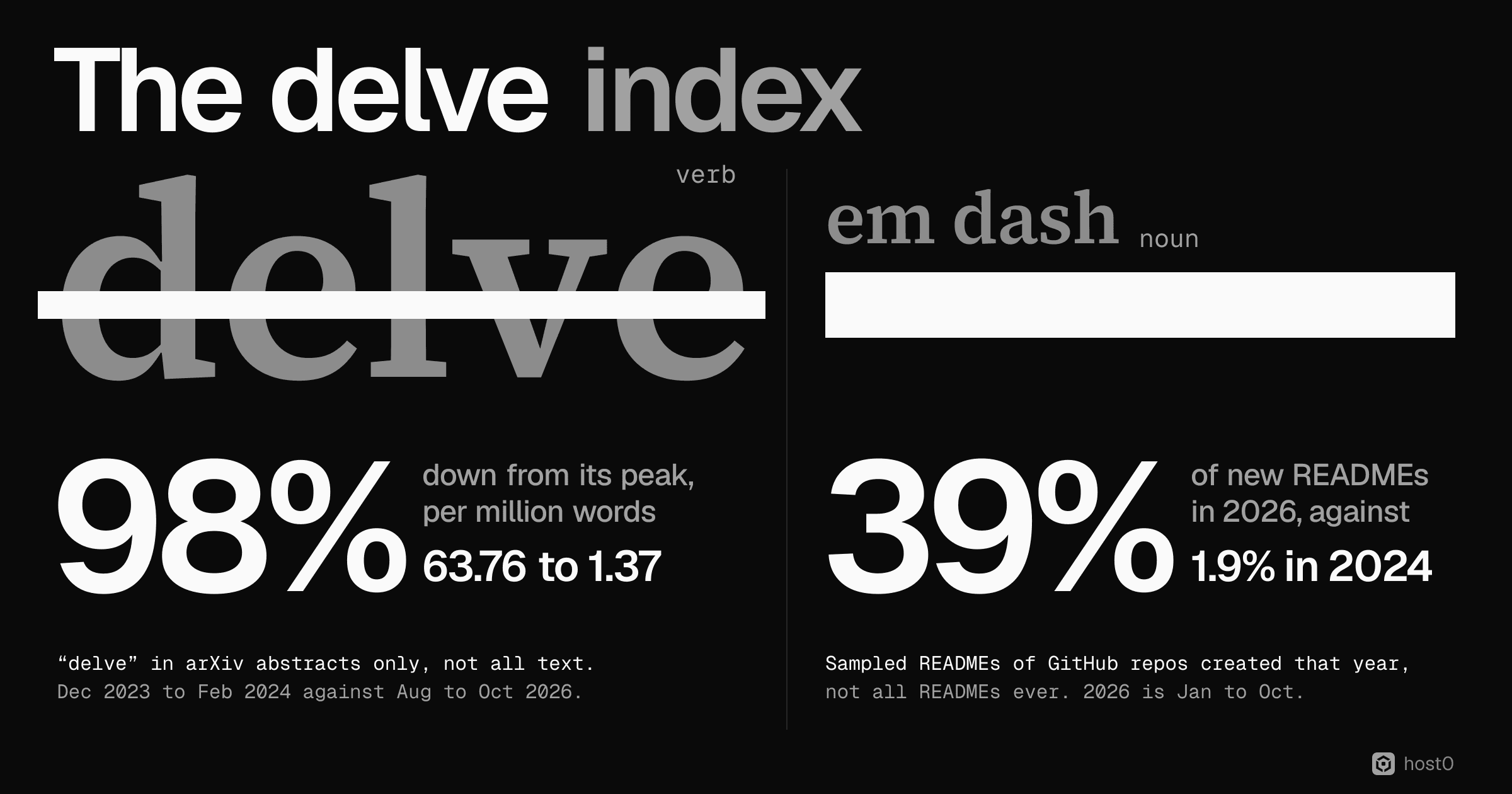
For about a year, "delve" was the word people pointed at when they suspected a chatbot. They had a case. From December 2023 to February 2024 it appeared 595 times in 9.33M words of new arXiv abstracts: 63.76 per million, about 21 times its rate before ChatGPT. From August to October 2026 it appeared 29 times in 21.22M words. That's 1.37 per million, down 98% from the peak and 0.45× the 3.06 per million of January 2019 to October 2022.
Geng and Trotta already showed delve falling on arXiv in data through 2024. We wanted to know what happened to the rest of the vocabulary, so we wrote down a list of 31 words before counting anything, and ran it over arXiv abstracts, Hacker News comments and the READMEs of GitHub repos, through October 2026. We later took one word out, so the headline list is the other 30; here's why, with both versions. We looked for a cross-platform version of this and we didn't find one. The list is back near its pre-ChatGPT rate, but read that as suggestive: on arXiv ordinary control words moved as far, and on Hacker News the later fall may partly be moderation. These are word-frequency markers: they don't detect AI text, we don't estimate how much text AI wrote, and falling markers don't mean falling AI use. The methodology explains how we counted, and where the method falls short.
Key findings
- 1"Delve" on arXiv is down 98% from its peak. 63.76 per million words (Dec 2023 to Feb 2024) to 1.37 (Aug to Oct 2026), a ratio of 0.021 with a 95% interval of 0.012 to 0.031. That's 0.45× its pre-ChatGPT rate. The 98% is arXiv only.
- 2A list of 30 AI-linked words is back near its pre-ChatGPT rate on all three platforms, which is suggestive rather than proven. arXiv went 2,335 → 5,858 (2025) → 1,969, or 0.84×. READMEs went 871 → 2,770 (2024) → 643, or 0.74×. Hacker News, where the rise was small, went 594 → 673 (2024) → 601, or 1.01×. We registered 31 words and removed
harnessafter seeing its result; with it in, Hacker News is 1.29×, which isn't near. On arXiv the return doesn't clear a strict placebo (finding 5). On Hacker News, dead comments went from 2.57% in 2025 to 5.67% from March 2026, so some of its fall may be removal. - 3It happened in two phases. From 2024 to 2025, arXiv's delve fell 77% while the list kept rising: later words took over from earlier ones. In 2026 nearly every word on the list falls.
- 434 of 40 registered markers on arXiv peaked and fell, against 8 of 30 control words. On Hacker News it's 15 of 40 against 1 of 30. Same rule, no selection.
- 5The arXiv controls moved too. Ordinary words ended anywhere from 0.32× to 3.2× their baseline in 2026, so the list's 0.84× doesn't clear a strict placebo. Delve's rise and fall do, and so does "genuinely".
- 6Exploratory: the em dash. In our sample of READMEs of GitHub repos created from January to October 2026, read as they stood 30 days after creation, 39.0% contain an em dash (34.6% across all repos, 44.5% among repos with at least one star). For 2024 repos it's 1.9%.
- 7Exploratory: "genuinely". Up 6.2× on arXiv and 1.9× on Hacker News, both clear of the controls, and from 3 uses to 29 in READMEs. It's the one registered word that isn't a topic word and is up on all three. It has started to slip.
- 8On Hacker News, delve isn't a few accounts, and in 2026 about half of it isn't the ordinary word. The top 10 authors hold 4 to 9% of uses every year. In a hand check, ordinary use went from 93.8% before ChatGPT to 52.5% in 2026 (63 of 120, interval 43.6% to 61.2%); the rest is names, quotes and people talking about the word, helped that year by one startup's news.
−98%
"Delve" in arXiv abstracts, peak (Dec 2023 to Feb 2024) to Aug to Oct 2026. arXiv only
Source: host0 analysis of arXiv abstracts
0.84×
The list of 30 on arXiv against its pre-ChatGPT rate, inside the range of the control words. Hacker News 1.01×, GitHub READMEs 0.74×
Source: host0 analysis
34 of 40
Registered markers on arXiv that peaked and fell, against 8 of 30 control words
Source: host0 analysis
39.0%
Sampled READMEs of GitHub repos created Jan to Oct 2026 with an em dash, at 30 days old. Exploratory
Source: host0 analysis
Delve on arXiv rose about 21×, then fell 98%#
We count every form of the word (delve, delves, delved, delving) in every field, and date each paper by its arXiv id. "Per million words", or ppm, is the unit throughout. The baseline is January 2019 to October 2022, which stops before ChatGPT's launch on 30 November 2022.
"Delve" in arXiv abstracts
Uses per million words, centred 3-month rate, all fields, Jan 2019 to Oct 2026
| x | y |
|---|---|
| Feb 2019 | 0.91 |
| Mar 2019 | 0.69 |
| Apr 2019 | 1.14 |
| May 2019 | 0.98 |
| Jun 2019 | 1.13 |
| Jul 2019 | 0.84 |
| Aug 2019 | 1.3 |
| Sep 2019 | 0.95 |
| Oct 2019 | 0.92 |
| Nov 2019 | 1.85 |
| Dec 2019 | 2.96 |
| Jan 2020 | 3.98 |
| Feb 2020 | 3.06 |
| Mar 2020 | 2.68 |
| Apr 2020 | 2 |
| May 2020 | 2.27 |
| Jun 2020 | 2.32 |
| Jul 2020 | 2.35 |
| Aug 2020 | 3.42 |
| Sep 2020 | 3.28 |
| Oct 2020 | 3.58 |
| Nov 2020 | 2.33 |
| Dec 2020 | 2.53 |
| Jan 2021 | 2.18 |
| Feb 2021 | 4.06 |
| Mar 2021 | 4.66 |
| Apr 2021 | 4.5 |
| May 2021 | 3.15 |
| Jun 2021 | 2.9 |
| Jul 2021 | 3.24 |
| Aug 2021 | 2.9 |
| Sep 2021 | 2.01 |
| Oct 2021 | 2.59 |
| Nov 2021 | 3.73 |
| Dec 2021 | 4.48 |
| Jan 2022 | 5.07 |
| Feb 2022 | 5.01 |
| Mar 2022 | 5.05 |
| Apr 2022 | 4.07 |
| May 2022 | 3.43 |
| Jun 2022 | 3.38 |
| Jul 2022 | 3.98 |
| Aug 2022 | 5.55 |
| Sep 2022 | 5.86 |
| Oct 2022 | 6.08 |
| Nov 2022 | 4.98 |
| Dec 2022 | 5.64 |
| Jan 2023 | 5.93 |
| Feb 2023 | 7.25 |
| Mar 2023 | 8.67 |
| Apr 2023 | 11.38 |
| May 2023 | 16.14 |
| Jun 2023 | 18.92 |
| Jul 2023 | 26.84 |
| Aug 2023 | 34.98 |
| Sep 2023 | 45.17 |
| Oct 2023 | 52.52 |
| Nov 2023 | 58.83 |
| Dec 2023 | 63.61 |
| Jan 2024 | 63.76 (63.76 · Dec 2023 to Feb 2024) |
| Feb 2024 | 62.94 |
| Mar 2024 | 61.32 |
| Apr 2024 | 58.47 |
| May 2024 | 51.49 |
| Jun 2024 | 48.62 |
| Jul 2024 | 44.61 |
| Aug 2024 | 41.18 |
| Sep 2024 | 33.96 |
| Oct 2024 | 29.96 |
| Nov 2024 | 28.4 |
| Dec 2024 | 25.37 |
| Jan 2025 | 22.36 |
| Feb 2025 | 17.4 |
| Mar 2025 | 15.85 |
| Apr 2025 | 13.86 |
| May 2025 | 13.4 |
| Jun 2025 | 10.79 |
| Jul 2025 | 9.01 |
| Aug 2025 | 6.06 |
| Sep 2025 | 5.88 |
| Oct 2025 | 5.67 |
| Nov 2025 | 5.7 |
| Dec 2025 | 4.87 |
| Jan 2026 | 4.09 |
| Feb 2026 | 3.8 |
| Mar 2026 | 2.45 |
| Apr 2026 | 2.03 |
| May 2026 | 1.85 |
| Jun 2026 | 2.09 |
| Jul 2026 | 1.86 |
| Aug 2026 | 1.17 |
| Sep 2026 | 1.37 |
Source: host0 analysis of 1.75M arXiv abstracts
The count includes the DELVE astronomy survey, in capitals. Lowercase only tells the same story: 2.65 in the baseline, 44.6 in 2024, 0.99 in the latest window. A peak is the highest of many windows, so it's biased up a little; read the 98% with its interval, a ratio of 0.012 to 0.031.
It wasn't only computer science. At its peak, delve ran 15.6× its baseline in AI-type categories, 29× in other CS, 20.9× in physics, 23.7× in math, 28.7× in statistics and 34.8× in electrical engineering. Levels differ (108 ppm at the peak in other CS, 46 in physics, 37 in math), and the small fields have small counts, but the rate fell in all of them: the latest window is 0.5% to 5.4% of the peak where the counts allow a number.
Hacker News fell too, by a smaller amount. By our registered rule delve peaked and fell there, from 7.26 ppm (330 uses, centred on May 2024) to 2.61 (133 uses), a ratio of 0.36 with an interval of 0.29 to 0.44. That's 0.86× its baseline of 3.04. On Show HN (9 uses at the peak, 4 in the latest window) and GitHub READMEs (19 uses in 5.4M words, none in the latest window) the word is too rare to claim anything.
The whole list is back near where it started#
One word can fall for its own reasons, so the test that matters is a list. Ours comes from Wikipedia's advice page on signs of AI writing and the published literature, and we wrote it down before counting, except that one registered word came out later (see below): delve, tapestry, meticulous, intricate, pivotal, underscore, realm, leverage, robust, testament, garner, boast, fostering, showcasing, enhance, align with, emphasizing, highlighting, multifaceted, prioritize, crucial, landscape, vibrant, interplay, seamless, comprehensive, nuanced, navigate, genuinely and significant. The same 30 words and the same tokenizer run on every platform, and each platform is compared only with its own past. Levels between platforms reflect genre, so arXiv's 1,969 against Hacker News's 601 says nothing about who uses more AI.
The list of 30, against each platform's own pre-ChatGPT rate
Rate as a multiple of the Jan 2019 to Oct 2022 rate, by year, then the latest window
| Series | x | y |
|---|---|---|
| arXiv abstracts | 2019 | 0.89× |
| arXiv abstracts | 2020 | 0.97× |
| arXiv abstracts | 2021 | 1.03× |
| arXiv abstracts | 2022 | 1.11× |
| arXiv abstracts | 2023 | 1.61× |
| arXiv abstracts | 2024 | 2.4× |
| arXiv abstracts | 2025 | 2.51× |
| arXiv abstracts | Sep 2026 | 0.84× |
| Hacker News comments | 2019 | 0.99× |
| Hacker News comments | 2020 | 1.02× |
| Hacker News comments | 2021 | 1× |
| Hacker News comments | 2022 | 0.99× |
| Hacker News comments | 2023 | 1.06× |
| Hacker News comments | 2024 | 1.13× |
| Hacker News comments | 2025 | 1.13× |
| Hacker News comments | Sep 2026 | 1.01× |
| GitHub READMEs | 2019 | 0.98× |
| GitHub READMEs | 2020 | 1.04× |
| GitHub READMEs | 2021 | 1.1× |
| GitHub READMEs | 2022 | 0.9× |
| GitHub READMEs | 2023 | 2.01× |
| GitHub READMEs | 2024 | 3.18× |
| GitHub READMEs | 2025 | 3.08× |
| GitHub READMEs | Sep 2026 | 0.74× |
Source: host0 analysis of arXiv, Hacker News and a GitHub sample
We say "near" on purpose, because the answer depends on how you summarise the list. The median word, among those with at least 20 baseline uses (28, 30 and 16 words), sits at 0.88× on arXiv, 0.93× on Hacker News and 0.87× on READMEs. Drop the three most common words and it's 0.99×, 0.99× and 1.08×. Hold arXiv's field mix at its baseline shares and it's 0.85×; use only papers with one version, so the abstract is what was first submitted, and it's 0.86×. Physics alone is 1.10×. The honest summary is "back to roughly where it was". The 95% intervals on the latest rates are 1,945 to 1,993 on arXiv, 591 to 612 on Hacker News and 517 to 784 on READMEs.
READMEs are the shakiest of the three. July to September alone is 799 ppm (0.92×), and October, with under 30 days of history, is 469. READMEs also got longer, so the share with at least one listed word is up (14.9% to 23.8%), though among READMEs of 300 words or fewer it barely moves (10.6% to 11.4%). And on arXiv this return is suggestive, not proven, because ordinary words moved as far.
Hacker News deserves its own shape, because it never had the climb. Its comments moved 13% at most on a yearly view, and the fall since then may have a separate cause, which we get to later.
The list of 30 on Hacker News
Uses per million words in comments, monthly, Jan 2019 to Oct 2026
| x | y |
|---|---|
| Jan 2019 | 590 |
| Feb 2019 | 580 |
| Mar 2019 | 577 |
| Apr 2019 | 605 |
| May 2019 | 593 |
| Jun 2019 | 585 |
| Jul 2019 | 583 |
| Aug 2019 | 592 |
| Sep 2019 | 573 |
| Oct 2019 | 576 |
| Nov 2019 | 588 |
| Dec 2019 | 584 |
| Jan 2020 | 611 |
| Feb 2020 | 588 |
| Mar 2020 | 610 |
| Apr 2020 | 612 |
| May 2020 | 603 |
| Jun 2020 | 610 |
| Jul 2020 | 608 |
| Aug 2020 | 606 |
| Sep 2020 | 584 |
| Oct 2020 | 579 |
| Nov 2020 | 610 |
| Dec 2020 | 611 |
| Jan 2021 | 597 |
| Feb 2021 | 590 |
| Mar 2021 | 600 |
| Apr 2021 | 577 |
| May 2021 | 589 |
| Jun 2021 | 585 |
| Jul 2021 | 586 |
| Aug 2021 | 595 |
| Sep 2021 | 617 |
| Oct 2021 | 599 |
| Nov 2021 | 615 |
| Dec 2021 | 587 |
| Jan 2022 | 586 |
| Feb 2022 | 582 |
| Mar 2022 | 589 |
| Apr 2022 | 596 |
| May 2022 | 606 |
| Jun 2022 | 594 |
| Jul 2022 | 579 |
| Aug 2022 | 595 |
| Sep 2022 | 586 |
| Oct 2022 | 586 |
| Nov 2022 | 591 |
| Dec 2022 | 590 |
| Jan 2023 | 592 |
| Feb 2023 | 606 |
| Mar 2023 | 597 |
| Apr 2023 | 622 |
| May 2023 | 660 |
| Jun 2023 | 641 |
| Jul 2023 | 642 |
| Aug 2023 | 626 |
| Sep 2023 | 635 |
| Oct 2023 | 646 |
| Nov 2023 | 655 |
| Dec 2023 | 652 |
| Jan 2024 | 652 |
| Feb 2024 | 669 |
| Mar 2024 | 675 |
| Apr 2024 | 667 |
| May 2024 | 674 |
| Jun 2024 | 674 |
| Jul 2024 | 667 |
| Aug 2024 | 667 |
| Sep 2024 | 681 |
| Oct 2024 | 688 |
| Nov 2024 | 690 (690 · Nov 2024) |
| Dec 2024 | 683 |
| Jan 2025 | 681 |
| Feb 2025 | 652 |
| Mar 2025 | 689 |
| Apr 2025 | 664 |
| May 2025 | 673 |
| Jun 2025 | 672 |
| Jul 2025 | 686 |
| Aug 2025 | 662 |
| Sep 2025 | 664 |
| Oct 2025 | 654 |
| Nov 2025 | 651 |
| Dec 2025 | 674 |
| Jan 2026 | 675 |
| Feb 2026 | 672 |
| Mar 2026 | 651 |
| Apr 2026 | 636 |
| May 2026 | 629 |
| Jun 2026 | 622 |
| Jul 2026 | 634 |
| Aug 2026 | 630 |
| Sep 2026 | 595 |
| Oct 2026 | 579 |
Source: host0 analysis of 26.7M Hacker News comments
Show HN posts tell a sharper story but a less certain one. There the list fell 69% from 2024, from 1,779 ppm (1,687 to 1,874) to 555 (508 to 604). We can't compare it with the baseline: before about 2022 the dataset's Show HN records are mostly titles, so any index against those years is inflated.
Why 30 words and not 31#
Our registration lists 31 words in these groups. It doesn't define a list-level number at all; we added that summary afterwards, and we took one word out after seeing its result, so this is a departure from what we registered. The word is harness, and it turned out to be a topic: agent harnesses. On arXiv it went from 25 to 437 ppm in AI-type categories between January 2022 and October 2026, while staying flat in physics (14 to 19) and math (3 to 3). With it back in, the three platforms read 0.90×, 1.29× and 1.04×. The median word index is 0.88×, 0.93× and 0.87× without it, and 0.93×, 0.93× and 0.87× with it, so you can decide for yourself.
How much the answer depends on one word
Latest rate as a multiple of the pre-ChatGPT rate, three ways of summarising the list
| Label | Value |
|---|---|
| arXiv, list of 30 | 0.84× |
| arXiv, with harness | 0.90× |
| arXiv, median word | 0.88× |
| Hacker News, list of 30 | 1.01× |
| Hacker News, with harness | 1.29× |
| Hacker News, median word | 0.93× |
| READMEs, list of 30 | 0.74× |
| READMEs, with harness | 1.04× |
| READMEs, median word | 0.87× |
Source: host0 analysis
Two phases: a swap, then a fall#
Did delve fall while the other words rose? Yes, and then no. Harness aside, a list written down in advance is what lets us say so without picking the words afterwards.
2024 to 2025 was a swap. On arXiv, delve fell 77%, from 45.4 ppm to 10.4, while the list kept rising, from 5,612 to 5,858. The words that peaked first were the ones reported first.
When each era's words peaked on arXiv
Median peak month of the words in each registered group
Oct 2023
Oct 2023
Words reported for 2023 to mid-2024
Testament, garner, boast.Mar 2024
Mar 2024
The core five
Delve, tapestry, meticulous, intricate, pivotal.Mar 2025
Mar 2025
Words reported for mid-2024 to mid-2025
Fostering, showcasing, enhance, align with.May 2025
May 2025
Words reported from mid-2025
Emphasizing, highlighting, multifaceted, prioritize.
Source: host0 analysis of arXiv abstracts
2026 is when nearly every word on the list falls. The list on arXiv dropped from 6,533 ppm in March 2025, its monthly high, to 1,711 in October 2026. It fell in AI-type categories, other CS, physics and math alike.
The list of 30 on arXiv
Uses per million words in abstracts, monthly, Jan 2019 to Oct 2026
| x | y |
|---|---|
| Jan 2019 | 1,889 |
| Feb 2019 | 1,981 |
| Mar 2019 | 2,016 |
| Apr 2019 | 2,008 |
| May 2019 | 2,110 |
| Jun 2019 | 2,218 |
| Jul 2019 | 2,037 |
| Aug 2019 | 2,040 |
| Sep 2019 | 2,143 |
| Oct 2019 | 2,118 |
| Nov 2019 | 2,174 |
| Dec 2019 | 2,168 |
| Jan 2020 | 2,058 |
| Feb 2020 | 2,132 |
| Mar 2020 | 2,219 |
| Apr 2020 | 2,204 |
| May 2020 | 2,196 |
| Jun 2020 | 2,336 |
| Jul 2020 | 2,290 |
| Aug 2020 | 2,288 |
| Sep 2020 | 2,264 |
| Oct 2020 | 2,380 |
| Nov 2020 | 2,325 |
| Dec 2020 | 2,347 |
| Jan 2021 | 2,251 |
| Feb 2021 | 2,329 |
| Mar 2021 | 2,470 |
| Apr 2021 | 2,467 |
| May 2021 | 2,370 |
| Jun 2021 | 2,446 |
| Jul 2021 | 2,321 |
| Aug 2021 | 2,391 |
| Sep 2021 | 2,495 |
| Oct 2021 | 2,482 |
| Nov 2021 | 2,423 |
| Dec 2021 | 2,411 |
| Jan 2022 | 2,433 |
| Feb 2022 | 2,452 |
| Mar 2022 | 2,618 |
| Apr 2022 | 2,555 |
| May 2022 | 2,561 |
| Jun 2022 | 2,595 |
| Jul 2022 | 2,560 |
| Aug 2022 | 2,550 |
| Sep 2022 | 2,607 |
| Oct 2022 | 2,755 |
| Nov 2022 | 2,728 |
| Dec 2022 | 2,584 |
| Jan 2023 | 2,637 |
| Feb 2023 | 2,773 |
| Mar 2023 | 2,959 |
| Apr 2023 | 3,157 |
| May 2023 | 3,551 |
| Jun 2023 | 3,653 |
| Jul 2023 | 3,562 |
| Aug 2023 | 4,130 |
| Sep 2023 | 4,113 |
| Oct 2023 | 4,422 |
| Nov 2023 | 4,692 |
| Dec 2023 | 4,737 |
| Jan 2024 | 4,759 |
| Feb 2024 | 5,086 |
| Mar 2024 | 5,452 |
| Apr 2024 | 5,321 |
| May 2024 | 5,344 |
| Jun 2024 | 5,623 |
| Jul 2024 | 5,677 |
| Aug 2024 | 5,856 |
| Sep 2024 | 5,869 |
| Oct 2024 | 5,978 |
| Nov 2024 | 5,922 |
| Dec 2024 | 6,261 |
| Jan 2025 | 6,155 |
| Feb 2025 | 6,495 |
| Mar 2025 | 6,533 (6,533 · Mar 2025) |
| Apr 2025 | 6,200 |
| May 2025 | 6,397 |
| Jun 2025 | 6,204 |
| Jul 2025 | 5,879 |
| Aug 2025 | 6,019 |
| Sep 2025 | 5,583 |
| Oct 2025 | 5,269 |
| Nov 2025 | 5,151 |
| Dec 2025 | 4,743 |
| Jan 2026 | 4,723 |
| Feb 2026 | 4,398 |
| Mar 2026 | 4,203 |
| Apr 2026 | 3,920 |
| May 2026 | 3,290 |
| Jun 2026 | 3,090 |
| Jul 2026 | 2,691 |
| Aug 2026 | 2,308 |
| Sep 2026 | 1,978 |
| Oct 2026 | 1,711 |
Source: host0 analysis of 1.75M arXiv abstracts
Put the two lines on one chart and the swap is easy to see. Delve turned in early 2024. The list carried on for another year.
Delve and the list of 30 on arXiv
Each as a multiple of its own pre-ChatGPT rate, centred 3-month rate, log scale, Jan 2022 to Oct 2026
| Series | x | y |
|---|---|---|
| Delve | Jan 2022 | 1.66× |
| Delve | Feb 2022 | 1.64× |
| Delve | Mar 2022 | 1.65× |
| Delve | Apr 2022 | 1.33× |
| Delve | May 2022 | 1.12× |
| Delve | Jun 2022 | 1.11× |
| Delve | Jul 2022 | 1.3× |
| Delve | Aug 2022 | 1.82× |
| Delve | Sep 2022 | 1.92× |
| Delve | Oct 2022 | 1.99× |
| Delve | Nov 2022 | 1.63× |
| Delve | Dec 2022 | 1.84× |
| Delve | Jan 2023 | 1.94× |
| Delve | Feb 2023 | 2.37× |
| Delve | Mar 2023 | 2.83× |
| Delve | Apr 2023 | 3.72× |
| Delve | May 2023 | 5.28× |
| Delve | Jun 2023 | 6.18× |
| Delve | Jul 2023 | 8.77× |
| Delve | Aug 2023 | 11.44× |
| Delve | Sep 2023 | 14.77× |
| Delve | Oct 2023 | 17.17× |
| Delve | Nov 2023 | 19.23× |
| Delve | Dec 2023 | 20.8× |
| Delve | Jan 2024 | 20.84× (20.8× · Jan 2024) |
| Delve | Feb 2024 | 20.58× |
| Delve | Mar 2024 | 20.05× |
| Delve | Apr 2024 | 19.11× |
| Delve | May 2024 | 16.83× |
| Delve | Jun 2024 | 15.9× |
| Delve | Jul 2024 | 14.58× |
| Delve | Aug 2024 | 13.46× |
| Delve | Sep 2024 | 11.1× |
| Delve | Oct 2024 | 9.79× |
| Delve | Nov 2024 | 9.29× |
| Delve | Dec 2024 | 8.29× |
| Delve | Jan 2025 | 7.31× |
| Delve | Feb 2025 | 5.69× |
| Delve | Mar 2025 | 5.18× |
| Delve | Apr 2025 | 4.53× |
| Delve | May 2025 | 4.38× |
| Delve | Jun 2025 | 3.53× |
| Delve | Jul 2025 | 2.95× |
| Delve | Aug 2025 | 1.98× |
| Delve | Sep 2025 | 1.92× |
| Delve | Oct 2025 | 1.85× |
| Delve | Nov 2025 | 1.86× |
| Delve | Dec 2025 | 1.59× |
| Delve | Jan 2026 | 1.34× |
| Delve | Feb 2026 | 1.24× |
| Delve | Mar 2026 | 0.8× |
| Delve | Apr 2026 | 0.66× |
| Delve | May 2026 | 0.6× |
| Delve | Jun 2026 | 0.68× |
| Delve | Jul 2026 | 0.61× |
| Delve | Aug 2026 | 0.38× |
| Delve | Sep 2026 | 0.45× |
| List of 30 | Jan 2022 | 1.04× |
| List of 30 | Feb 2022 | 1.08× |
| List of 30 | Mar 2022 | 1.09× |
| List of 30 | Apr 2022 | 1.1× |
| List of 30 | May 2022 | 1.1× |
| List of 30 | Jun 2022 | 1.1× |
| List of 30 | Jul 2022 | 1.1× |
| List of 30 | Aug 2022 | 1.1× |
| List of 30 | Sep 2022 | 1.13× |
| List of 30 | Oct 2022 | 1.16× |
| List of 30 | Nov 2022 | 1.15× |
| List of 30 | Dec 2022 | 1.14× |
| List of 30 | Jan 2023 | 1.14× |
| List of 30 | Feb 2023 | 1.2× |
| List of 30 | Mar 2023 | 1.27× |
| List of 30 | Apr 2023 | 1.39× |
| List of 30 | May 2023 | 1.49× |
| List of 30 | Jun 2023 | 1.54× |
| List of 30 | Jul 2023 | 1.62× |
| List of 30 | Aug 2023 | 1.69× |
| List of 30 | Sep 2023 | 1.81× |
| List of 30 | Oct 2023 | 1.89× |
| List of 30 | Nov 2023 | 1.97× |
| List of 30 | Dec 2023 | 2.03× |
| List of 30 | Jan 2024 | 2.08× |
| List of 30 | Feb 2024 | 2.19× |
| List of 30 | Mar 2024 | 2.27× |
| List of 30 | Apr 2024 | 2.3× |
| List of 30 | May 2024 | 2.32× |
| List of 30 | Jun 2024 | 2.38× |
| List of 30 | Jul 2024 | 2.45× |
| List of 30 | Aug 2024 | 2.48× |
| List of 30 | Sep 2024 | 2.53× |
| List of 30 | Oct 2024 | 2.54× |
| List of 30 | Nov 2024 | 2.59× |
| List of 30 | Dec 2024 | 2.62× |
| List of 30 | Jan 2025 | 2.7× |
| List of 30 | Feb 2025 | 2.74× |
| List of 30 | Mar 2025 | 2.75× (2.75× · Mar 2025) |
| List of 30 | Apr 2025 | 2.73× |
| List of 30 | May 2025 | 2.69× |
| List of 30 | Jun 2025 | 2.64× |
| List of 30 | Jul 2025 | 2.58× |
| List of 30 | Aug 2025 | 2.49× |
| List of 30 | Sep 2025 | 2.4× |
| List of 30 | Oct 2025 | 2.29× |
| List of 30 | Nov 2025 | 2.17× |
| List of 30 | Dec 2025 | 2.09× |
| List of 30 | Jan 2026 | 1.98× |
| List of 30 | Feb 2026 | 1.89× |
| List of 30 | Mar 2026 | 1.78× |
| List of 30 | Apr 2026 | 1.62× |
| List of 30 | May 2026 | 1.46× |
| List of 30 | Jun 2026 | 1.3× |
| List of 30 | Jul 2026 | 1.16× |
| List of 30 | Aug 2026 | 0.98× |
| List of 30 | Sep 2026 | 0.84× |
Source: host0 analysis of arXiv abstracts
Word by word, on arXiv: "significant" went from 1,611 ppm to 462, now 0.58× its baseline. "Crucial" went from 427 to 102, or 0.59×. "Enhance" went from 1,232 to 273, or 0.93×. Geng and Trotta reported that "significant" kept rising in their data through 2024. That's right for their window: it kept rising until about February 2025, and this is what happened next.
Not everything has come all the way back. "Align with" is still at 3.3× on arXiv, "prioritize" at 3.1× and "underscore" at 4.6×, though all three are off their own peaks.
How many words peaked and fell, by the registered rule
Share of words whose latest rate is at most 2/3 of their peak, with 95% intervals apart
| Label | Value |
|---|---|
| arXiv, markers | 34 of 40 |
| arXiv, controls | 8 of 30 |
| Hacker News, markers | 15 of 40 |
| Hacker News, controls | 1 of 30 |
| Show HN, markers | 25 of 40 |
| Show HN, controls | 2 of 30 |
| GitHub, markers | 15 of 40 (23 inconclusive) |
| GitHub, controls | 1 of 30 |
Source: host0 analysis
Why did it fall? We can't say. Model updates, people editing out known tells and fear of detectors all fit, and our data can't separate them. Geng and Trotta read the early drop as writers adapting: choosing among outputs or changing them. That's their reading, of their data through 2024. Nothing here measures how much anyone uses AI.
The controls moved too#
We counted 30 ordinary word families alongside the markers, in three frequency bands, to see how much a word moves when nothing in particular is happening to it. On Hacker News the answer is reassuring: the median control is at 1.01×, with a range of 0.82× to 1.34×. On arXiv it isn't. The median is 1.11×, but the range runs from 0.32× to 3.2×.
Ordinary words on arXiv moved as far as the markers did
Latest rate (Aug to Oct 2026) as a multiple of the pre-ChatGPT rate, selected controls with delve and the list
| Label | Value |
|---|---|
| never | 3.20× |
| remember | 3.07× |
| cheap | 2.81× |
| before | 2.65× |
| because | 1.47× |
| List of 30 | 0.84× |
| Delve | 0.45× |
| somewhat | 0.37× |
| obvious | 0.36× |
| puzzled | 0.32× |
Source: host0 analysis of arXiv abstracts
So arXiv's general vocabulary shifted in 2026, plain words included, and we have to say so plainly: the list's return to 0.84× doesn't clear a strict placebo on arXiv. A word like "before" moved further than the list did. These do clear it: delve's rise (20.8× at the peak, against a control maximum of 4.5×), delve's fall (latest over peak of 0.021, against 0.123 for the lowest control) and the rise of "genuinely". A March 2026 paper by Geng, Dong and Poibeau also reports shifts in ordinary function words on arXiv, such as "beyond" and "via" rising in titles and "the" and "of" falling in abstracts, which they consider likely to be LLM-driven. Abstracts have also grown, from about 162 words in our baseline to 188 in October 2026. We don't know why the plain words moved, so we list it under open questions.
Who says it on Hacker News#
It isn't a few accounts or an obvious bot farm. In every year, the top 10 authors hold 4 to 9% of "delve" uses and the top 1% hold 3 to 6%. A control word with a similar count, "clumsy", looks the same (the top 10 hold 6 to 11%). We looked at these only as aggregates, and our data contains no usernames.
Newer accounts do over-index, and the gap is shrinking. This cut is exploratory: we added it after seeing results.
Older accounts moved too, in another exploratory cut using 1 author in 5. "Genuinely" among accounts that were already active before ChatGPT went from 41.4 ppm in 2021 to 76.9 in July to October 2026. Among newer accounts it's 92.1. So it isn't only new accounts.
Hacker News changed its rules in March 2026#
Anything that falls on Hacker News after March 2026 comes with a caveat. The site's guidelines now say "Don't post generated text or AI-edited text." Reading the moderators' own statements in the public dataset, they said on 8 March that Show HN would be restricted for new accounts for a while, and on 11 March that the rule on generated comments had moved from moderation practice into the written guidelines, and that accounts breaking it were being banned. By their account the rule itself wasn't new; writing it down and limiting Show HN were. We link the thread and name nobody.
Dead comments on Hacker News
Share of all comments marked dead, monthly, Jan 2024 to Oct 2026
| x | y |
|---|---|
| Jan 2024 | 2% |
| Feb 2024 | 2% |
| Mar 2024 | 2.3% |
| Apr 2024 | 4.4% |
| May 2024 | 2.1% |
| Jun 2024 | 2.3% |
| Jul 2024 | 2.7% |
| Aug 2024 | 2.6% |
| Sep 2024 | 2.6% |
| Oct 2024 | 2.1% |
| Nov 2024 | 2.6% |
| Dec 2024 | 2.6% |
| Jan 2025 | 2.4% |
| Feb 2025 | 2.8% |
| Mar 2025 | 3.2% |
| Apr 2025 | 2.8% |
| May 2025 | 2.7% |
| Jun 2025 | 2.7% |
| Jul 2025 | 2.5% |
| Aug 2025 | 2.2% |
| Sep 2025 | 2.8% |
| Oct 2025 | 2.3% |
| Nov 2025 | 2.4% |
| Dec 2025 | 2.2% |
| Jan 2026 | 2.8% |
| Feb 2026 | 3.4% |
| Mar 2026 | 5.6% (5.6% · Mar 2026) |
| Apr 2026 | 5.8% |
| May 2026 | 5.6% |
| Jun 2026 | 5.4% |
| Jul 2026 | 5.4% |
| Aug 2026 | 5.7% |
| Sep 2026 | 5.6% |
| Oct 2026 | 6.2% |
Source: host0 analysis of Hacker News comments
Em dashes on Hacker News went up and then back down, with a peak just before the rule took effect.
Em dashes in Hacker News comments
Uses per million words, monthly, Jan 2022 to Oct 2026
| x | y |
|---|---|
| Jan 2022 | 215 |
| Feb 2022 | 215 |
| Mar 2022 | 208 |
| Apr 2022 | 231 |
| May 2022 | 217 |
| Jun 2022 | 229 |
| Jul 2022 | 231 |
| Aug 2022 | 207 |
| Sep 2022 | 211 |
| Oct 2022 | 218 |
| Nov 2022 | 220 |
| Dec 2022 | 228 |
| Jan 2023 | 219 |
| Feb 2023 | 218 |
| Mar 2023 | 234 |
| Apr 2023 | 236 |
| May 2023 | 247 |
| Jun 2023 | 226 |
| Jul 2023 | 237 |
| Aug 2023 | 220 |
| Sep 2023 | 235 |
| Oct 2023 | 233 |
| Nov 2023 | 237 |
| Dec 2023 | 230 |
| Jan 2024 | 248 |
| Feb 2024 | 244 |
| Mar 2024 | 240 |
| Apr 2024 | 250 |
| May 2024 | 269 |
| Jun 2024 | 252 |
| Jul 2024 | 258 |
| Aug 2024 | 263 |
| Sep 2024 | 283 |
| Oct 2024 | 292 |
| Nov 2024 | 313 |
| Dec 2024 | 340 |
| Jan 2025 | 309 |
| Feb 2025 | 367 |
| Mar 2025 | 395 |
| Apr 2025 | 457 |
| May 2025 | 450 |
| Jun 2025 | 433 |
| Jul 2025 | 461 |
| Aug 2025 | 413 |
| Sep 2025 | 366 |
| Oct 2025 | 383 |
| Nov 2025 | 361 |
| Dec 2025 | 368 |
| Jan 2026 | 359 |
| Feb 2026 | 589 (589 · Feb 2026) |
| Mar 2026 | 537 |
| Apr 2026 | 379 |
| May 2026 | 285 |
| Jun 2026 | 273 |
| Jul 2026 | 292 |
| Aug 2026 | 281 |
| Sep 2026 | 251 |
| Oct 2026 | 211 |
Source: host0 analysis of Hacker News comments
Show HN fell harder. Em dashes there went from 3,491 ppm in the first quarter of 2026 (6,245 in 1.79M words) to 244 in October, as posts went from 2,408 in October 2025 to 6,215 in February 2026 and 2,641 in May, then back to 4,241 in October, and the share of posts with body text fell from about 70% to 38%.
So a fall on Hacker News after March 2026 may be removal rather than changed writing, and we can't separate the two. The timing lines up. We can't say the rule caused it, because the comments that were removed can't be read.
Where the tell went: the em dash and genuinely#
Everything in this section is exploratory. The em dash and "genuinely" are both in our registered list, but the README document share and the decision to single these two out came after we'd seen results. Treat them as leads.
Start with the em dash (—). In our sample of READMEs of GitHub repos created from January to October 2026, 39.0% contain one: 841 of 2,156, with a 95% interval of 37.0% to 41.1%. For repos created in 2024 it's 1.9% (38 of 1,984), and for 2022 it's 0.6% (11 of 1,734). "New" here means each README as it stood 30 days after the repo was created. This isn't a rate for GitHub as a whole, because it pools two sampling strata: all repos (34.6% in 2026, 1.8% in 2024) and repos with at least one star (44.5% in 2026, 2.0% in 2024).
Sampled READMEs that contain an em dash
By the year the repo was created; each README as it stood 30 days after creation; 2026 is Jan to Oct
| Label | Value |
|---|---|
| 2019 | 2.1% (87 of 4,099) |
| 2020 | 1.1% (17 of 1,543) |
| 2021 | 1.1% (19 of 1,742) |
| 2022 | 0.6% (11 of 1,734) |
| 2023 | 1.5% (28 of 1,890) |
| 2024 | 1.9% (38 of 1,984) |
| 2025 | 11.7% (245 of 2,103) |
| 2026 | 39.0% (841 of 2,156) |
Source: host0 analysis of a sample of 17,251 GitHub READMEs
A few files don't drive this: in 2026, the top 1% of READMEs hold 19.5% of the dashes (2024: 81.4%), and 57 of the 841 use one as an empty table cell. READMEs did get longer, from a median of 129 words in 2022 to 318 in 2026, and a longer document has more chances to contain a dash. But the rate per word rose too, from 174 ppm in the baseline to 6,931 in July to October 2026. Held at 2024's mix of lengths, the 2026 share is 30.0% rather than 39.0%, so length explains part of the level and little of the rise. The pooled figure also hides a climb through the year: 17.9% for January's repos, 50.8% for June's and 52.6% for August's.
Why READMEs, when the em dash on Hacker News sits at 1.12×? We have reasons to be careful, and one guess.
- Who makes repos. We can't separate a change in who creates repos from a change in how the same people write. New people, and agents creating repos for them, would look the same here. Some simple cuts don't explain it away: at 2024's mix of length, language and stratum the 2026 share is 29.0%, with one repo per owner it's 38.9%, and only 20 of the 841 share a dash-bearing line with another owner's README, so it isn't one template. But the frame moved as well. We list about 146 surviving repos a minute for 2026 against about 86 for 2024 (older cohorts have had longer to lose repos), and more of what we read passes our filters: 25% of all repos against 21%, and 58% of starred repos against 41%. Counted against every repo we read, with or without a usable README, about 17.0% have a dash for 2026 and 0.7% for 2024, so 39.0% is a level for READMEs that pass our filters.
- Survivorship. We can only read repos that still exist and are public. A random GH Archive sample, which includes repos deleted later, shows 32 to 42% of each cohort gone, with no steep trend by age. That frame's list rate agrees with ours (2,684 ppm in 2025 against 2,682), though its em dash counts are too small to use. The check stops at 2025 cohorts, because GH Archive's repo events stop in October 2025, so 2026 has no check, and younger repos have had less time to disappear.
- A time-boxed sample. About 100 minutes of collection listed 140,747 repos, read 71,178 and kept 17,251 READMEs, or 5.4M words. Most drop-outs have no README or too few words. That's enough for lists and document shares, and not enough for rare single words, so we cite none on GitHub beyond the raw count for "genuinely" below. Repos created in October 2026 have under 30 days of history.
- Dating. We read each README at 30 days because current text with a creation date would backdate rewrites. On the same repos, em dashes at 30 days against today: 2 → 14 for 2024 repos, 78 → 218 for 2025 repos, 13 → 45 for 2019 repos. So old READMEs get rewritten, and our rule keeps that out.
- Our guess: nobody edits a README the way people edit an abstract or a comment. There are no coauthors, no moderators and no reviewers. We haven't measured this.
Louis Abraham's separate study of GitHub pull request descriptions points the same way: its README gives about 0.2 em dashes per 10,000 words in early 2024 and 123 in mid-2026, in a corpus of 461,121 descriptions. The study reads vocabulary only and says it can't tell who wrote a text. We leave arXiv out of this: abstracts are almost entirely ASCII, authors type ---, and that count swings for reasons unrelated to style. And the em dash proves nothing about any single author. In 2021, one Hacker News account alone wrote more than a thousand of them.
The tell may already be moving again, but the evidence is thin. On READMEs the em dash peaked at 10,486 ppm in the second quarter of 2026. The third quarter is 10,350, so nearly all of the fall to 6,931 for July to October comes from October (3,130), whose repos have under 30 days of history. By document share, September's repos (41.1%, only 73 READMEs) and October's (32.9%) sit under August's 52.6%.
"Genuinely" against its pre-ChatGPT rate
Rate as a multiple of the Jan 2019 to Oct 2022 rate, by year, then Aug to Oct 2026
| Series | x | y |
|---|---|---|
| arXiv abstracts | 2022 | 1.08× |
| arXiv abstracts | 2023 | 1.04× |
| arXiv abstracts | 2024 | 1.42× |
| arXiv abstracts | 2025 | 2.26× |
| arXiv abstracts | Sep 2026 | 6.15× |
| Hacker News comments | 2022 | 1.06× |
| Hacker News comments | 2023 | 1.08× |
| Hacker News comments | 2024 | 1.13× |
| Hacker News comments | 2025 | 1.49× |
| Hacker News comments | Sep 2026 | 1.94× |
Source: host0 analysis of arXiv and Hacker News
"Genuinely" is the one registered word that's up and clear of the controls on arXiv, Hacker News and READMEs and isn't a topic word. On READMEs the counts are tiny: from 3 uses to 29, so we don't quote a multiple. It's also starting to slip: on arXiv from 27.3 ppm (June to August 2026) to 19.0 in October, and on Hacker News from 84.0 (February to April 2026) to 73.8 in October. "Align with" is up and clear on arXiv and Hacker News as well, but not on READMEs.
Some words that Abraham's study surfaced, as Implicator reported in August 2026, also show up in arXiv abstracts, a separate corpus. Baseline to latest, in ppm: byte-identical 0.01 → 2.40 (1 → 51 uses), load-bearing 0.48 → 3.53, quietly 0.11 → 1.55, seam 1.44 → 6.64, survived 5.09 → 36.2. We added these after registering, so they're exploratory, and remember arXiv's plain words moved as much as 3.2×.
Words move for reasons that have nothing to do with AI#
A word count can't read. Here's what it picked up along the way.
A startup called Delve. Hacker News's raw "delve" rate jumps to 8.2 and 8.8 ppm in March and April 2026, and April is the highest month in our data. The cause is a compliance startup with that name, backed by Y Combinator at the time. TechCrunch reported allegations against it in March, which Delve disputes, and in April that the two had parted ways. Title-case uses mid-sentence go from usually under 5 a month to 51 and 77.
"Delve" on Hacker News, with and without the noise
Uses per million words, monthly, Jul 2024 to Oct 2026
| Series | x | y |
|---|---|---|
| All uses | Jul 2024 | 6.18 |
| All uses | Aug 2024 | 5.53 |
| All uses | Sep 2024 | 7.88 |
| All uses | Oct 2024 | 5.51 |
| All uses | Nov 2024 | 4.29 |
| All uses | Dec 2024 | 5.54 |
| All uses | Jan 2025 | 3.08 |
| All uses | Feb 2025 | 3.8 |
| All uses | Mar 2025 | 5.63 |
| All uses | Apr 2025 | 3.47 |
| All uses | May 2025 | 4.35 |
| All uses | Jun 2025 | 6.03 |
| All uses | Jul 2025 | 3.88 |
| All uses | Aug 2025 | 5.2 |
| All uses | Sep 2025 | 2.87 |
| All uses | Oct 2025 | 2.69 |
| All uses | Nov 2025 | 3.97 |
| All uses | Dec 2025 | 3.03 |
| All uses | Jan 2026 | 3.4 |
| All uses | Feb 2026 | 3.2 |
| All uses | Mar 2026 | 8.17 |
| All uses | Apr 2026 | 8.77 (8.77 · Apr 2026) |
| All uses | May 2026 | 2.98 |
| All uses | Jun 2026 | 2.63 |
| All uses | Jul 2026 | 3.98 |
| All uses | Aug 2026 | 3.47 |
| All uses | Sep 2026 | 2.72 |
| All uses | Oct 2026 | 1.65 |
| Without names and talk about the word | Jul 2024 | 4.24 |
| Without names and talk about the word | Aug 2024 | 2.8 |
| Without names and talk about the word | Sep 2024 | 3.98 |
| Without names and talk about the word | Oct 2024 | 3.4 |
| Without names and talk about the word | Nov 2024 | 2.42 |
| Without names and talk about the word | Dec 2024 | 3 |
| Without names and talk about the word | Jan 2025 | 1.82 |
| Without names and talk about the word | Feb 2025 | 2.49 |
| Without names and talk about the word | Mar 2025 | 3.49 |
| Without names and talk about the word | Apr 2025 | 2.2 |
| Without names and talk about the word | May 2025 | 2.33 |
| Without names and talk about the word | Jun 2025 | 2.29 |
| Without names and talk about the word | Jul 2025 | 1.59 |
| Without names and talk about the word | Aug 2025 | 2.54 |
| Without names and talk about the word | Sep 2025 | 1.74 |
| Without names and talk about the word | Oct 2025 | 1.85 |
| Without names and talk about the word | Nov 2025 | 2.05 |
| Without names and talk about the word | Dec 2025 | 1.6 |
| Without names and talk about the word | Jan 2026 | 1.81 |
| Without names and talk about the word | Feb 2026 | 2.11 |
| Without names and talk about the word | Mar 2026 | 1.99 |
| Without names and talk about the word | Apr 2026 | 1.89 |
| Without names and talk about the word | May 2026 | 1.19 |
| Without names and talk about the word | Jun 2026 | 0.88 |
| Without names and talk about the word | Jul 2026 | 1.54 |
| Without names and talk about the word | Aug 2026 | 1.61 |
| Without names and talk about the word | Sep 2026 | 1.45 |
| Without names and talk about the word | Oct 2026 | 1.18 |
Source: host0 analysis of Hacker News comments
The Bayeux Tapestry. "Tapestry" is the one core word rising on Hacker News, from 0.39 to 1.86 ppm (95 uses). In a sample of 25 from August to October 2026, 13 are about the Bayeux Tapestry and 5 about the Star Trek episode. One is about the word. That's news, not a marker.
Load-bearing. An exploratory word. It went from 0.53 ppm on Hacker News to 24 in August 2026, but about 7 in 10 of a sample of 30 are people joking about it or discussing it as a model's habit. A word's fame shows up in the count of the word.
People talking about delve. We hand-checked random Hacker News comments containing the word. Before ChatGPT, 93.8% were ordinary use. In 2026 it's 52.5% (63 of 120, 95% interval 43.6% to 61.2%), with 18.3% about the word itself and 29.2% names and quotes. The 2026 sample includes the startup's spike: title-case mid-sentence uses in March and April alone are 128 of the year's 700, so part of that 29.2% is one news story.
How often "delve" on Hacker News is just the word
Share of hand-checked comments using it in the ordinary sense
| Label | Value |
|---|---|
| Before ChatGPT | 93.8% (75 of 80) |
| 2023 | 96.3% (77 of 80) |
| 2024 | 74.2% (89 of 120) |
| 2025 | 76.2% (61 of 80) |
| 2026 | 52.5% (63 of 120) |
Source: host0 hand check of random Hacker News comments
What this means if you build with AI#
- Don't use a word list as a detector. A list like ours would score a 2026 arXiv abstract about the same as a 2019 one (0.84× against 0.89×). Human text has these words and AI text doesn't need them, so it fails in both directions. Liang and colleagues found that GPT detectors consistently misclassify non-native English writing as AI-generated, which is one more reason not to build on this.
- Assume any tell has a short shelf life. Median peaks on arXiv ran from October 2023 to May 2025 across eras. "Genuinely" has already started to slip. If you keep a list for review or moderation, date it and expect to replace it.
- Don't judge a person by a word. One account wrote more than a thousand em dashes in 2021, and in a hand check of 30 Hacker News comments every "genuinely" was ordinary use. Ask about the work instead.
- Read the README your agent wrote. Before you publish it, run each command, check each claim and cut what you wouldn't say yourself. The em dash isn't the problem. A README nobody checked is. In our sample, 39.0% of READMEs of repos created from January to October 2026 have a dash at 30 days old.
- Ask for facts, not a banned-word list. Telling an agent to avoid "delve" changes the word and nothing else: one README in our 2026 sample is itself a prompt telling a model to avoid "delve into". Ask for what the reader needs: what it does, how to run it, what doesn't work yet.
- If you measure vocabulary, fix the list first and keep controls. Without controls we'd have reported arXiv's 0.84× with more confidence than it deserves. Without field splits we wouldn't have seen that
harnesswas a topic. Both changed what we can claim.
Agents write the app and its README in the same afternoon. We built host0 so that what they make gets a link you can share, private until you say otherwise, once you've read it.
Related: what happened to the repos behind the hype, in the half-life of hyped AI repos, and who posts their AI chats in public, in who links to AI chats?
Methodology#
All data is public, pulled on 5 November 2026. Every number stops at 31 October 2026.
- Pre-registration. We wrote down the corpora, word list, controls, measures and decision rules before computing any marker or control count. That order rests on file times on our own machine, not on a third-party timestamp, so treat it as our account rather than proof. The executable list is
scripts/patterns.py(sha256 starts4ce95339, unchanged at the end). Our registration file lists the later additions to the analysis, and we mark those as exploratory in the post. The next bullet also covers what that file leaves out. - What departs from it. The list-level summaries and removing
harness; the case split of "delve" and the words from Abraham's study; the README document shares, including the em dash; account-cohort and per-author tables on Hacker News; and picking out "genuinely". The moderators' statements and the monthly dead-comment and Show HN post counts also came after we saw results. We changed the GitHub frame's window lengths once, from 2 minutes to between 2 and 12 by year, and read part of the sample through a faster path until it was rate-limited. The registered dead-comment sensitivity failed because that text doesn't exist, so we only give counts. The registered relative index (the rate against the median control) isn't charted: for the list it's 0.76×, 1.00× and 0.73×. The registered sensitivity variants for pivotal, realm and underscore are in the data. - arXiv. 1,751,361 abstracts and 296.8M words, from January 2019 to October 2026, from a CC0 snapshot on Hugging Face plus an OAI-PMH top-up of 10,480 October 2026 papers. Month is the arXiv id. The text is the latest abstract version; single-version papers give the same result (0.86×).
- Hacker News. 26.7M comments and 1.57B words from the public ClickHouse copy (
hackernews_history), excluding deleted and dead comments, with HTML, code blocks and links removed. Show HN is stories whose title starts with "Show HN", title plus text, by quarter. A parity check over 5,729 comments gave the same counts for all 73 patterns in both our pipelines. - GitHub READMEs. Complete listings of surviving public non-forks created in random short windows, from GitHub search, in two strata: all repos, and repos with at least one star on random days. Each README is read at its last commit within 30 days of creation, stripped of code, HTML, URLs and badges, and kept at 30 words or more if it looks like English, with exact duplicates dropped within a month. The pooled numbers are a sample, not a GitHub-wide rate.
- Measures. Word =
[A-Za-z]+(?:['’][A-Za-z]+)?; rate = matches per million words. Baseline = January 2019 to October 2022. Peak = highest centred 3-month rate from November 2022 (highest quarter for Show HN and GitHub). Latest = August to October 2026 (July to October for Show HN and GitHub). Brackets are 95% cluster bootstrap intervals by author, paper or repo. "Peaked and fell" = latest at most 2/3 of peak, with intervals apart. - Controls. 30 ordinary word families in three frequency bands, all kept. A marker's move counts as a signal only if it's outside the range of the controls' moves.
- Limits. These are word counts, not readings. Nothing here detects AI text, and we have no data on author language. HN's moderation can't be separated from changes in writing after March 2026, and on GitHub we can't separate who creates repos from how they write. Peaks are biased up a little. The Show HN index against baseline isn't usable, and neither are rare words on GitHub. Hand checks are small samples.
The data pack, with every source, the sensitivity tables and a do-not-cite list, is in our repository at docs/research/2026-11-05-delve-index.md. The series behind every chart, the registration and the scripts are in docs/research/2026-11-05-delve-index-data/. It holds no usernames, repo names or comment text.
Open questions#
- Why did arXiv's plain words move in 2026? "Before", "never" and "because" are up across fields, including math, and abstracts got longer. That could be model style, editing tools or something else.
- Are the em dash and "genuinely" next to fade? Both have turned down in the last few months on most platforms.
- Is Hacker News's drop after March writing or removal? Dead-comment text isn't available to check.
- How did non-native writers' word choice shift? We have no author-language data on any corpus.
- What's behind arXiv's volume? October 2026 has 42,152 new papers against 27,692 in October 2025, up 52%, and math went from 3,337 in January 2024 to 8,817 in October 2026. We haven't looked into why.