A browser extension sees what you see. It can read the page you're on, the email you're writing and the chat you're having with an AI model, and with one permission it can do that on every website you open. For most of the Chrome Web Store's history that power went to ad blockers, password managers and grammar checkers. Since ChatGPT, it has gone increasingly to AI: sidebars that summarize the page, assistants that write your replies, agents that click through sites for you, and tools that export, organize or count your chatbot conversations.
No one publishes how many Chrome extensions are AI, or what they ask for. So on 1 November 2026 we sampled the store ourselves. We took all 374,417 listing URLs in its sitemap, fetched 10,166 listing pages in a stratified random sample (we stopped the crawl at about a quarter of its planned size), read each one's name, description, user count, first-published date, privacy declarations and full manifest.json, and weighted the sample back up to the whole store. Every share below is our estimate with a 95% interval; the methodology has the details. Then we put it next to what security researchers found inside AI extensions in 2025 and 2026, and checked which of those extensions are still listed.
Key findings
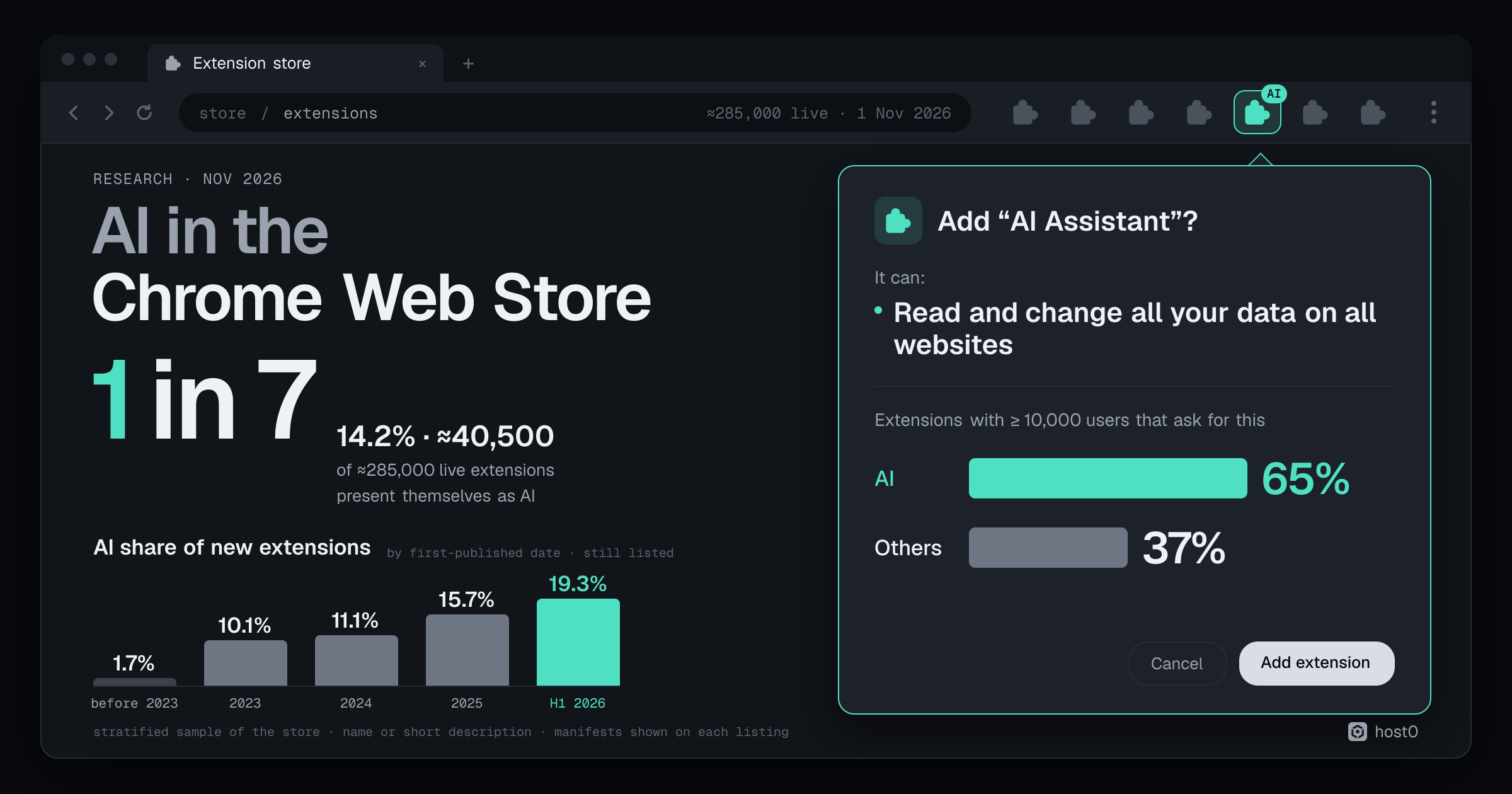
- 1About one in seven Chrome extensions presents itself as AI. 14.2% of the ≈285,000 live extensions do in their name or short description, about 40,500. Counting only the name, it's 8.2%.
- 2AI took nearly a fifth of new extensions in early 2026. Among extensions still listed, AI made up 1.7% of those first published before 2023, 10.1% of the 2023 cohort and 19.3% of those first published in the first half of 2026. In Q3 2026 the share dipped to 15.4% while volume kept climbing: 52% of everything listed today was first published in 2026.
- 3Most of it is tiny. 93.4% of AI extensions have fewer than 1,000 users, about the same as the rest (91.7%). AI extensions make up 14% of the store but about 9.5% of its summed installs.
- 4The biggest AI extensions are older than ChatGPT. 29 of the 50 most-installed AI extensions were first published before November 2022, Grammarly (40M users) first. The model makers' own are next: Anthropic's Claude (20M) and OpenAI's ChatGPT (8M) rank second and third, and neither carries the store's Featured badge.
- 5A quarter are accessories for chatbots, not AI themselves. In a hand-check of 200, 53 were exporters, folders, usage meters and prompt libraries for ChatGPT, Claude and the like. 30% of AI extensions name a model brand, and 12.7% call a model API straight from the extension.
- 6Popular AI extensions ask for far more access. Among extensions with at least 10,000 users, 65% of AI ones can read and change data on all websites, against 37% of the rest. Across all sizes there's no gap (31.1% vs 30.0%). AI extensions also request
scripting(41.5% vs 29.0%) and Google sign-in (12.3% vs 4.9%) more often. - 7They also say they collect more. 40.2% of AI extensions declare that they handle website content (20.7% of others), and 11.0% personal communications (3.0%). 46.7% declare they collect nothing, against 68.8%.
- 8Some extensions that researchers reported for taking AI chats are still listed. Of 36 extensions named in four 2025–26 reports on AI-chat harvesting and fake AI assistants, 6 are listed on 1 November with 8.7 million users shown between them. Two are in our AI top 50: Similarweb (1M users) and "Smart Sidebar" (400K). Being listed doesn't mean they still do what was reported.
14.2%
Of the ≈285,000 live Chrome extensions present themselves as AI, about 40,500 (1 Nov 2026)
Source: host0 sample of the Chrome Web Store
19.3%
Of extensions first published in H1 2026 are AI, up from 1.7% before 2023 (still-listed only)
Source: host0 sample
65%
Of AI extensions with 10,000+ users can read and change data on all websites, vs 37% of others
Source: host0 analysis of manifests
29 of 50
Most-installed AI extensions that predate ChatGPT; Claude (20M) and ChatGPT (8M) rank #2 and #3
Source: host0 sample
About one in seven extensions is AI#
Chrome's store sitemap listed 374,417 item URLs on 1 November 2026. Weighting our sample back up, about 285,000 of them (95% interval 281,000–288,000) are live extensions. The rest are themes (about 62,000), legacy Chrome apps (about 8,000) and roughly 14,000 listings taken down after the sitemap was built.
We counted an extension as AI when its name or short description presents it that way: the word "AI", a model or lab name (ChatGPT, GPT-5, Claude, Gemini, DeepSeek, Copilot, Grok and three dozen more), or terms like "LLM", "chatbot" and "generative". That measures presentation, not code, so an extension that added "AI" to its pitch counts. By that rule 14.2% of live extensions are AI (13.6–14.9%), about 40,500. A hand-check of 200 matches put precision at 96–98%, and a check of 200 non-matches found a few misses, so the true share is probably 14–16%: about one in seven. If only the name counts, it's 8.2%, about 23,400. The gap is mostly mainstream products that put AI in their description, like DuckDuckGo's, Bitdefender's and Glean's extensions.
Where AI extensions are
AI share of live extensions in each store category, 1 November 2026
| Label | Value |
|---|---|
| Communication | 22.1% |
| Education | 19.1% |
| Tools | 18.8% (52% of all AI) |
| Privacy | 14.6% |
| Developer tools | 14.4% |
| Workflow | 12.2% |
| Social | 12.1% |
| Art | 8.4% |
| Shopping | 8.0% |
| Accessibility | 6.8% |
| Functionality | 6.6% |
| Entertainment | 5.2% |
| Fun | 3.6% |
| Games | 1.6% |
Source: host0 sample of the Chrome Web Store
The store made room for this early. Its November 2023 redesign added new categories "like AI-powered and shopping extensions", Google said. The same thing shows up in other registries: in our look at app stores and developer registries, extensions with AI terms in their names grew from 2.6% of new VS Code extensions in the first half of 2024 to 11.6% two years later.
Nearly one in five new extensions#
Every listing carries the date it was first published, which lets us split the store into cohorts. The catch is that only extensions still listed carry a date: anything removed is gone from the count. So these aren't launch counts, and older cohorts are thinned more than new ones. The AI share within a cohort is less affected than its size.
By quarter, the share sat under 2.5% through 2022, jumped to about 10% in the first quarter of 2023 and stayed near there for two years. It climbed again through 2025, peaked at 20.2% in the last quarter, and stayed near 19% in the first half of 2026 before slipping to 15.4% in the third quarter. Quarterly shares are noisy, plus or minus 2–4 points, so read the shape rather than single quarters.
The dip isn't fewer AI extensions. The number of new extensions still listed kept rising through the third quarter, from about 42,000 first published in Q2 2026 to about 50,000 in Q3, and other kinds of extension simply grew faster. 52% of every extension listed today was first published between January and October 2026, and 72% since the start of 2025.
New extensions still listed, by first-published year
Estimated extensions live on 1 November 2026, by year first published, 2019–2026 (2026 = January to October)
| Label | Value |
|---|---|
| 2019 | 1.9K (AI: 17) |
| 2020 | 3.4K (AI: 34) |
| 2021 | 6K (AI: 157) |
| 2022 | 12.8K (AI: 155) |
| 2023 | 19.7K (AI: 1,982) |
| 2024 | 28.3K (AI: 3,135) |
| 2025 | 58.4K (AI: 9,159) |
| 2026 | 147.3K (AI: 25,725) |
Source: host0 sample of the Chrome Web Store
Survivorship can't explain all of that, because the store itself grew. Chrome's sitemap splits its URLs into files capped at about 8,000–9,000 items each. Copies of the sitemap index in the Internet Archive show 25 files in May 2025 and 45 on 1 November 2026, roughly 230,000–240,000 items in mid-2025 growing to 374,417 today. And churn is real too: of 18,626 URLs in two sitemap files archived in July 2025, a third are gone from today's sitemap.
The Chrome Web Store sitemap keeps growing
Number of sitemap files (each capped at about 8,000–9,000 items), Internet Archive copies, May 2025 to 1 November 2026
| x | y |
|---|---|
| 2 May 2025 | 25 |
| 1 Jun 2025 | 25 |
| 1 Jul 2025 | 26 |
| 1 Aug 2025 | 27 |
| 1 Oct 2025 | 25 |
| 5 Nov 2025 | 25 |
| 9 Dec 2025 | 26 |
| 1 Jan 2026 | 27 |
| 1 Feb 2026 | 27 |
| 1 Mar 2026 | 28 |
| 1 Apr 2026 | 29 |
| 12 May 2026 | 31 |
| 24 Jul 2026 | 35 |
| 8 Oct 2026 | 44 |
| 1 Nov 2026 | 45 |
Sources: host0 analysis of Internet Archive copies of chromewebstore.google.com/sitemap; Chrome Web Store
What "AI extension" means#
Not every AI extension runs a model. In a hand-check of 200 random matches, 137 were AI-powered tools (writers, summarizers, translators, note takers, agents) and 53 were accessories for AI chatbots (exporters, folder managers, usage meters, prompt libraries, AI-text detectors); the rest were false positives or borderline. So about a quarter of "AI extensions" exist to make ChatGPT, Claude or Gemini more convenient.
Their manifests say the same. 26.3% of AI extensions run on an AI chat site (their content scripts or host permissions match chatgpt.com, claude.ai, gemini.google.com and others), and 30% name a model brand. 12.7% call a model API straight from the extension. More than half, 53.7%, do none of these and presumably use their developer's own backend.
What AI extensions build on
Share of AI extensions, 1 November 2026
| Label | Value |
|---|---|
| Names any model brand | 30.0% |
| Runs on an AI chat site | 26.3% |
| Names OpenAI, ChatGPT or GPT | 19.7% |
| Calls a model API directly | 12.7% |
| Names Claude | 9.7% |
| Names Gemini | 9.4% |
| Names Copilot | 2.8% |
| Names Grok | 1.8% |
| Names Perplexity | 1.3% |
| Names DeepSeek | 1.1% |
Source: host0 analysis of names and manifests
The long tail, and the giants#
The typical AI extension has 11 users; the typical other extension has 14. 93.4% of AI extensions have fewer than 1,000 users and 1.7% have 10,000 or more, about the same spread as the rest of the store. The store rounds user counts down above 1,000 and counts installs, not people. Summing them, AI extensions hold about 165 million of the store's roughly 1.73 billion installs, about 9.5%. Both totals are lower bounds.
Those installs are concentrated in a few old products. The 50 most-installed AI extensions hold about 127 million of them, and 29 of the 50 were first published before ChatGPT. Grammarly (2012) shows 40 million users, QuillBot (2018) 6 million and DeepL (2021) 4 million. Only 1.1% of all AI extensions are that old.
The most-installed AI extensions
Users shown on the store listing (rounded down), 1 November 2026
| Label | Value |
|---|---|
| Grammarly | 40M (since 2012) |
| Claude (Anthropic) | 20M (since 2025) |
| ChatGPT (OpenAI) | 8M (since 2026) |
| QuillBot | 6M (since 2018) |
| Sider | 5M (since 2023) |
| DeepL | 4M (since 2021) |
| ChatGPT search (OpenAI) | 4M (since 2024) |
| Immersive Translate | 3M (since 2022) |
| Monica | 3M (since 2023) |
| Smallpdf | 3M (since 2018) |
| DuckDuckGo | 3M (since 2016) |
| YouTube Summary with ChatGPT & Claude | 2M (since 2022) |
| LanguageTool | 2M (since 2015) |
| Similarweb | 1M (since 2010) |
| Tactiq | 1M (since 2019) |
Source: host0 sample of the Chrome Web Store
The model makers came late and went straight to the top. Anthropic's Claude extension, which runs Claude in Chrome, shows 20 million users; OpenAI's ChatGPT extension, which since 15 October 2026 can read your open tabs and act in them, shows 8 million, and OpenAI's older ChatGPT search extension 4 million. We have no history for these counts, and some may come from managed or bundled installs rather than people finding them in the store.
They've moved in while AI also moved into browsers themselves: Gemini in Chrome from September 2025, and OpenAI's own browser, Atlas, which OpenAI was targeting to shut down on 9 August 2026 after less than a year, moving its ideas into ChatGPT Work, a desktop app with its own browser. An extension that drives the browser is also an extension that reads untrusted pages. When Anthropic previewed Claude for Chrome in August 2025 it reported that, across 123 prompt-injection test cases, attacks succeeded 23.6% of the time without its safety mitigations and 11.2% with them. Its later research on browser defenses, a different test with an adaptive attacker, put the best result near 1% and called that rate one that "still represents meaningful risk."
Popular AI extensions ask for more#
Every listing shows the extension's manifest.json, the file where it declares what it may do. The permission that matters most is the one Chrome describes as "read and change all your data on all websites": host access to every URL, or a content script that runs on every page.
Across the whole store, AI and other extensions ask for it equally often: 31.1% of AI extensions and 30.0% of others. The difference is at the top. Among extensions with at least 10,000 users, 65% of AI ones have all-sites access, against 37% of the rest. Among the 50 most-installed AI extensions, 39 do.
Extensions that can read and change data on all websites
Share with host access or content scripts on every URL, by size, 1 November 2026
| Label | Value |
|---|---|
| AI, all sizes | 31.1% |
| Other, all sizes | 30.0% |
| AI, 10,000+ users | 65% |
| Other, 10,000+ users | 37% |
Source: host0 analysis of manifests
That's partly the job. A sidebar that summarizes any page has to read any page. But it means the AI extensions people actually install are the ones holding the widest access, and it's a capability, not evidence of abuse. The same pattern shows in other permissions: AI extensions request scripting (injecting code into pages), identity (Google sign-in) and the side panel far more often, and debugger, which gives full DevTools control of a tab, more than twice as often.
Permissions AI extensions request more often
Share of AI extensions requesting each permission; notes give other extensions, 1 November 2026
| Label | Value |
|---|---|
| activeTab | 49.1% (vs 35.0%) |
| scripting | 41.5% (vs 29.0%) |
| tabs | 26.3% (vs 23.2%) |
| sidePanel | 21.6% (vs 7.6%) |
| contextMenus | 18.3% (vs 11.4%) |
| identity | 12.3% (vs 4.9%) |
| downloads | 9.2% (vs 6.4%) |
| cookies | 6.2% (vs 4.8%) |
| debugger | 2.9% (vs 1.2%) |
| webRequest | 2.6% (vs 3.7%) |
Source: host0 analysis of manifests
Enterprise telemetry points the same way, on a different population. LayerX, which says its product runs on more than a million enterprise devices, reported in 2026 that 1 in 6 enterprise users run at least one AI extension, and that AI extensions there are more likely than average to have a known vulnerability and to have changed their permissions in the past year.
AI extensions in enterprise browsers
Share of AI extensions vs all extensions in LayerX's customer telemetry, 2026 report
| Label | Value |
|---|---|
| Request scripting | 41.9% (all: 15.4%) |
| Request tabs | 39.4% (all: 19.9%) |
| Changed permissions in a year | 25.0% (all: 4.3%) |
| Access cookies | 18.2% (all: 6.7%) |
| Known CVE | 16.3% (all: 10.8%) |
Source: LayerX, Enterprise Browser Extension Security Report 2026
What they say they collect#
Every listing has a privacy panel where the developer declares which kinds of user data it handles. These are self-declarations, but they're a promise the store can enforce, and AI extensions declare more of almost everything.
What extensions declare they handle
Share of AI extensions declaring each data type in the store's privacy panel; notes give other extensions, 1 November 2026
| Label | Value |
|---|---|
| Website content | 40.2% (vs 20.7%) |
| Personally identifiable info | 26.0% (vs 13.5%) |
| Authentication information | 23.4% (vs 11.5%) |
| User activity | 13.7% (vs 7.6%) |
| Personal communications | 11.0% (vs 3.0%) |
| Web history | 8.3% (vs 6.8%) |
| Location | 4.2% (vs 3.4%) |
| Financial and payment info | 4.0% (vs 2.1%) |
| Collects nothing | 46.7% (vs 68.8%) |
Source: host0 sample of the Chrome Web Store
That fits outside counts. Incogni's 2026 review of 442 AI-powered extensions found 52% collected at least one type of user data and 29% personally identifiable information; in our much larger sample, 53.3% of AI extensions declare at least one data type. AI extensions also look more maintained and more commercial: 84.6% link a privacy policy (65.3% of others), 56.4% were updated in the last six months (48.6%) and 16.5% sell in-app purchases (6.8%). Fewer carry the Featured badge, 5.0% against 7.5%.
Reported, and still listed#
Over the past year, security researchers published a run of reports on extensions that collected people's AI conversations or posed as AI assistants. Koi Security reported that Urban VPN Proxy, a VPN extension with the Featured badge, captured conversations on ChatGPT, Claude, Gemini, Copilot, Perplexity, DeepSeek, Grok and Meta AI. Urban VPN Proxy and its sibling extensions on Chrome and Edge had "more than 8 million" installs in all, The Register reported. OX Security reported two extensions posing as an AI sidebar, one of them Featured, that sent ChatGPT and DeepSeek chats and every open tab's URL to an outside server every 30 minutes. Secure Annex reported that Similarweb's extension collects prompts and responses from AI tools for web analytics. And Akamai's AiFrame report described 30 fake ChatGPT, Claude, Gemini and Grok assistants, several Featured, that loaded their interface from a remote server so their behavior could change without a store update.
We took the 36 extension IDs those four reports name (leaving out StayFocusd, which Secure Annex flagged for past versions only) and opened each listing on 1 November 2026. 30 of AiFrame's 32 IDs are gone. Six are listed, showing 8.7 million users between them.
Named in AI-data reports, listed today
Users shown on 1 November 2026 for the 6 still-listed extensions of 36 named in four 2025–26 reports
| Label | Value |
|---|---|
| Urban VPN Proxy | 7M (Koi, Dec 2025) |
| Similarweb | 1M (Secure Annex) |
| Smart Sidebar | 400K (OX, Dec 2025) |
| AI Sidebar for DeepSeek | 200K (OX, Dec 2025) |
| AI Sidebar | 50K (AiFrame, Featured) |
| AI Agent | 50K (AiFrame) |
Sources: host0 check of Chrome Web Store listings; The Register; OX Security; Secure Annex; Akamai
Two of them sit in our AI top 50: Similarweb at #14 and Smart Sidebar at around #46. The second OX extension shows how a takedown can play out. Google pulled it in January 2026; it came back, and in August Netskope reported a new version that hijacked affiliate links and the uninstall page. It is listed today with 200,000 users and its original first-published date. The store doesn't say whether Google or the developer removed an item, or why it came back.
The pattern isn't new. In March 2023, a fake ChatGPT extension that stole Facebook session cookies had over 9,000 downloads before Google removed it. Google says malware is rare overall: "less than 1% of all installs" from the store in 2024. It hasn't published an AI-specific figure, or the share of Chrome users who have any extension at all.
AI and the Chrome Web Store, 2018 to 2026
1 Oct 2018
1 Oct 2018
Manifest V3 announced
Google says over 70% of the malicious extensions it blocks contain obfuscated code.Source: Chromium Blog
23 Mar 2023
23 Mar 2023
Fake ChatGPT extension steals Facebook sessions
Over 9,000 downloads before removal.Source: Help Net Security
20 Nov 2023
24 Dec 2024
24 Dec 2024
Cyberhaven's extension hijacked
A phished developer account starts a campaign that, by SecurityWeek's 31 December count, hit at least 29 extensions with potentially more than 2.5 million users. A community list of malicious extension IDs ties at least seven AI assistants to the campaign.Source: SecurityWeek
24 Jul 2025
24 Jul 2025
Manifest V2 disabled for everyone
Chrome 138 turns off the remaining MV2 extensions.Source: Chrome for Developers
25 Aug 2025
25 Aug 2025
Claude for Chrome preview
1,000 Max users; prompt-injection success 23.6% → 11.2% with mitigations.Source: Anthropic
18 Sep 2025
16 Dec 2025
29 Dec 2025
30 Dec 2025
12 Feb 2026
1 Jul 2026
1 Jul 2026
New store policy
Data must be strictly necessary and disclosed; extensions built to get around AI services' safety guardrails are banned. Enforced from 1 August.Source: Chrome for Developers
11 Aug 2026
31 Aug 2026
15 Oct 2026
1 Nov 2026
1 Nov 2026
Our sample: 14.2% of extensions are AI
The rules have tightened on paper. Manifest V3, now the only kind of extension in the store, bans code loaded from a server, though AiFrame worked around that by loading a whole remote page in a frame. Google's July 2026 policy update requires collected data to be "strictly necessary" for an extension's single purpose and makes developers tell users when data handling changes after install. Its one AI-specific rule bans extensions "designed to circumvent safety guardrails" of AI services. Nothing in it addresses extensions that read your AI chats.
What this means if you build with AI#
- Read the permission line before you install. On the listing and in the install prompt, "Read and change all your data on all websites" means the extension can see every page you open, including your AI chats, your email and your admin consoles. Popular AI extensions ask for it twice as often as other popular extensions. If it's only needed on a few sites, set it in
chrome://extensions→ Details → Site access to "On click" or "On specific sites". - Prefer first-party. If you want Claude, ChatGPT or Gemini in your browser, use the extension from Anthropic or OpenAI, or Gemini built into Chrome, not a third-party sidebar that resells several models. Check the publisher name and its verified website on the listing. Don't treat the Featured badge as a safety check: neither lab extension has it, and Urban VPN Proxy, an OX extension and several AiFrame fakes did when they were reported.
- Read the privacy panel and the update history. "Handles website content" or "personal communications" means the developer says it collects them. A sudden rename, a new owner or a version that adds permissions is the moment to look again: Chrome disables an extension whose update asks for permissions with new warnings until you accept them, so don't click through that prompt.
- Keep sensitive work out of a browser full of extensions. Use a separate Chrome profile with no extensions for banking, HR, production dashboards and AI chats that touch customer data. An agent extension that reads pages can also be steered by them; even Anthropic calls a 1% attack success rate a meaningful risk.
- For teams: allowlist, don't blocklist. In Chrome Enterprise policy, block everything with
ExtensionInstallBlocklistset to*, approve extensions by ID withExtensionInstallAllowlist, and useExtensionSettingsto block risky permissions (debugger,cookies) or keep extensions off sensitive hosts (runtime_blocked_hosts). Re-review approved AI extensions when they change permissions; LayerX saw that happen to a quarter of them in a year. - If you build an extension with an AI agent, ask for less. Agents tend to write
<all_urls>into the manifest. UseactiveTab(access to the current tab only after a click) oroptional_host_permissionsfor the sites you need, declare in the privacy panel exactly what you send to a model, and don't put an API key in the extension, since anyone can unpack it.
Some things people build as extensions don't need to live in anyone's browser: a summary page, a team dashboard, a small tool with shared data. host0 puts what your agent made at a private link you share by email, with no access to the browsers of the people who open it.
Methodology#
Population. On 1 November 2026 we downloaded the Chrome Web Store sitemap (45 files) with a reject-all consent cookie: 374,417 unique /detail/ URLs covering extensions, themes and legacy apps. No CRX package was downloaded or run.
- What one listing gives us. Each listing page embeds its own record: name, short description, rating, displayed users, category, item type, a first-published timestamp, the full
manifest.json, version and last-updated date. The rendered page adds the badges, the EU trader declaration, in-app purchases and the privacy panel. We didn't store developers' contact details. Requests were self-identified (host0-research/1.0), at most two per second. - Sample. Two strata: the 21,187 sitemap URLs whose slug (roughly the first 25 characters of the name) carries an AI keyword, and the other 353,230. We fetched 6,708 of a planned 20,000 random URLs and 3,342 of the 20,148 AI-slug URLs outside that draw before stopping the crawl, plus 118 popular listings found through each page's "Related" cards or added by hand (used only for the top-50 list and installs, never for shares). Totals and shares are stratum-weighted, with 95% intervals from 300 bootstrap resamples.
- AI classifier. Name plus short description, matched against "AI" as a token, model and lab names, and AI terms in English and CJK scripts. Precision from a hand-check of 200 matches: 96–98%. Recall from 200 non-matches: 0.5–2% of "non-AI" extensions are AI. The true share is about 14–16%. Other scripts (Cyrillic, Arabic) aren't matched.
- Cohorts use the listing's first-published date. Checks: known launches match (Merlin December 2022, Sider February 2023, Monica March 2023); none of 303 items in a July 2025 sitemap copy has a later first-published date; none of 16 listings with an Internet Archive capture was archived before that date. Cohorts include only extensions still listed. Years before 2019 are too thinly sampled to show.
- Users and installs. The store floors counts above 1,000, so sums are lower bounds, and they count installs per extension, not people. Sample sums swing on single large extensions, so installs combine every extension with 100,000+ users we saw anywhere (1,216, of which 141 AI), summed directly, with a sample estimate for the rest.
- Permissions. "All websites" =
<all_urls>,*://*/*orhttp(s)://*/*in host permissions or content-script matches, which is what Chrome warns about as reading and changing data on all websites. A permission is a capability, not evidence of what the code does. - Still-listed check. We opened each of the 36 extension IDs named by The Register (Koi), OX Security, Akamai (AiFrame) and Secure Annex on 1 November 2026. A removed item redirects to an empty listing; a listed one shows a user count. All six listed pages were read by hand.
- Other sources (LayerX, Incogni, Anthropic, Google) are quoted with their own population and date, re-read on 1 November 2026, and never combined with ours.
The scripts, the 10,166 fetched listings with every flag, the hand-check labels and the full data pack are in our repository under docs/research/2026-11-01-chrome-web-store-ai.md.
Open questions#
- How many extensions disappear, and why. A third of the URLs in two July 2025 sitemap files are gone. We can't tell spam and malware takedowns from developers who gave up, or how much faster AI extensions churn.
- Why the AI share dipped in Q3 2026. The share of new extensions that are AI fell from 19.9% to 15.4% while the volume of new extensions kept rising. A wave of non-AI extensions is one explanation; the sample can't tell.
- Where the labs' installs come from. Claude's 20 million and ChatGPT's 8 million could be people finding the extensions, or installs pushed by desktop apps, sign-up flows and company policies.
- What still-listed extensions do now. Checking a listing tells us it exists, not what its current version sends where. That needs the code, version by version.
- A full crawl. Sampling all 374,417 listings would roughly halve every interval and complete the top 50. We'll rerun it.