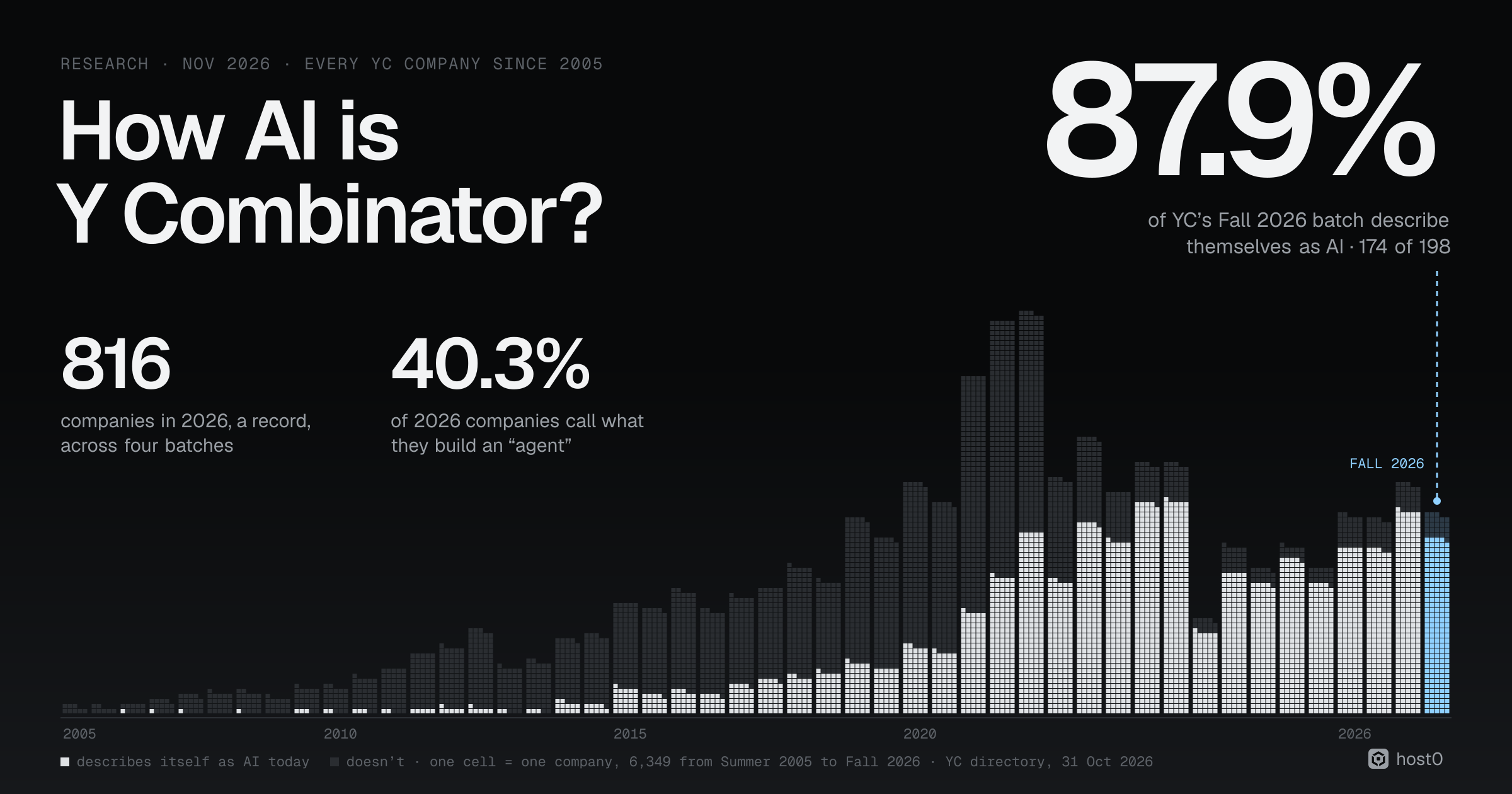
Since 2025 Y Combinator has run four batches a year, of roughly 140 to 230 startups each. Ask what share of them are AI companies and you get a different answer from every outlet that has tried: TechCrunch counted 86 of 247 in Winter 2024, YC itself said "at least 50%", and newsletters now quote numbers near 90% that YC never published. The answers differ because the definitions do, and because YC's directory is edited by founders long after their batch ends.
So we counted all of it. We pulled every company in YC's public directory on 31 October 2026, 6,360 in all, from Summer 2005 to the Fall 2026 batch now in session, and classified each one three ways: YC's own tags, the words in its description, and a stricter test of whether the product itself is built on AI. We read 300 random companies and 100 agent companies by hand to check the classifiers, matched 829 companies to the Launch HN posts they wrote at the time to see how much of the history has been rewritten, and coded every one of YC's 107 Requests for Startups since 2024. The methodology has the details and the limits.
Key findings
- 1Nearly nine in ten. 87.9% of the Fall 2026 batch (174 of 198 companies listed so far) describe themselves as AI, and every batch since Winter 2024 sits between 83.8% and 92.8%. The peak was Summer 2025, at 92.8%. By a stricter test, whether the product itself is built on AI, it's about seven in ten.
- 2The real step was Winter 2023. In the Launch HN posts YC companies wrote at the time, 12.3% of Winter 2022 and 12.8% of Summer 2022 launches pitched AI. Winter 2023, the first batch after ChatGPT, jumped to 40.0%.
- 3The history has been rewritten. Of 451 companies from 2019–2022 batches, 6.7% pitched AI on Launch HN at the time; 21.3% have AI in their directory one-liner today. Superpowered became Vapi, and Infra became Ollama.
- 4A third of 2026 companies build agents. 40.3% of 2026 companies call what they build an agent; 83 of 100 we checked really are agents or tools for agents. One in five puts "agent" in its one-line pitch.
- 5AI is going vertical and physical. Among AI companies, the share selling to one industry rose from 26.5% in 2024 to 35.3% in 2026. Robotics went from 0.7% of Winter 2023 to 18.0% of Summer 2026.
- 6The non-AI minority is hard tech. Of the 113 companies in 2026 batches that aren't AI by any of our tests, 61 are in YC's Industrials category: space, drones, batteries, turbines.
- 7Batches got smaller, years got bigger. The directory lists a record 816 companies for 2026, across four batches, against 725 in 2021's two.
- 8YC asks for AI too. 68 of the 107 items in YC's Requests for Startups since 2024 (64%) are AI products. The list YC had up until early 2024 had one AI topic out of 20.
87.9%
Fall 2026 companies (174 of 198, in session) that describe themselves as AI; peak 92.8% in Summer 2025
Source: host0 analysis of the YC directory, 31 Oct 2026
40.3%
2026 YC companies that call what they build an agent; 83 of 100 hand-checked really are
Source: host0 analysis
816
Companies listed for 2026, a record, across four batches (725 in 2021's two)
Source: host0 analysis of the YC directory
40.0%
Winter 2023 Launch HN taglines pitching AI, the first batch after ChatGPT (Summer 2022: 12.8%)
Source: host0 analysis of HN Algolia
Nine in ten, batch after batch#
Our broad test counts a company as AI if YC's tags say so or if its one-liner or description uses AI terms: AI, LLM, machine learning, computer vision, foundation models, AI agents and dozens more, with insurance, travel and real estate agents filtered out. In a hand check of 150 random companies from 2024–2026 batches, it was right 96% of the time and caught 95% of the companies we judged AI. It measures what founders say about themselves, which is the question most people are asking.
By that test, the AI share of each year's companies has climbed from single digits to the high 80s. Read the early years with care: every number below uses the directory as it reads today, and older companies have had years to rewrite their pitch.
YC companies that describe themselves as AI, by batch year
Share of companies listed in YC's directory, by the year of their batch, 2005 to 2026, as described on 31 Oct 2026
| Label | Value |
|---|---|
| 2005 | 0% |
| 2006 | 5.9% |
| 2007 | 6.1% |
| 2008 | 2.3% |
| 2009 | 7.1% |
| 2010 | 7.9% |
| 2011 | 6.7% |
| 2012 | 8.1% |
| 2013 | 5.1% |
| 2014 | 13.8% |
| 2015 | 21% |
| 2016 | 18.8% |
| 2017 | 26.1% |
| 2018 | 28.2% |
| 2019 | 26.1% |
| 2020 | 29.2% |
| 2021 | 32.7% |
| 2022 | 49.4% |
| 2023 | 72.9% |
| 2024 | 84.9% |
| 2025 | 88.9% |
| 2026 | 86.2% |
Across every company YC lists from Summer 2005 to Fall 2026, exactly half are AI by this test: 3,174 of 6,349. Two-thirds of those come from 2023 or later batches.
Batch by batch, the line flattens out after Winter 2024. Since then every batch has been between 83.8% and 92.8% AI, so the share has stopped rising. There's almost no room left.
"Describes itself as AI" includes a lot of companies where AI is a feature: an accounting firm that uses models internally, a marketplace with smart matching. When we read 150 random 2024–2026 companies by hand, 134 (89%) built with AI or claimed it, and 107 (71%) had a product built on machine learning or language models, or made tools for AI. Our stricter classifier, which needs AI in the one-liner (or an AI tag plus AI at the top of the description), puts 2026 at 65.6% and is a little conservative. About seven in ten is the honest strict answer.
The real step was Winter 2023#
Everything above has a catch. The directory is today's text, and founders edit it. A 2021 company that pivoted to AI in 2023 now reads as an AI company in its 2021 batch. To see what companies pitched at the time, we used Launch HN: the post a YC company writes on Hacker News when it launches, titled "Launch HN: Name (YC W23) – tagline". We matched 829 of them to the directory and ran the same AI test on the tagline they wrote then.
Launch HN taglines that pitched AI, by batch
Share of each batch's matched Launch HN posts whose tagline mentions AI, at the time of posting, W19 to S26
| Label | Value |
|---|---|
| W19 | 2.1% (n=48) |
| S19 | 2.5% (n=40) |
| W20 | 5.8% (n=52) |
| S20 | 4.2% (n=48) |
| W21 | 4.5% (n=89) |
| S21 | 9% (n=78) |
| W22 | 12.3% (n=57) |
| S22 | 12.8% (n=39) |
| W23 | 40% (n=60) |
| S23 | 40% (n=20) |
| W24 | 42.4% (n=33) |
| S24 | 43.8% (n=32) |
| W25 | 52.4% (n=21) |
| X25 | 68.8% (n=16) |
| S25 | 56% (n=25) |
| W26 | 77.8% (n=18) |
| S26 | 57.1% (n=21) |
The jump is sharp. Twelve to thirteen percent of the 2022 batches pitched AI at launch; Winter 2023 pitched it 40% of the time. Today's directory makes Summer 2022 look 56.7% AI, and most of that is companies that changed their pitch later. Of Summer 2022's 39 matched launches, 24 were posted before ChatGPT, and 3 of those pitched AI.
Put the same companies side by side, then and now, and the rewrite is clear. For companies from 2019 to 2022 batches, AI in the one-liner today runs two to six times what they pitched at launch, about three times pooled. From 2025 on the two agree within the noise of comparing two different texts, about ten points either way.
AI in the pitch, then and now, for the same companies
Share of Launch HN companies with AI in their tagline at launch vs in their directory one-liner on 31 Oct 2026, by batch year, 2017 to 2026
| Series | x | y |
|---|---|---|
| One-liner today | 2017 | 9.8% |
| One-liner today | 2018 | 10% |
| One-liner today | 2019 | 14.8% |
| One-liner today | 2020 | 21% |
| One-liner today | 2021 | 22.8% |
| One-liner today | 2022 | 25% |
| One-liner today | 2023 | 51.2% |
| One-liner today | 2024 | 66.2% |
| One-liner today | 2025 | 69.2% |
| One-liner today | 2026 | 58.5% |
| Launch HN tagline, at the time | 2017 | 6.6% |
| Launch HN tagline, at the time | 2018 | 6% |
| Launch HN tagline, at the time | 2019 | 2.3% |
| Launch HN tagline, at the time | 2020 | 5% |
| Launch HN tagline, at the time | 2021 | 6.6% |
| Launch HN tagline, at the time | 2022 | 12.5% |
| Launch HN tagline, at the time | 2023 | 40% |
| Launch HN tagline, at the time | 2024 | 45.5% |
| Launch HN tagline, at the time | 2025 | 58.5% |
| Launch HN tagline, at the time | 2026 | 68.3% |
We read 25 of the companies that moved from a non-AI launch to an AI one-liner. All 25 had changed their pitch. Fourteen became a different product, often under a new name: Vapi (W21) launched on Hacker News in March 2021 as Superpowered, "Calendar in your menu bar", and now sells voice AI for developers. Ollama (W21) launched as Infra in May 2022 with open-source access management for Kubernetes. The other 11 kept the product and reframed it: Rootly (S21) launched in 2022 to "Manage Incidents in Slack" and is now "AI-native on-call and incident response".
The older batches lean further. We sampled 60 companies from 2005–2019 batches that our test calls AI today and looked up their own websites in the Wayback Machine in the 18 months or so after their batch started. Of the 30 with a usable capture, 13 mentioned AI, machine learning or computer vision at the time. The real ones are there, Wit.ai and Deepgram among them, but a fair reading of 2015–2019 is roughly 10–15% AI at the time, not the 19–28% the directory gives today.
How you count changes the answer#
The same batch can be a third AI or three quarters AI depending on who counts and how. Winter 2024 is the best example, because five different counts exist for it.
Five answers to how AI Winter 2024 was
Share of the W24 batch counted as AI, by source and definition
| Label | Value |
|---|---|
| Call themselves an AI startup | 35% (86 of 247) |
| YC: building around AI | ≥50% (YC blog) |
| Hand review, AI or ML | 65% (158 of 245) |
| Mention AI in the pitch | 76% (187 of 247) |
| Our test, today's text | 84% (209 of 248) |
Sources: TechCrunch, 5 Apr 2024; YC blog, 3 Apr 2024; Artificial Ignorance
None of these is wrong; they answer different questions. "Calls itself an AI startup" is a label founders pick from a list. "Mentions AI" is the widest net. Ours is close to "mentions AI", checked by hand. YC hasn't published a per-batch AI share since Winter 2025, when CNBC reported that "about 80% of the YC companies that presented this week were AI focused". The 88–91% figures circulating for 2026 batches come from newsletters, not from YC.
A third of 2026 companies build agents#
The word of the moment is "agent". In 2026, 40.3% of YC companies use agent or agentic for what they build, with human agents (insurance, real estate, support) filtered out. We read 100 random flagged companies from 2024–2026: 83 sell an AI agent or tools for agents, 15 mention agents as one feature, and 2 were false hits. So about a third of 2026 companies are agent companies in the strict sense.
YC companies that build agents
Share of companies per batch year using agent or agentic for what they build, 2023 to 2026
| Label | Value |
|---|---|
| 2023 | 22.1% (one-liner: 12.3%) |
| 2024 | 29.7% (15.9%) |
| 2025 | 39.6% (20.1%) |
| 2026 | 40.3% (21.6%) |
Agents come in two kinds. Roughly a third of the real agent companies in our sample (27 of 83, on a rough second pass) build for other agents rather than for people: browsers, sandboxes, memory, payments, evaluation, data. The rest sell an agent that does a job. The job title is the pitch now: in 2026, 9.1% of one-liners describe an "AI" plus a role, such as an AI accountant, recruiter, receptionist, analyst or SDR.
What kind of AI#
Most YC AI companies sell to businesses, and most of those sell a business function rather than an industry. Between 2024 and 2026, 62.9% of AI companies were horizontal by YC's own sub-industry labels (engineering, sales, finance, HR, security), 30.2% were vertical (one industry: healthcare, fintech, industrials, real estate, education, government) and 6.9% were consumer. The vertical share is the one moving: 26.5% in 2024, 27.0% in 2025, 35.3% in 2026.
What YC's AI companies work on, 2026
Share of 2026 AI companies by keyword in the one-liner and opening description (a company can match several), n = 703
| Label | Value |
|---|---|
| AI infra, models and data | 17.2% (2024: 7.2%) |
| Finance, accounting, tax | 11.2% (2024: 10.2%) |
| Coding and software | 10.4% (2024: 13.8%) |
| Healthcare and bio | 10% (2024: 14.2%) |
| Manufacturing and industrial | 8.8% (2024: 5.2%) |
| Robotics and physical AI | 8.5% (2024: 3.4%) |
| Sales, marketing, GTM | 5.1% (2024: 7.2%) |
| Security | 4.6% (2024: 3.8%) |
| Insurance | 4.3% (2024: 2.0%) |
| Legal and compliance | 3.8% (2024: 6.2%) |
| Voice | 3% (2024: 5.2%) |
Coding is still huge if you count YC's own labels. Dev tools and infrastructure were 21.2% of all 2026 companies, and 96.5% of those were AI. The share fell from 25.1% in 2024 and 2025 because the batches grew elsewhere. TechCrunch reported in 2024 that YC had backed more than a dozen AI code editors between 2022 and 2024, citing Deckmatch's analysis.
A newer pattern is the AI-native firm: companies that sell the service itself rather than software for it. One-liners like "AI-native accounting firm", "AI-native law firm" or "AI-native customs brokerage" went from 6 companies in 2024 to 9 in 2025 and 32 in 2026, 3.9% of the year. YC asked for exactly this in its Summer 2026 Requests for Startups ("AI-Native Service Companies") and its Spring 2026 one ("AI-Native Agencies").
Who YC's AI companies sell to
Share of AI companies by YC industry and sub-industry, horizontal = a business function, vertical = one industry
| Label | Value |
|---|---|
| Horizontal, 2024 | 63.5% |
| Horizontal, 2026 | 59.6% |
| Vertical, 2024 | 26.5% |
| Vertical, 2026 | 35.3% |
| Consumer, 2024 | 10% |
| Consumer, 2026 | 5.1% |
Robots and the holdouts#
The fastest-growing category isn't software. Companies that build robots, drones, humanoids or "physical AI" were 0.7% of Winter 2023 and 18.0% of Summer 2026. YC's Industrials category grew from 2.2% to 25.0% of a batch over the same period.
Robotics in YC batches
Share of companies per batch building robots, drones, humanoids or physical AI, W23 to Fall 2026
| Label | Value |
|---|---|
| W23 | 0.7% |
| S23 | 1.8% |
| W24 | 2.8% |
| S24 | 7.7% |
| F24 | 4.3% |
| W25 | 7.2% |
| X25 | 7.6% |
| S25 | 8.4% |
| F25 | 8.3% |
| W26 | 10.2% |
| X26 | 11.9% |
| S26 | 18% |
| F26 | 16.7% |
That's where the companies that aren't AI went too. In 2026, 113 of the 816 companies aren't AI by any of our tests, and more than half of them are hardware.
The YC companies that aren't AI, 2026
2026 companies that pass none of our AI tests, by YC industry, n = 113
| Label | Value |
|---|---|
| Industrials | 61 (54%) |
| B2B | 21 (19%) |
| Fintech | 13 (12%) |
| Consumer | 8 (7%) |
| Healthcare | 8 (7%) |
| Real estate | 1 |
| Government | 1 |
Smaller batches, more of them#
YC moved from two batches a year to four. Fall 2024 was the first fall batch and Spring 2025 the first spring one. YC's announcement in January 2025 gave AI as part of the reason: "the rate of change currently happening as a result of AI is causing more people to create startups". The standard deal stayed at $500,000, the amount YC has invested in every company since early 2022.
YC companies per year
Companies listed in YC's directory by batch year, 2016 to 2026, as of 31 Oct 2026
| Label | Value |
|---|---|
| 2016 | 224 (2) |
| 2017 | 241 (2) |
| 2018 | 277 (2) |
| 2019 | 368 (2) |
| 2020 | 438 (2) |
| 2021 | 725 (2) |
| 2022 | 631 (2) |
| 2023 | 494 (2) |
| 2024 | 590 (3) |
| 2025 | 621 (4) |
| 2026 | 816 (4) |
The batches also moved back to San Francisco. 72.3% of 2026 companies list San Francisco as a location, against 27.4% of the 2021 cohort, which mostly ran remote. Locations are current, so older companies may have moved since.
YC's partners have made big claims about what AI does inside these companies. In March 2025 YC said that a quarter of the Winter 2025 batch had 95% of their codebases generated by AI, in TechCrunch's paraphrase of partner Jared Friedman. Garry Tan told CNBC the whole Winter 2025 batch was growing "10% week on week", and in March 2026 wrote on X that Winter 2026 grew 14% a week on average across "nearly 200 startups". Those are YC's own figures, self-reported by founders, unaudited, and for the whole batch rather than its AI companies. We measured how much code AI writes elsewhere in our post on AI-written code.
What YC asks for#
YC publishes Requests for Startups, the ideas its partners want to fund. Until early 2024 it had a long-standing list of 20 topics, one of them "A.I.". The new-style list went up between February and March 2024, and the page now holds nine rounds, from "Summer 2024" to "Winter 2027", with 107 items. We read and coded each one.
AI products in YC's Requests for Startups
Share of items per round whose product is AI, Summer 2024 to Winter 2027 rounds, hand-coded
| Label | Value |
|---|---|
| Summer 2024 | 43.8% (7 of 16) |
| Winter 2025 | 33.3% (3 of 9) |
| Spring 2025 | 91.7% (11 of 12) |
| Summer 2025 | 92.9% (13 of 14) |
| Fall 2025 | 66.7% (4 of 6) |
| Spring 2026 | 80% (8 of 10) |
| Summer 2026 | 50% (8 of 16) |
| Fall 2026 | 61.5% (8 of 13) |
| Winter 2027 | 54.5% (6 of 11) |
In total, 68 of the 107 items (64%) are AI products. With the physical buildout (compute, chips, data centres, robot hardware), it's 75 (70%), and 83 (78%) with ideas that only exist because of AI, such as retraining workers for the AI economy. The AI-product share peaked in 2025 and fell to 54.5% in the Winter 2027 round, whose framing is that "AI's biggest bottlenecks are moving beyond the models": data centre supply chains, robots made in America, financing for the physical buildout.
YC versus the rest of venture#
YC is more AI than the venture market it feeds, at least by count. In 2026 so far, AI took 82.7% of US venture deal value, the highest annual share in PitchBook's data, according to the PitchBook-NVCA Venture Monitor for Q3 2026, published in October 2026. But AI was about 45% of deals: a few huge rounds for frontier labs carry the dollar share.
Globally the pattern is the same. In its 5 October 2026 report, Crunchbase counted $102 billion for AI startups in Q3 2026, 64% of all venture funding, down from the two quarters before. The comparison with YC isn't exact: we count companies by how they describe themselves, PitchBook counts deals by its own taxonomy. But the gap is wide enough to say YC's batches are more concentrated in AI than venture as a whole.
What this means if you build with AI#
- "AI" no longer tells anyone anything. Nine in ten YC companies say it. Say what the product does and who pays for it; the stricter question, whether the product is built on AI, is the one investors and customers will ask.
- Agents are crowded, and so is agent plumbing. A third of 2026 YC companies are agent companies, and a third of those build tools for other agents. If you build one, pick a customer and a job before you pick the primitive.
- The growth is in verticals. Vertical AI rose from 26.5% to 35.3% of YC's AI companies in two years, and AI-native firms that sell the service itself went from 6 to 32. Knowing one industry well is worth more than another horizontal assistant.
- Coding tools are the most contested space. Dev tools and infrastructure are a fifth of all 2026 companies, nearly all of them AI. TechCrunch found YC has backed near-duplicates before, so expect competition from inside your own batch.
- The open lane is physical. Robotics went from 0.7% to 18.0% of a batch, and YC's newest requests are about data centres, chips and robots. More than half of the companies that aren't AI at all are in industrials and hardware.
- Read the growth claims as claims. Weekly growth rates and "95% AI-written" come from YC partners and founders, not audits. Our counts are of descriptions too: useful for what founders want to be seen as, not proof of what their code does.
- Expect your own pitch to change. All 25 of the companies we read that moved to an AI pitch changed their one-liner after launch, and 14 became a different product. Write for this year, and don't be surprised to rewrite it.
One of the items in YC's Fall 2026 Requests for Startups is "A Cloud for Small Software", for tools with one or a small handful of users that are easy to build but hard to deploy and share. That's the problem host0 works on, and we wrote about the wider trend in personal software by the numbers.
Methodology#
We used public data only, collected on 31 October 2026.
- The directory. Every company in YC's public directory at ycombinator.com/companies, read from the public search index behind the page, one query per batch so no batch hit the 1,000-result cap: 6,360 companies, matching the index's own total. We kept the one-liner, description, YC industry and sub-industry, tags, status, team size and locations. Batch codes follow YC's shorthand (W, X for spring, S, F); Launch HN posts also tag spring batches as P, which we read as X. Winter and Summer 2027 early admits (8 companies) are left out of every batch and year figure.
- Three AI tests. Tag: one of YC's AI tags (AI, Generative AI, Machine Learning, Computer Vision, NLP and 11 more). Text: AI terms in the one-liner or description, plus "agent" when it isn't a human agent. AI-native: an AI term in the one-liner, or an AI tag plus an AI term in the description's opening. The headline "describe themselves as AI" is tag or text. W26 and X26 are mostly untagged (141 of 197 and 130 of 193), so we never use tags alone for them.
- Hand checks. 300 random companies (150 from 2024–2026, 50 from 2020–2023, 100 from 2005–2019) read by one labeller and marked AI-native, AI-enabled or not AI. For 2024–2026 the broad test was right 96% of the time and found 95% of AI companies; for 2005–2019 its precision falls to 85%. A second sample of 100 agent-flagged companies gave 83 real agent companies.
- Back-dating. 1,158 Launch HN stories from the HN Algolia API, 829 matched to directory companies by batch and name (using former names), with the same AI test run on the tagline then and the one-liner now. A Launch HN post can come a year or more after the batch, and launches are a self-selected, developer-heavy slice of each batch, so we use the differences, not the levels. A second count of every Launch HN title (926 with a batch tag, own keyword list) shows the same step: 12.6% of 2022 batches' titles mention AI, 38.8% of 2023's. For 2005–2019, the first Wayback capture of 60 AI-flagged companies' websites within about 18 months of the batch; 30 were usable.
- Categories. Verticals are keyword matches on the one-liner and the description's opening; horizontal, vertical and consumer use YC's own industry labels. Robotics is a keyword, a Robotics tag or YC's Manufacturing and Robotics sub-industry.
- Requests for Startups. All 107 items on ycombinator.com/rfs as of 31 October 2026, read from the page's script and coded by hand as AI product, AI buildout, AI premise or none. Rounds were dated by monthly Wayback captures. YC edits old rounds: the first print of Summer 2024 had 20 items, the live page keeps 16.
- Limits. Every classification is of today's text, so pre-2023 shares are what those companies say now. Status, team size and location are current values. Counts are directory listings, which can differ from what YC funded. Fall 2026 is in session and still adding profiles. PitchBook and Crunchbase revise their quarters; we cite the edition linked.
The data pack, with every source, tier and the do-not-cite list, is in our repository at docs/research/2026-10-31-ai-startups-in-yc.md. The company list, the samples and their labels, and every script are in docs/research/2026-10-31-ai-startups-in-yc-data/.
Open questions#
- How AI were the pre-2023 batches really? Launch HN and Wayback bound it at roughly 10–15% for 2015–2019, but only a dated snapshot of the directory would pin it, and none is archived.
- What share of applicants pitch AI? YC publishes how many apply, not what they pitch, so we can't tell whether YC selects for AI or just receives it.
- Are agent companies selling agents, or selling to them? Our rough split is two to one, from one sample of 83.
- Do the AI companies do better? It's too early: 90% to 99% of 2024–2026 companies are still active, and the older AI companies are partly survivors that pivoted into AI.